Accessible Locker Spacing Guide UK: Part M, Wheelchair Access and Inclusive Locker Layout Design (2026 Guide)
April 29, 2026
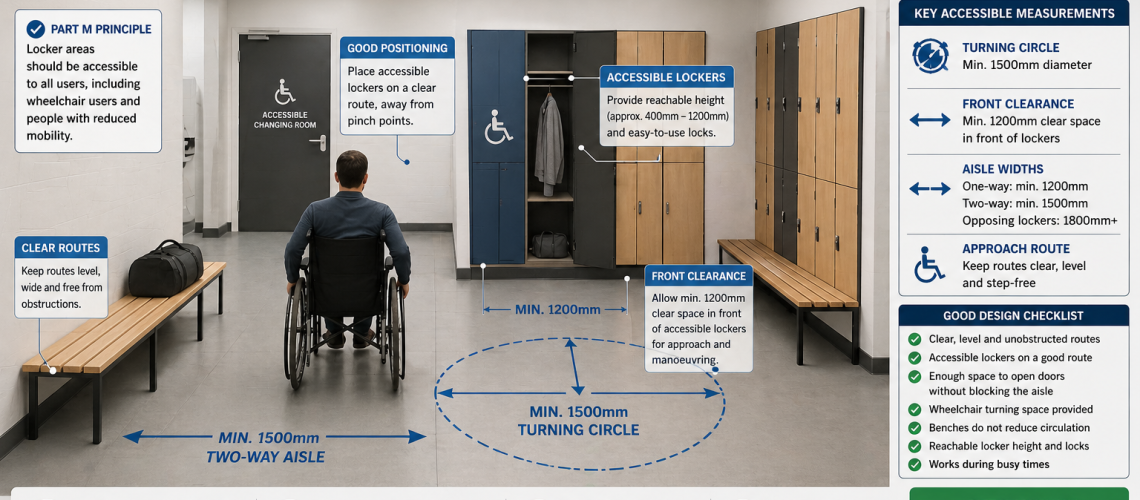
Accessible locker spacing means planning lockers so disabled users, wheelchair users and people with reduced mobility can approach, turn, reach and use the storage area without being blocked by narrow aisles, benches, doors or other users. In the UK, Approved Document M gives baseline accessibility guidance for access to and use of buildings, including buildings other than dwellings.
Approved Document M should be treated as a minimum accessibility baseline, not the full measure of good inclusive design. Locker rooms, changing areas and workplace storage spaces should be planned around real user movement, reach, turning space and safe circulation. GOV.UK publishes Approved Document M guidance for access to and use of buildings.
This guide explains accessible locker spacing, wheelchair turning circles, aisle widths and inclusive locker layout decisions for UK workplaces, schools, leisure centres, gyms and changing rooms.
Accessible spacing should be planned as part of the wider locker planning process. For the main category overview, use the lockers UK guide.
For general layout planning, read our locker room layout planning guide. For aisle design, see the locker aisle width guide. For minimum space calculations, use our minimum space for lockers guide.
What Part M means for locker spacing
Part M does not give a simple “one-size-fits-all” locker spacing rule. Instead, it sets access principles for buildings and facilities. For lockers, the practical requirement is that users should be able to reach the locker area, move through it, approach suitable lockers and use them without unnecessary barriers.
Not sure which system you need? Start with our storage system categories.
That means locker spacing should consider:
- clear routes to the locker area
- accessible aisle widths
- wheelchair turning space
- locker reach height
- door swing and obstruction risk
- bench and seating positions
- floor level, slip risk and threshold changes
- inclusive use during busy periods
The important point is simple: an accessible locker is not accessible if the route to it is too narrow, blocked, crowded or hard to turn within.
Quick answer: how much space should accessible lockers have?
As a practical planning guide, accessible locker areas should provide a clear approach route, a usable space in front of accessible lockers and enough room for wheelchair users to turn or reposition safely. A commonly used planning allowance is a 1500 mm turning circle where a wheelchair user may need to turn around.
For early planning, use these figures as a starting point:
| Design element | Practical planning allowance | Why it matters |
|---|---|---|
| Accessible approach route | Keep clear, level and unobstructed | Users must reach the locker area safely |
| Space in front of accessible lockers | 1200 mm to 1500 mm preferred | Allows approach, door opening and repositioning |
| Wheelchair turning space | 1500 mm diameter where turning is needed | Allows a wheelchair user to turn around |
| Two-way accessible circulation | Wider aisles where users pass each other | Reduces conflict and obstruction |
| Bench and locker clearance | Avoid blocking accessible routes | Seated users and benches can narrow circulation |
These allowances should be checked against the final building design, user needs, fire strategy and any project-specific access consultant requirements.
Wheelchair turning circles in locker rooms
A wheelchair turning circle is the clear floor space needed for a wheelchair user to turn around. In locker areas, turning space is especially important where users may enter a row of lockers, stop, access storage and then need to leave without reversing through a narrow aisle.
Where possible, provide a 1500 mm diameter clear turning space near accessible lockers, at aisle ends, or in wider circulation zones. This is particularly useful in changing rooms, staff facilities, gyms, leisure centres and school locker areas.
Turning space should be kept clear of:
- open locker doors
- bench legs
- loose bags and shoes
- waste bins
- radiators or pipe boxing
- door swings from nearby rooms
- temporary storage or cleaning equipment
A marked turning space on a drawing is not enough. It must remain usable once lockers, benches, doors and people are included.
Accessible aisle widths for locker areas
Accessible aisle width depends on whether the route is one-way, two-way, used for turning, or shared with locker door opening space. A narrow aisle may technically allow movement when empty but fail when users open doors or stop to change.
For accessible locker planning, wider aisles are usually better because users may need extra time and space to approach lockers, open doors and manoeuvre safely.
| Locker layout | Accessibility risk | Better approach |
|---|---|---|
| Single locker run with narrow aisle | Door swing blocks access | Increase clear space in front of lockers |
| Opposing lockers | Doors may open from both sides | Use a wider central aisle |
| Dead-end aisle | Wheelchair users may need to reverse out | Provide turning space or avoid dead ends |
| Bench between locker runs | Seated users narrow the route | Separate bench space from circulation |
| Locker area near entrance | Users pause and block the doorway | Move accessible lockers away from pinch points |
Accessible locker position
Accessible lockers should be placed where users can reach them without travelling through the most congested part of the room. They should not be hidden at the end of a narrow aisle or placed behind benches, bins or door swings.
Good positions include:
- near a clear circulation route
- away from main collision points
- close to accessible changing or welfare facilities where relevant
- beside a wider manoeuvring zone
- where doors can open without blocking other users
Avoid placing accessible lockers in left-over space. They should be part of the main layout from the start.
Locker reach height and inclusive use
Spacing is only one part of accessibility. Users also need to reach the compartment, lock, handle and stored items. Very high or very low locker compartments may be difficult for wheelchair users or people with reduced mobility.
For inclusive design, accessible lockers should usually be positioned at a comfortable reachable height. Mid-level compartments are often easier to use than very high top-tier lockers or very low bottom-tier lockers.
Consider:
- lock height
- handle position
- door weight and opening force
- whether the door stays open safely
- whether users need to lift heavy bags into the locker
- whether the user can approach from the front or side
Bench spacing and accessible circulation
Benches often cause accessibility problems because they reduce the amount of clear space available around lockers. A bench may look tidy on a floor plan, but seated users, bags and shoes can block the route in real use.
Accessible locker layouts should keep benches out of essential circulation zones. Where benches are needed, allow space for wheelchair users to pass, turn and transfer where relevant.
For changing rooms, do not rely on the gap between a bench and a locker as both the changing space and the accessible route unless it is genuinely wide enough for both uses.
For more detail, see our bench spacing and clearance guide.
Door swing and obstruction risk
Locker doors can create temporary barriers. When a door opens into an accessible route, it can reduce the clear width and force users to stop, reverse or wait.
To reduce obstruction risk:
- Avoid placing accessible lockers in narrow dead-end aisles
- Allow extra space in front of locker doors
- Avoid opposing locker doors opening into the same narrow aisle
- Keep locker doors clear of entrance doors and toilet or changing room doors
- Check whether users can open the locker while positioned safely
For dedicated guidance, read the locker door clearance guide.
Inclusive design in schools, workplaces and leisure centres
Inclusive locker design is not just for wheelchair users. It also supports people with temporary injuries, reduced strength, limited reach, visual impairment, balance issues, neurodivergent needs and users carrying equipment or personal belongings.
| Setting | Inclusive design priority | Common risk |
|---|---|---|
| School locker areas | Clear routes and easy supervision | Corridor crowding between lessons |
| Workplace lockers | Accessible staff storage for different needs | Shift-change congestion |
| Gym changing rooms | Wet and dry route separation | Benches blocking circulation |
| Leisure centres | Accessible changing and locker access together | Wet floors and high peak use |
| Healthcare or care settings | Safe access and controlled storage | Poor reach or awkward door swing |
Accessible locker planning checklist
Use this checklist before choosing locker positions or finalising a layout.
- Is there a clear accessible route to the locker area?
- Can wheelchair users approach the accessible lockers?
- Is there enough space to turn or reposition?
- Are accessible lockers away from doorway pinch points?
- Can locker doors open without blocking the route?
- Are locks and handles at a reachable height?
- Are benches clear of accessible circulation routes?
- Can users pass during busy periods?
- Is the floor level stable and suitable for the environment?
- Has the layout been reviewed for real peak-time use?
Common accessible locker spacing mistakes
- Adding one accessible locker but not providing an accessible route to it
- Placing accessible lockers at the end of a narrow aisle
- Ignoring wheelchair turning space
- Allowing benches to block circulation
- Using top-tier lockers as accessible compartments
- Forgetting that open locker doors reduce usable aisle width
- Planning from an empty room rather than peak-time use
- Treating Part M as the target instead of the minimum baseline
Accessible locker spacing example
A workplace changing room uses 450 mm deep lockers along one wall. The room also includes benches and a main route to the exit. If the accessible lockers are placed in the middle of a narrow aisle, users may be blocked by open doors, seated users and other staff during shift change.
A better layout places accessible lockers near a clear route, provides wider space in front, avoids bench obstruction and includes a nearby turning area. This gives users a practical approach, usable reach and safer exit route.
Part M and the Equality Act
Approved Document M gives technical guidance for access to and use of buildings. However, inclusive design also sits within a wider duty to avoid unnecessary barriers for disabled people. In practice, this means locker layouts should be planned for real accessibility, not only minimum dimensional compliance.
For higher-risk projects, public buildings, education sites, healthcare environments or major refurbishments, it is sensible to involve the project architect, building control body or access consultant before finalising the locker layout.
Explore storage systems by use case
- Workplace storage systems UK
- Industrial storage systems UK
- School storage systems UK
- Care home storage systems UK
- Storage access control guide UK
- Storage system planning checklist UK
FAQ: Accessible Locker Spacing UK (Part M & Inclusive Design)
What is accessible locker spacing?
Accessible locker spacing means providing enough clear space for all users, including wheelchair users and people with reduced mobility, to approach, open and use lockers safely without obstruction.
What does Part M say about lockers?
Approved Document M sets accessibility standards for buildings, including access routes, circulation space and usability. It does not give exact locker dimensions, but requires that facilities are accessible and usable for disabled people.
What is the minimum turning space for a wheelchair in a locker area?
A commonly used planning allowance is a 1500 mm diameter turning circle.
How much space should be in front of accessible lockers?
Allow at least 1200 mm clear space, with 1500 mm preferred where turning or repositioning is required.
What aisle width is needed for accessible locker areas?
Typical guidance is around 1200 mm for one-way movement and 1500 mm or more for two-way or busy areas.
Is meeting Part M enough?
No. It is a baseline. Good locker layouts go further by considering real use, peak periods and practical movement.
Summary: accessible locker spacing is about usable movement
Accessible locker spacing is not just about leaving a wider aisle. It is about creating a locker area that disabled users can approach, use and leave safely.
Good layouts provide clear routes, suitable locker positions, reachable locks, enough space in front of lockers and a wheelchair turning area where needed. They also avoid door clashes, bench obstruction, dead-end aisles and peak-time congestion.
Part M gives an important accessibility baseline, but the strongest locker room layouts go further by designing around real people, real movement and real daily use.
Discover more from Blog Total Locker Service
Subscribe to get the latest posts sent to your email.