Workplace Storage Systems UK: Lockers, Cabinets, Keys and Staff Storage
May 1, 2026
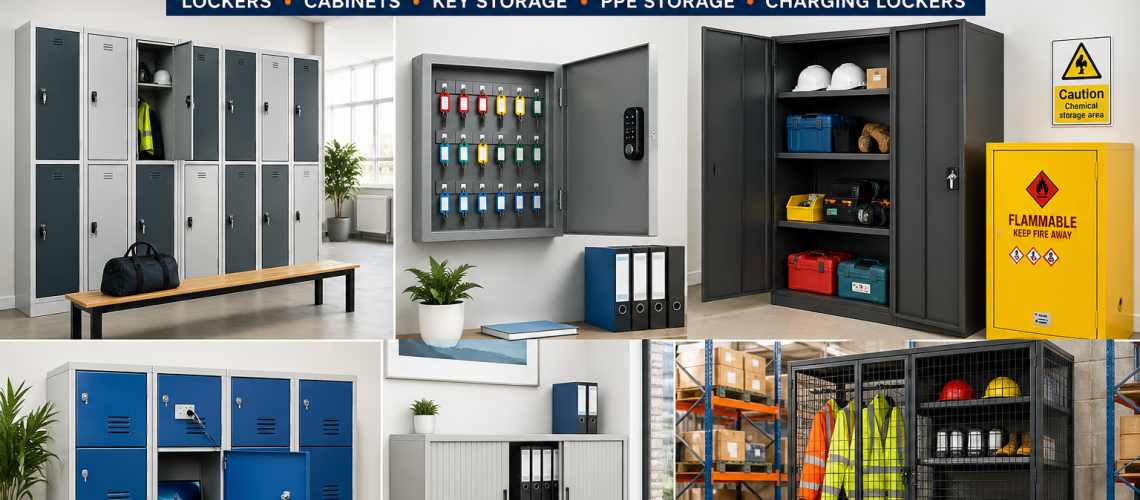
Workplace storage systems combine lockers, cupboards, cabinets, key storage, document storage and equipment storage to give staff and facilities teams appropriate places for personal belongings, shared resources and controlled items.
The correct workplace storage system is rarely one product. An office may need staff lockers, secure laptop storage and document cabinets, while a facilities department may also need key cabinets, tool storage and space for consumables.
This guide focuses on the whole workplace storage mix: what types of items workplaces need to store, which broad storage formats suit them and how those different systems work together.
For detailed staff-locker specification, use Workplace Lockers UK. For factories, warehouses and workshop environments, use Industrial Storage Systems UK.
Quick Answer: What Storage Does a Workplace Need?
Start by separating workplace items into different storage groups rather than trying to put everything into lockers or cupboards.
| Workplace requirement | Typical storage approach |
|---|---|
| Personal belongings | Staff lockers |
| Uniforms and workwear | Suitable lockers or clothing storage |
| Workplace keys | Key cabinet or specialist key storage |
| Paper records | Filing or lockable document storage |
| Laptops and devices | Secure device or charging storage |
| Shared equipment | Cupboards, cabinets or shelving |
| Tools and facilities equipment | Suitable cabinet or industrial storage |
| Cash and valuables | Appropriate safe |
The important principle is to match each item group to a suitable storage format rather than making one product solve every requirement.
What This Workplace Storage Guide Owns
| Subject | Ownership |
|---|---|
| Whole-workplace storage mix | This guide |
| Staff belongings at overview level | This guide |
| Document storage at overview level | This guide |
| Key storage at overview level | This guide |
| Device and laptop storage | This guide |
| Shared equipment storage | This guide |
| Workwear and PPE storage at overview level | This guide |
| Facilities-team storage mix | This guide |
| How different storage types work together | This guide |
What This Guide Hands Off
| Detailed question | Use this guide |
|---|---|
| Which staff locker should we specify? | Workplace Lockers UK |
| Assigned, shared or temporary lockers? | Locker Allocation Systems UK |
| How should lockers be managed day to day? | Locker Management Systems UK |
| Which access technology should storage use? | Storage Access Control UK |
| How should physical keys be stored? | Key Storage Systems UK |
| How should the whole project be planned? | Storage System Planning Checklist UK |
| What storage is appropriate for factories and warehouses? | Industrial Storage Systems UK |
| Which broad storage format should we use? | Types of Storage Systems UK |
Why Workplace Storage Matters
Workplace storage affects more than appearance. It determines where staff belongings, shared equipment and controlled items are kept during normal operations.
A clear storage structure can help:
- keep personal belongings away from work areas;
- give shared equipment a defined location;
- keep workplace keys out of desks and open offices;
- separate sensitive records from general supplies;
- reduce clutter around desks and circulation routes;
- make stock and equipment easier to find;
- and make future storage requirements easier to identify.
Start With What the Workplace Needs to Store
Before choosing lockers or cabinets, divide stored items into broad groups.
- Personal belongings: coats, bags, phones, helmets and personal effects.
- Workwear: uniforms, protective clothing and footwear.
- Shared equipment: tools, radios, scanners and departmental equipment.
- Devices: laptops, tablets and portable electronics.
- Keys: building, vehicle, plant-room and restricted-area keys.
- Documents: accounts, personnel, maintenance and operational records.
- Consumables: stationery, stock and general supplies.
- Higher-value items: cash, valuables and sensitive small assets.
Once these groups are understood, the storage mix becomes much easier to specify.
Staff Lockers for Personal Belongings
Staff lockers are normally the primary workplace storage product where employees need individual space for personal belongings, clothing or issued equipment.
Typical contents include:
- coats;
- bags;
- phones and personal effects;
- uniforms;
- workwear;
- footwear;
- helmets;
- and personally issued equipment.
The detailed locker specification depends on compartment size, material, ventilation, lock type, environment and the items actually being stored.
Those decisions belong in Workplace Lockers UK. To compare products, browse our workplace lockers.
Assigned and Shared Locker Storage
Workplace lockers can be permanently assigned or shared between changing users.
At a broad workplace-storage level:
- assigned lockers can suit regular employees who attend consistently and keep items on site;
- shared or day-use lockers can suit genuinely flexible workplaces;
- temporary storage can suit visitors and contractors;
- and team storage can suit departmental equipment rather than personal belongings.
This page does not own the detailed allocation model. For assigned, shared, hot and temporary lockers, use Locker Allocation Systems UK.
Key Storage in the Workplace
Many businesses manage physical keys for buildings, vehicles, cupboards, lockers, gates, plant areas and equipment.
Those keys should normally have a defined physical storage location rather than being distributed between desks, drawers and individual staff members without a clear structure.
At the simplest level this may be a conventional key cabinet. Larger or more complex organisations may need separate storage for particular key groups or more structured systems.
For the physical storage options, use Key Storage Systems UK. For the broader business application, see Key Storage for Businesses UK.
Document and Record Storage
Workplaces may still need physical storage for contracts, personnel documents, maintenance records, accounts, manuals and other paper information.
Different documents can justify different physical storage.
- Frequently used working files may suit filing cabinets or office cupboards.
- Restricted records may need lockable storage with access limited to appropriate staff.
- Valuable or particularly sensitive items may justify stronger secure storage.
- Documents requiring fire protection should use a product specifically designed and rated for that purpose.
An ordinary steel cupboard should not be assumed to provide specialist fire protection merely because it is metal and lockable.
Laptop, Tablet and Device Storage
Portable electronics often need a different type of storage from documents or personal belongings.
Workplaces may need storage for:
- laptops;
- tablets;
- radios;
- scanners;
- handheld terminals;
- and other shared portable devices.
The first distinction is whether the equipment only needs secure storage or whether it also needs power while stored.
Where charging is required, use storage intended for that purpose and consider device dimensions, cable management, power arrangements and ventilation.
Shared Workplace Equipment Storage
Shared equipment often works better in central cupboards or cabinets than inside individual staff lockers.
Examples include:
- departmental tools;
- test equipment;
- stationery;
- cleaning equipment;
- facilities supplies;
- shared electronics;
- and stock consumed by several users.
Central storage makes it easier to see what is available and avoids shared equipment becoming dispersed through personal lockers.
Where tools, parts, workshop equipment or heavy stock dominate the requirement, move to Industrial Storage Systems UK.
Workwear and PPE Storage
Workwear and PPE can require individual or shared storage depending on how equipment is issued.
Items may include:
- uniforms;
- coats;
- overalls;
- helmets;
- boots;
- gloves;
- and other protective equipment.
Where workwear is personally issued, suitable staff lockers may be appropriate. Shared PPE can be easier to manage in central storage where availability and inspection are visible.
Detailed industrial PPE and equipment storage belongs in the Industrial Storage Systems UK guide.
Workplace Storage for Offices
Office storage increasingly needs to support a mixture of personal belongings, hybrid working, shared technology and departmental resources.
A typical office storage mix may include:
- staff lockers;
- day-use or shared lockers;
- visitor storage;
- secure laptop storage;
- filing cabinets;
- departmental cupboards;
- key cabinets;
- and storage for stationery or shared supplies.
The correct balance depends on actual attendance patterns and what must remain on site rather than on total employee headcount alone.
Workplace Storage for Staff Changing Areas
Changing areas need to accommodate both belongings and the process of changing clothes.
Typical stored items include:
- coats;
- bags;
- uniforms;
- workwear;
- footwear;
- personal effects;
- and PPE where relevant.
Locker dimensions, benches, circulation, ventilation and room layout therefore need to work together.
For locker selection, use Workplace Lockers UK. For detailed room planning, use the relevant locker-layout and changing-room guides.
Storage for Facilities and Maintenance Teams
Facilities teams commonly need several different storage systems at the same time.
| Requirement | Typical storage |
|---|---|
| Personal belongings | Staff locker |
| Building keys | Key cabinet |
| Tools | Tool or equipment cabinet |
| Manuals and records | Document storage |
| Consumables | Cupboard or shelving |
| Portable devices | Secure device storage |
Keeping personal storage separate from shared operational equipment makes responsibility and stock availability easier to understand.
Workplace Storage vs Industrial Storage
There is some natural overlap between workplace and industrial storage, but the centre of gravity is different.
| Workplace storage | Industrial storage |
|---|---|
| Personal belongings | Tools and heavy equipment |
| Office documents | Parts and components |
| Laptops and portable devices | Workshop supplies |
| General staff workwear | PPE-heavy storage |
| Keys and facilities equipment | Operational plant and warehouse equipment |
A warehouse still needs workplace storage for its employees, but where tools, PPE, stock and heavy-duty operational equipment dominate the project, use Industrial Storage Systems UK.
Access Control for Workplace Storage
Different workplace storage products can use keys, padlocks, combinations, electronic PINs, cards, RFID credentials or other access methods.
This article does not need to compare those technologies in depth. The broad principle is to choose an access method that matches the users and the storage requirement without adding unnecessary administration.
For the detailed comparison, use Storage Access Control UK: Keys, Codes, Padlocks and Electronic Access Compared.
Planning the Workplace Storage Mix
This page defines the storage mix rather than owning the full project-planning process.
At a broad level, establish:
- what needs storing;
- which items are personal or shared;
- which items need restricted storage;
- how much capacity each category requires;
- and which storage format suits each group.
For dimensions, available space, access requirements, delivery routes, cleaning, installation and future growth, use Storage System Planning Checklist UK.
Common Workplace Storage Mistakes
- Using lockers for every item. Shared equipment is often better in central cabinets or cupboards.
- Using cupboards for personal belongings. Individual users may need defined personal storage.
- Mixing keys with ordinary office supplies. Physical keys normally benefit from dedicated controlled storage.
- Ignoring device dimensions. Laptop and charging storage must suit the actual equipment.
- Treating workwear like ordinary office storage. Garment length, footwear and PPE can change the space required.
- Choosing access technology before defining the users. Determine the requirement first.
- Forcing industrial equipment into office-style storage. Heavy tools and stock may need dedicated industrial systems.
- Ignoring future change. Storage requirements can alter as staffing and equipment change.
Workplace Storage Decision Table
| Need | Start with | Detailed guide |
|---|---|---|
| Staff belongings | Commercial lockers | Workplace Lockers UK |
| Keys and fobs | Key cabinet or key storage | Key Storage Systems UK |
| Shared workplace equipment | Cupboard or cabinet | This guide |
| Laptops and devices | Device or charging storage | This guide |
| Factory and workshop equipment | Industrial storage | Industrial Storage Systems UK |
| Access technology | Key, code, padlock or electronic access | Storage Access Control UK |
| Complete project planning | Pre-purchase checklist | Storage System Planning Checklist UK |
| General storage-type comparison | Locker, cabinet, cupboard, safe or specialist storage | Types of Storage Systems UK |
Workplace Storage from Total Locker Service
Total Locker Service supplies commercial workplace storage for offices, staff areas, facilities teams, warehouses and other UK organisations.
For staff belongings and workwear, browse our workplace lockers. For broader locker ranges, see our commercial lockers. For physical key storage, browse our key cabinets. For valuables and other secure items, see our safes.
Related Workplace Storage Guides
- Workplace Lockers UK for detailed staff locker specification.
- Industrial Storage Systems UK for factories, warehouses, tools, PPE and heavier-duty applications.
- Key Storage Systems UK for physical key-storage formats.
- Storage Access Control UK for keys, codes, padlocks and electronic access.
- Storage System Planning Checklist UK for the pre-purchase planning process.
- Types of Storage Systems UK for comparison of the main storage categories.
Workplace Storage Systems FAQs
What are workplace storage systems?
Workplace storage systems are combinations of lockers, cabinets, cupboards, key storage, document storage and other products used to organise staff belongings, equipment and controlled workplace items.
What storage does an office need?
An office may need staff lockers, laptop or device storage, filing cabinets, departmental cupboards, key storage and secure storage for sensitive or valuable items. The correct mix depends on what remains on site and how the workplace operates.
Should every employee have a locker?
Not necessarily. Regular employees may benefit from assigned lockers, while genuinely flexible workplaces may use shared or day-use storage. The appropriate allocation model depends on attendance patterns and what users need to store.
What is the best way to store workplace keys?
Workplace keys should normally have a defined controlled storage location. This may be a conventional key cabinet for a small key estate or a more structured system where the number, importance or use of keys justifies it.
How should workplace laptops and devices be stored?
Portable devices should be stored in compartments or cabinets sized for the equipment. Where devices also need charging, use storage designed for secure charging with suitable power, cable management and ventilation.
Should shared equipment be stored in staff lockers?
Usually shared departmental equipment is easier to locate and manage in central cabinets or cupboards rather than being spread between individual staff lockers.
What is the difference between workplace and industrial storage?
Workplace storage focuses on staff belongings, documents, devices, keys and general shared resources. Industrial storage places greater emphasis on tools, PPE, parts, stock and equipment used in factories, warehouses and workshops.
Build Workplace Storage Around the Items, Not One Product
A good workplace storage system normally combines several storage types. Personal belongings may need lockers, physical keys may need a dedicated cabinet, devices may need secure charging storage and shared equipment may belong in central cupboards or cabinets.
Keep this broad workplace-storage decision separate from detailed locker allocation, access technology, key-control procedures and project planning. Those subjects now have their own specialist guides.
Start with the items, separate personal from shared and controlled storage, then choose the appropriate storage type for each requirement.
Discover more from Blog Total Locker Service
Subscribe to get the latest posts sent to your email.