Small Locker Room Design UK: Maximising Limited Space with Compact Locker Layouts (2026 Guide)
April 30, 2026
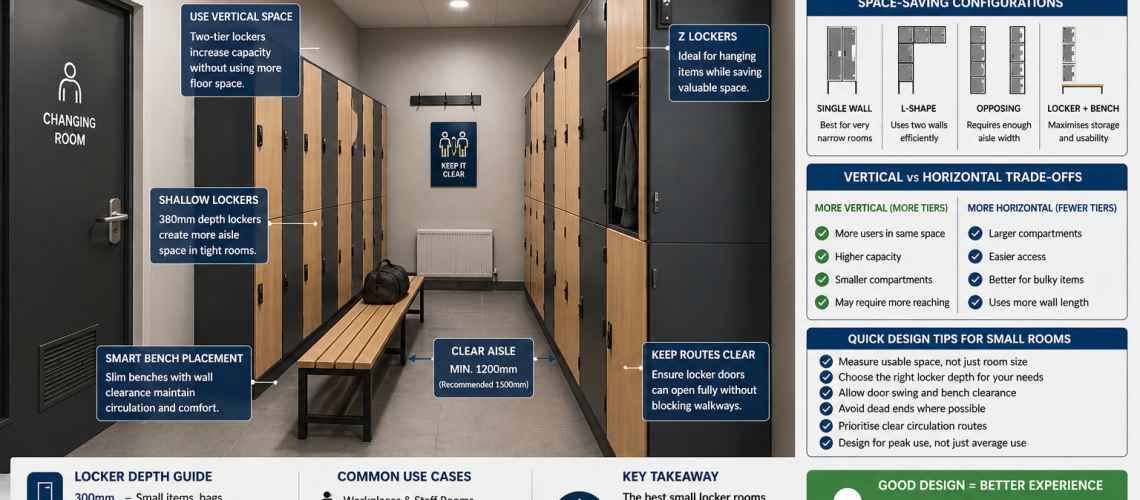
Small locker room design is about fitting enough storage into a limited area without making the space cramped, unsafe or difficult to use. The best compact layouts balance locker quantity, aisle width, door clearance, bench position and user movement.
This guide owns the small-space layout problem: how to make a constrained locker room usable without sacrificing necessary storage. It focuses on layout options, compact locker configurations, locker depth, bench placement and the trade-off between capacity and movement space.
For the wider room-planning process, use Locker Planning UK. For detailed aisle calculations use Locker Aisle Width Guide UK, for door opening use Locker Door Clearance Guide UK, and for inclusive layouts use Locker Accessibility and DDA Planning UK.
This page does not set universal minimum dimensions. It helps choose the best arrangement once the room constraints and storage requirement are known. Quantity calculations belong in How Many Lockers Do You Need?, while the procurement brief belongs in Locker Specification Planning UK.
What This Page Owns, and What It Hands Off
| Question | Owner |
|---|---|
| How can a constrained locker room be made usable? | This guide |
| Should the room use a single wall, L-shape, opposing runs or another compact arrangement? | This guide |
| Should capacity be increased vertically rather than by using more floor space? | This guide |
| How many lockers or compartments are actually required? | Locker Capacity Planning |
| What exact aisle allowance should be used? | Locker Aisle Width Guide UK |
| What door-opening space is needed? | Locker Door Clearance Guide UK |
| How are accessibility requirements worked through? | Locker Accessibility and DDA Planning UK |
| What locker dimensions should be specified? | Locker Sizes UK and Locker Depth Guide UK |
| What should suppliers be asked to provide? | Locker Specification Planning UK |
| How are delivery, fixing and site logistics handled? | Locker Installation Planning UK |
Why small locker rooms need careful planning
Small locker rooms fail when too many lockers, benches and users are forced into one tight area. A layout may look efficient on paper, but become difficult to use once people open doors, sit down, change clothes or move around others.
The aim is not always to fit the highest number of lockers. The better aim is to create a compact storage area that remains usable during real daily use.
Quick answer: how do you maximise space in a small locker room?
To maximise space in a small locker room, use the right locker depth, increase vertical storage where suitable, avoid oversized benches, keep routes clear and choose locker configurations that match how people actually use the space.
The most effective space-saving options include:
- two-tier, three-tier or multi-tier lockers
- shallower lockers where full-depth storage is not needed
- Z lockers for hanging storage in a compact footprint
- wall-mounted or under-bench storage where appropriate
- single-sided locker runs instead of opposing rows in narrow rooms
- clear zoning between lockers, benches and circulation routes
Start with the real usable space
Before choosing lockers, measure the space that can actually be used. Do not only measure the room wall to wall. Small rooms often lose usable space because of doors, radiators, pipe boxing, windows, columns, low ceilings, sloped ceilings or electrical equipment.
Check these points first:
- door swing into the room
- fire exits and escape routes
- radiators, heaters and ventilation grilles
- columns, boxed pipework and skirting
- ceiling height and lighting position
- bench position and seated-use space
- minimum aisle and door-opening clearance
- accessible route requirements
A small room can usually accept fewer lockers than the raw wall length suggests. This is normal. Leaving enough usable clearance usually creates a better result than filling every wall.
Tight locker layouts: what works best?
In tight locker rooms, the layout should reduce door clashes and avoid dead zones. Simple layouts are often better than complex ones because users can move more easily.
| Small layout type | Best use | Main caution |
|---|---|---|
| Single wall locker run | Very narrow rooms | May limit total locker count |
| L-shaped locker layout | Rooms with two usable walls | Corner areas can become awkward |
| Opposing locker runs | Wider small rooms | Needs enough central aisle width |
| Locker run plus bench opposite | Changing rooms with limited width | Bench may reduce circulation |
| Central island lockers | Usually only larger rooms | Can overfill compact spaces |
For most small rooms, start by testing a single wall or L-shaped layout before considering opposing rows. Opposing lockers can work well, but only if the aisle remains usable when doors are open.
Space-saving locker configurations
Locker configuration has the biggest effect on small room capacity. A single-tier locker gives one user a full-height compartment. A multi-tier locker divides the same vertical space between more users.
| Locker type | Space advantage | Best for |
|---|---|---|
| Single-tier lockers | Full-height storage per user | Coats, uniforms, workwear and long items |
| Two-tier lockers | Doubles user capacity per column | Workplaces, schools and staff areas |
| Three-tier lockers | Higher capacity in the same footprint | Bags, personal items and compact storage |
| Four-tier to six-tier lockers | Maximum compartment count | Small personal belongings |
| Z lockers | Hanging space for two users in one vertical bay | Changing rooms and workwear storage |
| Cube lockers | Compact modular storage | Phones, wallets, small bags and valuables |
The right choice depends on what users need to store. Choosing more compartments is not helpful if each compartment is too small for the items being stored.
If damp clothing, PPE or wet kit is part of the requirement, use Locker Ventilation & Airflow to separate passive airflow from genuine drying requirements.
Vertical vs horizontal trade-offs
Small locker rooms often rely on vertical space. This can be effective, but it creates trade-offs. More tiers increase capacity, while wider or full-height lockers improve comfort and storage volume.
| Choice | Advantage | Trade-off |
|---|---|---|
| More vertical tiers | More users in less floor space | Smaller compartments and more bending/reaching |
| Fewer larger lockers | Better storage for coats, PPE and bags | Lower user capacity |
| Wider lockers | Easier storage and access | Uses more wall length |
| Narrower lockers | Fits more compartments in a row | May be unsuitable for bulky items |
| Shallower lockers | Improves aisle space | Reduces internal storage depth |
As a rule, go vertical when users only need small personal storage. Use larger compartments when users need to store coats, workwear, bags, helmets, boots or PPE.
When Z lockers help in small spaces
Z lockers can be useful in compact changing rooms because they provide hanging space for two users within one vertical locker bay. Each user gets a tall hanging section, but the doors overlap in a Z-shaped layout.
They can work well where users need to hang clothing but the room cannot support a full bank of single-tier lockers.
Z lockers are especially useful for:
- staff changing rooms
- workwear storage
- gyms and leisure changing areas
- small cloakroom-style spaces
- compact rooms where hanging space is still needed
However, they are not always ideal for small loose items. For bags, phones or compact personal storage, multi-tier lockers may provide better density.
Locker depth matters in small rooms
Locker depth can make or break a compact layout. A deeper locker gives more internal space, but it also reduces the aisle or standing space in front.
In a tight room, reducing locker depth may create a more usable layout than reducing aisle width. A narrower route may cause daily frustration, especially during busy times.
| Locker depth | Small-room effect | Best use |
|---|---|---|
| 300 mm | Saves floor depth | Small bags, personal items, compact storage |
| 380 mm | Balanced compact option | General staff and school storage |
| 450 mm | Standard practical depth | Coats, bags and everyday use |
| 500 mm+ | More storage, less aisle space | Bulky items where room allows |
If the aisle becomes too narrow, the space may be technically full of lockers but practically poor to use.
Use Locker Depth Guide UK for detailed depth selection and Locker Sizes UK where overall and usable compartment dimensions need to be compared.
Bench planning in small locker rooms
Benches are useful, but they are also one of the easiest ways to overfill a small locker room. A bench needs seated space, foot space and circulation around it.
In compact rooms, consider:
- shorter bench runs instead of full-length benches
- wall-fixed benches where suitable
- benches positioned away from door swings
- under-seat storage where appropriate
- separating bench space from the main route
A bench directly in front of lockers may look efficient, but it can block access when people are seated. In small rooms, this effect is more noticeable. Use Changing Room Bench Sizes UK where bench dimensions need to be worked through separately.
Avoiding overfilled layouts
The main risk in small locker room design is overfilling the space. More lockers do not always mean a better result. If users cannot open doors, pass each other or change comfortably, the layout will fail in practice.
Warning signs of an overfilled locker room include:
- users standing in doorways while accessing lockers
- locker doors clashing with benches or other doors
- people needing to reverse out of dead-end aisles
- bags and shoes blocking the only walkway
- staff avoiding the lockers because the area feels cramped
- no practical space for cleaning or maintenance access
Small locker room layout examples
Narrow staff locker room
A narrow staff locker room may work best with lockers on one wall and a slim bench on the opposite wall, provided the central route remains clear. If the space is very tight, use shallower lockers or reduce the bench length.
Small workplace changing room
A small changing room for workwear may need Z lockers or two-tier lockers, depending on whether users need hanging space. Benches should be positioned so they do not block locker doors during shift change.
Compact school locker area
A small school locker area should avoid creating a crowd at the entrance. Multi-tier lockers can increase capacity, but the layout must still allow pupils to move quickly between lessons.
Small gym changing area
A compact gym changing room should separate wet movement from dry locker access where possible. Cube lockers or multi-tier lockers may suit valuables and bags, while fewer full-height lockers may be needed for coats or longer items.
How to choose the best compact locker configuration
Use the stored items to choose the locker type. The room size matters, but the contents matter too.
| Stored item | Better locker choice | Reason |
|---|---|---|
| Coats and uniforms | Single-tier or Z lockers | Needs hanging height |
| Small bags | Two-tier or three-tier lockers | Good balance of capacity and usability |
| Phones and wallets | Cube or multi-compartment lockers | Maximum small-item density |
| PPE and workwear | Larger or ventilated lockers | Needs space and airflow |
| School bags | Two-tier or three-tier lockers | Compact but still practical |
| Wet clothing or kit | Ventilated or wet-area-suitable lockers | Helps manage airflow and moisture; active drying may require a specialist system |
Space-saving design checklist
Use this checklist before finalising a small locker room layout.
- Have you measured the usable space, not just the room size?
- Does the layout allow locker doors to open properly?
- Is there enough clear aisle space for users to pass?
- Does the locker type match what people need to store?
- Could shallower lockers improve the layout?
- Would vertical tiers increase capacity without reducing usability?
- Are benches clear of the main route?
- Are accessible users considered from the start?
- Can the room work during peak use?
- Is there space for cleaning and maintenance?
Explore storage systems by use case
- Workplace storage systems UK
- Industrial storage systems UK
- School storage systems UK
- Care home storage systems UK
- Storage access control guide UK
- Storage system planning checklist UK
Related Small Locker Room Planning Guides
- Locker Planning UK – wider room and layout planning.
- How Many Lockers Do You Need? – quantity and demand planning.
- Locker Aisle Width Guide UK – detailed working-space calculations.
- Locker Door Clearance Guide UK – door swing and obstruction checks.
- Locker Depth Guide UK – choosing depth where floor space is tight.
- Locker Accessibility and DDA Planning UK – inclusive approach and reach planning.
- Changing Room Bench Sizes UK – bench dimensions and spacing.
- Locker Ventilation & Airflow – airflow and moisture considerations.
- Locker Specification Planning UK – turn the agreed layout into a procurement brief.
- Locker Installation Planning UK – delivery, setting out, fixing and handover.
Small Locker Room Design UK FAQs
How do you design a small locker room effectively?
Measure the real usable space, protect doors and movement routes first, then test compact locker configurations around those constraints. The objective is usable storage, not simply the highest possible locker count.
What is the best layout for a small locker room?
The best layout depends on the room shape. Single-wall and L-shaped layouts often suit narrow or awkward rooms, while opposing runs only work where the central aisle remains usable during real operation.
How much space do you need in a small locker room?
There is no single clearance figure that suits every room. The required space depends on locker depth, door swing, opposing runs, benches, user numbers and accessibility, so detailed aisle and door-clearance planning should be completed separately.
What lockers are best for small spaces?
Space-saving options can include two-tier or three-tier lockers, Z lockers where hanging space is required, shallower lockers where the stored items allow it and cube lockers for small personal belongings.
Should you use multi-tier lockers in a small room?
Multi-tier lockers can increase capacity without using more floor space, but the compartments become smaller and upper or lower positions may be less convenient for some users. The stored items and user population should decide the configuration.
Are shallow lockers better for small rooms?
They can be. Reducing locker depth may improve aisle and standing space, but only where the shallower compartment still accommodates the items users need to store.
Do benches work in small locker rooms?
Yes, but bench length, depth and position need to be tested against locker-door opening and circulation. A bench directly opposite lockers can substantially reduce usable space when people are seated.
What is the biggest mistake in small locker room design?
The most common mistake is maximising locker numbers before protecting movement and access. A high-capacity room that users cannot move through or operate comfortably is not an efficient layout.
Can a small locker room still be accessible?
Yes. Compact rooms still need appropriate approach routes, usable locker positions and operating space. Accessibility should be included from the start rather than added after the layout is full.
Summary: small locker rooms need smarter choices
Small locker room design is not just about fitting as many lockers as possible into a tight space. It is about choosing the right configuration, depth, layout and clearance so the room remains practical.
Vertical locker layouts can increase capacity, but they reduce compartment size and may affect reach. Horizontal layouts can be easier to use, but need more wall length. Z lockers, multi-tier lockers, shallower depths and careful bench placement can all help maximise limited space.
The best compact locker rooms protect movement and access first, then use depth, configuration and vertical capacity intelligently around that usable space.
Discover more from Blog Total Locker Service
Subscribe to get the latest posts sent to your email.