Storage System Planning Checklist UK: What to Check Before You Buy
May 1, 2026
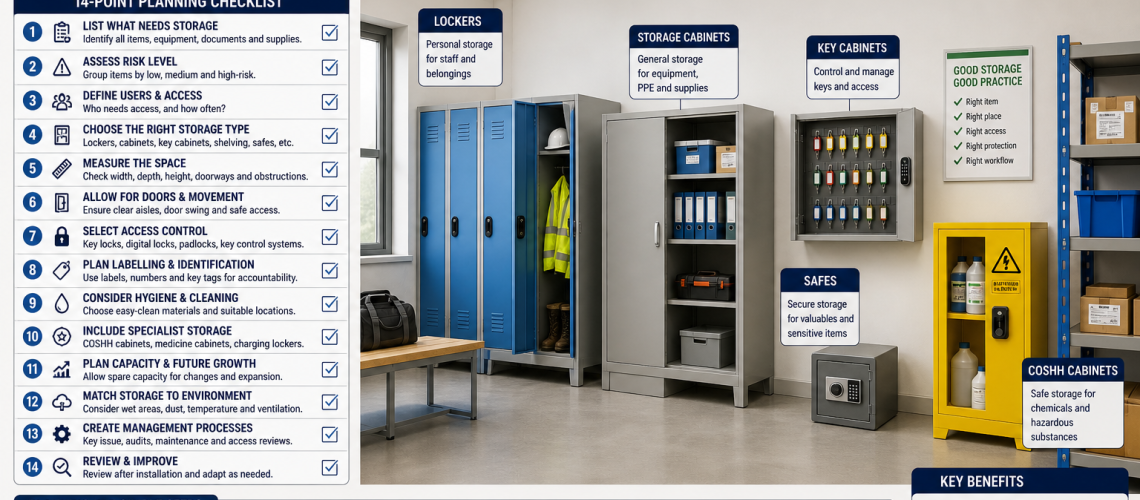
A storage system planning checklist helps workplaces define what needs storing, who needs access, how much space is available and which practical constraints must be resolved before lockers, cabinets, cupboards, safes or specialist storage are ordered.
Good storage planning starts with the site and the users rather than with a particular product. Measuring too late, overlooking door clearance, underestimating capacity or choosing access technology before defining the user requirement can all turn a suitable product into a poor installation.
This guide provides a practical pre-purchase storage planning sequence for offices, schools, healthcare environments, warehouses, factories, leisure facilities and other UK workplaces.
For the wider storage architecture, use Storage Systems Explained UK. If you still need to choose the basic storage format, see Types of Storage Systems UK.
Storage Planning: Quick Answer
Before ordering workplace storage, answer these questions:
- What needs to be stored?
- How much of it is there?
- Who needs access?
- What level of physical protection is appropriate?
- Which storage format suits the items?
- Where will the storage be installed?
- What dimensions and clearances are available?
- Does the environment affect the material or product choice?
- How will users open and operate it?
- Can it be delivered and installed in the proposed location?
- How will it be cleaned, maintained and managed?
- Will the system still have enough capacity if requirements grow?
Resolving those points before purchase removes much of the avoidable risk from a storage project.
What This Storage Planning Guide Owns
| Planning question | Ownership |
|---|---|
| Defining what must be stored | This guide |
| Identifying users and broad access needs | This guide |
| Measuring available space | This guide |
| Checking clearances and movement space | This guide |
| Considering environmental conditions | This guide |
| Checking delivery and installation constraints | This guide |
| Considering cleaning and maintenance | This guide |
| Allowing for future growth | This guide |
| Final pre-order review | This guide |
What This Guide Hands Off
| Detailed question | Use this guide |
|---|---|
| Which broad storage type should we use? | Types of Storage Systems UK |
| How do the main storage systems fit together? | Storage Systems Explained UK |
| Which lock or access method should we use? | Storage Access Control UK |
| How should a locker project be planned in detail? | Locker Layout Planning Guide UK |
| Which storage suits a workplace? | Workplace Storage Systems UK |
| Which storage suits an industrial site? | Industrial Storage Systems UK |
| Which storage suits a school? | School Storage Systems UK |
1. List Everything That Needs Storage
Start with the items rather than the products.
Walk through the site and identify everything that needs a permanent or regular storage location.
- staff belongings;
- bags and coats;
- uniforms and workwear;
- PPE;
- keys and fobs;
- documents and records;
- tools and maintenance equipment;
- laptops, tablets and shared devices;
- cleaning products;
- specialist substances or materials;
- first-aid supplies;
- stock and consumables;
- cash or valuables;
- spare equipment.
This prevents one product being forced to solve several unrelated storage problems.
2. Separate Different Storage Requirements
Do not assume everything on the list belongs in the same type of storage.
Separate items according to factors such as:
- physical size;
- frequency of use;
- who uses them;
- value;
- sensitivity;
- need for restricted access;
- charging requirement;
- cleaning or hygiene considerations;
- and any need for specialist storage.
A coat, laptop, bunch of keys and valuable document may all need secure storage, but they do not necessarily need the same storage product.
3. Establish How Much Capacity You Need
Measure the actual storage demand rather than estimating from the number of employees or rooms alone.
Depending on the project, capacity may mean:
- number of locker users;
- number of keys;
- volume of documents;
- number and size of tools;
- quantity of PPE;
- number of laptops or devices;
- or physical volume of stock and consumables.
Also distinguish between current capacity and likely future demand. A system that is already full when installed has very little resilience to changes in staffing, equipment or building use.
4. Decide Who Needs Access
Define the users before choosing locks or credentials.
- Does one person use each storage compartment?
- Does a small team share the storage?
- Do users change throughout the day?
- Do supervisors or facilities staff need management access?
- Will contractors or temporary users require access?
- Should some users be restricted from particular storage?
This page only defines the broad access requirement. Detailed lock, key, code, RFID and electronic-system selection belongs in Storage Access Control UK.
5. Choose the Appropriate Storage Type
Once the items, quantities and users are understood, choose the physical storage format.
| Storage requirement | Typical starting point |
|---|---|
| Personal belongings | Lockers |
| Keys and fobs | Key cabinet or specialist key storage |
| Tools, PPE and supplies | Steel cupboard, shelving or specialist storage |
| Documents and files | Filing or document storage |
| Cash and valuables | Suitable safe |
| Electronic devices | Locker, charging locker or device storage |
| Chemicals or specialist substances | Appropriate specialist cabinet |
| General stock | Shelving, cupboards or other bulk storage |
This table is only a starting point. Use Types of Storage Systems UK when the product category itself still needs to be decided.
6. Measure the Available Space
Measure the proposed installation area before choosing product dimensions.
Record:
- available width;
- available height;
- available depth;
- skirting boards;
- columns and structural projections;
- radiators;
- pipework;
- electrical fittings;
- doors and door swings;
- windows;
- and any other fixed obstruction.
Do not use the nominal room dimensions alone. The usable storage footprint may be considerably smaller once obstructions are taken into account.
7. Check Door Clearance and User Space
Storage needs usable space in front of it as well as enough wall or floor area to physically fit.
Consider:
- locker and cabinet door swing;
- drawers pulling forward;
- people standing in front of the storage;
- two-way movement through the surrounding area;
- benches or seating;
- nearby doors;
- trolleys or equipment;
- and emergency or operational routes.
A product can fit against a wall and still make the room difficult to use once its doors are open and people are standing in front of it.
8. Consider How People Move Through the Area
Storage should support the movement of users rather than create avoidable congestion.
Ask when users will arrive, how many may use the storage simultaneously and what they will be carrying.
- Do employees arrive at the same shift-change time?
- Do pupils use lockers between lessons?
- Will users be carrying bags or PPE?
- Will changing-room benches occupy the same circulation area?
- Do facilities staff need access while other users are present?
Detailed locker-room traffic and layout questions belong in the dedicated locker-planning cluster rather than this general storage checklist.
9. Check the Installation Environment
The same storage product is not suitable for every environment.
| Environment | Planning consideration |
|---|---|
| Dry office | Appearance, capacity and ease of everyday use |
| Changing room | Moisture, cleaning and ventilation |
| Warehouse | Dust, impact, forklifts and operational traffic |
| Industrial site | Contaminants, heavy use and serviceability |
| Healthcare environment | Cleaning regime and suitability for the intended stored items |
| Outdoor or exposed area | Weather exposure and explicit product suitability |
Do not assume that steel construction or a lockable door automatically makes a storage product suitable for wet, corrosive or exposed conditions.
10. Consider Accessibility
The storage should be practical for the people expected to use it.
Depending on the project, consider:
- reach height;
- door and handle operation;
- lock position;
- visibility of numbering or labels;
- space in front of the storage;
- and whether the proposed configuration creates unnecessary barriers for intended users.
Accessibility should be considered while selecting and positioning the storage rather than treated as a correction after installation.
11. Decide the Broad Access Requirement
At the planning stage, define what the access system needs to achieve rather than immediately choosing a particular lock.
- Is the storage assigned to one person?
- Is it shared by a small team?
- Do users change frequently?
- Is a physical key acceptable?
- Would keyless access solve a genuine problem?
- Is authorised override or management access needed?
- Does the organisation actually require electronic administration?
Then move to Storage Access Control UK for the detailed technology choice.
12. Check the Delivery Route
Storage must reach the installation location before it can be used.
Check:
- vehicle access;
- unloading arrangements;
- external doors;
- internal door widths;
- corridors;
- corners;
- stairs;
- lifts;
- ceiling height;
- and any restricted delivery periods or site procedures.
A storage unit can fit perfectly in the final room but still be impossible to move through the route leading to it.
13. Check Fixing and Installation Requirements
Identify how the storage will be positioned and whether fixing is required.
- Is the unit floor-standing or wall-mounted?
- Is the wall suitable for the intended fixing?
- Does the loaded weight matter?
- Are there concealed services?
- Does the product require levelling?
- Will units be nested or linked together?
- Does the installation require access to power or data?
These questions should be resolved before installation day wherever possible.
14. Plan Cleaning and Maintenance
Consider how the storage will be kept usable throughout its working life.
- Can surfaces be cleaned using the site’s normal regime?
- Can staff reach beneath or around the unit where necessary?
- Would a stand or plinth change cleaning access?
- Are locks, hinges or other parts replaceable?
- Do electronic locks require battery servicing?
- Will labels or numbering need replacing?
- Can damaged components be changed without replacing the complete system?
Small maintenance considerations become significant when repeated across dozens or hundreds of storage units.
15. Allow for Future Growth
Storage requirements rarely remain completely static.
Consider whether the site may gain:
- more staff;
- additional pupils or users;
- new equipment;
- extra vehicles;
- more keys;
- different PPE;
- or additional buildings or departments.
The answer is not always to buy substantially more storage immediately. Instead, understand how easily the chosen system can be extended if requirements change.
16. Decide Who Will Manage the Storage
Physical storage still needs an owner after installation.
Depending on the project, someone may need responsibility for:
- allocating compartments;
- issuing keys or credentials;
- maintaining spare keys;
- ordering replacement locks or parts;
- updating labels;
- reporting damage;
- and reviewing whether capacity still meets demand.
This page only identifies that operational ownership is required. Detailed management procedures belong in the relevant specialist guides.
Storage System Pre-Order Checklist
- Have we listed everything that needs storage?
- Have we separated unrelated storage requirements?
- Do we know current quantities?
- Have we allowed for realistic future changes?
- Do we know who needs access?
- Have we chosen the correct broad storage type?
- Have we measured width, height and depth?
- Have fixed obstructions been recorded?
- Is there sufficient door and drawer clearance?
- Is there enough room for users to operate the storage?
- Does the storage suit the environment?
- Have accessibility needs been considered?
- Is the broad access-control requirement clear?
- Can the product be delivered through the complete route?
- Are fixing and installation requirements understood?
- Have cleaning and maintenance needs been considered?
- Can the system be extended later if necessary?
- Is someone responsible for managing it after installation?
Common Storage Planning Mistakes
- Choosing products before defining what must be stored.
- Using headcount as the only capacity calculation.
- Measuring the wall but not allowing for doors and users.
- Ignoring the delivery route.
- Choosing access technology before defining the user model.
- Assuming one storage product can handle unrelated items.
- Ignoring environmental conditions.
- Forgetting cleaning and maintenance access.
- Installing to today’s exact capacity with no thought for change.
- Failing to decide who owns the system after installation.
Storage Planning by Sector
The same planning sequence applies across sectors, but the balance of requirements changes.
| Environment | Typical planning emphasis |
|---|---|
| Office | Staff belongings, documents, devices and efficient use of space |
| School | User numbers, circulation, durability and pupil/staff storage separation |
| Industrial | PPE, tools, workwear, shift patterns and demanding environments |
| Warehouse | Staff storage, equipment, operational movement and impact risk |
| Leisure | Changing users, wet/dry areas, benches and locker access |
| Healthcare | Staff storage, cleaning regime and specialist storage requirements |
Use the sector-specific guides where those applications require more detail.
Explore Storage Systems by Use Case
- Workplace Storage Systems UK
- Industrial Storage Systems UK
- School Storage Systems UK
- Care Home Storage Systems UK
- Storage Access Control UK
Plan Commercial Storage with Total Locker Service
Total Locker Service supplies commercial storage products for workplaces, schools, leisure facilities, healthcare environments, warehouses and industrial sites across the UK.
For staff and personal storage, browse our commercial lockers. For physical key storage, see our key cabinets. For secure valuables storage, browse our safes.
Before ordering, establish the storage requirement, measure the installation area and check delivery, access and environmental constraints so that the selected product suits the site as well as the stored items.
Storage System Planning FAQs
What is a storage system planning checklist?
A storage system planning checklist is a structured pre-purchase review covering stored items, capacity, users, available space, access, environment, delivery, installation, maintenance and future growth.
What should I check before buying workplace storage?
Identify what needs storing and who will use it, measure the available space, check door and user clearances, consider the environment and access requirement, confirm the delivery route and allow for future changes.
Should I choose the storage product before measuring the room?
No. Measure the proposed location and record obstructions, clearances and the delivery route before finalising product dimensions.
Why is door clearance important when planning storage?
A cabinet or locker may fit within the available footprint but still obstruct circulation when its doors or drawers are open. User space and door clearance should therefore be considered alongside the product dimensions.
How much spare storage capacity should I allow?
There is no universal spare-capacity percentage. Consider realistic changes in staff numbers, stored items, equipment and site use, and choose a system that can accommodate or be extended for likely future demand.
Should access control be chosen before the storage type?
Usually the users and broad access requirement should be defined early, but the exact lock or credential should be selected together with a storage product that supports the required operating model.
Why should the delivery route be checked before ordering storage?
Large storage units may fit the final room but not pass through external doors, corridors, stairs, lifts or tight corners. Checking the complete route reduces installation problems.
Plan the Storage Before Choosing the Product
A successful storage project starts by defining the requirement rather than selecting a product from a catalogue.
List what must be stored, understand the users, calculate capacity, measure the site, check clearances, consider the environment and accessibility, establish the broad access requirement and confirm that delivery and installation are practical.
Once those questions are answered, the specialist storage, access-control and sector guides can be used to choose the final product and specification without forcing one article to own every decision.
Discover more from Blog Total Locker Service
Subscribe to get the latest posts sent to your email.