Locker Room Traffic Flow UK: Congestion, Aisles & Peak-Use Planning
April 29, 2026
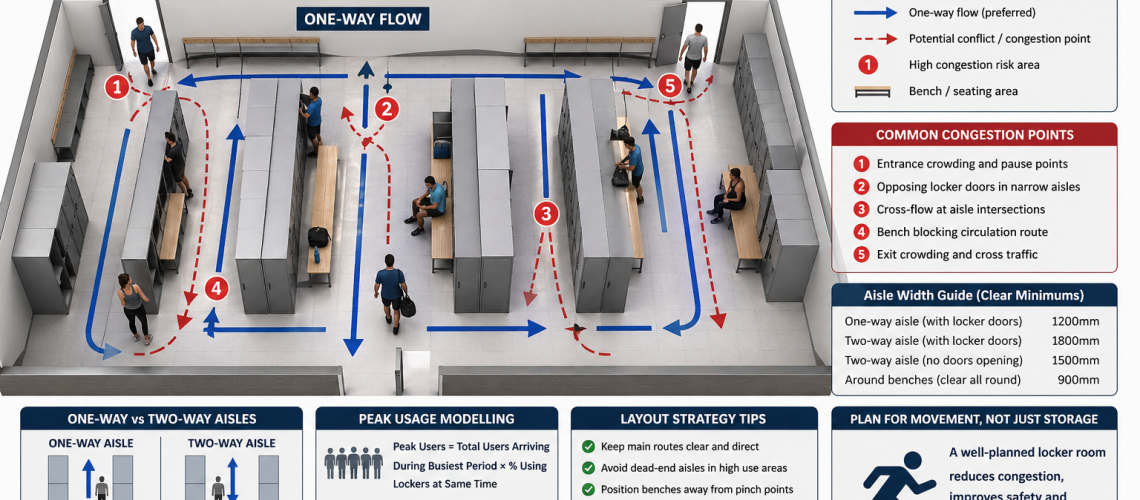
Locker room traffic flow is the way people move through a locker or changing area during normal and peak use. Good traffic-flow planning reduces bottlenecks, blocked aisles, door clashes, queues and conflicts between people using lockers, benches and circulation routes.
A locker room is not a static storage area. Users enter, stop, open doors, handle bags, change clothing, sit on benches, move towards showers or work areas and eventually leave. A successful layout therefore needs to work when the room is occupied, not simply when every locker door is closed.
This guide explains how to plan locker room movement, distinguish circulation space from active-use space, manage peak demand, compare one-way and two-way routes and identify the bottlenecks that make changing rooms difficult to use.
For the complete project process, start with our Locker Planning UK guide. For detailed physical arrangement, use our Locker Layout Planning UK.
Quick Answer: How Do You Reduce Locker Room Congestion?
Separate the space needed for walking from the space people occupy while opening lockers, handling bags, changing clothing or sitting on benches. Keep entrances clear, protect the main circulation route, avoid placing the busiest lockers at pinch points and test the layout for the busiest realistic period rather than average use.
Where possible, arrange the room so users move naturally from entry to storage, changing and exit without repeatedly crossing the same congested area.
Why Traffic Flow Matters
A changing room can contain the correct number of lockers and still feel too small if several activities compete for the same floor area.
- People need space to walk through the room.
- Users stop in front of lockers while handling belongings.
- Open locker doors temporarily reduce usable space.
- Bench users sit, stand, bend and change footwear.
- Bags, coats, PPE and shoes occupy temporary space.
- Entrances attract people who pause or wait.
- Peak periods can bring many users into the same area simultaneously.
Good traffic flow makes these activities compatible instead of allowing them to compete for the same narrow strip of floor.
Circulation Space and Use Space Are Different
One of the most useful distinctions in locker-room planning is between circulation space and active-use space.
| Type of space | What happens there | Typical problem |
|---|---|---|
| Circulation space | People walk through the room | Stationary users block the route |
| Locker-use space | Users open doors, stand and handle belongings | Doors and users reduce walking width |
| Bench-use space | Users sit, change and place belongings nearby | Activity extends beyond the physical bench |
| Entrance space | Users arrive, pause and orient themselves | Queues develop beside the doorway |
| Transition space | Users move between dry, wet or work zones | Different traffic streams collide |
An aisle may appear generous on an empty drawing but become much narrower when several doors are open and users are standing at nearby lockers.
Identify the Main Locker Room Zones
| Zone | Main activity | Congestion risk |
|---|---|---|
| Entrance | Arrival, orientation and waiting | Blocked doorways |
| Locker access | Opening lockers and handling belongings | Open doors and stationary users |
| Bench area | Sitting, changing and footwear use | Reduced working and passing space |
| Circulation | Walking between areas | Opposing traffic and pinch points |
| Wet transition | Movement to pools or showers | Wet and dry users crossing |
| Exit | Leaving and regrouping | Outgoing users conflicting with arrivals |
For more detailed separation of functions, see our Locker Room Zoning Guide UK.
Identify Primary and Secondary Routes
Most locker rooms contain one or more primary movement routes and several secondary routes serving individual locker banks or smaller areas.
Primary routes
The main route should normally be the clearest and easiest path through the room. It may connect the entrance with lockers, changing areas, showers, toilets or exits.
- Keep unnecessary obstacles out of the route.
- Avoid placing major stopping points at the narrowest sections.
- Do not rely on people weaving around benches.
- Avoid having open locker doors permanently conflict with the main route.
- Keep the route visually understandable.
Secondary routes
Secondary routes serve smaller locker banks or less frequently used parts of the changing room. They may carry fewer users, but they still need enough usable space for doors, bags and people accessing lockers.
One-Way vs Two-Way Traffic
| Route type | Potential advantage | Main limitation |
|---|---|---|
| One-way | Can reduce opposing movement | Only works where the route is intuitive |
| Two-way | Flexible and direct | Needs enough space for passing |
| Loop route | Can support continuous movement | Requires suitable entrances, exits and room shape |
| Dead-end aisle | Can increase storage in small areas | Users need to reverse against incoming traffic |
A one-way system is not automatically better. It works only where the physical layout and normal user behaviour make the direction obvious.
Locker Aisle Width and Traffic Flow
Aisle width affects whether people can pass while other users are standing at lockers, opening doors or using nearby benches.
The appropriate clear width depends on the locker arrangement, door swing, user numbers, benches, accessibility and peak occupancy. Avoid relying on one generic dimension for every project.
For the detailed subject, use our Locker Aisle Width Guide UK.
Plan for Peak Use, Not Average Use
A room that works well with five users may behave very differently when thirty people arrive together.
| Environment | Typical peak pattern | Main priority |
|---|---|---|
| School | Groups arriving between lessons | Protect entrances and corridors |
| Factory or warehouse | Shift start and finish | Allow simultaneous changing and locker access |
| Gym | Morning, lunchtime and evening peaks | Protect routes around lockers and benches |
| Sports facility | Teams arriving together | Allow for groups and large bags |
| Office | Morning arrival and end of day | Keep shared storage easy to access |
| Leisure centre | Pool sessions and class changeovers | Manage high turnover and wet/dry crossover |
Simple peak-use estimate
Peak active locker users = people arriving during the busiest period × estimated proportion using lockers simultaneously
For example, if 60 employees arrive around one shift change and approximately half may be actively using lockers at the same time, review the room for around 30 active users rather than one or two.
This is an early planning estimate rather than a substitute for project-specific occupancy or building requirements.
Design Around Real User Behaviour
Changing rooms often fail because they are designed around ideal behaviour instead of normal behaviour.
- People stop unexpectedly.
- Friends and colleagues gather together.
- Bags are temporarily placed on the floor.
- Users favour convenient lockers rather than distributing themselves evenly.
- Doors remain open while people change clothing.
- Users wait near entrances.
- People carrying PPE or sports equipment move more slowly.
A robust layout needs enough tolerance for this normal behaviour. If it only works when every person moves continuously and keeps every item perfectly contained, the layout is too dependent on ideal conditions.
How Long Users Occupy Space Matters
| Activity | Typical space effect | Congestion potential |
|---|---|---|
| Collecting a small bag | Short standing pause | Relatively low |
| Changing clothes | Standing, bending and turning | High |
| Handling PPE | Bulky items and longer access | High |
| Using a bench | Seated and surrounding working space | High |
| Waiting for another user | Static occupancy | Medium to high |
A locker area used only for quick bag storage can therefore operate differently from a full changing room where people remove clothing, footwear and PPE.
Identify Collision and Conflict Points
- Locker doors opening into narrow aisles.
- Opposing locker doors opening simultaneously.
- Users standing behind seated bench users.
- Entrances opening directly into active locker areas.
- Bench ends narrowing the main route.
- Dead-end aisles requiring users to turn around.
- Wet and dry users crossing at one narrow point.
- Bags, footwear and PPE being left in circulation space.
- Sharp changes of direction immediately beside doorways.
Locker Door Swing and Congestion
Locker doors are temporary obstructions. A route that appears clear becomes narrower once doors are open and users stand in front of them.
- Avoid putting the busiest lockers immediately beside entrances where possible.
- Check corners where doors may hit walls or neighbouring doors.
- Allow for opposing locker banks being used simultaneously.
- Include standing and bending space.
- Do not assess traffic flow with every locker door closed.
For detailed clearances, see our Locker Door Clearance Guide UK.
Bench Position and Traffic Flow
Benches are essential in many changing rooms but can create major congestion when positioned inside the principal route.
- Avoid benches immediately inside entrances.
- Allow for seated users as well as the bench itself.
- Allow room for people standing up and changing footwear.
- Check interactions between bench users and nearby locker doors.
- Keep important routes clear around bench ends.
- Remember that bags may temporarily sit beside users.
Browse our changing-room bench seating or use our detailed bench-spacing guidance when planning the room.
Entrance and Exit Planning
Doorways commonly become bottlenecks because users do more than simply walk through them. People stop, wait, orient themselves, adjust clothing and decide where to go.
- Keep locker door swing away from entrances.
- Avoid benches directly inside the doorway.
- Allow users somewhere to orient themselves.
- Keep the route from entrance to storage obvious.
- Reduce conflicts between incoming and outgoing users.
- Avoid concentrating the highest-use lockers beside a narrow entrance.
Dead-End Aisles
Dead-end aisles can work in small, lightly used areas but become increasingly difficult as traffic rises.
Users entering a dead-end route eventually need to reverse direction and pass incoming users. If several people are accessing lockers at once, congestion can build both at the closed end and around the aisle entrance.
Where the room allows it, a through-route or logical loop can work better in high-use areas.
Wet and Dry Traffic Flow
Swimming pools, gyms and leisure changing facilities often have users moving between lockers, benches, showers and wet activity areas.
Where practical, avoid forcing heavy wet traffic repeatedly through dry storage areas.
- Identify where wet users enter the changing area.
- Plan where towels and footwear are handled.
- Keep dry storage away from the busiest wet route where practical.
- Avoid narrow wet/dry crossover points.
- Specify locker and bench materials suitable for the actual environment.
How to Identify Traffic Problems in an Existing Changing Room
An existing locker room often provides strong evidence about where its layout is failing.
- Users regularly queue for particular locker banks.
- Aisles become blocked when several doors open.
- People repeatedly wait at entrances or bench ends.
- Some areas stay underused while others remain crowded.
- Scuffing and dirt repeatedly build up at narrow turning points.
- Locker doors or benches suffer impact damage in one location.
- Users regularly complain about cramped routes.
- Bags and footwear routinely end up in the walkway.
Repeated wear patterns can reveal how people actually move through the space even when the room appears acceptable during a quiet inspection.
Improving Traffic Flow Without Replacing All the Lockers
Congestion does not always require a complete locker-room refurbishment.
- Move benches away from narrow access points.
- Move the highest-use locker allocations away from entrances.
- Remove unused furniture from circulation routes.
- Spread user allocation across several locker banks.
- Improve numbering and signage.
- Introduce a logical one-way route where appropriate.
- Stagger access times where operations allow.
- Replace unsuitable locker configurations where they create local crowding.
If the entire room arrangement is causing the problem, review our Locker Layout Planning UK.
Traffic Flow by Environment
| Environment | Main flow problem | Useful response |
|---|---|---|
| School | Large groups accessing lockers together | Distribute storage and protect entrances |
| Workplace | Shift-change concentration | Design for simultaneous use |
| Factory or industrial | Bulky PPE and longer changing time | Allow greater working space around lockers and benches |
| Gym | High turnover and bench congestion | Keep movement separate from changing activity where possible |
| Leisure or swimming pool | Wet and dry users crossing | Use clear zones and transitions |
| Office | Shared lockers concentrated near entrances | Spread high-use storage and maintain clear access |
Common Locker Room Traffic-Flow Mistakes
- Planning the room only when it is empty.
- Treating circulation and locker-use space as the same area.
- Putting the busiest lockers beside entrances.
- Ignoring open locker doors.
- Positioning benches inside the main route.
- Using narrow dead-end aisles in high-use areas.
- Planning around average rather than peak occupancy.
- Assuming users will behave ideally.
- Allowing unnecessary wet and dry crossover.
- Ignoring people waiting for friends or colleagues.
- Ignoring repeated queues, impact damage or scuff marks.
- Maximising locker quantity without considering movement.
Locker Room Traffic Flow Checklist
- Can users enter without blocking the doorway?
- Is the main route through the room obvious?
- Can locker doors open without blocking that route?
- Can users stand at lockers while others pass?
- Are benches clear of important movement routes?
- Are bench ends free from obvious pinch points?
- Have opposing locker banks been checked during simultaneous use?
- Are dead-end aisles suitable for the expected traffic?
- Are wet and dry routes separated where practical?
- Can incoming and outgoing users move without excessive conflict?
- Has the room been reviewed for realistic peak occupancy?
- Have normal behaviours such as waiting and bag placement been considered?
- In an existing room, have recurring queues and wear patterns been investigated?
Related Locker Room Planning Guides
- Locker Planning UK – main planning hub.
- Locker Room Design UK – complete changing-room design guide.
- Locker Layout Planning UK – physical room arrangement.
- Locker Spacing Guidelines – practical clearances around lockers and benches.
- Locker Aisle Width Guide UK – detailed aisle planning.
- Locker Door Clearance Guide UK – door swing and working space.
- Locker Room Zoning Guide UK – wet/dry, PPE and activity zones.
- Bench Seating – changing-room bench products.
Locker Room Traffic Flow FAQs
What is locker room traffic flow?
Locker room traffic flow is the way people enter, move through, use lockers and benches, move between changing zones and leave the room. Good planning reduces congestion and conflicts between moving and stationary users.
What causes congestion in locker rooms?
Common causes include narrow aisles, open locker doors, benches within main routes, high-use lockers near entrances, groups arriving together and too many activities sharing the same floor space.
What is the difference between circulation space and locker-use space?
Circulation space is primarily used for walking through the room. Locker-use space is occupied by users standing at lockers, opening doors and handling belongings. Congestion increases when both functions depend on the same narrow area.
Should a locker room be designed for peak use?
Yes. Schools, workplaces, gyms and sports facilities can experience short periods when many users access lockers simultaneously. The layout should be tested against the busiest realistic operating period.
Is one-way traffic better in a changing room?
Not automatically. One-way movement can reduce opposing traffic where entrances, exits and user behaviour support it. Two-way routes may be more practical where adequate passing space is available.
Can benches cause locker room congestion?
Yes. The working space around a bench is larger than the bench footprint because users sit, stand, change footwear and place belongings around it. Poorly positioned benches can narrow important circulation routes.
Why are entrances common changing-room bottlenecks?
People often pause at entrances to orient themselves, wait or decide where to go. Congestion becomes worse when lockers, benches or other stopping activities are also positioned beside the doorway.
Can locker room traffic flow be improved without replacing all the lockers?
Often, yes. Moving benches, changing locker allocation, improving signage, removing unnecessary furniture or changing access patterns can improve flow without complete locker replacement.
Plan Locker Rooms Around Movement as Well as Storage
A changing room can have enough lockers and still perform badly if people cannot move through it comfortably. Traffic flow therefore needs to be considered alongside locker quantity, compartment size, benches and door clearance.
The strongest layouts protect the main circulation route, provide usable working space around active lockers and benches, reduce entrance bottlenecks and remain practical during the busiest periods.
Once the room requirements have been established, browse our commercial lockers and changing-room bench seating.
For help with a locker or changing-room project, call 01284 749211 or email sales@totallocker.co.uk.
Discover more from Blog Total Locker Service
Subscribe to get the latest posts sent to your email.