Emergency Locker Access UK
May 14, 2026
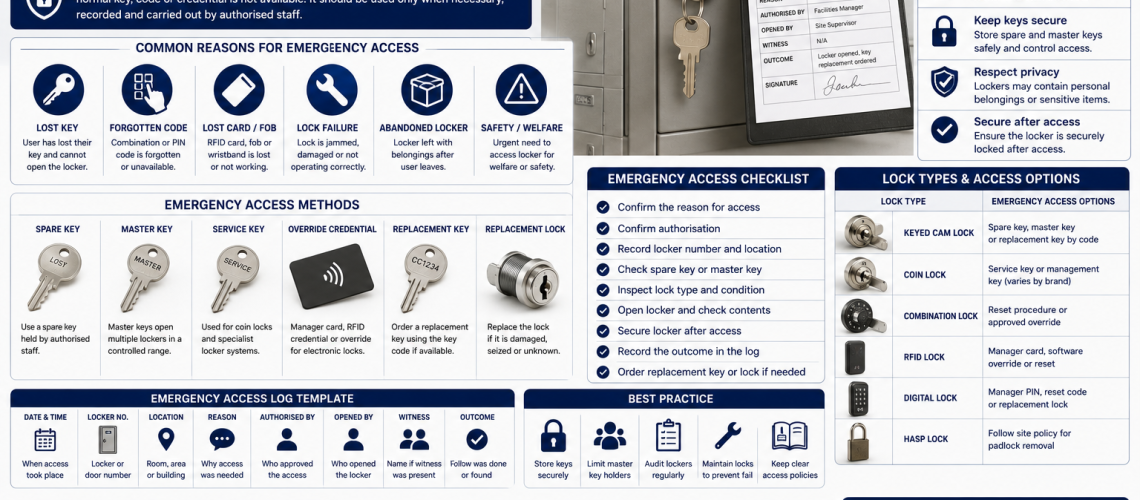
Emergency locker access is the controlled process of opening a locker when normal access is not available. This may happen when a key is lost, a user is unavailable, a locker is abandoned, a lock fails or authorised staff need urgent access for safety, welfare or operational reasons.
This guide explains how UK schools, workplaces, gyms, leisure centres and facilities teams can manage emergency locker access safely, legally and professionally.
Quick answer: what is emergency locker access?
Emergency locker access is authorised access to a locker when the normal user key, code, card or credential cannot be used. It should be handled by approved staff, recorded in a simple access log and supported by spare keys, master keys, service keys, override credentials or replacement locks where needed.
| Emergency access situation | Best controlled response |
|---|---|
| Lost user key | Check spare key, master key or lock code |
| Key snapped or damaged | Assess lock condition and order replacement parts |
| User absent or left site | Follow site policy and record access |
| Abandoned locker | Use a documented clearance process |
| Lock failure | Identify lock type and replace if required |
| Electronic lock issue | Use authorised override or management credential |
Need a Replacement Key After Emergency Locker Access?
If the lock is working and the key number, lock code or manufacturer details are known, use our replacement locker keys cut to code service to order the correct user key, spare key or site replacement key online.
Emergency access must be authorised
Locker access should never be casual. Lockers may contain personal belongings, work equipment, uniforms, PPE, medication, school property or sensitive items. Emergency access should only be carried out by authorised people following a clear site procedure.
- Confirm why access is needed.
- Confirm who has authority to approve it.
- Record the locker number and location.
- Record who opened the locker.
- Record the time, date and reason.
- Secure the locker again after access.
Common reasons for emergency locker access
Emergency access is usually needed because access has failed, not because the locker itself is the problem. The correct response depends on the lock type and the site policy.
| Reason | Typical example | Follow-up action |
|---|---|---|
| Lost key | Staff member or student cannot access locker | Order replacement locker key |
| Forgotten code | Combination lock cannot be opened by user | Use approved reset or replacement process |
| Lost card or fob | RFID locker will not open | Use management credential or reissue access |
| Lock fault | Key turns but door will not open | Inspect lock, cam and door alignment |
| Abandoned locker | User has left belongings behind | Follow clearance and storage policy |
| Welfare or safety concern | Urgent need to check locker contents | Use authorised witnessed access |
Use spare keys before replacing locks
If the lock face, original key, barrel or site key register shows a readable code, a replacement key may avoid an unnecessary lock change. Order through our locker key replacement by code page when the code and manufacturer range are clear.
If the locker uses a standard keyed lock, check whether a spare key exists before replacing the full lock. Spare keys are often held by facilities teams, school site teams, reception desks, estates teams or maintenance departments.
If the spare key is missing, check whether the lock face has a readable key number. A replacement key by code may be possible.
For more detail, see Replacement Locker Keys by Code UK and Locker Key Number Guide UK.
Use master keys carefully
A master key can open multiple lockers in a controlled lock range. This makes it useful for emergency access, but it also creates responsibility. Master keys should be stored securely and issued only to authorised staff.
- Keep master keys separate from user keys.
- Record each use of a master key.
- Limit the number of authorised holders.
- Store master keys in secure key control.
- Review risk if a master key is lost.
For a full governance page, see Locker Master Key Systems UK.
Emergency access for different locker lock types
Different locks need different emergency access planning. The best system is one where the access route is known before a problem occurs.
| Lock type | Emergency access route | Important note |
|---|---|---|
| Keyed cam lock | Spare key, master key or replacement key by code | Check key number and lock face |
| Hasp lock | Site policy for user padlocks | Set rules before issue |
| Coin lock | Service key, management key or lock support | Confirm lock brand and coin type |
| Combination lock | Approved reset, override or replacement process | Do not rely on undocumented codes |
| RFID lock | Manager card, software access or override credential | Keep admin credentials controlled |
| Digital PIN lock | Manager override, reset procedure or replacement lock | Check battery and system status |
Emergency access log template
An emergency access log protects users, staff and the organisation. It creates a clear record of why access took place and who authorised it.
| Log field | What to record |
|---|---|
| Date and time | When access took place |
| Locker number | Door or compartment number |
| Location | Room, floor, building or site |
| Reason for access | Lost key, abandoned locker, fault or emergency |
| Authorised by | Manager, site team, facilities lead or safeguarding lead |
| Opened by | Name of authorised staff member |
| Witness present | Name if required by policy |
| Outcome | Key replaced, lock replaced, contents secured or locker cleared |
Abandoned locker access
Abandoned lockers should be handled with a clear process. This is common in schools, gyms, workplaces and leisure centres where users leave without returning keys or clearing belongings.
- Check allocation records.
- Try to contact the assigned user where appropriate.
- Record the access reason.
- Use authorised staff to open the locker.
- List and secure any contents according to policy.
- Replace keys or locks before reissuing the locker.
Emergency access in schools
Schools need controlled access for lost student keys, abandoned lockers, end-of-term clearance, welfare concerns and damaged locks. Access should be handled by authorised staff and recorded clearly.
- Use a student locker allocation register.
- Keep master keys under site-team control.
- Record all emergency access events.
- Replace missing keys before reallocation.
- Check lock condition during holidays.
Emergency access in workplaces
Workplaces may need emergency locker access for staff lockers, PPE lockers, uniform storage and changing rooms. Access should be linked to HR, facilities or site policy where personal belongings may be present.
Emergency access in gyms and leisure centres
Gyms and leisure centres often need emergency access for lost keys, abandoned lockers, coin lock issues, wet-area lockers and high daily turnover. Service keys, master keys and clear access records are important in these environments.
Emergency access in healthcare and care environments
Healthcare and care environments may use lockers for staff belongings, uniforms and controlled work areas. Emergency access should be handled carefully, with attention to privacy, security and local site procedures.
When a replacement key is enough
Replacement keys are usually the lowest-disruption route when the lock still works and the correct code is known. This helps schools, workplaces, gyms and leisure centres keep the existing locker system in use while restoring normal access.
A replacement key is usually enough when the lock is working and the correct key code is known.
- The key is lost but the lock code is visible.
- The spare key is missing but records are accurate.
- The lock turns smoothly with another key.
- The locker needs to stay in the same access system.
- The site wants extra spare keys for future control.
When a replacement lock is better
A replacement lock may be better when the lock is damaged, unknown, unreliable or no longer secure.
- No key number can be found.
- The lock is seized or damaged.
- The key has snapped inside the lock.
- The cam no longer secures the door.
- The master key no longer works with the lock.
- The site wants to change to a different access method.
Emergency locker access checklist
| Check | Completed? |
|---|---|
| Reason for access confirmed | Yes / No |
| Authorisation confirmed | Yes / No |
| Locker number and location recorded | Yes / No |
| Spare key or master key checked | Yes / No |
| Lock face code recorded | Yes / No |
| Access logged | Yes / No |
| Locker secured again afterwards | Yes / No |
| Replacement key or lock ordered if needed | Yes / No |
How to reduce emergency locker access problems
The best emergency access process starts before there is an emergency. Good records and controlled spare keys reduce delays and damage.
- Keep a locker key register.
- Record locker numbers and key numbers separately.
- Store spare keys securely.
- Control master keys tightly.
- Audit locks during maintenance checks.
- Replace worn locks before they fail.
- Use consistent lock types across locker banks where possible.
Internal links for emergency locker access
- Replacement locker keys cut to code – order keys using a key number, lock code or manufacturer details.
- Locker locks – replacement locker locks and lock parts.
- Lost Locker Keys UK – what to do when keys are missing.
- Replacement Locker Keys by Code UK – understand ordering by code.
- Locker Master Key Systems UK – master keys and authorised access.
- Locker Lock Identification Guide UK – identify locks before replacing parts.
- Locker Key Management Systems UK – reduce lost-key and access problems.
FAQ: emergency locker access
Who should open a locker in an emergency?
Only authorised staff should open a locker in an emergency. The reason, date, locker number and staff member should be recorded.
Can a lost locker key be replaced without opening the locker?
Often, yes. If the lock face has a readable code, a replacement key by code may be possible.
Should every site have a locker master key?
Many sites benefit from controlled master key access, but the key must be stored securely and issued only to authorised staff.
What if a locker master key is lost?
The site should review which lockers are affected, who had access and whether affected locks need to be changed or rekeyed.
When should a locker lock be replaced?
A locker lock should be replaced when it is damaged, seized, insecure, obsolete or impossible to identify.
Need help with emergency locker access planning?
Total Locker Service can help with replacement locker keys, locker master key planning, locker lock identification and replacement locker locks. Record the lock code, locker number and access issue before ordering keys or parts.
Discover more from Blog Total Locker Service
Subscribe to get the latest posts sent to your email.