Industrial Storage Systems UK: Lockers, Cabinets, Tool Storage and PPE Storage
May 1, 2026
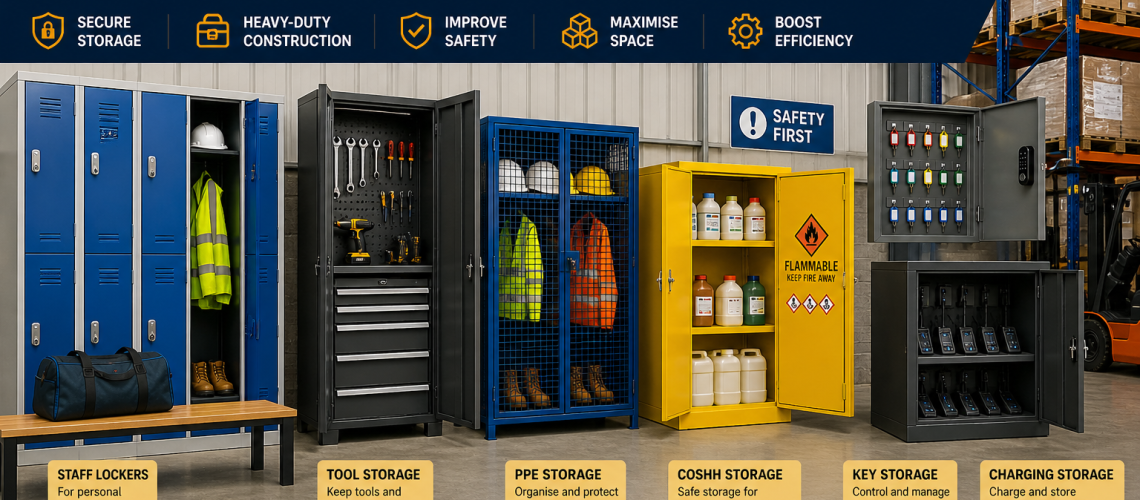
Industrial storage systems help factories, warehouses, workshops and maintenance teams organise staff belongings, PPE, tools, parts, equipment, workplace devices and operational supplies. Most industrial sites need several storage types working together rather than one universal locker or cabinet.
The correct mix depends on what is being stored, its size and weight, how frequently it is used, who needs access and the conditions in which the storage will operate.
This guide focuses specifically on industrial storage applications: tool storage, PPE, workwear, parts, consumables, operational equipment and staff storage across factories, warehouses, workshops and maintenance environments.
For a general comparison of storage categories, use Types of Storage Systems UK. For the full pre-purchase planning process, see Storage System Planning Checklist UK.
Quick Answer: What Storage Systems Are Used in Industrial Workplaces?
Industrial sites normally combine several storage formats.
| Industrial requirement | Typical storage approach |
|---|---|
| Staff clothing and belongings | Industrial or workplace lockers |
| PPE | Lockers, cabinets, racks, shelving or dedicated PPE storage |
| Tools and maintenance equipment | Tool cabinets, cupboards or secure equipment storage |
| Parts and components | Shelving, bins, drawers or cupboards |
| Consumables | Shelving, bins or central stock storage |
| Vehicle and building keys | Key cabinet or specialist key-storage system |
| Scanners, radios and tablets | Secure device or charging storage |
| Valuable equipment | Appropriate secure cabinet or safe |
| Specialist substances | Storage specifically suitable for the substance and application |
What This Industrial Storage Guide Owns
| Subject | Ownership |
|---|---|
| Industrial storage mix | This guide |
| Tool and maintenance-equipment storage | This guide |
| PPE and industrial workwear storage at application level | This guide |
| Parts and consumables storage | This guide |
| Heavy-item storage considerations | This guide |
| Industrial storage by access frequency | This guide |
| Factory, warehouse and workshop storage differences | This guide |
| Industrial environment and durability considerations | This guide |
| Separating personal and operational storage | This guide |
What This Guide Hands Off
| Detailed question | Use this guide |
|---|---|
| Which industrial locker should we buy? | Industrial Lockers UK |
| Which staff locker should we specify? | Workplace Lockers UK |
| Which key, code or electronic access method should we use? | Storage Access Control UK |
| How should workplace keys be stored? | Key Storage Systems UK |
| How should the complete storage project be planned? | Storage System Planning Checklist UK |
| Which general workplace storage types do we need? | Workplace Storage Systems UK |
| Which broad storage category should we use? | Types of Storage Systems UK |
What Is an Industrial Storage System?
An industrial storage system is a combination of storage products used to organise personal belongings, tools, PPE, equipment, parts and operational supplies within demanding workplaces.
It may include:
- staff lockers;
- PPE storage;
- tool cabinets;
- steel cupboards;
- shelving;
- parts bins and drawers;
- key cabinets;
- charging storage;
- secure equipment cabinets;
- and specialist storage where the items require it.
The industrial element is not simply the use of steel products. It is the need to accommodate equipment, PPE, work patterns, physical loads and environments that can differ substantially from ordinary office storage.
Start With the Industrial Items Being Stored
The first industrial-storage decision is to separate the different types of items used across the site.
- Personal: bags, coats, phones and personal effects.
- Workwear: uniforms, overalls, boots and protective clothing.
- PPE: helmets, gloves, eye protection and other protective equipment.
- Tools: hand tools, power tools and maintenance equipment.
- Parts: fixings, components, spares and maintenance stock.
- Operational devices: scanners, radios, tablets and handheld terminals.
- Keys: vehicles, gates, plant rooms, buildings and restricted areas.
- Controlled or valuable equipment: items requiring restricted storage.
Each category can then be matched to the storage format that best suits its physical and operational requirements.
Industrial Lockers for Staff and Workwear
Factories, warehouses and workshops still need personal storage for employees, but the contents are often bulkier than those found in an office.
Industrial staff lockers may need to accommodate:
- coats;
- bags;
- uniforms;
- overalls;
- boots;
- helmets;
- personally issued PPE;
- and small work equipment.
A compartment that works for a phone and small bag may be unsuitable for boots, workwear and a helmet. Measure representative equipment before selecting the locker configuration.
For the locker-specific buying decision, use Industrial Lockers UK. You can also browse our workplace and industrial lockers.
Industrial Storage for Shift-Based Workplaces
Industrial storage often has to cope with concentrated shift changes rather than a steady flow of users throughout the day.
This can affect:
- how many people use lockers at the same time;
- how much circulation space is required;
- how shared radios or scanners are returned;
- when charging equipment is needed;
- how shared PPE is replenished;
- and where storage should be positioned relative to entrances and work areas.
Shift patterns are therefore part of the storage requirement, particularly in warehouses, logistics operations and factories.
PPE Storage in Industrial Workplaces
PPE needs suitable accommodation while it is not in use. The appropriate format depends on the equipment, whether it is individually issued or shared and what condition it is in when returned.
PPE storage may include:
- individual lockers;
- open shelving;
- racks;
- cupboards;
- labelled compartments;
- containers;
- or dedicated PPE stations.
The storage should help protect equipment from unnecessary dirt, loss, damage or unsuitable environmental conditions.
Equipment that is ready for use may also need to be separated from PPE awaiting inspection, cleaning, repair or replacement.
Where work creates a genuine clean/dirty clothing requirement, that should be planned as part of the wider changing process rather than simply placing all garments into the same compartment.
Tool and Maintenance Equipment Storage
Tool storage is one of the clearest differences between industrial and ordinary office storage.
Possible formats include:
- tool cabinets;
- lockable steel cupboards;
- drawer units;
- shelving;
- equipment cabinets;
- and controlled tool stores.
The best format depends on the size, weight, value and frequency of use of the equipment.
Frequently used hand tools need to be easy to locate. Larger or more valuable equipment may justify enclosed or restricted storage. Heavy equipment requires storage that is physically designed for the load.
Parts, Components and Consumables
Industrial workplaces can accumulate large quantities of small components, replacement parts, fixings and consumable stock.
These items often benefit more from clear organisation than from individual locked compartments.
- open shelving can suit larger low-risk items;
- labelled bins can separate small parts;
- drawer units can organise fixings and components;
- cupboards can contain general consumables;
- and lockable storage can be used where particular stock needs additional control.
For ordinary operational stock, identification and logical grouping can be more useful than locking every item away.
Plan Industrial Storage Around Frequency of Use
The frequency with which an item is used should affect where it is stored.
| Access frequency | Broad approach |
|---|---|
| Continuous | Keep close to the point of use and easy to identify |
| Daily | Provide convenient access without obstructing the work area |
| Occasional | Can normally be positioned further from the immediate workstation |
| Emergency | Keep clearly identified and accessible when required |
| Restricted | Balance operational convenience with the required access control |
Poorly positioned equipment tends to migrate out of storage because users leave frequently needed items on benches, machines or worktops rather than repeatedly travelling to inconvenient stores.
Storage for Heavy Industrial Items
Industrial storage may carry substantially heavier loads than ordinary office cupboards.
Before placing heavy tools, components or equipment into storage, consider:
- the weight of the individual item;
- the combined shelf load;
- the manufacturer’s stated load capacity;
- cabinet or shelving stability;
- the height at which heavy items are stored;
- whether handling equipment needs access;
- and the consequences of an item falling or shifting.
An object fitting physically onto a shelf does not prove that the shelf or cabinet is designed to support its weight.
Charging Storage for Scanners, Radios and Devices
Warehouses, logistics operations and factories increasingly rely on portable electronic equipment such as scanners, radios, tablets and handheld terminals.
A dedicated storage location can help keep devices together between shifts and make it easier to identify missing equipment.
Where charging is required, consider:
- device dimensions;
- charger dimensions;
- number of devices;
- power requirements;
- ventilation;
- cable management;
- and how devices move between shifts or teams.
Browse our charging lockers and secure charging storage for suitable product options.
Industrial Key Storage
Industrial sites can accumulate large numbers of keys for buildings, gates, vehicles, forklifts, plant rooms, machinery and restricted areas.
The industrial-storage question is simple: those keys need a defined physical home rather than being spread through desks, drawers and informal key boards.
The detailed choice between cabinets, high-security storage, electronic systems, logs and other control methods belongs in the dedicated key-management cluster.
Start with Key Storage Systems UK or browse our commercial key cabinets.
Specialist Industrial Storage
Some industrial items should not be treated as ordinary tools, stock or workplace supplies.
This can include substances, materials or assets that require a particular storage specification because of their hazards or protection requirements.
Do not assume a general-purpose steel cupboard is suitable merely because it is lockable. Equally, do not assume every controlled substance requires the same specialist cabinet.
Where specialist storage is required, use the product and guidance appropriate to the actual substance, item and site assessment rather than turning this broad industrial page into a specialist safety guide.
Secure Storage for Valuable Industrial Equipment
Portable tools, instruments and other higher-value industrial equipment may justify additional physical protection.
Possible storage formats include:
- lockable steel cupboards;
- restricted-access equipment cabinets;
- separately locked compartments;
- higher-security cabinets;
- or an appropriate safe for particular high-risk items.
The storage format should follow the actual item, its portability, value and consequences of loss rather than appearance alone.
Match Storage to the Industrial Environment
Industrial storage can be exposed to conditions that ordinary office furniture rarely experiences.
- dust;
- dirt;
- frequent impacts;
- high levels of use;
- moisture;
- temperature variation;
- industrial contaminants;
- and traffic from trolleys or handling equipment.
Choose products according to the conditions in which they will actually operate. Steel construction alone does not prove that a product is suitable for wet, corrosive or exposed environments.
Industrial Storage and Site Traffic
Factories and warehouses also need storage positioned around operational movement.
Before positioning lockers, cupboards or shelving, consider whether they could interfere with:
- pedestrian movement;
- trolleys;
- forklifts or other vehicles;
- loading operations;
- machinery access;
- maintenance access;
- or other site routes.
The detailed safety assessment belongs to the workplace itself, but the storage layout should be planned as part of the operational environment rather than as an isolated furniture arrangement.
Industrial Storage Systems by Workplace Type
| Environment | Typical storage mix |
|---|---|
| Factory | Staff lockers, PPE storage, tool cabinets, parts storage and specialist storage where required |
| Warehouse | Staff lockers, scanner charging, key storage, PPE and equipment cabinets |
| Workshop | Tool storage, parts bins, consumables, PPE and secure equipment storage |
| Maintenance department | Tools, spare parts, keys, documents and controlled equipment |
| Facilities team | Keys, tools, PPE, replacement components and supplies |
| Loading or dispatch area | PPE, radios, scanners, documents and operational equipment |
Storage Systems for Factories
Factories typically need to separate employee storage from production and maintenance storage.
A typical factory may use:
- staff lockers for belongings and workwear;
- PPE storage close to relevant work areas;
- tool and maintenance cabinets;
- parts and consumables storage;
- key storage;
- and specialist storage for particular operational materials where required.
Trying to accommodate all of these requirements inside staff lockers normally creates a poor result. Personal and operational storage should generally be treated as separate requirements.
Storage Systems for Warehouses
Warehouses combine staff welfare requirements with equipment used continuously across shifts.
Common requirements include:
- staff lockers;
- PPE storage;
- vehicle and building key storage;
- scanner and radio charging;
- operational equipment cupboards;
- and stock or consumable storage.
The storage should support shift handovers and keep shared equipment in predictable locations.
Storage Systems for Workshops
Workshop storage often prioritises visibility and fast access.
Low-risk consumables and frequently used parts may work well in open bins, drawers or shelves, while valuable tools and controlled equipment can be kept in lockable storage.
The objective is not to lock every item away. It is to keep equipment organised and apply additional control where there is a genuine reason for it.
Industrial Storage Maintenance
Industrial storage should remain serviceable after installation.
Useful routine checks can include:
- door condition;
- hinges;
- locks;
- shelf condition;
- cabinet stability;
- labels and identification;
- corrosion or impact damage;
- charging equipment;
- and whether the original storage allocation still matches operational use.
For locker parts and servicing, see our Locker Parts & Service Solutions.
Allow Industrial Storage to Change With the Site
Factories and warehouses rarely remain completely static.
Storage requirements can change because of:
- additional staff;
- new PPE;
- new equipment;
- extra scanners or radios;
- additional maintenance parts;
- new vehicles or keys;
- or changes to production and working practices.
The answer is not necessarily to oversize every installation. Instead, consider how difficult the system will be to expand if likely requirements change.
Access Control for Industrial Storage
Industrial storage can use conventional keys, padlocks, mechanical combinations, electronic PINs, cards, RFID credentials and other access systems.
This page does not need to own that comparison. The industrial requirement is to establish who needs access and how frequently, then choose an appropriate system for the storage product.
For the detailed comparison, use Storage Access Control UK: Keys, Codes, Padlocks and Electronic Access Compared.
Industrial Storage Planning
At application level, an industrial storage project should establish:
- what is personal and what is operational;
- which items are heavy or bulky;
- which items are used frequently;
- which equipment requires restricted storage;
- whether PPE is individually issued or shared;
- whether devices need charging;
- and whether the physical environment places extra demands on the storage.
Measurements, delivery routes, installation, accessibility, detailed access decisions and the complete pre-order sequence belong in Storage System Planning Checklist UK.
Common Industrial Storage Mistakes
- Using staff lockers for shared tools. Operational equipment often needs central storage.
- Using light-duty storage for heavy equipment. Check product loading and construction.
- Ignoring PPE dimensions. Helmets, boots and bulky protective equipment require real space.
- Hiding frequently used items in inconvenient stores. Storage location should reflect frequency of use.
- Locking every consumable away. Low-risk stock may benefit more from clear visibility and organisation.
- Ignoring device charging. Radios, scanners and tablets may need dedicated powered storage.
- Mixing personal and operational equipment. They normally have different ownership and access requirements.
- Ignoring the industrial environment. Dust, moisture, impacts and contaminants can affect product suitability.
- Placing storage without considering site traffic. Cabinets and shelving should support rather than obstruct operations.
- Buying at exact current capacity. Consider likely future change and whether storage can be extended.
Industrial Storage Decision Table
| Requirement | Start with | Detailed guide |
|---|---|---|
| Factory staff belongings | Industrial lockers | Industrial Lockers UK |
| General employee storage | Workplace lockers | Workplace Lockers UK |
| Tools and maintenance equipment | Cabinets, cupboards or tool storage | This guide |
| PPE | Locker, cabinet, rack or other suitable storage | This guide |
| Parts and consumables | Shelving, bins, drawers or cupboards | This guide |
| Workplace keys | Key cabinet or key storage | Key Storage Systems UK |
| Scanners and radios | Secure charging storage | Charging Storage |
| Access technology | Key, code, padlock or electronic system | Storage Access Control UK |
| Complete pre-purchase planning | Storage planning checklist | Storage System Planning Checklist UK |
Industrial Storage from Total Locker Service
Total Locker Service supplies storage products for factories, warehouses, workshops, engineering businesses, maintenance teams and other industrial workplaces throughout the UK.
For staff belongings and workwear, browse our workplace and industrial lockers. For keys, see our commercial key cabinets. For radios, scanners and portable devices, browse our charging lockers and device storage.
Related Industrial Storage Guides
- Industrial Lockers UK for factory and warehouse locker specification.
- Workplace Storage Systems UK for the broader workplace storage mix.
- Workplace Lockers UK for detailed staff locker selection.
- Key Storage Systems UK for physical key-storage formats.
- Storage Access Control UK for locks, keys, codes and electronic access.
- Storage System Planning Checklist UK for full pre-purchase planning.
- Types of Storage Systems UK for the general storage-category comparison.
Industrial Storage Systems FAQs
What are industrial storage systems?
Industrial storage systems are combinations of lockers, cabinets, shelving, parts storage, PPE storage, key storage and other products used to organise items in factories, warehouses, workshops and maintenance environments.
What storage systems are used in factories?
Factories commonly use staff lockers, PPE storage, tool cabinets, parts storage, key cabinets, charging storage and specialist storage for particular operational items. Most sites use several formats together.
What storage does a warehouse need?
Warehouses may need staff lockers, PPE storage, scanner and radio charging, vehicle and building key storage, equipment cupboards and storage for consumables or parts.
How should PPE be stored in an industrial workplace?
PPE should have storage suitable for its size, type and condition. Depending on the equipment, this may include lockers, cupboards, shelves, racks, containers or dedicated PPE stations.
Are lockers suitable for factories and warehouses?
Yes. Lockers are commonly used for employee belongings, uniforms, workwear, footwear and individually issued PPE. The locker dimensions and material should suit the actual contents and working environment.
What is the best storage for industrial tools?
The appropriate tool storage depends on tool size, weight, value and frequency of use. Options can include tool cabinets, steel cupboards, drawer units, shelving and controlled equipment stores.
How should industrial parts and components be stored?
Parts and components can be organised using shelving, labelled bins, drawers, trays or cupboards. Frequently used low-risk items often benefit from visible, clearly labelled storage rather than individual locked compartments.
How do I choose an industrial storage system?
Start with the items being stored and consider their size, weight, frequency of use, users and working environment. Then combine appropriate lockers, cabinets, shelving, parts storage, device storage or specialist storage rather than trying to use one product for every requirement.
Build Industrial Storage Around the Work
A strong industrial storage system separates personal belongings, PPE, tools, parts, devices and controlled equipment into storage suited to each job.
Factories, warehouses and workshops should not force every requirement into staff lockers or general cupboards. Frequently used tools need convenient organisation, heavy equipment needs suitable load capacity, PPE needs appropriate accommodation and operational devices may need dedicated charging storage.
Use this page for the industrial application and storage mix, then move to the specialist guides for locker specification, access technology, key storage and detailed project planning.
Discover more from Blog Total Locker Service
Subscribe to get the latest posts sent to your email.