Storage Access Control UK: Keys, Codes, Padlocks and Electronic Access Compared
May 1, 2026
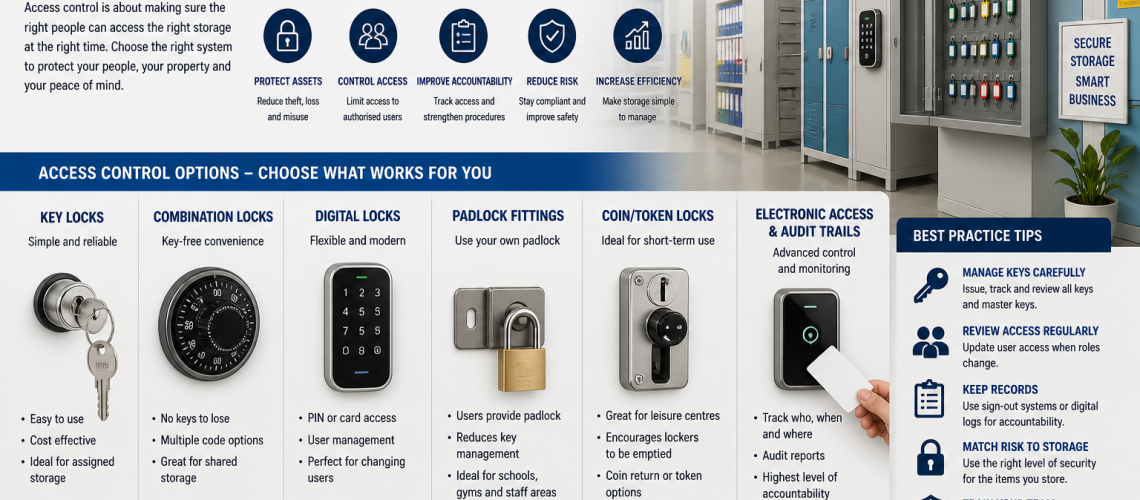
Storage access control is the method used to decide how authorised users open lockers, cabinets, cupboards, safes and other secure storage. The correct system may be as simple as a key or padlock, or it may use a combination, PIN, card, fob or electronically managed access system.
The best choice depends on who uses the storage, whether users remain the same or change regularly, what is being protected, how much administration the organisation can support and whether simple mechanical access is sufficient.
This guide compares the main storage access-control methods at a broad workplace level. It does not replace the detailed specialist guidance for locker locks, key cabinets, smart lockers, safes or workplace key management.
For wider storage planning, see Storage Systems Explained UK. If you are still deciding what type of storage is required, use Types of Storage Systems UK.
Quick Answer: Which Storage Access Method Should You Choose?
Choose the simplest access method that reliably supports the way the storage will actually be used.
- Key locks suit stable users and straightforward assigned storage.
- Padlock fittings can transfer ordinary access-device responsibility to the user.
- Mechanical combination locks remove ordinary keys without introducing batteries or software.
- Electronic PIN locks provide keyless access with electronic reset or management features on suitable products.
- Card, fob or RFID access can suit organisations where compatible credentials are already used.
- Connected electronic systems become useful where changing users, central administration, reporting or integrations solve a genuine operational problem.
The most technically advanced option is not automatically the best. Access control should match the storage requirement rather than adding complexity for its own sake.
What Is Storage Access Control?
Storage access control is the physical or electronic method used to restrict access to a storage unit.
It answers a basic question:
How does an authorised user open this storage?
Depending on the product, access may be provided through:
- a physical key;
- a user-supplied padlock;
- a mechanical combination;
- an electronic PIN;
- a card or fob;
- an RFID credential;
- a mobile or digital credential;
- or a managed electronic access system.
Access control applies across many forms of commercial storage, including lockers, cupboards, key cabinets, tool cabinets, filing cabinets, specialist cabinets and safes.
What This Guide Owns
| Subject | Ownership |
|---|---|
| Broad comparison of storage access methods | This guide |
| Keys vs codes vs padlocks vs electronic access | This guide |
| When simple mechanical access is enough | This guide |
| When electronic access may be worthwhile | This guide |
| Broad assigned vs changing-user considerations | This guide |
| Cross-product workplace examples | This guide |
| Choosing access complexity by storage use | This guide |
What This Guide Hands Off
| Detailed question | Use this guide |
|---|---|
| Which locker access technology should we use? | Locker Access Control Systems UK |
| Which locker lock type should we buy? | Locker Locks |
| Mechanical or digital key cabinet? | Mechanical vs Digital Key Cabinets UK |
| How should workplace keys be issued and returned? | Managing Keys in the Workplace UK |
| How should key movements be recorded? | Key Tracking Methods UK |
| How should a smart locker system work? | Smart Locker Systems UK |
| How should locker permissions and overrides be governed? | Locker Access Permissions & Governance UK |
| What physical key-storage format should we use? | Key Storage Systems UK |
Why Storage Access Control Matters
Storage is only useful if the appropriate people can access it while unnecessary access is restricted.
A suitable access method can help:
- reduce unauthorised access;
- reduce lost or uncontrolled keys;
- make storage practical for the intended users;
- support assigned or shared storage;
- reduce unnecessary administration;
- and provide a workable route for authorised management access.
Poorly matched access control can create the opposite result. A technically secure lock that staff cannot use efficiently may produce workarounds, while a highly complex electronic system can create unnecessary servicing and administration on a simple storage installation.
Storage Access Control Options Compared
| Access method | Main advantage | Main consideration |
|---|---|---|
| Key lock | Simple and familiar | Physical key issue, loss and replacement |
| Hasp and padlock | User can control their own padlock | Lost, forgotten or abandoned padlocks |
| Mechanical combination | Keyless without batteries | Forgotten or widely shared codes |
| Electronic PIN | Flexible keyless operation | Batteries, reset and management access |
| Card or RFID credential | Fast credential-based access | Compatibility and credential administration |
| Connected electronic access | Central administration and wider capabilities | Infrastructure, software and support |
There is no universally superior access technology. The correct option depends on the users, storage product, operating environment and administrative requirement.
Key Locks for Storage
Key-operated locks remain one of the simplest ways to control access to commercial storage.
They can be appropriate for:
- assigned staff lockers;
- office cupboards;
- filing cabinets;
- tool cabinets;
- key cabinets;
- and other storage used by a relatively stable authorised group.
The main benefit is simplicity. Key locks normally require no battery, network connection or software.
The main cost is key administration. Lost keys, replacement keys and spare-key control become more significant as the number of users or locks increases.
For locker-specific replacement keys, use our locker key service. For business key storage itself, see Key Storage for Businesses UK.
Padlock Access
A hasp or padlock fitting allows the storage user or organisation to fit a compatible padlock rather than relying on an integrated lock.
This can work well where users already carry their own padlocks or where an organisation wants to avoid issuing a separate key for every storage unit.
- No integrated user key is required.
- Users can often provide their own compatible padlock.
- No batteries or software are required.
- The storage can remain relatively simple to maintain.
The organisation should still consider how damaged, forgotten or abandoned padlocks will be handled and whether the fitting is compatible with the intended padlock dimensions.
Mechanical Combination Locks
Mechanical combination locks remove the ordinary user key without introducing electronic components.
They can suit workplaces where users can reliably operate and remember a code and where battery servicing would add unnecessary work.
- No ordinary user key is required.
- No electrical power is normally required.
- They can suit individual assigned storage.
- Suitable products can also support changing-user operation.
- Management or reset capability varies by product.
A combination lock is only useful if its operating mode suits the storage. An assigned-user lock and a public-use combination lock can behave very differently even though both use a code.
Electronic PIN Access
Electronic keypad locks provide access through a numerical PIN rather than a physical user key.
Depending on the product, electronic PIN systems may support:
- private assigned use;
- temporary or changing users;
- management codes;
- reset functions;
- and emergency or override access.
Electronic access introduces additional considerations such as battery replacement, low-battery behaviour, reset procedures and what happens if normal electronic operation becomes unavailable.
Card, Fob and RFID Access
Some storage systems use a card, fob or other RFID credential instead of a key or PIN.
This can be useful where people already carry an organisational credential or where fast access is desirable.
However, the word RFID does not prove that an existing staff card or fob will work with a proposed storage system.
- credential technology;
- reader compatibility;
- enrolment requirements;
- supported user numbers;
- and integration requirements
should be confirmed before ordering.
Connected Electronic Storage Access
Connected access becomes relevant when the organisation needs more than an electronic lock operating by itself.
A managed system may provide functions such as:
- central user administration;
- remote access changes;
- time-limited credentials;
- event reporting;
- integration with identity systems;
- or dynamic allocation.
These capabilities can be useful, but they also introduce software, communications and support requirements.
For connected locker systems specifically, use Smart Locker Systems UK.
Assigned Users vs Changing Users
One of the most important access-control questions is whether the storage normally belongs to one regular user or is repeatedly used by different people.
| User model | Typical access need |
|---|---|
| One regular user | Simple key, padlock, private-use code or assigned credential may be sufficient |
| Small stable authorised team | Shared key, controlled code or straightforward credential access may work |
| Frequently changing users | Public-use code, managed credential or another easily reset access method may be more practical |
| Large changing population | Electronic or centrally managed access may become worthwhile |
This page uses those models only to help choose broad access technology. Detailed locker allocation belongs in Locker Allocation Systems UK.
Access Control for Lockers
Lockers can use almost every access method described in this guide, from conventional keys and padlocks to mechanical combinations, electronic PIN locks, RFID credentials and connected systems.
The correct option depends heavily on whether the locker is assigned to one user, used temporarily by changing users or administered through a wider workplace system.
Locker access is now a specialist topic in its own right. Use Locker Access Control Systems UK for the detailed comparison.
To compare commercial lock products, browse our locker locks.
Access Control for Key Cabinets
A key cabinet introduces an unusual access-control situation because the cabinet itself contains the access devices for other doors, vehicles or equipment.
A conventional cabinet may use:
- a physical key;
- a mechanical combination;
- an electronic keypad;
- a card or fob;
- or a more advanced electronic key-management system.
The detailed technology decision belongs in Mechanical vs Digital Key Cabinets UK.
For physical cabinet types and applications, use Key Cabinets Explained UK.
Access Control for Cupboards and Cabinets
Office cupboards, filing cabinets, tool cabinets and other workplace storage often need simpler access control than lockers or electronically managed systems.
A basic key lock or combination may be entirely adequate where:
- the authorised group is small;
- access changes rarely;
- there is no requirement for individual electronic credentials;
- and the storage itself does not require more specialised control.
Do not specify electronic access merely because it is available. For routine workplace cupboards, simplicity can be an advantage.
Access Control for Safes
Safes use their own purpose-designed locking and security systems, and the appropriate lock should be considered as part of the complete safe specification rather than treated as a generic cabinet-lock choice.
Depending on the product, safe access may use keys, mechanical combinations, electronic PINs or other approved locking arrangements.
Where a safe is required, select the safe according to the assets, protection requirement and product specification first, then compare available lock options within that suitable safe range.
When Simple Access Control Is Better
A simple mechanical system is often the better choice where the operating requirement is stable.
- Users remain broadly the same.
- Access changes infrequently.
- No central reporting is required.
- No useful software integration exists.
- Battery servicing would add unnecessary work.
- Existing mechanical access already performs satisfactorily.
Complexity should solve a real problem. It should not be treated as a security upgrade simply because it is electronic.
When Electronic Storage Access Is Worth Considering
Electronic access becomes more useful where mechanical access creates meaningful administration or does not provide the required flexibility.
- Authorised users change frequently.
- Physical keys are difficult to administer.
- Individual credentials would provide a useful benefit.
- Access needs to be removed quickly.
- Shared codes are undesirable.
- Central administration would remove significant manual work.
- Reporting or system integration is an established requirement.
Even then, distinguish between a simple standalone electronic lock and a genuinely connected management platform. They are not the same thing.
Management and Override Access
Many commercial storage systems need some technical method for authorised intervention if the normal user cannot open the storage.
Depending on the product, this may involve:
- a master key;
- a manager key;
- a reset tool;
- a management code;
- an administrator credential;
- or an electronic management function.
The existence of an override capability is a product feature. Who is authorised to use it is a separate governance decision.
For locker systems, see Locker Access Permissions & Governance UK.
Access Control Is Not the Same as an Audit Trail
An access-control system decides how a user gets access. An audit or tracking system records what happened.
A lock can provide strong physical control without recording individual events. Conversely, a paper sign-out record can document key movement without changing how the cabinet itself is locked.
Do not treat these as the same specification question.
For physical key movement, use Key Tracking Methods UK. For locker event logging, use Locker Access Audit Systems UK.
Match Access Hardware to the Environment
The access technology must suit the physical environment as well as the users.
| Environment | Access consideration |
|---|---|
| Office | Ease of use, administration and appearance |
| School | Durability, lost access and ease of support |
| Changing room | User turnover, moisture and product suitability |
| Warehouse | Gloves, dust, impact and serviceability |
| Industrial site | Contaminants, physical use and maintenance |
| Public-facing area | Simple operation and controlled management access |
Descriptions such as digital, electronic or RFID do not by themselves prove that a lock is suitable for wet, dusty, exposed or demanding environments. Check the specification of the actual product.
Consider User Experience and Accessibility
The access method also has to work for the people expected to use it.
- Can users comfortably turn a key?
- Can a padlock be fitted and removed easily?
- Are combination dials readable?
- Is a keypad positioned appropriately?
- Does the electronic reader provide clear feedback?
- Can users tell whether the storage is actually locked?
- Can authorised staff assist when normal access fails?
A technically capable access system is still a poor choice if it creates unnecessary difficulty for the actual user population.
Storage Access Control Selection Process
- Define the storage type. Locker, cupboard, cabinet, safe, key cabinet or specialist storage.
- Identify the users. One person, stable team, changing staff, visitors or public users.
- Decide whether access is assigned or changing.
- Consider what users can realistically carry or remember. Key, padlock, code, card, fob or other credential.
- Establish whether mechanical access is sufficient.
- Identify whether individual electronic credentials add genuine value.
- Check management and override requirements.
- Check the installation environment.
- Consider battery, power and network requirements.
- Confirm physical product compatibility.
- Compare servicing and administration as well as purchase cost.
- Move to the relevant specialist guide before final specification.
Common Storage Access Control Mistakes
- Choosing a lock before defining how the storage will be used.
- Assuming electronic access is automatically more secure or more suitable.
- Using shared codes when individual accountability is actually required.
- Assuming RFID credentials are universally compatible.
- Ignoring battery and servicing requirements.
- Specifying connected software where standalone access would be enough.
- Confusing access technology with tracking or audit records.
- Ignoring the environment in which the lock will operate.
- Failing to provide an authorised management or override route.
- Using a product-specific answer as if it applies to every type of storage.
Storage Access Control by Use Case
| Use case | Broad starting point |
|---|---|
| Assigned office locker | Key, padlock, private-use combination or simple electronic access |
| Shared changing-room locker | Public-use combination, coin, RFID or suitable electronic access |
| Office cupboard | Simple keyed or combination access often sufficient |
| Staff key cabinet | Mechanical or digital cabinet depending on authorised user group |
| Vehicle-key storage | Controlled cabinet access, potentially stronger where many users share valuable keys |
| Frequently changing workplace users | Electronic credentials may reduce key or code administration |
| Simple low-change storage | Mechanical access may remain the most practical option |
These are starting points rather than fixed rules. The actual product should be selected against the users, physical storage and operating environment.
Related Storage Access Guides
| Question | Guide |
|---|---|
| Which broad access method should storage use? | This guide |
| Which access technology should lockers use? | Locker Access Control Systems UK |
| Which locker locks are available? | Locker Locks |
| Mechanical or digital key cabinet? | Mechanical vs Digital Key Cabinets UK |
| How should workplace keys be operated day to day? | Managing Keys in the Workplace UK |
| How should key movements be recorded? | Key Tracking Methods UK |
| How should connected lockers be managed? | Smart Locker Systems UK |
| What type of storage system should we use? | Types of Storage Systems UK |
Explore Storage Systems by Use Case
- Workplace Storage Systems UK
- Industrial Storage Systems UK
- School Storage Systems UK
- Care Home Storage Systems UK
- Storage System Planning Checklist UK
Storage and Locker Access Products
Total Locker Service supplies commercial storage products and access hardware for workplaces, schools, leisure facilities, healthcare staff areas, warehouses and other UK organisations.
For staff storage, browse our workplace lockers. For replacement and alternative locker locking options, see our locker locks. For physical key storage, browse our commercial key cabinets.
Storage Access Control FAQs
What is storage access control?
Storage access control is the physical or electronic method used to determine how authorised users open lockers, cabinets, cupboards, safes and other controlled storage.
What is the simplest storage access-control method?
A conventional key lock is one of the simplest options and can be suitable where users are stable and key administration is straightforward. Padlocks and mechanical combinations are also simple non-electronic options for suitable products.
Are electronic locks better than key locks?
Not automatically. Electronic locks can reduce physical key administration and provide additional management features, but they may introduce batteries, servicing, credentials, software or infrastructure. The correct technology depends on the actual storage requirement.
When is a combination lock better than a key?
A combination lock can be useful where users should not need a physical key. It still requires a suitable process for forgotten codes, resets and management access, and the operating mode must suit whether the storage is assigned or used by changing users.
Can staff access cards be used for storage?
Some electronic storage systems can use cards or RFID credentials, but compatibility must be confirmed. A staff card working with another building system does not prove it will work with a proposed locker or cabinet reader.
Does electronic access always require a network connection?
No. Many electronic PIN, card and RFID locks can operate as standalone devices. Networked access is only required on systems designed for central administration, reporting, integration or other connected functions.
What access control is best for staff lockers?
The best method depends on whether lockers are assigned or shared, how often users change and how much administration is practical. Options can include keys, padlocks, mechanical combinations, PIN locks, RFID credentials and connected systems.
Is storage access control the same as an audit trail?
No. Access control determines how a user gains access to storage. An audit trail records access events or key movements. Some electronic systems provide both functions, but they are separate specification requirements.
Storage Access Control Should Match the User and the Storage
The best storage access-control system is not necessarily the most complex one. Key locks, padlocks and mechanical combinations remain suitable for many straightforward workplace applications, while electronic PIN, RFID and connected systems become more useful where changing users or central administration create a genuine need.
Start with the storage type, user population and operating model. Then choose the least complex access technology that reliably supports those requirements.
Once the broad method is clear, move to the appropriate specialist guide for lockers, key cabinets, key management or smart connected systems before final specification.
Discover more from Blog Total Locker Service
Subscribe to get the latest posts sent to your email.