Locker Master Key Systems UK
May 14, 2026
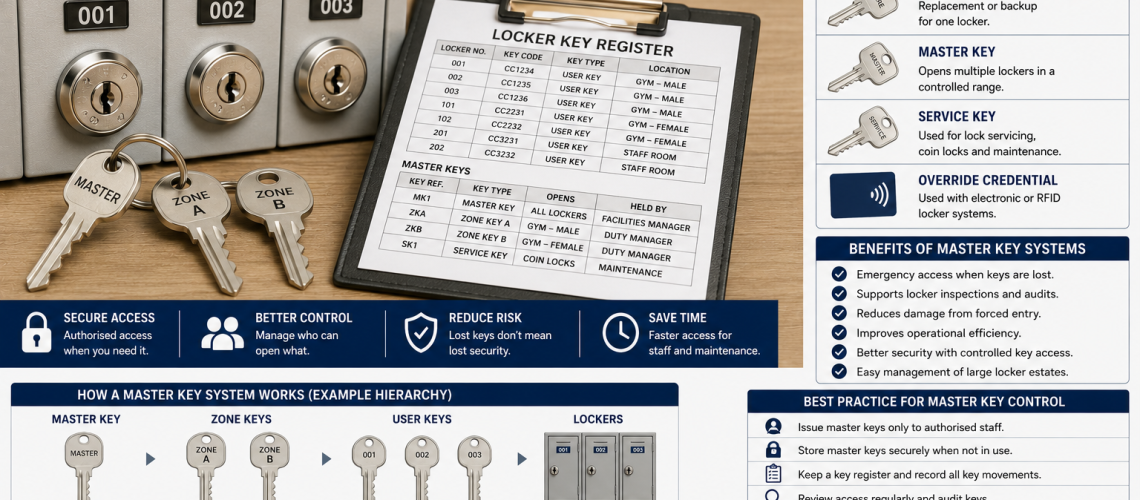
A locker master key system allows authorised staff to open multiple lockers within a controlled lock range. It is commonly used in schools, workplaces, gyms, leisure centres, healthcare sites, warehouses and managed facilities where lockers need safe supervision and emergency access.
This guide explains how locker master key systems work, when they are useful, how to manage them safely and when replacement keys, replacement locks or a full access review may be needed.
Quick answer: what is a locker master key system?
A locker master key system is a controlled key arrangement where individual users have keys for their own lockers, while authorised staff hold a master key or pass key that can open a defined group of lockers. It supports emergency access, maintenance, audits, lost-key recovery and locker management.
| Key type | Main purpose |
|---|---|
| User key | Opens one assigned locker |
| Spare key | Replacement or backup for one locker |
| Master key | Opens multiple lockers in a controlled range |
| Service key | Used for lock servicing or coin lock management |
| Override credential | Used with some electronic or RFID locker systems |
Why locker master keys matter
Master keys help organisations manage lockers without forcing locks open whenever a key is lost or access is needed. They also support inspection, maintenance and operational control.
- They allow authorised emergency access.
- They reduce damage caused by forced entry.
- They help facilities teams manage lost keys.
- They support locker audits and inspections.
- They make maintenance faster and cleaner.
- They reduce unnecessary lock replacement.
Where locker master key systems are used
Locker master key systems are useful wherever a site has many lockers and needs controlled management access.
| Environment | Typical use |
|---|---|
| Schools | Student lockers, sports lockers and staff areas |
| Gyms and leisure centres | Changing rooms, wet areas and coin-operated lockers |
| Workplaces | Staff lockers, PPE lockers and changing rooms |
| Healthcare sites | Staff changing areas and controlled storage zones |
| Warehouses | Uniform lockers, personal storage and equipment lockers |
| Multi-site estates | Standardised access control across several locations |
User keys, master keys and service keys
Not every management key is the same. A user key normally opens one locker. A master key opens a controlled group. A service key may support maintenance, coin lock reset, lock removal or system management.
The correct key depends on the lock brand, lock range and locker system. Before ordering a replacement master key, confirm the lock type, key series and site records.
How a locker master key system works
A master key system is planned so that locks are arranged into a controlled access structure. Individual lockers still have their own keys, but selected management keys can open more than one lock within the same system.
This can be simple or layered. A single school changing room may need one master key. A large workplace or leisure centre may need different master keys for different zones.
| System structure | Example |
|---|---|
| Single master key | One authorised key opens one locker bank |
| Zone master keys | Separate keys for male, female, staff or visitor areas |
| Department master keys | Different teams control different locker groups |
| Site master key | One facilities key opens all lockers in a location |
| Multi-site structure | Standardised access across several branches or buildings |
Security risks of locker master keys
A locker master key is useful, but it must be controlled carefully. If a master key is lost or issued casually, it can create a wider security risk than a single lost user key.
- It may open many lockers.
- It may give access to personal belongings.
- It may bypass normal user control.
- It may affect trust if access is not recorded.
- It may require lock changes if lost.
Master key control policy
Every site with master keys should have a simple control policy. This does not need to be complicated, but it should be clear and followed consistently.
- Only authorised staff should hold master keys.
- Master keys should be stored securely when not in use.
- Every issue and return should be recorded.
- Keys should not be copied without approval.
- Access to lockers should be justified and logged.
- Lost master keys should trigger a risk review.
Locker master key register
A master key register helps facilities teams track which master keys exist, who holds them and which lockers they control.
| Register field | Purpose |
|---|---|
| Master key reference | Identifies the management key |
| Lock series | Confirms the matching lock range |
| Locker zone | Shows which lockers are controlled |
| Authorised holder | Records who may use the key |
| Storage location | Shows where the key is kept |
| Issue date | Tracks when the key was issued |
| Last audit date | Supports security checks |
| Lost key action | Records risk review or lock change decision |
Lost locker master keys
A lost locker master key should be treated more seriously than a lost user key. The risk depends on how many lockers the key opens, where the lockers are located and what users store inside them.
If a master key is lost, review the affected lock range, access records and whether the locks should be changed. For low-risk areas, a controlled replacement key may be enough. For higher-risk areas, rekeying or lock replacement may be safer.
Replacement locker master keys
Replacement master keys may be possible when the correct master key reference, lock series and authorisation details are available. Because master keys control multiple lockers, they should not be treated like ordinary spare keys.
- Confirm the lock brand and key series.
- Check the master key reference.
- Confirm the authorised site contact.
- Check whether the master key was lost or simply needs duplication.
- Review whether affected locks remain secure.
Master key systems for keyed locker locks
Traditional keyed locker locks may support master key control depending on the lock range. This is common in schools, staff changing rooms, workplaces and older locker banks.
When replacing locks, check whether the new lock needs to match the existing master key system. A random replacement lock may work for the user but fail to work with the site master key.
Master keys for coin locker systems
Coin locker systems may use service keys, security keys, master keys or collection keys depending on the lock design. These are common in gyms, pools, leisure centres and public changing rooms.
Before ordering a key for a coin-operated locker, confirm whether you need a normal user key, a service key, a security key or a management key.
Override access for electronic and RFID lockers
Electronic and RFID locker systems may use override cards, manager cards, service credentials, software permissions or emergency access tools instead of traditional master keys.
Access should still be controlled. The same principle applies: management access must be limited, recorded and reviewed.
When to upgrade a locker master key system
An old master key system can become difficult to manage if locks have been replaced randomly over time. This creates mixed key ranges, missing records and inconsistent access.
- Several lockers no longer work with the master key.
- The site has lost track of spare keys.
- Different lock brands have been fitted across one locker bank.
- Master keys are held by too many people.
- Records do not match the lockers on site.
- Lost keys are becoming a repeated problem.
Locker master key audit checklist
| Audit question | Yes / No |
|---|---|
| Do you know how many master keys exist? | Yes / No |
| Do you know who holds each master key? | Yes / No |
| Are master keys stored securely? | Yes / No |
| Are locker access events recorded? | Yes / No |
| Do all locks still match the correct master key? | Yes / No |
| Are lost master keys reviewed quickly? | Yes / No |
| Are replacement locks checked for master key compatibility? | Yes / No |
Master key system planning for schools
Schools need fast, controlled access to student lockers when keys are lost, lockers are abandoned or welfare concerns arise. A master key system can help, but it must be managed by authorised staff only.
- Separate student keys from management keys.
- Keep master keys in secure storage.
- Record authorised access events.
- Audit lockers during term breaks.
- Update records when locks are changed.
Master key system planning for workplaces
Workplaces use locker master keys for staff lockers, PPE lockers, uniform storage and changing rooms. They support facilities teams when keys are lost or staff leave without returning locker keys.
Master key system planning for gyms and leisure centres
Gyms and leisure centres often need controlled management access for lost keys, abandoned lockers, coin lock servicing and daily operations. Master keys and service keys should be stored securely and checked regularly.
Internal links for locker master key systems
- Locker Keys UK – replacement locker keys and key support.
- Locker Locks – replacement locker locks and lock parts.
- Locker Key Management Systems UK – manage locker keys across larger sites.
- Replacement Locker Keys by Code UK – order replacement keys using key codes.
- Lost Locker Keys UK – what to do when locker keys are missing.
- How to Identify Your Locker Lock UK – identify lock types and key details.
- Locker Lock Compatibility Guide UK – check replacement lock compatibility.
FAQ: locker master key systems
What is a locker master key?
A locker master key is a management key that opens more than one locker within a controlled lock range.
Can I get a replacement locker master key?
Sometimes. Replacement depends on the lock brand, key series, master key reference and authorisation details.
Is a master key the same as a spare key?
No. A spare key usually opens one locker. A master key may open multiple lockers and should be controlled more carefully.
What should we do if a locker master key is lost?
Review which lockers are affected, who had access, whether the key could be misused and whether locks should be changed or rekeyed.
Will a replacement lock work with our master key?
Not always. Replacement locks must be checked for master key compatibility before fitting.
Need help with locker master keys?
Total Locker Service can help with replacement locker keys, master key planning, lock identification and replacement locker locks. Record your key codes, lock details and affected locker areas before ordering.
Discover more from Blog Total Locker Service
Subscribe to get the latest posts sent to your email.