Locker Room Layout Showing Common Mistakes with Narrow Aisles, Door Clashes and Benches Blocking Access UK
April 30, 2026
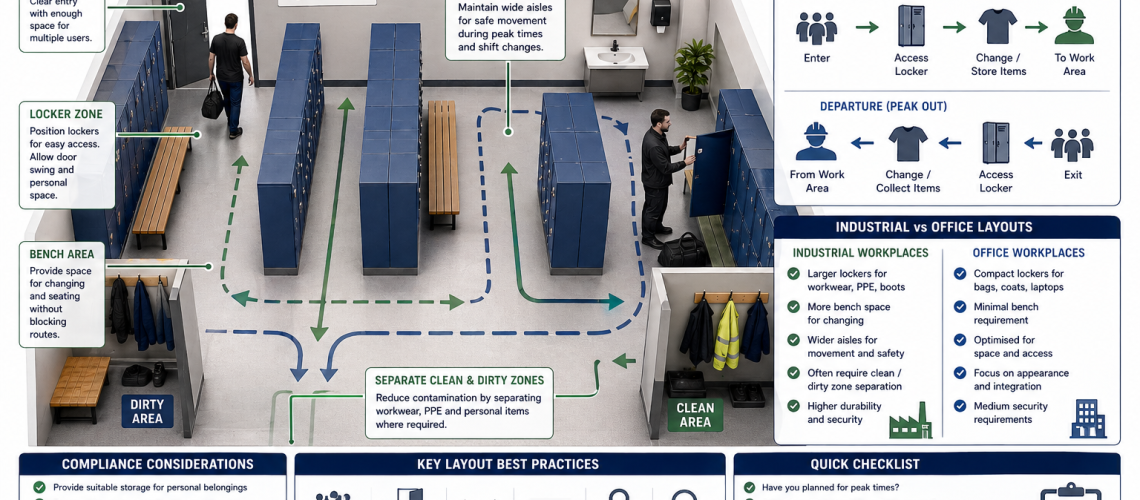
A poor locker room layout can make a space feel cramped, unsafe and difficult to use, even when the room has enough lockers. The most common problems are narrow aisles, locker doors clashing, benches blocking access, poor circulation routes and layouts that only work when the room is empty.
This guide owns the failure-mode and correction side of locker-room planning. It identifies common layout problems, explains why they occur and shows what should be changed before installation. It does not replace the full room-layout method or specialist clearance calculations.
For the complete layout process, use Locker Room Layout Planning UK. For detailed aisle calculations, use Locker Aisle Width Guide UK. For door opening space, use Locker Door Clearance Guide UK. For constrained rooms, use Small Locker Room Design UK.
This page should be used after the basic room and storage requirement are understood. It is a diagnostic guide for layouts that risk congestion, clashes or poor usability.
What This Page Owns, and What It Hands Off
| Question | Owner |
|---|---|
| What common layout problems should we look for? | This guide |
| What is likely causing congestion, clashes or blocked access? | This guide |
| What practical layout correction should be tested? | This guide |
| How should the complete locker room be planned? | Locker Room Layout Planning UK |
| What detailed aisle allowance is appropriate? | Locker Aisle Width Guide UK |
| What detailed door-opening clearance is required? | Locker Door Clearance Guide UK |
| How should constrained rooms be optimised? | Small Locker Room Design UK |
| How should inclusive routes, reach and manoeuvring space be planned? | Locker Accessibility and DDA Planning UK |
| How should the agreed layout be delivered and installed? | Locker Installation Planning UK |
Why locker room layouts go wrong
Locker room layouts usually go wrong because the design focuses on locker quantity instead of usable space. A drawing may show lockers fitting neatly along a wall, but real users need space to stand, open doors, bend, sit, turn, move past others and carry belongings.
That means a locker room is not just a storage area. It is a movement space. Every locker creates activity in front of it. Every bench creates a seated-use zone. All doorways create a pause point. Every aisle becomes a shared route.
The layout must work when the room is busy, not just when it is empty. This is especially important in staff changing rooms, school locker areas, gyms and factories where many users may arrive at the same time.
The three most common locker layout mistakes
Most poor locker room layouts can be traced back to three avoidable mistakes:
- Narrow aisles that do not allow users to pass comfortably
- Door clashes caused by lockers placed too close together or opposite each other
- Benches blocking access because seating has been placed in the main movement route
These mistakes often appear together. A narrow aisle becomes worse when doors open into it. A bench becomes a bigger obstruction when users need to pass behind seated people. Opposing lockers become harder to use when two users open doors at the same time.
Mistake 1: aisles are too narrow
Narrow aisles are one of the biggest causes of poor locker room performance. A narrow aisle may look acceptable on a plan, but it can quickly fail once users start opening doors, standing in front of lockers or carrying bags.
The problem is not just walking width. Locker aisles also need to support stopping, turning, reaching and passing. A user standing in front of a locker temporarily reduces the aisle width. An open door reduces it further. If a bench, bag or shoe is also in the route, movement becomes restricted.
Signs an aisle is too narrow
- Users have to turn sideways to pass each other
- Open locker doors block the route
- People wait at the end of the aisle until others finish
- Bags and footwear regularly end up in the walkway
- Users avoid certain lockers because access is awkward
- Congestion appears during shift change, school breaks or gym peaks
Check the aisle under real use
This page should not set a universal aisle width. The correct allowance depends on locker depth, door swing, opposing runs, benches, user numbers, accessibility and the way the room is used.
- Check the route with locker doors open.
- Check the route with a user standing at the locker.
- Check whether another person can still pass.
- Check whether benches or loose belongings reduce the effective route.
- Check the busiest normal use period rather than the empty room.
Use Locker Aisle Width Guide UK for the detailed working-space calculation.
Mistake 2: locker doors clash
Locker doors need clear opening space. When lockers are placed too close to walls, benches, corners or opposing locker runs, doors can clash with objects or other users.
This can make lockers awkward to use and can damage doors, hinges, handles and nearby finishes over time. It also creates frustration because users cannot access their belongings properly.
Where door clashes usually happen
- Opposing locker runs in a narrow aisle
- Lockers placed too close to room corners
- Lockers installed beside inward-opening doors
- Locker doors opening into bench seating zones
- Low-tier lockers where users need to bend or crouch
- High-use areas where many doors open at the same time
Door clearance is not only about whether the door can physically open. It is also about whether the user can stand in a safe, comfortable position while opening it.
How to prevent locker door clashes
- Allow clear access space in front of locker doors
- Avoid tight opposing locker runs unless the central aisle is wide enough
- Keep locker banks away from entrance door swings
- Avoid placing benches directly in the door opening zone
- Check end lockers near corners, walls and partitions
- Use shallower lockers where room depth is limited
If door swing is ignored, the layout may technically fit but still fail in daily use. Use Locker Door Clearance Guide UK where the detailed opening-space relationship needs to be checked.
Mistake 3: benches block locker access
Benches are useful in changing rooms, but they are also a common cause of blocked movement. A bench is not just a narrow object on a plan. Once people sit on it, place bags beside it or remove footwear, it becomes a wider active-use zone.
When benches are placed too close to lockers, users may struggle to open doors, stand in front of compartments or move past seated people. This is especially common in small changing rooms and compact staff areas.
Bench placement problems
- Bench directly in front of locker doors
- Bench positioned in the only circulation route
- Bench too close to opposing locker runs
- Bench placed immediately inside the entrance
- Bench length too large for the room
- No allowance for bags, shoes or seated users
Better bench planning
Good bench planning separates seated changing space from main movement routes. In a small room, this may mean using a shorter bench, a wall-fixed bench, a slim bench or a layout where the bench is positioned away from the busiest locker doors.
- Keep benches away from main aisles where possible
- Allow users to sit without blocking locker doors
- Use shorter bench sections instead of one long obstruction
- Leave enough space for users to pass behind seated people
- Plan for bags and shoes as well as the bench itself
A well-placed bench improves the room. A poorly placed bench becomes the main obstruction. Use Changing Room Bench Sizes UK where bench dimensions and spacing need separate consideration.
Mistake 4: designing around the empty room
Many locker room mistakes happen because the layout is assessed while empty. Empty rooms are misleading. Lockers are closed, benches are clear and no one is moving through the space.
Real use is different. People arrive together, open doors, stand in front of lockers, talk, change, place items on benches and move between zones. A layout that looks clean when empty can become congested within minutes.
To avoid this mistake, test the layout against the busiest normal use period.
- How many people arrive at once?
- Where do they stop first?
- How many locker doors may be open at the same time?
- Where do bags and shoes go?
- Can people pass if someone is seated?
- Can users leave without crossing incoming users?
Mistake 5: placing lockers too close to entrances
Entrances are natural congestion points. People pause as they enter, look for their locker, wait for others or move from one zone to another. Placing high-use lockers immediately beside an entrance can create a bottleneck.
This is a common problem in school corridors, workplace changing rooms and gym locker rooms. The doorway becomes blocked by users accessing lockers, while others try to enter or leave.
Better entrance planning keeps the first section of the room clear, avoids locker door swing near the doorway and gives users space to move inside before stopping.
Mistake 6: dead-end aisles
Dead-end aisles can work in very low-use areas, but they cause problems in busy locker rooms. Users enter the aisle, access lockers, then turn back through the same route against incoming users.
Dead ends are especially awkward for wheelchair users, users carrying bags, and groups arriving together. If the aisle is narrow, the problem becomes worse.
Where possible, use through-routes or loop layouts. If a dead-end aisle cannot be avoided, keep it wider, limit the number of high-use lockers within it and provide turning space where needed.
Mistake 7: ignoring accessibility
Accessibility should be considered from the start, not added after the locker layout is fixed. An accessible locker is not truly accessible if the aisle is too narrow, the route is blocked, the lock is too high or the user cannot turn safely.
Accessible locker planning should consider clear approach routes, manoeuvring space, locker reach, lock operation, bench obstruction and door swing. These requirements should be resolved from the actual users, room and project rather than by applying one figure universally.
For detailed inclusive-layout guidance, use Locker Accessibility and DDA Planning UK.
Mistake 8: using the wrong locker depth
Locker depth affects both storage capacity and room usability. Deeper lockers provide more internal space, but they also reduce the aisle width. In a tight room, this can turn a workable layout into a cramped one.
Before choosing deeper lockers, check whether the room can still provide the required clear space in front. If not, a shallower locker may create a better overall layout. Use Locker Depth Guide UK and Locker Sizes UK for the detailed product-size decision.
| Locker depth | Benefit | Layout risk |
|---|---|---|
| 300 mm | Saves floor space | Limited storage depth |
| 380 mm | Good compact option | May not suit bulky items |
| 450 mm | Common practical depth | Needs proper aisle allowance |
| 500 mm+ | Better for bulky storage | Can reduce movement space in small rooms |
Mistake 9: choosing the wrong locker configuration
Locker configuration should match the items being stored and the space available. A single-tier locker gives generous storage, but fewer compartments. Multi-tier lockers increase capacity, but each compartment is smaller. Z lockers can save space while still allowing hanging storage.
The wrong configuration can make a room inefficient. For example, using single-tier lockers for small personal items may waste space. Using very small compartments for bulky PPE may frustrate users.
| Need | Better locker choice | Reason |
|---|---|---|
| Coats and uniforms | Single-tier or Z lockers | Hanging space matters |
| Bags and personal items | Two-tier or three-tier lockers | Good balance of size and capacity |
| Phones and wallets | Cube lockers | Maximum small-item density |
| PPE or workwear | Larger ventilated lockers | More space and airflow may be needed |
| School storage | Two-tier or three-tier lockers | Useful capacity without overlarge compartments |
Mistake 10: poor zoning
Good locker rooms separate storage, changing and circulation where possible. Poor zoning forces all activities into the same strip of floor. This creates conflict between people opening lockers, sitting on benches and walking through the space.
The correction is to separate conflicting activities where the room allows it: keep main movement routes clear, move benches away from the busiest access zones and avoid forcing every user through the same strip of floor.
How to check a locker room layout before installation
Before installation, test the agreed layout with a simple practical review. This catches problems that are easy to miss on drawings. The installation-stage site checks themselves belong in Locker Installation Planning UK.
- Mark locker depth on the floor
- Mark bench positions and seated-use zones
- Check door swing for room doors and locker doors
- Walk the main route through the room
- Check whether two people can pass during use
- Test the busiest likely period, not the quietest
- Check accessible routes and turning space
- Allow for bags, shoes and loose items
Quick correction guide
| Problem | Likely cause | Better solution |
|---|---|---|
| Users cannot pass | Aisle too narrow | Increase aisle width or reduce locker depth |
| Doors hit other doors | Opposing lockers too close | Widen aisle or change layout |
| Bench blocks lockers | Bench in access zone | Move bench away from locker doors |
| Entrance becomes crowded | Lockers too close to doorway | Keep entrance zone clear |
| Users reverse out of aisles | Dead-end layout | Create through-route or turning area |
| Accessible lockers hard to use | Poor route or reach position | Reposition accessible lockers on a clear route |
Checklist: avoid these locker room layout mistakes
- Do locker doors open fully without hitting benches, walls or other doors?
- Is the aisle wide enough when users are standing at lockers?
- Can two users pass during normal use?
- Are benches kept out of the main circulation route?
- Is the entrance clear of high-use locker activity?
- Are dead-end aisles avoided or properly managed?
- Does the locker depth suit the room size?
- Does the locker configuration match the stored items?
- Is accessibility built into the layout from the start?
- Has the layout been tested against peak-time use?
Related Locker Room Layout Guides
- Locker Room Layout Planning UK – complete room-layout methodology.
- Small Locker Room Design UK – constrained-space layouts and capacity trade-offs.
- Locker Aisle Width Guide UK – detailed working-space calculations.
- Locker Door Clearance Guide UK – door swing and obstruction checks.
- Changing Room Bench Sizes UK – bench dimensions and spacing.
- Locker Accessibility and DDA Planning UK – inclusive reach, approach and manoeuvring space.
- Locker Depth Guide UK – depth selection where room width is constrained.
- Locker Installation Planning UK – delivery, setting out, fixing and handover.
Locker Room Layout Mistakes UK FAQs
What are the most common locker room layout mistakes?
Common problems include aisles that become blocked during use, locker doors clashing, benches obstructing access, congestion near entrances, dead-end routes, poor zoning and layouts designed only for the empty room.
Why are narrow aisles a major problem in locker rooms?
Locker aisles are used for more than walking. Users stop, open doors, turn, handle belongings and sometimes pass seated users, so a route that appears adequate when empty can become blocked during normal use.
How wide should locker room aisles be?
There is no single aisle width that suits every locker room. The required allowance depends on locker depth, door swing, opposing runs, benches, user numbers, accessibility and peak-use conditions. The detailed calculation should be completed through the dedicated aisle-planning process.
What causes locker doors to clash?
Door clashes occur when lockers face each other too closely, sit near walls or entrances, or open into benches and other active-use zones.
Why do benches block locker room flow?
A bench creates a wider active-use zone than its physical footprint because seated users, bags and footwear occupy additional space. Poor placement can therefore reduce both locker access and circulation.
What is a dead-end locker aisle?
A dead-end aisle allows access from only one direction, so users entering and leaving must use the same route. This can create congestion where the aisle is narrow or heavily used.
Should high-use lockers be placed immediately beside entrances?
Usually this should be avoided where it creates a bottleneck. Entrances already concentrate movement, so placing high-use locker activity directly beside them can interfere with people entering and leaving.
What is the key principle for correcting a poor locker room layout?
Test the room as an active-use space rather than an empty drawing. Protect movement, locker access and changing activity first, then adjust locker depth, bench position, zoning or configuration to remove the conflict.
Summary: design for movement first
The most common locker room layout mistakes are narrow aisles, door clashes and benches blocking access. These problems usually happen when the design tries to fit too many lockers into the room without protecting clear movement space.
A better layout starts with how people use the room. Users need to enter, stop, open lockers, sit, change, turn, pass others and leave without obstruction. Once those movement needs are protected, lockers and benches can be positioned around them.
The best locker room layouts are not simply the ones with the highest locker count. They are the ones that remain practical under real daily use, with door opening, movement, seated activity and peak demand considered together.
Discover more from Blog Total Locker Service
Subscribe to get the latest posts sent to your email.