What Depth Locker Do I Need? 300mm, 450mm and 600mm Locker Depths Explained
April 30, 2026
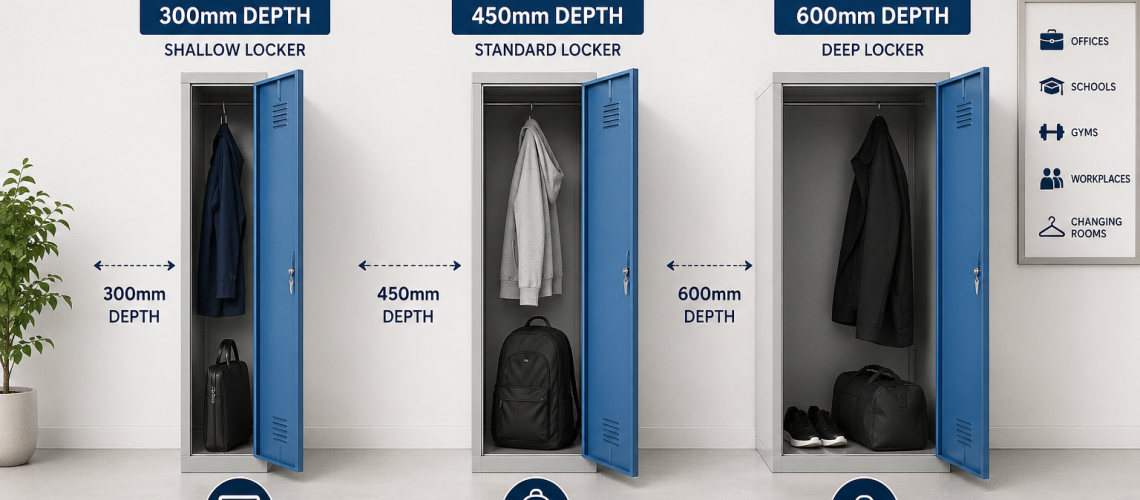
Locker depth determines both how much users can store and how far the locker projects into the room. A shallow locker saves floor space but provides less internal capacity. A deeper locker holds larger bags, coats, workwear and PPE but can reduce aisle width and make a small room difficult to use.
For most UK commercial locker projects, the main depths to compare are approximately 300 mm, 450 mm and 600 mm. The correct choice depends on what users actually store, the available room width, door movement, benches and how busy the locker area becomes at peak times.
This guide compares shallow and deep lockers for schools, workplaces, offices, gyms, changing rooms, factories and warehouses and explains how locker depth affects storage, room projection, aisle space and everyday usability.
For overall locker dimensions and compartment sizes, see our Locker Sizes UK guide. To compare current products and exact manufacturer dimensions, browse our commercial lockers.
Quick Answer: What Depth Locker Do I Need?
| Locker depth | Best for | Main advantage | Main limitation |
|---|---|---|---|
| 300 mm | Small items, compact offices, restricted rooms and personal storage | Lowest projection into the room | Limited capacity for bulky belongings |
| 450 mm | General schools, workplaces, offices and staff storage | Good balance of capacity and room space | May not suit bulky PPE or large bags |
| 600 mm | Coats, workwear, PPE, boots, sports bags and industrial changing | Greater internal storage depth | Uses considerably more room depth |
Choose the shallowest locker that comfortably accommodates the belongings users genuinely need to store.
What Does Locker Depth Mean?
Locker depth is the front-to-back measurement of the cabinet. It determines how far the closed locker projects from the wall or locker row.
Depth affects two things simultaneously:
- the usable storage available inside the locker;
- and the amount of floor space remaining in front of it.
A deeper locker can accommodate larger belongings, but those extra millimetres come directly out of the usable room width.
Locker Depth Is Different From Width and Height
| Dimension | What it controls |
|---|---|
| Height | Vertical storage and compartment configuration |
| Width | Side-to-side storage space and wall capacity |
| Depth | Front-to-back storage and projection into the room |
A locker can therefore be tall but shallow, or relatively small in height while still being deep.
300mm Deep Lockers
A 300 mm locker is relatively shallow and is particularly useful where conserving room depth is important.
Typical uses include:
- phones and wallets;
- documents;
- small personal items;
- small bags;
- visitor storage;
- compact office storage;
- narrow staff areas;
- and locations where projection must be minimised.
Advantages of 300mm lockers
- Preserve more usable floor area.
- Useful in narrow rooms.
- Reduce projection into circulation areas.
- Can work well for light personal storage.
- Allow more flexibility where room width is restricted.
Limitations of 300mm lockers
- Large backpacks may not fit comfortably.
- Bulky coats can be difficult to store.
- Work boots and PPE can require greater depth.
- Sports bags may be unsuitable.
- Users may leave oversized items outside the locker if the compartment is too small.
Do not choose a shallow locker purely because the room is tight if users genuinely need larger storage.
450mm Deep Lockers
Around 450 mm is a useful general-purpose depth for many UK locker installations. It provides substantially more internal space than a shallow locker while avoiding the full projection of a 600 mm cabinet.
It commonly suits:
- schools;
- offices;
- general workplaces;
- staff rooms;
- dry changing rooms;
- warehouses;
- leisure facilities;
- and multi-tier personal storage.
Advantages of 450mm lockers
- Good capacity for everyday bags and clothing.
- Moderate projection into the room.
- Available across many locker ranges.
- Useful for mixed user groups.
- Works with many single-tier and multi-tier configurations.
When 450mm may not be enough
Users storing thick winter coats, large work bags, helmets, extensive PPE or bulky workwear may require a deeper or more specialised locker.
600mm Deep Lockers
A 600 mm locker provides considerably more front-to-back storage and can suit applications where users need to store bulky belongings.
Typical uses include:
- industrial changing rooms;
- factories;
- warehouses;
- PPE storage;
- workwear;
- large coats;
- sports kit;
- boots;
- and larger bags or equipment.
Advantages of 600mm lockers
- Greater capacity for bulky items.
- More practical for workwear and PPE.
- Useful where users change clothing.
- Can accommodate larger bags and equipment.
The main disadvantage
Projection into the room is substantially greater. In a narrow room, that extra depth can reduce circulation, interfere with benches and make opposing locker rows difficult to use.
300mm vs 450mm vs 600mm Lockers
| Requirement | 300 mm | 450 mm | 600 mm |
|---|---|---|---|
| Phones and valuables | Excellent | More than required in many cases | Usually excessive |
| Small bags | Possible | Excellent | Excellent |
| School books and bags | Depends on bag size | Good | Often unnecessary |
| Coats | Limited | Good | Very good |
| Large backpacks | Limited | Usually good | Very good |
| PPE and boots | Poor | Depends on equipment | Good |
| Small rooms | Excellent | Good | Requires careful planning |
| Industrial changing | Usually too shallow | Possible | Often strong choice |
Start With What Users Need to Store
The best way to choose locker depth is to examine the actual belongings rather than starting with catalogue dimensions.
- phones;
- wallets;
- handbags;
- backpacks;
- laptop bags;
- coats;
- uniforms;
- safety boots;
- PPE;
- sports bags;
- helmets;
- and work equipment.
Where possible, measure representative items. This is more reliable than assuming a particular depth will be sufficient.
Shallow vs Deep Lockers
The decision between shallow and deep lockers is fundamentally a trade-off between storage capacity and room space.
| Shallow lockers | Deep lockers |
|---|---|
| Use less floor depth | Provide more internal storage |
| Help protect aisle width | Better for bulky belongings |
| Useful in small rooms | Useful for PPE and changing rooms |
| Can increase layout flexibility | Can reduce circulation space |
| Risk being too small | Risk being larger than necessary |
The correct choice is not automatically the deepest locker. It is the depth that provides enough storage without creating unnecessary problems elsewhere in the room.
How Locker Depth Affects Room Space
Every additional millimetre of locker depth reduces the remaining room width by the same amount.
For example, replacing a 300 mm locker bank with 600 mm lockers adds 300 mm of projection from that wall.
If lockers are positioned on both sides of the room, increasing both runs from 300 mm to 600 mm uses an additional 600 mm of the room width.
This can materially change whether the central aisle, benches and open locker doors can function comfortably.
Locker Depth and Aisle Width
Locker depth directly affects the clear floor area remaining in front of the lockers.
A basic single-sided planning relationship is:
Total room depth required = locker depth + required working and circulation space.
If a 450 mm locker is used with 1200 mm of planned clear space, the combined depth is:
450 mm + 1200 mm = 1650 mm.
A 600 mm locker with the same clear space requires:
600 mm + 1200 mm = 1800 mm.
The required clear space itself depends on the actual room, users and activity. For the dedicated subject, see our Locker Aisle Width Guide UK.
Locker Depth and Door Clearance
Locker depth and locker door clearance are related but they are not the same measurement.
- Locker depth is how far the cabinet projects into the room.
- Door clearance is the space required for the door to open and for a user to access the compartment.
A shallow locker can still have a relatively wide door. A deep locker may use several narrow compartment doors. Both factors should therefore be checked separately.
For the specialist measurement, see our Locker Door Clearance Guide UK.
Opposing Locker Rows
Depth becomes particularly important where lockers face each other.
The available room width has to accommodate:
- the first locker bank;
- the central working and circulation area;
- and the second locker bank.
Deeper lockers on both sides can quickly consume the usable central space.
Do not calculate the central aisle only with every locker door closed. Consider users standing at both sides and doors being opened simultaneously.
Locker Depth and Benches
Changing-room benches create another occupied zone within the room.
A layout containing deep lockers and central benches must provide space for:
- locker projection;
- open locker doors;
- standing users;
- bench depth;
- seated users;
- and people moving through the remaining route.
For detailed bench positioning, see our Bench Layout and Spacing Guide.
Locker Depth for Small Rooms
Small rooms are where shallow lockers provide the greatest planning advantage.
Consider a shallower locker where:
- the room is narrow;
- circulation space is limited;
- lockers sit beside an important route;
- benches already occupy significant floor area;
- users only need compact personal storage;
- or deeper lockers would create door clashes.
However, reducing depth only works if the resulting compartment remains useful.
Locker Depth for Schools
School locker depth should reflect pupil age, bag size, stored books, PE kit and the location of the locker bank.
Around 300 mm can work for compact storage where projection must be minimised. Around 450 mm often provides more practical everyday storage for bags and school belongings.
600 mm lockers require substantially more room and are normally justified only where the stored items genuinely require the additional depth.
Where lockers are positioned in corridors, projection and user congestion are particularly important.
For the wider specification, see our School Lockers UK guide.
Locker Depth for Offices
Many office users primarily need space for bags, laptops, coats and small personal items.
Around 300 mm may work for compact day storage. Around 450 mm gives greater flexibility for normal bags and clothing.
600 mm may be appropriate where staff store larger coats, cycle equipment, uniforms or other bulky items, but it is often unnecessary for ordinary personal storage.
Locker Depth for Workplaces
Workplace storage varies considerably between offices, warehouses, factories and staff changing facilities.
For general staff belongings, around 450 mm is a useful starting point. Industrial users with PPE, boots, workwear and larger equipment may benefit from 600 mm or specialist lockers.
Always base the decision on what employees actually bring to work and need to store during the shift.
For the wider environment, see our Workplace Lockers UK guide.
Locker Depth for Factories and Warehouses
Factories and warehouses often require deeper storage because users may need room for:
- workwear;
- PPE;
- boots;
- heavy coats;
- large bags;
- uniforms;
- and small work equipment.
450 mm may be sufficient for lighter requirements, while 600 mm can provide useful additional capacity where bulky items are involved.
Locker depth should still be balanced against shift-change congestion and available changing-room space.
Locker Depth for Gyms and Leisure Centres
Gym users typically store clothing, footwear, towels and bags. Around 300 mm may work for compact valuables storage, while around 450 mm provides greater flexibility for ordinary changing-room use.
Very deep lockers should only be specified where the stored items justify the extra projection.
Locker Depth for Changing Rooms
Changing rooms generally require more internal storage than simple personal-effects areas because users may store coats, clothing, footwear and bags.
450 mm and 600 mm lockers are therefore common possibilities, but the final choice should be checked against:
- bench positions;
- aisle width;
- door swing;
- opposing locker rows;
- peak user numbers;
- and whether users change clothing directly in front of the locker.
Locker Depth for PPE and Workwear
PPE is one of the strongest reasons to consider deeper lockers, particularly where employees store several pieces of equipment together.
Before simply selecting 600 mm depth, identify:
- the largest item;
- whether garments need to hang;
- whether boots are stored;
- whether clean and dirty clothing must be separated;
- whether equipment needs shelves;
- and whether specialist PPE lockers would work better than a standard deep locker.
Depth vs Locker Configuration
Depth does not solve every storage problem. Height, width and compartment configuration matter as well.
For example:
- a deep six-tier compartment may still be too short for a coat;
- a shallow full-height locker may provide hanging space but insufficient bag depth;
- a Z locker can provide hanging space for multiple users without simply increasing depth;
- and specialist garment lockers may provide better workwear organisation than a standard single-tier locker.
For the broader comparison, see our Locker Sizes and Dimensions Guide UK.
Internal Depth vs External Depth
Do not assume that a nominal external depth is the same as the usable internal storage depth.
Internal space can be affected by:
- door construction;
- rear panels;
- shelves;
- hooks;
- garment rails;
- internal partitions;
- electronic lock bodies;
- and other internal fittings.
Check the manufacturer’s internal dimensions where fit is critical.
Locker Depth and Accessible Use
Depth also affects the usable approach to accessible lockers.
A deeper cabinet can reduce:
- clear approach space;
- turning room;
- the space available beside benches;
- and usable circulation routes.
Accessibility should be considered as part of the complete room layout, including reach, lock operation, door movement and approach space.
When Shallow Lockers Are Better
- Users only store compact belongings.
- The room is narrow.
- The lockers form part of a circulation area.
- Protecting aisle width is important.
- Large bags, PPE and coats are not required.
- More floor area is needed for benches or movement.
When Deep Lockers Are Better
- Users store large bags.
- PPE or workwear needs more space.
- Boots or helmets are stored.
- Coats and uniforms require practical storage.
- Industrial or changing-room use justifies the capacity.
- The room has enough width to accommodate the extra projection.
When Deep Lockers Cause Problems
- Aisles become too narrow.
- Locker doors clash with benches.
- Opposing rows leave insufficient central space.
- Users cannot pass comfortably at peak times.
- Accessible circulation is reduced.
- The extra storage capacity is not actually needed.
A Simple Locker Depth Planning Method
- List everything users need to store.
- Measure representative bags, PPE and equipment.
- Decide whether hanging storage is required.
- Choose a preliminary depth.
- Measure the locker projection within the room.
- Add door movement and standing-user space.
- Add benches where required.
- Check opposing locker rows.
- Check circulation and accessible use.
- Reduce or increase depth if the proposed arrangement does not work.
- Confirm exact manufacturer dimensions before ordering.
Common Locker Depth Mistakes
- Choosing the deepest locker available because it appears better value.
- Choosing shallow lockers only to maximise floor space.
- Ignoring actual bag and equipment sizes.
- Confusing locker depth with locker door clearance.
- Ignoring open locker doors.
- Ignoring benches.
- Ignoring opposing locker rows.
- Assuming external depth equals internal usable depth.
- Using 600 mm lockers where 450 mm would comfortably meet the requirement.
- Using 300 mm lockers for bulky workplace storage.
- Ignoring accessible circulation.
- Choosing depth without considering locker configuration.
Locker Depth Checklist
- What is the largest item being stored?
- Are coats stored?
- Are large bags stored?
- Are boots, helmets or PPE stored?
- Do garments need to hang?
- How much room width is available?
- Are lockers on one or both sides?
- Are benches included?
- How wide are locker doors?
- Can users stand comfortably in front of the lockers?
- Can people pass when lockers are being used?
- Is accessible approach space maintained?
- What are the actual internal dimensions?
- Does a specialist locker solve the storage requirement better?
Related Locker Size and Layout Guides
- Locker Sizes UK – height, width, depth and configurations.
- Locker Aisle Width Guide UK – space in front of locker banks.
- Locker Door Clearance Guide UK – door swing and working clearance.
- Locker Room Layout Planning Guide UK – complete room arrangement.
- Bench Layout and Spacing Guide – seating and locker clearances.
- Workplace Locker Layout Guide UK – staff and shift-use planning.
- Commercial Lockers – current products and exact dimensions.
Locker Depth FAQs
What is the best general locker depth?
Around 450 mm is a useful starting point for many general school and workplace applications because it balances internal storage with room projection. The correct depth should still be based on the items being stored and available space.
What are 300mm deep lockers suitable for?
Around 300 mm depth is useful for compact personal storage, small bags, phones, documents and rooms where projection must be minimised. It may be too shallow for bulky coats, PPE or large bags.
What are 600mm deep lockers suitable for?
Around 600 mm depth can suit workwear, PPE, boots, coats, sports bags and other bulky items where the room has sufficient space for the extra projection.
Are shallow lockers better for small rooms?
They can be. Shallower lockers preserve more floor space and can help maintain circulation in compact rooms, provided the compartments remain large enough for the belongings users need to store.
Does locker depth affect aisle width?
Yes. A deeper locker projects further into the room and therefore reduces the clear space remaining in front of the locker bank unless the room itself is wider.
Is locker depth the same as door clearance?
No. Locker depth is the front-to-back size of the cabinet. Door clearance is the working space required for the locker door to open and for a user to access the compartment.
Are 450mm lockers deep enough for bags?
They are suitable for many everyday bags, but bag dimensions vary considerably. Where fit is important, measure representative bags and compare them with the actual internal compartment dimensions.
Should I choose the deepest locker that fits?
Not necessarily. Extra depth is useful only when users need the additional storage. Unnecessary depth consumes floor space and can reduce aisle width and room usability.
Choose Locker Depth Around Storage and Space
The correct locker depth balances two competing requirements: users need enough internal storage, while the room needs enough space for access and movement.
Use shallow lockers where belongings are small and floor space is limited. Around 450 mm provides a strong general-purpose starting point for many projects. Consider deeper 600 mm lockers where coats, PPE, boots, workwear or large bags genuinely need the additional capacity.
Then test that decision against aisle width, open doors, benches, opposing locker rows and peak-time use before placing the order.
Browse our commercial locker range, or call 01284 749211 or email sales@totallocker.co.uk for help matching locker dimensions to your available space.
Discover more from Blog Total Locker Service
Subscribe to get the latest posts sent to your email.