Locker Layout Mistakes to Avoid
April 30, 2026
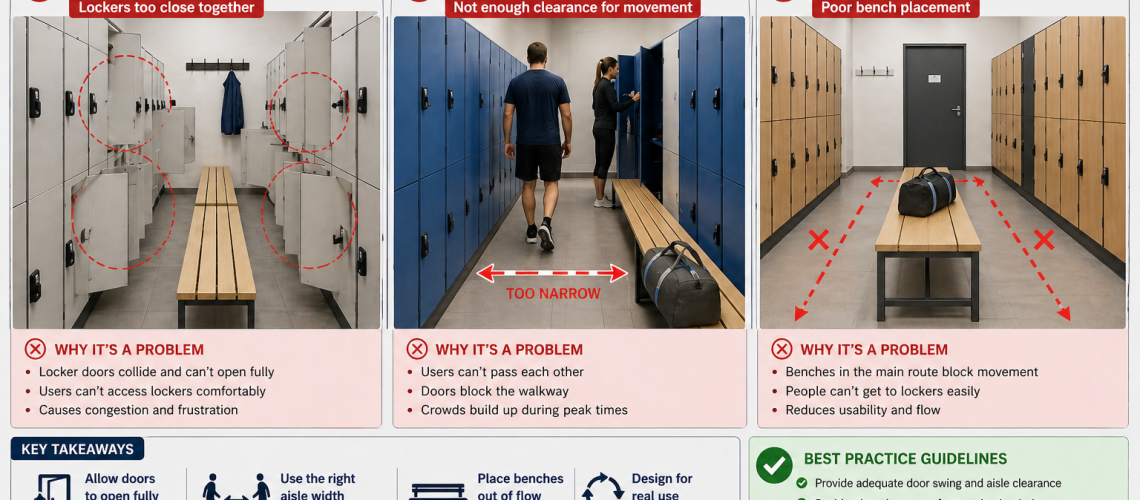
Locker layout mistakes usually come from treating lockers as static furniture instead of active-use spaces. In reality, lockers create movement, door swing, queues, changing activity and shared use. If the layout does not account for this, the space quickly becomes congested, awkward or unsafe.
This guide highlights the most common locker layout mistakes, including door clashes, narrow aisles and poor bench placement, and shows how to avoid them in workplaces, schools, gyms and changing rooms.
For correct spacing, read our minimum space for lockers guide. For movement planning, see the traffic flow guide. For full layouts, use the locker layout planning guide.
Not sure which wider storage system you need? Start with our types of storage systems guide.
Why locker layouts fail in real use
Most locker layout mistakes can be avoided by starting with the locker planning guide. For the wider product and category overview, use the lockers UK guide.
A locker room can look well planned on paper but fail when people actually use it. This happens because drawings often show closed doors and empty space, while real use includes open doors, people standing, turning, bending, sitting and moving at the same time.
Most layout problems appear during peak use, such as shift changes, school break times or gym class changeovers.
Mistake 1: Locker doors clashing
Locker doors need space to open. When lockers are placed too close together, or opposite each other in a narrow aisle, doors can collide with other doors, walls, benches or people.
This is one of the most common and disruptive layout problems.
What causes door clashes?
- Opposing lockers in a narrow aisle
- Locker doors opening into circulation routes
- Benches placed directly in front of lockers
- Doors opening near entrances or corners
- Using full-depth lockers in tight rooms
How to avoid door clashes
- Allow enough clear space in front of lockers
- Avoid opposing locker runs unless the aisle is wide enough
- Keep lockers away from entrances and pinch points
- Position benches outside of door swing zones
- Use shallower lockers where space is limited
Door clearance is not optional. If doors cannot open properly, the lockers cannot be used properly.
Mistake 2: Aisles that are too narrow
Narrow aisles are one of the main reasons locker rooms feel cramped. Even if users can technically walk through the space, narrow aisles become blocked as soon as someone opens a locker or stops to use it.
This problem is often caused by trying to maximise locker numbers at the expense of usable space.
What happens in a narrow aisle?
- Users cannot pass each other comfortably
- Open locker doors block the route
- People stand in doorways while accessing lockers
- Queues form during peak times
- Users avoid the space because it feels cramped
How to fix narrow aisles
- Increase the clear space in front of lockers
- Reduce locker depth where possible
- Use a single-sided layout instead of opposing lockers
- Choose multi-tier lockers to reduce wall length
- Remove unnecessary furniture from circulation routes
A slightly wider aisle often improves the space more than adding extra lockers.
Mistake 3: Benches blocking flow
Benches are useful in changing areas, but they are also one of the main causes of congestion. A seated user takes up more space than a standing user, and bags, shoes and clothing often spread into the surrounding area.
If a bench is placed in the wrong position, it can block both locker access and the main circulation route.
Common bench layout problems
- Bench directly in front of locker doors
- Bench placed in the only walkway
- Bench between opposing lockers without enough clearance
- Full-length benches in small rooms
- No space for people to move around seated users
How to position benches correctly
- Keep benches out of main circulation routes
- Allow space around benches for movement
- Use shorter or segmented bench runs
- Consider wall-mounted or slim bench designs
- Separate changing zones from movement routes
In small locker rooms, bench placement often determines whether the layout works or fails.
Mistake 4: Blocking entrances and exits
Entrances and exits are natural pause points. Users often stop there to wait, check belongings or decide where to go. If lockers or benches are placed too close to these areas, congestion builds quickly.
- Keep doorways clear of locker door swing
- Avoid placing busy lockers beside entrances
- Allow space for users to pause without blocking others
- Maintain a clear route in and out of the room
Mistake 5: Dead-end layouts
Dead-end aisles force users to enter, stop and then turn around or reverse out. This becomes a problem in busy areas where people are moving in both directions.
In small or low-use spaces, this may be acceptable. In busy locker rooms, it creates congestion and delays.
- Use through-routes or loop layouts where possible
- Avoid placing high-use lockers at the end of a dead-end
- Provide turning space where dead ends cannot be avoided
Mistake 6: Designing for empty space, not real use
The biggest mistake is designing for an empty room. In real use, lockers are opened, people stand in front of them, bags are placed on the floor and multiple users arrive at the same time.
A layout that works when empty may fail during peak use.
Always ask:
- What happens during the busiest time of day?
- How many users will access lockers at once?
- Can people pass each other when doors are open?
- Is there space to stand, turn and move?
Quick checklist: avoiding locker layout mistakes
- Are locker doors able to open fully?
- Is there enough aisle space for users to pass?
- Are benches clear of the main route?
- Are entrances and exits unobstructed?
- Does the layout work during peak use?
- Are dead-end aisles avoided or managed?
- Is locker depth suitable for the room size?
- Have accessibility needs been considered?
Explore storage systems by use case
- Workplace storage systems UK
- Industrial storage systems UK
- School storage systems UK
- Care home storage systems UK
- Storage access control guide UK
- Storage system planning checklist UK
FAQ: Locker Layout Mistakes to Avoid UK Guide
What is the most common locker layout mistake?
The most common issue is not allowing enough usable space. This leads to door clashes, blocked aisles and poor movement, especially during busy periods.
Why do locker doors clash in bad layouts?
Door clashes happen when lockers are placed opposite each other in narrow aisles, benches sit too close to lockers, doors open into walkways or entrances, or there is not enough clearance for full door opening.
How wide should locker room aisles be to avoid problems?
As an early guide, allow 900 mm for light use only, 1200 mm for practical everyday layouts and 1500 mm or more for busy areas. If lockers face each other, the aisle should be wider to allow for door opening and passing users.
Why are narrow aisles a problem?
Narrow aisles block movement when doors open, prevent users passing each other, create queues during peak times and make the space feel cramped.
How do benches cause congestion in locker rooms?
Benches create seated-use areas. When placed badly, they block locker doors, reduce aisle width, force users into the same space and create obstacles during busy periods.
Where should benches be placed in a locker room?
Benches should be positioned away from main walkways, clear of locker door swing, sized appropriately for the room and located in defined changing zones.
What is a dead-end locker layout and why is it a problem?
A dead-end layout forces users to walk in and then turn back. In busy areas, this creates congestion and conflict between users moving in opposite directions.
Should lockers be placed near entrances?
No. Entrances are natural congestion points. Placing lockers too close can block access and cause crowding. Keep entry and exit routes clear.
How can you fix a poor locker layout without replacing everything?
You can often improve the space by moving benches, clearing walkways, reducing obstructions, reassigning locker use and adjusting layout flow.
Why do locker layouts fail during peak times?
They often fail because they are designed for empty conditions. During peak use, multiple users access lockers at once, doors are open, and people stand and move in the same space.
Is it better to have fewer lockers with more space?
In most cases, yes. A slightly lower locker count with proper spacing creates a more usable, safer and more efficient space.
What is the key principle to avoid layout mistakes?
Design for movement first, storage second. If people can move easily, access lockers and avoid congestion, the layout will work in practice.
Summary: avoid the common failures
Most locker layout problems come down to three issues: doors that cannot open properly, aisles that are too narrow and benches that block movement. These problems are easy to overlook but have a major impact on how the space works.
The best locker layouts protect movement space first, then fit lockers and benches around it. If users can move freely, access lockers easily and avoid congestion, the layout will work in practice.
Discover more from Blog Total Locker Service
Subscribe to get the latest posts sent to your email.