Medical Cabinets vs Lockers, COSHH Cabinets and Safes UK: Which Storage Should You Use? (2026 Guide)
May 6, 2026
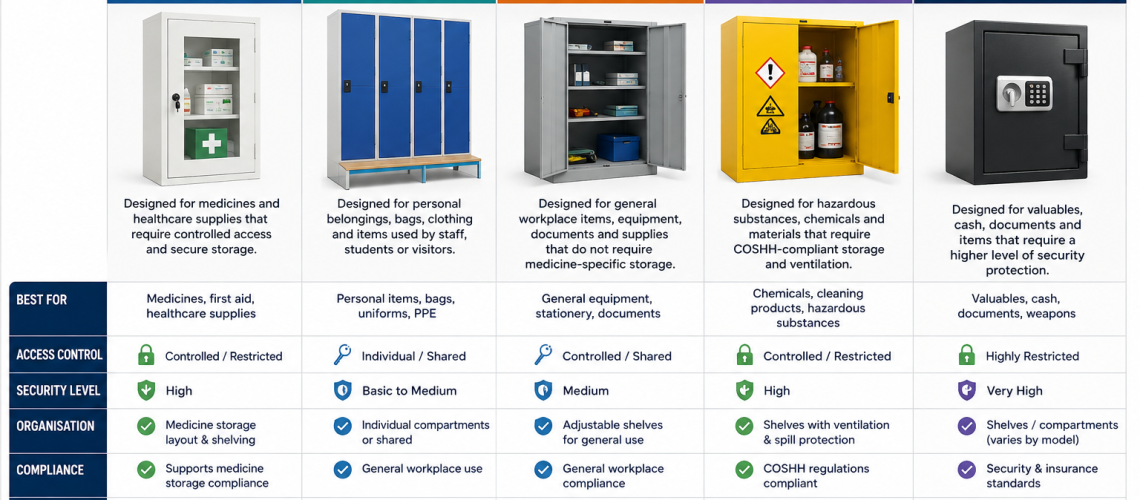
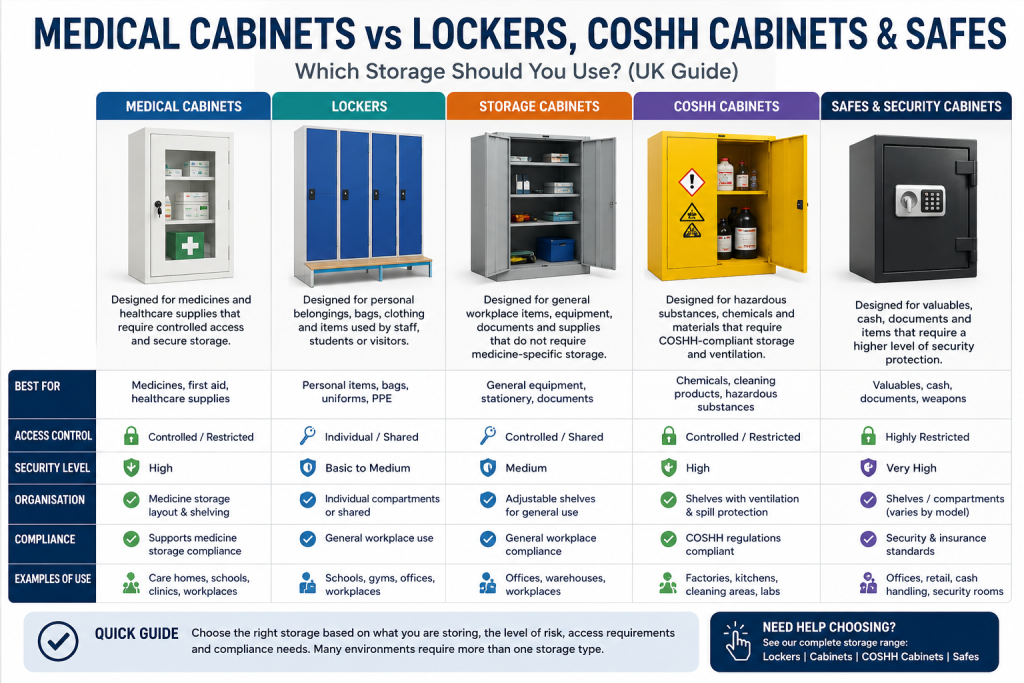
Medical cabinets, lockers, COSHH cabinets, storage cabinets and safes are used for different storage risks. This guide helps you choose the correct storage type based on what you are storing, who needs access and the level of control required.
Quick answer: Use medical cabinets for medicines, lockers for personal belongings, COSHH cabinets for hazardous substances, storage cabinets for general items and safes for valuables or high-security storage.
This comparison supports the Medical Cabinets UK: Medicines Storage, Compliance and Security Guide. If medicines are the main item being stored, use the main guide as your starting point.
Storage types quick comparison
| Storage Type | Main Use | Access Level | Do not use for |
|---|---|---|---|
| Medical cabinets | Medicines and healthcare supplies | Controlled | Chemicals or general belongings |
| Lockers | Personal belongings | Individual or shared | Controlled medicines |
| COSHH cabinets | Hazardous substances | Restricted | Medicines or personal items |
| Storage cabinets | General workplace items | Shared | Controlled medicines or hazardous substances |
| Safes | Valuables and documents | Highly restricted | Daily medicine handling workflows |
For the main medical storage framework, see the medical cabinets and medicine storage systems guide. For wider storage systems planning across lockers, cabinets, COSHH storage and safes, use the full storage systems guide.
Choose the right storage type
How to choose the right storage in 30 seconds
- Step 1 – What are you storing? Medicines, belongings, chemicals, general equipment or valuables.
- Step 2 – Who needs access? Authorised staff, individual users or shared teams.
- Step 3 – What is the risk level? Low for general items, medium for controlled access and high for hazardous or high-value items.
- Step 4 – Choose the correct storage type. Use the routing list below.
- Medicines → medical cabinet
- Personal belongings → locker
- General equipment → storage cabinet
- Chemicals or hazardous substances → COSHH cabinet
- Valuables or sensitive documents → safe or security cabinet
| What are you storing? | Best storage route | Next step |
|---|---|---|
| Medicines and healthcare supplies | Medical cabinet | View secure medical cabinets |
| Staff belongings, bags and clothing | Locker | View lockers |
| General workplace equipment | Storage cabinet | View storage cabinets |
| Cleaning chemicals or hazardous substances | COSHH cabinet | View COSHH cabinets |
| Documents, valuables or higher-risk items | Safe or security cabinet | View safes and security cabinets |
Best option rule: choose by item first, then by access level and risk. Medicines usually need medical cabinets, personal belongings need lockers, hazardous substances need COSHH cabinets and high-value items need safes.
Choosing the wrong storage type can lead to unauthorised access, compliance issues, safety risks or loss of control over stored items. Always match storage to the item, access level and risk.
Medical cabinets vs lockers
Medical cabinets are designed for controlled storage of medicines, first aid stock and healthcare supplies. Lockers are designed for personal belongings, staff items, workwear, bags and user-assigned storage.
Where medicines are involved, the cabinet should form part of a wider medicine storage system that controls access, stock visibility and daily handling.
Use a medical cabinet when medicines or healthcare items need controlled access. Use lockers when staff, pupils, visitors or workers need personal storage.
Do not use lockers for medicines: lockers are not designed for controlled access, stock visibility or regulated medicine storage.
Medical cabinets vs general storage cabinets
General storage cabinets are useful for workplace supplies, documents, tools, stationery and equipment. Medical cabinets are more suitable when the stored items need controlled access, clear separation and medicine-specific handling.
Use storage cabinets for general workplace storage. Use medical cabinets when medicines, clinical items or healthcare supplies need restricted access and organised control as part of a medicine storage system.
Medical cabinets vs COSHH cabinets
COSHH cabinets are used for substances that may be hazardous to health, such as cleaning products, chemicals and controlled workplace substances. Medical cabinets are used for medicines and healthcare supplies.
Do not treat medicines and hazardous substances as the same storage category. If you are storing chemicals, use COSHH cabinets. If you are storing medicines, use medical storage and follow the medical storage compliance UK guide.
For workplaces that need both medicine storage and chemical storage, use storage systems planning to separate products by risk, access level and legal responsibility.
Medical cabinets vs safes
Safes and security cabinets are used for valuables, cash, documents and higher-risk items. Medical cabinets are used for controlled medicine storage and healthcare supplies. A safe may protect against theft, but it may not provide the organisation, access workflow or medicine-specific storage layout required for daily use. For the wider framework, see the medical cabinets and medicine storage systems guide.
Use safes and security cabinets for valuables, sensitive documents and security-led storage. Use medical cabinets for medicine handling, stock visibility and controlled healthcare storage, especially where the site also needs a documented medical storage compliance UK process.
When a medical cabinet is the right choice
- You need to store medicines or healthcare supplies.
- Access must be restricted to authorised staff.
- Stock needs to be organised and checked regularly.
- The cabinet supports medicine handling, audit and safe storage procedures.
- The site is a care home, clinic, school medical room, workplace first aid room or healthcare setting.
For care-home-specific use, see care home medicine storage. For controlled drugs, see controlled drug cabinet requirements. For the full medicine storage framework, return to the medical cabinets and medicine storage systems guide.
Medical cabinets should be chosen through the wider medical cabinets UK guide, especially when medicines, staff access and compliance all need to be considered together.
When not to use medical cabinets
- Use lockers when the main need is personal storage.
- Use storage cabinets when the items are general workplace supplies.
- Use COSHH cabinets when the items are hazardous substances.
- Use safes when the main risk is theft, fire protection or valuables security.
For wider product planning, connect this decision with the storage systems planning guide, especially where a site needs several storage types working together.
Common storage selection mistakes
- Using staff lockers for medicine storage.
- Using general cupboards where controlled access is needed.
- Putting hazardous substances into standard storage cabinets instead of COSHH cabinets.
- Choosing a safe when medicine visibility and daily access are more important.
- Buying storage before defining users, risk level and access control.
Build a complete storage setup
Many sites need more than one storage type. A care home may need medical cabinets, medicine trolleys and secure staff storage. A workplace may need lockers, first aid storage, COSHH cabinets and safes. A school may need pupil lockers, medical storage and secure staff cabinets.
In care settings, this wider setup should still route back to care home medicine storage so medicine access, records and stock control remain separate from staff or general storage.
- Medical cabinets for medicines and healthcare supplies.
- Lockers for staff, pupil and visitor belongings.
- Storage cabinets for general workplace items.
- COSHH cabinets for hazardous substances.
- Safes and security cabinets for valuables and documents.
Ready to choose? View secure medical cabinets, lockers, storage cabinets, COSHH cabinets and safes and security cabinets to build the correct storage setup for your site.
Explore related storage guides
- Medical cabinets and medicine storage systems guide
- Medicine storage systems UK
- Medical storage compliance UK
- Care home medicine storage
- Storage systems UK planning guide
Medical cabinets vs other storage FAQs
What is the best storage for medicines?
The best storage for medicines is usually a suitable medical cabinet or specialist medicine storage unit with controlled access, clear organisation and safe handling procedures. For full setup guidance, use the medicine storage systems guide.
Can medicines be stored in lockers?
Lockers are usually intended for personal belongings. Medicines that need controlled access should normally be stored in suitable medical cabinets or specialist medicine storage.
Can a general storage cabinet be used for medicines?
A general storage cabinet may be suitable for low-risk supplies, but medicines that need controlled access should usually be stored in a suitable medical cabinet or medicine storage unit.
What is the difference between a medical cabinet and a COSHH cabinet?
A medical cabinet is used for medicines and healthcare supplies. A COSHH cabinet is used for hazardous substances such as chemicals, cleaning products and materials that need COSHH-compliant storage.
When should you use a safe instead of a medical cabinet?
Use a safe when the main concern is theft protection, valuables storage or document security. Use a medical cabinet when the main need is controlled medicine storage, organisation and safe healthcare access.
What storage is best for workplaces?
Most workplaces need a mix of storage types, such as lockers for staff belongings, cabinets for general items, COSHH cabinets for hazardous substances and safes for valuables or documents.
Next step
Need secure medicine storage? View our secure medical cabinets, or return to the medical cabinets and medicine storage systems guide for the full medical storage framework.
Discover more from Blog Total Locker Service
Subscribe to get the latest posts sent to your email.