Types of Storage Systems in the UK: Lockers, Cabinets, Safes and More
April 28, 2026
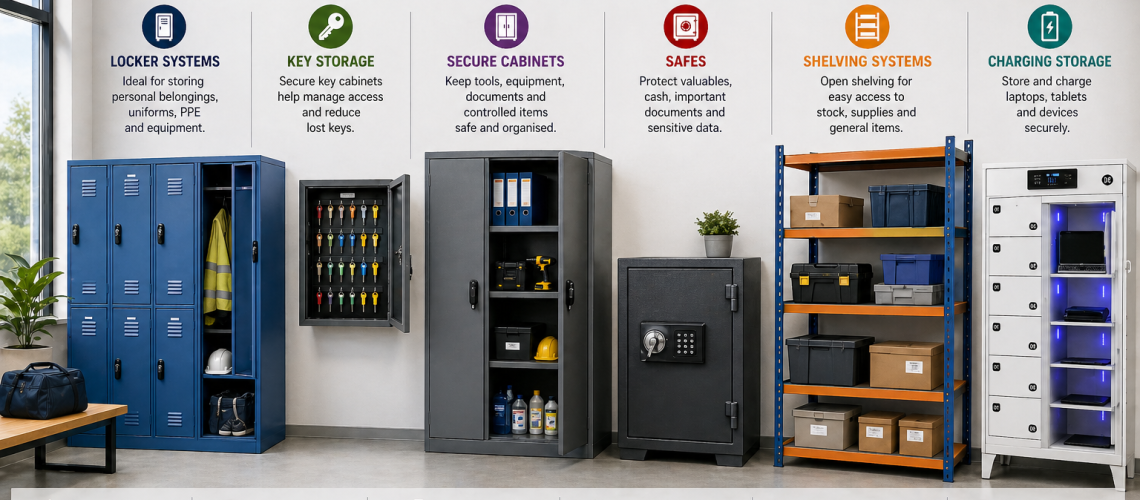
Storage systems in the UK include lockers, cabinets, safes, key storage, charging lockers, filing storage, shelving and specialist secure storage. The right choice depends on what needs to be stored, who needs access, the level of risk, the environment and how the storage will be managed day to day.
This guide is the main Total Locker Service guide to choosing storage systems for UK workplaces, schools, healthcare sites, leisure facilities, offices, warehouses and industrial environments. It explains the principal types of storage, compares their uses and security requirements, and links to the detailed guides needed for more specialised decisions.
What is a storage system?
A storage system is a planned way of organising, protecting and controlling access to physical items. The storage unit itself is only one part of the system. A practical installation also considers locking, positioning, users, identification, capacity and ongoing management.
| Component | What it includes | Why it matters |
|---|---|---|
| Storage unit | Lockers, cabinets, cupboards, safes, shelving or specialist storage | Provides the physical storage space |
| Locking method | Keys, combination locks, digital locks, padlock fittings or managed electronic access | Controls who can gain access |
| User access | Assigned users, shared users, managers or restricted groups | Prevents confusion and uncontrolled access |
| Layout | Position, aisles, door clearance and user movement | Determines whether the system works in daily use |
| Identification | Numbers, labels, key tags and asset records | Improves accountability and maintenance |
| Management | Key issue, inspections, cleaning, audits and reviews | Keeps the system effective after installation |
Start with the item being stored
The most reliable way to choose storage is to begin with the item rather than a particular product. Different contents create different requirements for dimensions, security, access, environmental resistance and management.
| What needs storing? | Typical storage solution |
|---|---|
| Staff belongings, clothing and bags | Workplace lockers |
| Pupil bags and personal items | School lockers |
| Keys, fobs and access cards | Key cabinet or controlled key-storage system |
| Tools and shared equipment | Secure cabinet, industrial storage or locker |
| Cash and valuables | Safe or higher-security cabinet |
| Documents and records | Filing cabinet, secure cabinet or fire-resistant storage |
| Medicines and healthcare supplies | Suitable medical cabinet or controlled medical storage |
| Hazardous substances | Appropriate specialist cabinet such as COSHH storage |
| Laptops, tablets and powered devices | Charging locker or charging cabinet |
| General low-risk stock | Cupboard or shelving |
Main types of storage systems in the UK
1. Locker systems
Locker systems provide individual or shared compartments for personal belongings, clothing, uniforms, PPE, equipment and devices. They are widely used in workplaces, schools, gyms, leisure centres, healthcare facilities, warehouses and changing rooms.
- Single-door lockers for coats, uniforms and larger belongings
- Multi-tier lockers where several users need compact storage
- Workplace lockers for staff belongings, uniforms and PPE
- School lockers for pupils and educational environments
- Plastic or moisture-resistant lockers for wet environments
- Charging lockers for powered devices
For commercial product selection, see the Total Locker Service locker range. For staff applications, see workplace lockers.
2. Key storage systems
Key storage systems organise building keys, vehicle keys, locker keys, cabinet keys, restricted-area keys and other controlled access items. The appropriate level of control depends on what each key can open and the consequences of a key being lost or used without authorisation.
- Basic wall-mounted key cabinets
- Numbered key hooks
- Engraved or numbered key tags
- Sign-out and issue records
- Restricted management-key storage
- Electronic key-control systems where auditing is justified
See the Key Storage Systems UK guide for detailed planning.
3. Secure cabinets and cupboards
Cabinets and cupboards are generally better than individual lockers when authorised staff need shared access to equipment, PPE, documents, supplies or stock. Construction, loading capacity and locking method should reflect the contents and expected level of use.
Specialist cabinets may also be required where the contents introduce additional risks. A general storage cupboard should not automatically be treated as suitable for medicines, hazardous substances or higher-value equipment.
4. Safes
Safes are intended for smaller quantities of higher-value or sensitive items such as cash, valuables, confidential records or important documents. Different safe designs prioritise burglary resistance, fire protection, deposit handling or protection of particular contents.
A safe should be chosen according to the actual risk and contents rather than simply by external dimensions.
5. Filing and document storage
Paper records may require open filing, lockable cabinets, cupboards or fire-resistant storage depending on confidentiality, value, retention requirements and how frequently staff need access.
High volumes of records and frequently accessed documents often need a different solution from small quantities of particularly sensitive material.
6. Shelving and open storage
Shelving is efficient for low-risk items that need to remain visible and easy to retrieve. Typical applications include stockrooms, workshops, archives, maintenance areas and general supplies.
Open storage is unsuitable where individual items require restricted access unless access to the complete room or storage area is already controlled.
7. Charging storage systems
Charging lockers and charging cabinets combine secure storage with electrical charging for laptops, tablets, phones, radios, scanners, tools or other powered equipment.
Capacity, electrical supply, ventilation, cable management, access control and the equipment being charged should all be considered. For the wider subject, use the Charging Lockers UK guide or view charging locker products.
8. Medical and controlled storage
Medicines, healthcare supplies and controlled clinical items need storage appropriate to the contents, authorised users and procedures governing access. A standard locker or general-purpose cabinet should not automatically be used as a substitute for suitable medical storage.
Start with the Medical Cabinets UK guide or use the medical cabinets vs lockers, COSHH cabinets and safes comparison when deciding between storage types.
Storage systems by risk level
The value of an item is only one measure of risk. Consider whether loss, misuse or unauthorised access could create a safety, operational, privacy or security problem.
| Risk level | Typical contents | Typical approach |
|---|---|---|
| Lower | Stationery, basic supplies, low-value stock | Shelving, cupboards or general cabinets |
| Moderate | Personal belongings, PPE, tools, routine documents and shared devices | Lockers, lockable cabinets or charging lockers |
| Higher | Keys, medicines, hazardous materials, valuables, sensitive records | Purpose-selected secure or specialist storage with controlled access |
These categories are planning aids rather than formal security ratings. The actual risk should be assessed for the organisation and the specific contents.
Storage system access control
Choosing the storage unit without planning how it will be opened often creates unnecessary management problems later. Access may be controlled using ordinary keys, padlocks, mechanical combination locks, electronic PIN locks, RFID credentials or more structured electronic systems.
- Who should normally have access?
- Is the storage assigned to one person or shared?
- Does management require master or override access?
- How will lost keys or forgotten codes be handled?
- How frequently do users change?
- Does access need to be audited?
- Who controls higher-level credentials?
For a fuller comparison, use the Storage Access Control UK guide. Locker-specific options are available through replacement locker locks and replacement locker keys.
Plan the storage layout before ordering
A storage unit can fit into a measured wall space and still be impractical once doors, users and circulation are considered. Plan the complete operating space rather than using cabinet or locker dimensions alone.
- Overall unit depth
- Door opening projection
- User standing space
- Aisle and circulation width
- Opposing rows of lockers or cabinets
- Benches and seating
- Doorways and escape routes
- Cleaning and maintenance access
- Delivery route into the building
For locker-specific planning, use the Locker Planning UK guide. When depth is the main constraint, see the locker depth guide.
Storage systems by environment
The same storage product is not automatically suitable for every building. Consider moisture, cleaning, frequency of use, impact, appearance, staff numbers, access patterns and the items being stored.
- Workplace Storage Systems UK for offices, staff areas and general business facilities
- School Storage Systems UK for pupil, staff and educational storage
- Industrial Storage Systems UK for factories, warehouses and workshops
- Care Home Storage Systems UK for staff, medicines and care-facility storage
Common storage-system mistakes
- Buying the product before defining the problem. Start with users, contents, risks and available space.
- Using one storage type for everything. Personal belongings, chemicals, medicines, documents and valuables have different requirements.
- Ignoring access management. Locks create an administrative process as well as physical security.
- Choosing capacity from averages. Plan for realistic peak demand and future growth.
- Ignoring open doors and users. Nominal room dimensions do not represent an occupied storage area.
- Failing to identify units and keys. Clear numbering supports allocation, maintenance and auditing.
- Using general storage for specialist contents. Hazardous, medical or higher-risk items may need purpose-selected storage.
- Failing to review the system. Staff numbers, equipment and operating procedures change over time.
Storage system planning checklist
- List everything that needs to be stored.
- Separate personal, shared, sensitive and specialist items.
- Identify the people who require access.
- Assess the consequence of loss or unauthorised access.
- Choose an appropriate storage type.
- Select the locking or access-control method.
- Measure the available space.
- Allow for doors, users, aisles and circulation.
- Plan numbering, labels, keys and records.
- Allow sensible spare capacity.
- Check delivery and installation access.
- Plan replacement keys, locks and components.
- Review the arrangement after installation and as requirements change.
For a more detailed process, use the Storage System Planning Checklist UK.
How to choose the right storage system
A useful specification can usually be built by answering five questions:
- What is being stored? Measure representative items rather than relying on assumptions.
- Who needs access? Separate individual users, shared users and management access.
- What level of control is required? Consider the consequences of loss, theft, misuse or unauthorised access.
- Where will the storage be installed? Account for environment, room dimensions and daily user movement.
- How will the system be managed? Consider keys, codes, inspections, repairs, user changes and future expansion.
When the requirement is primarily personal storage, start with commercial lockers. When several different storage types may be suitable, compare their actual function, security and management requirements rather than selecting solely on price or appearance.
Storage systems UK: summary
There is no single best storage system for every organisation. Lockers are effective for individual belongings, cabinets for shared equipment, key-storage systems for controlled keys, safes for higher-value items, specialist cabinets for particular risks and charging products for powered equipment.
The strongest solution is normally a planned combination of products matched to the contents, users, risk, environment and available space. Good storage planning also considers access control, layout, identification, maintenance and future changes before equipment is ordered.
Need help choosing storage? Browse commercial lockers or use the specialist guides linked above to narrow the requirement before selecting a product.
Discover more from Blog Total Locker Service
Subscribe to get the latest posts sent to your email.