Locker Predictive Maintenance UK: Forecasting Faults, Wear and Replacement Needs
May 13, 2026
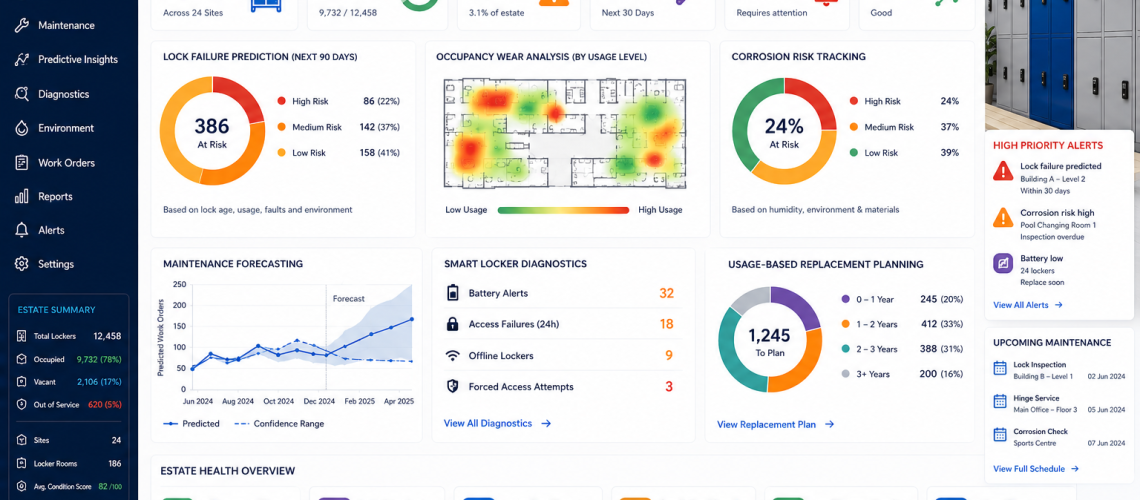
Locker predictive maintenance helps organisations move from reactive repairs to planned locker estate control. Instead of waiting for locks, hinges, doors or smart access systems to fail, facilities teams can use data to predict where maintenance is likely to be needed next.
This is important for workplaces, schools, NHS estates, leisure centres, industrial sites and multi-site facilities where locker systems support daily operations.
Modern lockers are not just storage units. They are managed assets with locations, users, lock types, maintenance histories, occupancy patterns and replacement cycles. Predictive maintenance connects these data points so facilities teams can plan repairs, reduce downtime and extend asset life.
What Is Locker Predictive Maintenance?
Locker predictive maintenance is the use of inspection data, fault records, occupancy patterns, environmental risk and smart locker diagnostics to forecast future maintenance needs.
It helps answer questions such as:
- Which locks are most likely to fail?
- Which locker banks have the highest wear?
- Which areas have corrosion risk?
- Which lockers need inspection soon?
- Which assets should be repaired, refurbished or replaced?
- Where should maintenance budgets be focused first?
Why Predictive Maintenance Matters
Many locker faults begin as small issues. A stiff lock, loose hinge, damaged cam, dented door or early sign of rust may not seem urgent. However, across a large estate, minor faults can quickly create operational disruption.
Predictive maintenance helps reduce:
- emergency repairs
- locker downtime
- lost access incidents
- unexpected replacement costs
- staff and student complaints
- security weaknesses
- reactive maintenance pressure
Maintenance Forecasting
Maintenance forecasting uses previous repair records and asset condition data to estimate future maintenance demand.
For locker estates, this may include:
- lock replacement forecasts
- hinge inspection cycles
- door alignment checks
- digital lock battery replacement
- ventilation and cleaning schedules
- planned refurbishment windows
- replacement budget forecasting
Lock Failure Prediction
Locks are one of the highest-risk components in a locker estate. A failed lock can stop access, create security concerns and increase facilities workload.
Lock failure prediction may review:
- lock age
- previous lock faults
- key loss frequency
- usage intensity
- forced access history
- electronic lock battery alerts
- known obsolete lock ranges
- environmental exposure
Where repeated failures occur, facilities teams can decide whether to repair individual locks or replace a wider lock range.
Occupancy Wear Analysis
Locker wear is rarely even across a site. Some lockers are used many times each day, while others remain empty for weeks.
Occupancy wear analysis identifies:
- high-use locker banks
- busy shared-use areas
- underused locker zones
- corridor pressure points
- hybrid workplace storage demand
- areas with repeated damage
High-use lockers may need shorter inspection cycles. Low-use lockers may be suitable for relocation, reassignment or estate rationalisation.
Corrosion Risk Tracking
Corrosion risk is a major issue in wet, humid and industrial environments.
Higher-risk areas include:
- leisure centre changing rooms
- swimming pool areas
- wet rooms
- industrial washdown spaces
- coastal buildings
- PPE drying areas
- poorly ventilated changing rooms
Predictive maintenance should track rust, bubbling paint, hinge corrosion, damp smells, lock stiffness and damaged bases before the locker bank becomes uneconomical to repair.
Environmental Monitoring
Environmental monitoring links locker condition to room conditions. This helps facilities teams understand why some areas deteriorate faster than others.
Useful environmental factors include:
- humidity
- temperature
- airflow
- water exposure
- cleaning chemical exposure
- dust levels
- salt exposure
- ventilation performance
Smart Locker Diagnostics
Smart lockers can provide diagnostic data that supports predictive maintenance.
Depending on the system, diagnostics may include:
- battery alerts
- failed access attempts
- door open warnings
- offline lock alerts
- usage logs
- controller faults
- network connection issues
- software update status
This helps facilities teams act before users lose access or locker availability falls.
Usage-Based Replacement Planning
Usage-based replacement planning is more accurate than replacing lockers by age alone. A locker bank in a busy school corridor may wear faster than one in a quiet office. A wet leisure environment may cause corrosion long before a dry workplace reaches end of life.
Replacement planning should consider:
- usage intensity
- fault frequency
- maintenance cost
- lock reliability
- condition score
- security requirement
- environmental exposure
- future access-control plans
Predictive Maintenance Data Fields
| Data Field | Maintenance Use |
|---|---|
| Locker ID | Links faults and inspections to a specific asset |
| Location | Identifies high-risk rooms, floors or buildings |
| Locker type | Supports maintenance planning by product type |
| Lock type | Tracks key, RFID, PIN or smart lock risks |
| Occupancy status | Shows whether usage may increase wear |
| Fault history | Highlights repeated issues and early failure patterns |
| Maintenance history | Shows servicing frequency and repair trends |
| Condition score | Supports repair, refurbish or replace decisions |
| Environmental risk | Flags damp, heat, corrosion or chemical exposure |
| Replacement priority | Ranks assets for future capital planning |
Predictive Maintenance Workflow
| Stage | Action | Outcome |
|---|---|---|
| Asset record | Give each locker a unique ID and location | Creates traceable data |
| Inspection | Record condition, lock status and visible damage | Builds a condition baseline |
| Fault tracking | Log repairs, failures and access issues | Identifies recurring problems |
| Usage review | Assess occupancy and turnover | Links wear to demand |
| Risk scoring | Score assets by condition, usage and environment | Ranks maintenance priorities |
| Planned action | Schedule repair, refurbishment or replacement | Reduces disruption |
Workplace Locker Predictive Maintenance
Workplaces use lockers for staff storage, hybrid working, PPE, visitor storage and shared-use systems.
Predictive maintenance supports:
- hot locker availability
- access reliability
- staff storage continuity
- cleaning schedules
- fault trend reporting
- replacement budgeting
School Locker Predictive Maintenance
School lockers often face heavy daily use, corridor congestion, lost keys and regular impact damage.
Predictive maintenance can help schools track:
- damaged doors
- lost key patterns
- lock failures
- high-use corridors
- term-end condition checks
- replacement needs by block or year group
NHS and Healthcare Locker Predictive Maintenance
NHS and healthcare estates need reliable locker infrastructure for staff changing, PPE storage and controlled access areas.
Predictive maintenance supports:
- department-level asset tracking
- high-use staff areas
- maintenance audit evidence
- lock reliability
- planned replacement
- cleaning and infection-control support
Leisure and Wet-Area Predictive Maintenance
Leisure centres, gyms and swimming facilities need strong corrosion monitoring and access reliability.
Predictive maintenance should focus on:
- humidity risk
- corrosion around locks and hinges
- coin lock wear
- RFID access faults
- door swelling or misalignment
- ventilation performance
Predictive Maintenance and CAFM Integration
Predictive maintenance becomes stronger when locker asset records are connected to CAFM systems, helpdesk workflows and facilities dashboards.
This allows locker maintenance to connect with:
- planned inspections
- work orders
- contractor allocation
- asset registers
- fault trend analysis
- multi-site reporting
- capital expenditure planning
Reactive Maintenance vs Predictive Maintenance
| Reactive Maintenance | Predictive Maintenance |
|---|---|
| Repairs lockers after failure | Forecasts faults before failure |
| Creates urgent work | Supports planned maintenance |
| Limited estate visibility | Uses data and asset history |
| Higher disruption risk | Reduces user disruption |
| Unclear budgeting | Improves lifecycle budgeting |
| Treats faults individually | Finds wider estate patterns |
Internal Links for Locker Predictive Maintenance
- Locker CAFM Integration UK
- Locker Asset Register UK
- Locker Lifecycle Management UK
- Locker Estate Audit UK
- Locker Management Systems UK
- Locker Occupancy Management Systems UK
- Smart Locker Analytics UK
- Locker Lock Replacement Guide UK
Conclusion
Locker predictive maintenance is a strong infrastructure intelligence layer for organisations that want better control over locker assets, faults, wear and replacement planning.
By combining maintenance forecasting, lock failure prediction, occupancy wear analysis, corrosion risk tracking, environmental monitoring and smart locker diagnostics, facilities teams can reduce reactive repairs and improve long-term locker estate performance.
For workplaces, schools, NHS estates, leisure centres and multi-site organisations, predictive maintenance turns lockers from isolated storage units into measurable, manageable infrastructure assets.
Discover more from Blog Total Locker Service
Subscribe to get the latest posts sent to your email.