Locker Estate Audit UK: Physical Condition, Asset Verification & Evidence
May 13, 2026
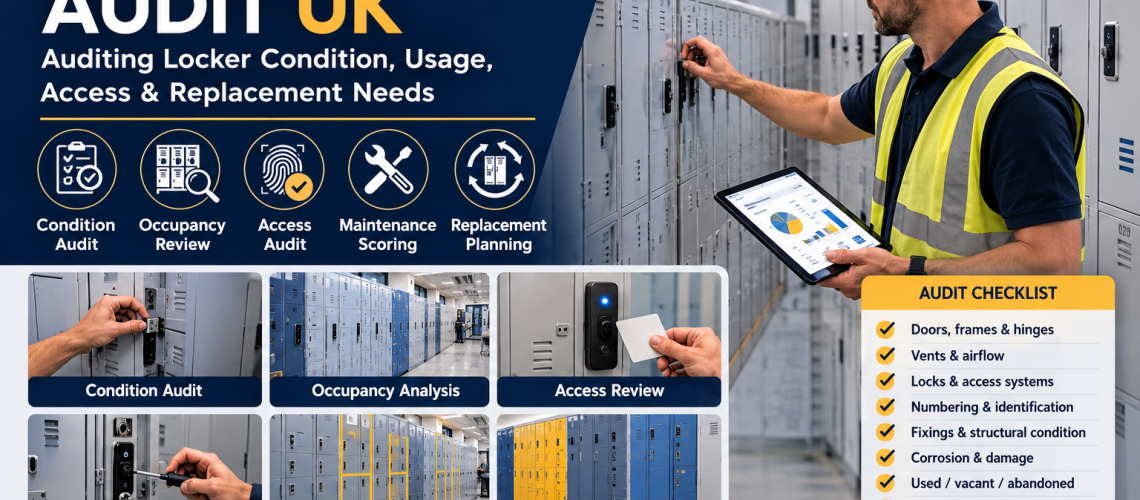
A locker estate audit is a structured physical verification of the locker estate. Its job is to establish what exists, where it is, what condition it is in, what could and could not be verified, and which findings need follow-up.
For workplaces, schools, leisure sites, healthcare estates and industrial buildings, the audit creates an evidence baseline. It can confirm quantities, locations, locker types, dimensions, materials, lock types, physical condition, numbering, usable or unavailable state, obvious access issues, cleaning or accessibility concerns and discrepancies between records and the real site.
The audit records and verifies the evidence. It does not make the specialist management decision. Repair, refurbishment, replacement, occupancy policy, access governance and future layout each have separate owners elsewhere in the locker-estate structure.
For overall locker-estate coordination, use Locker Estate Management UK. For asset IDs and register fields, use Locker Asset Register UK. For faults and initial intervention routing, use Locker Parts & Servicing. Approved refurbishment and replacement work then move into their dedicated project guides.
An audit should separate observation from decision: record the evidence first, then route the finding to the process that owns the next action.
Quick Answer: What Is a Locker Estate Audit?
A locker estate audit is a practical inspection that verifies the physical locker estate against available records. It records location, quantity, type, dimensions, material, lock type, physical condition, observed availability, identification, photographs where useful, discrepancies and evidence confidence.
| Audit area | What the audit records | Where the decision goes |
|---|---|---|
| Asset verification | Location, quantity, type, size, material and asset reference | Asset Register / Estate Management |
| Physical condition | Doors, frames, hinges, locks, fixings, corrosion and missing parts | Parts & Servicing / CAFM |
| Observed availability | Usable, unavailable, apparently occupied, apparently vacant or unknown at inspection | Occupancy Management |
| Access evidence | Lock type, visible faults, missing keys observed and whether management access can be demonstrated where appropriate | Lock / access-management process |
| Environment | Wet, dry, industrial or other conditions affecting suitability | Planning / Estate Management |
| Accessibility and cleaning | Observed barriers, reach problems, blocked access or difficult cleaning zones | Accessibility / Planning |
| Record quality | Missing IDs, conflicting records, unknown fields and evidence confidence | Asset Register / Estate Management |
Why Locker Estate Audits Matter
Lockers often grow into an unmanaged estate. New lockers are added when demand rises. Older lockers remain in place because they still appear usable. Keys are replaced. Locks are swapped. Compartments are abandoned. Some areas become overcrowded, while others are underused.
Without an audit, the organisation may not know how many lockers it has, how many are actually usable, which appear occupied at the time of inspection, which show physical defects, or whether the installed access hardware needs specialist review.
A good audit turns a scattered locker estate into managed infrastructure.
Where This Locker Estate Audit Fits
The audit is the evidence-verification layer. It should describe the physical estate accurately enough for another process to make the next decision without turning the audit itself into a maintenance manual, occupancy system, access policy or intervention model.
- Overall estate coordination: Locker Estate Management UK
- Asset IDs, QR references and register fields: Locker Asset Register UK
- Fault diagnosis and initial repair / refurbish / replace routing: Locker Parts & Servicing
- Approved refurbishment projects: Locker Refurbishment UK
- Approved replacement projects: Locker Replacement Planning UK
- Ongoing occupancy, vacancy and utilisation: Locker Occupancy Management Systems UK
- Allocation and user administration: Locker Management Systems UK
- Fault tickets and work orders: Locker CAFM Integration UK
- Failed or obsolete locks: Locker Lock Replacement Guide UK
- Key, PIN, RFID and digital access technology: Locker Access Control Systems UK
- Access roles, resets, overrides and authority: Locker Access Permissions & Governance UK
- Accessibility barriers: Accessible Locker Planning UK
- Future capacity, layout and replacement specification: Locker Planning UK
1. What Is Included in a Locker Estate Audit?
A locker audit should verify the physical estate consistently rather than simply count cabinets. The exact level of detail can vary by site, but the evidence categories should be defined before the inspection begins.
- Site, building, floor, room or zone.
- Locker-bank or asset reference.
- Number of locker units and compartments.
- Locker type and compartment configuration.
- Height, width and depth where specification evidence is required.
- Material and visible finish.
- Manufacturer or range where identifiable.
- Lock type or lock family.
- Door, frame, hinge and fixing condition.
- Corrosion, surface damage and missing components.
- Numbering and identification condition.
- Observed usable / unavailable status.
- Observed occupancy state only where it can be established without guessing.
- Obvious cleaning-access or accessibility concerns.
- Photographs where useful.
- Discrepancies between the existing record and the physical estate.
- Evidence confidence and fields that could not be verified.
- Date inspected and auditor or responsible role.
The audit output should describe the evidence and identify the follow-up owner. It should not automatically decide repair, refurbishment, replacement, access policy or occupancy strategy.
Where a fault needs technical diagnosis, the audit should record the symptom and route it to Locker Parts & Servicing rather than attempting to become the repair guide itself.
2. Locker Condition Audit
The condition audit checks the physical state of the lockers. This is the most visible part of the inspection, but it should still be structured.
Doors
Locker doors should open and close cleanly. The audit should record bent doors, loose doors, damaged corners, misaligned doors, noisy operation and doors that do not sit flush.
Frames and Carcasses
The locker frame should remain square, stable and secure. Damage to the frame can affect door movement, lock alignment and long-term usability.
Hinges
Hinges should be checked for looseness, corrosion, noise, stiffness and missing fixings. Failed hinges can increase door misalignment and wider physical deterioration if left unresolved.
Vents and Airflow
Ventilation matters in changing rooms, workplaces, industrial sites, leisure centres and areas where damp clothing or PPE is stored. Blocked, damaged or unsuitable vents should be recorded.
Locks
Where testing is permitted, each lock should be checked for operation, secure fixing and correct engagement. The audit should record missing keys, damaged barrels, stiff mechanisms, failed combination locks and obsolete lock types.
Numbering and Identification
Locker numbering helps users, facilities teams and maintenance staff identify compartments quickly. Missing or inconsistent numbers cause confusion during allocation, audits, repairs and key replacement.
Fixings and Stability
Locker banks should be stable. The audit should record loose units, poor levelling, unsafe positioning, missing wall fixings where required and movement caused by uneven floors.
Corrosion and Surface Damage
Corrosion is especially important in wet areas, swimming pools, leisure centres, changing rooms and industrial environments. Paint damage, exposed metal and rust should be recorded early because small failures can spread.
3. Record an Occupancy Snapshot, Not an Occupancy System
A physical audit can record what appears to be happening at the time of inspection, but it should not treat a one-off visit as proof of long-term utilisation. Assignment, occupancy and actual use are different states.
| Audit status | Meaning | Caution |
|---|---|---|
| Apparently occupied | Evidence suggests the compartment is in active use | Does not prove normal or continuous use |
| Apparently vacant | No evidence of use was observed | May still be assigned |
| Unavailable | Physical fault or other condition prevents normal use | Keep separate from vacancy |
| Abandoned / contents unresolved | Contents or status require local administration | Do not assume ownership or disposal rights |
| Unknown | Occupancy could not be verified confidently | Route to occupancy or allocation review |
Where occupancy, vacancy, under-use, sharing or shortages are the main question, keep the audit snapshot as evidence and move the ongoing methodology to Locker Occupancy Management Systems UK. User assignment and leaver administration belong in Locker Management Systems UK.
4. Record Access and Lock Evidence
The audit should identify the installed locking method and observable problems. It should not become a full review of key governance, credential administration or access policy unless that is a separately defined audit scope.
- Lock type or lock family.
- Whether the lock operates during the permitted inspection.
- Loose, stiff, damaged or missing lock components.
- Missing keys observed during the audit.
- Inconsistent lock families within the same managed area.
- Whether authorised management access can be demonstrated where this is part of the agreed audit.
- Electronic lock battery or diagnostic warnings where visible and supported.
- Any access issue that could not be verified.
Do not use the estate audit to decide who should hold master keys, how credentials should be issued or whether a site should adopt RFID, PIN or smart access. Failed hardware should move to the Locker Lock Replacement Guide UK; a wider change of locking method belongs in Locker Access Control Systems UK. Authority to approve resets, overrides or privileged access belongs in Locker Access Permissions & Governance UK.
5. Record Administrative Discrepancies Without Rebuilding the Allocation Process
Where an allocation register exists, the audit can compare it with the physical estate and flag obvious discrepancies. It should not become the ongoing user-administration system.
- Locker shown in the record but not found physically.
- Locker found physically but missing from the record.
- Visible number does not match the recorded reference.
- Allocation status cannot be reconciled with the inspected locker.
- Locker marked active but physically unavailable.
- Locker appears in use but no corresponding allocation can be confirmed.
- Local owner or administrator is unclear.
Record the discrepancy and confidence level. Ongoing assignment, reassignment, leavers, shared use and temporary allocation belong in Locker Management Systems UK. The physical estate record belongs in Locker Asset Register UK.
6. Audit Condition and Evidence Classification
The audit needs a repeatable way to describe what was observed without embedding a repair-or-replace decision inside the condition score. There is no universal UK locker condition classification, so any internal categories should be defined and used consistently.
| Audit finding status | Meaning | Audit output |
|---|---|---|
| No material finding | No significant issue observed within the agreed inspection scope | Record evidence and inspection date |
| Observation | Wear, variation or minor issue recorded for comparison or later review | Record component, location and evidence |
| Maintenance finding | A defined physical fault requires corrective work | Route to Parts & Servicing or CAFM without deciding a larger renewal project |
| Verification required | Evidence is incomplete, contradictory or could not be confirmed | Record uncertainty and identify the follow-up source or inspection |
| Intervention review required | Condition, recurrence or wider deterioration warrants a broader repair, refurbishment or replacement review | Route evidence to Parts & Servicing and Estate Management |
| Immediate escalation | Observed condition may require restriction of use or urgent specialist assessment | Escalate under the site’s safety / maintenance procedure |
Keep the factual observation separate from the action. For example, record door distorted and lock does not engage rather than simply writing replace locker. Use Parts & Servicing to diagnose the fault and determine whether it remains a repair issue or needs escalation into refurbishment or replacement planning.
7. Route Findings to the Correct Specialist Process
The audit should finish the evidence-gathering task and hand each material finding to the process that owns the decision.
| Audit finding | Next owner |
|---|---|
| Missing, conflicting or incomplete physical asset record | Locker Asset Register UK |
| Isolated fault requiring a work order | Locker CAFM Integration UK |
| Repair / refurbish / replace question | Locker Parts & Servicing for initial routing; Refurbishment or Replacement Planning once approved |
| Failed lock hardware | Locker Lock Replacement Guide UK |
| Locking method unsuitable for the operating model | Locker Locking Systems |
| Occupancy or utilisation unclear | Locker Occupancy Management Systems UK |
| Allocation or user administration problem | Locker Management Systems UK |
| Accessibility barrier | Accessible Locker Planning UK |
| Capacity, layout, location or specification problem | Locker Planning UK |
Evidence Confidence and Unknowns
An audit should distinguish confirmed evidence from assumptions. If a field cannot be established confidently, record it as unknown rather than promoting a guess into the estate record.
| Confidence status | Meaning | Example |
|---|---|---|
| Verified | Confirmed directly during the inspection | Compartment count physically counted |
| Verified from controlled record | Accepted from an identified current source | Asset ID matched to the estate register |
| Probable | Evidence supports the field but does not prove it completely | Manufacturer inferred from identifiable construction and remaining label |
| Unknown | Could not be established confidently | Lock family or occupancy state could not be confirmed |
| Conflict | Physical evidence and source record disagree | Register shows 30 compartments but 28 are found |
Preserving uncertainty is valuable. It shows where follow-up verification is required and prevents later teams from treating reconstructed or assumed data as observed fact.
8. Workplace Locker Estate Audit Example
In a workplace, the audit should record physical and administrative evidence without trying to redesign the allocation model or decide future capacity on the spot.
- Record the locker quantity, type, location and compartment configuration.
- Record whether the area appears to use assigned, shared or mixed locker operation.
- Note observed vacant, apparently occupied, unavailable or unresolved compartments without treating the snapshot as a utilisation study.
- Record damaged doors, locks, hinges, fixings and numbering.
- Record obvious mismatch between locker size and the bags, uniforms, PPE or belongings the area is intended to support.
- Record circulation, cleaning-access or location concerns where visible.
- Flag discrepancies between the physical estate and the available allocation or asset record.
Peak-demand, hybrid-working and long-term utilisation questions should move to Occupancy Management or Locker Management once the physical evidence has been captured.
9. School Locker Estate Audit Example
In schools, the audit should verify the physical locker estate and record observable evidence that may affect later allocation, planning or maintenance decisions.
- Record locker banks by building, corridor, year area or room.
- Record quantity, compartment configuration and visible numbering.
- Record damaged doors, locks, hinges and fixings.
- Record apparently occupied, vacant, unavailable or unresolved compartments as an inspection snapshot only.
- Note visible congestion, blocked circulation or door-swing conflict at the time of inspection.
- Record discrepancies between physical lockers and the school’s available allocation record.
- Record whether locker size or location appears inconsistent with the current intended use.
Year-group allocation, pupil movement, spare-capacity policy and lost-key procedures should be reviewed by the relevant school management process after the audit evidence has been recorded.
10. Changing Room Locker Estate Audit
Changing rooms need careful physical observation because lockers may be exposed to moisture, heavy use, crowding and repeated daily turnover.
- Record corrosion, damp-related damage and failed surface finishes.
- Record door swing, bench clearance and any visible obstruction.
- Record blocked ventilation, difficult cleaning access and areas where water or debris can collect.
- Record failed coin locks, hasp fittings, keypad locks or RFID hardware.
- Record whether compartment dimensions appear consistent with the intended bags, clothing, uniforms or equipment.
- Record visible movement, unstable banks or fixing defects.
- Record any observation that requires a separate circulation, accessibility or planning review.
The audit should describe what was observed. Whether the material, layout or locker type should change belongs in Locker Planning or the appropriate repair, refurbishment or replacement process.
11. NHS and Healthcare Locker Estate Audit
An NHS or healthcare locker audit should stay focused on the existing staff locker estate. It should record condition, physical availability, cleaning access, accessibility observations, installed lock technology and any discrepancy between the physical estate and available records.
- Record locker quantity, location and compartment configuration.
- Record whether compartments appear suitable for the coats, bags, uniforms and footwear expected in that area.
- Record corrosion, damaged coatings, broken doors, failed hinges and fixing problems.
- Record difficult cleaning access around bases, tops, benches and adjoining surfaces.
- Record the installed lock family and observable lock faults.
- Record accessible positions and any visible approach, reach or obstruction issue.
- Record apparently unavailable or unresolved lockers separately from apparently vacant lockers.
- Record discrepancies between locker references, numbering and local records.
- Record any evidence that the physical layout no longer matches the current department or changing-room arrangement.
Shift demand, temporary-staff allocation, access authority and changing-room workflow should be assessed by their specialist processes. For healthcare planning, use NHS & Healthcare Changing Room Planning UK. Accessibility observations can be routed to Accessible Locker Planning UK, while fault and intervention routing should move through Locker Parts & Servicing.
12. Industrial Locker Estate Audit
Industrial audits should capture physical evidence relevant to heavy use, PPE, contaminants, moisture, impact and the installed access hardware without turning the audit into a maintenance-performance review.
- Record locker size and compartment configuration.
- Record visible evidence of PPE, uniform or equipment-storage mismatch.
- Record corrosion, impact damage, contamination or failed finishes.
- Record lock, hinge, door and fixing condition.
- Record ventilation condition where relevant to stored workwear or PPE.
- Record apparently unavailable compartments separately from apparently vacant ones.
- Record location or cleaning-access concerns that need specialist follow-up.
Whether a locker is large enough, robust enough or suitably located for the future requirement should be decided by Locker Planning using the audit evidence, with faults and condition concerns routed through Parts & Servicing.
13. Locker Estate Audit Checklist
The checklist should capture observation, source evidence and uncertainty. Avoid forcing the auditor to make a intervention decision where the audit evidence alone does not support one.
| Checklist item | Record | Evidence / confidence |
|---|---|---|
| Location | Site, building, room, floor, zone or department | Verified / uncertain |
| Asset reference | Locker-bank or other stable ID | Matches record / discrepancy |
| Quantity | Units and compartments | Counted / estimated |
| Locker type | Configuration and use type | Observed |
| Dimensions | Height, width and depth where required | Measured / existing record |
| Material | Steel, laminate, plastic, mesh or other | Observed / unknown |
| Manufacturer / range | Where identifiable | Confirmed / probable / unknown |
| Door and frame | Observed condition and defect | Evidence class |
| Hinges and fixings | Observed condition and defect | Evidence class |
| Lock type | Installed locking method | Confirmed / unknown |
| Lock operation | Working / fault observed / not tested | State test limitation |
| Numbering | Clear, missing, inconsistent or damaged | Observed |
| Corrosion / surface damage | Location and extent | Evidence class + photo where useful |
| Observed availability | Usable / unavailable / unknown | Snapshot only |
| Observed occupancy | Apparently occupied / vacant / unresolved / unknown | Snapshot only |
| Environment | Dry, wet, industrial or other relevant condition | Observed |
| Cleaning access | Clear, restricted or obstructed | Observed |
| Accessibility concern | Approach, reach, manoeuvring or lock-use issue | Observed; route for review |
| Record discrepancy | Difference between source record and physical estate | Describe discrepancy |
| Photographs | Reference where useful | File / image reference |
| Inspection date | Date evidence was gathered | Required |
| Auditor / responsible role | Name or role | Required by local process |
| Follow-up owner | Asset / maintenance / occupancy / refurbishment / replacement / planning / access | Route, not final decision |
14. How Often Should Locker Estate Audits Be Carried Out?
There is no universal statutory interval for a general locker estate audit. Set the review cycle according to usage, environment, fault history, user turnover, local maintenance policy and the consequences of a failure. Routine maintenance checks can also feed into the audit record so the site does not wait for a formal survey before acting on a known problem.
| Site pattern | Reasons to review sooner | Typical trigger |
|---|---|---|
| School or college | High pupil turnover, lost keys, vandalism, corridor congestion | Term change, allocation reset or rising fault levels |
| Workplace | Staff moves, hybrid-working changes, allocation problems | Occupancy change, department move or repeated access faults |
| Industrial site | Heavy use, PPE storage, dirt, moisture or impact damage | Repeated repairs, environmental wear or changing workwear needs |
| Leisure or wet changing area | High turnover, corrosion, coin-lock wear, wet conditions | Rising lock failures, surface damage or cleaning problems |
| Healthcare staff estate | Shift changes, temporary staff, cleaning access, allocation changes | Department change, repeated faults, accessibility issue or refurbishment planning |
The important point is to define and document a review cycle that matches the site. A high-use or harsh environment may justify frequent inspection, while a stable low-use installation may need less formal intervention.
15. Common Problems Found During Locker Estate Audits
- Broken or stiff locks.
- Missing keys.
- Management-access evidence could not be verified where it was within the agreed audit scope.
- Abandoned lockers.
- Damaged doors.
- Loose hinges.
- Corrosion in wet areas.
- Missing locker numbers.
- Outdated allocation records.
- Obvious mismatch between installed locker quantity and the current physical use of an area.
- Lockers too small for current storage needs.
- Poor ventilation.
- Material findings with no clear follow-up owner.
16. Turn Audit Results Into an Evidence Register
The audit output should be structured enough for estate, maintenance, occupancy, refurbishment and replacement teams to use without repeating the site inspection.
- Asset or locker-bank reference.
- Verified location and quantity.
- Observed condition and evidence class.
- Specific defect or discrepancy.
- Photograph or supporting reference where useful.
- Observed availability and occupancy snapshot where relevant.
- Evidence confidence.
- Inspection date.
- Auditor or responsible role.
- Follow-up owner.
- Follow-up status.
The estate-management layer should retain visibility of the finding in Locker Estate Management UK. Work orders can move through Locker CAFM Integration UK, faults and initial intervention routing through Locker Parts & Servicing, approved refurbishment through Locker Refurbishment UK and approved renewal through Locker Replacement Planning UK.
17. Locker Estate Audit and Specification Planning
An audit is not only useful for maintaining existing lockers. It also improves future specification. Verified evidence about repeated physical defects, apparent under-use, dimensional mismatch or environmental problems can inform a later specification review.
For example, an audit may record that current compartments appear too shallow for the intended items, numbering is inconsistent, corrosion is concentrated in a wet area, or the installed lock family is creating repeated observable faults.
Use those findings as evidence in the next locker planning cycle. The replacement specification should address the failure or mismatch identified by the audit rather than simply reproduce the existing locker arrangement.
18. Locker Estate Audit and Access Evidence
The audit should record the installed locking method and any observable access problem. It should not decide master-key governance, credential policy or the organisation’s preferred access technology unless those subjects form a separate specialist review.
Record whether the lock operates where testing is permitted, whether keys or override access can be demonstrated where relevant, and whether inconsistent or obsolete hardware is visible. Failed components go to the Locker Lock Replacement Guide UK. A wider change of locking method belongs in Locker Access Control Systems UK.
19. Locker Estate Audit and Occupancy Evidence
An audit can expose obvious mismatch between the physical estate and the current allocation or occupancy record, but a one-off inspection should not be presented as a full utilisation study.
Keep the audit snapshot, discrepancy and confidence level as evidence. Where vacancy, sharing, peak demand or under-use is the real management question, use Locker Occupancy Management Systems UK for the ongoing methodology and Locker Management Systems UK for allocation administration.
20. What Information Should Be Kept After the Audit?
Keep enough information to preserve the evidence and update the estate record without turning the audit worksheet into a second asset-management system.
- Site and verified location.
- Locker-bank or asset reference.
- Number of units and compartments.
- Locker type, dimensions and material where relevant.
- Manufacturer or range where identifiable.
- Lock type.
- Condition evidence and classification.
- Observed usable / unavailable status.
- Occupancy snapshot only where observed.
- Record discrepancies.
- Accessibility or cleaning-access observations.
- Photographs where useful.
- Evidence confidence.
- Date of inspection.
- Auditor or responsible role.
- Follow-up owner and status.
Update stable asset information in Locker Asset Register UK. Keep overall estate visibility in Locker Estate Management UK.
21. Where Audit Results Should Go Next
A useful audit finishes with a destination for each material finding. Keep the audit as the evidence layer and use the specialist process that owns the next action.
- Locker Estate Management UK – overall estate coordination and visibility.
- Locker Asset Register UK – stable physical asset fields and record corrections.
- Locker CAFM Integration UK – fault tickets, inspections and work orders.
- Locker Parts & Servicing Guide – fault diagnosis, component repair and initial intervention routing.
- Locker Refurbishment UK – coordinated renewal where the locker structure remains suitable for retention.
- Locker Replacement Planning UK – delivery of approved replacement projects.
- Locker Occupancy Management Systems UK – vacancy, availability and utilisation methodology.
- Locker Management Systems UK – user allocation and locker administration.
- Locker Lock Replacement Guide UK – failed or obsolete lock hardware.
- Locker Access Control Systems UK – key, PIN, RFID and digital access technology.
- Locker Access Permissions & Governance UK – access authority, resets, overrides and revocation.
- Accessible Locker Planning UK – accessibility barriers and planning response.
- Locker Planning UK – capacity, location, layout and future specification.
FAQ: Locker Estate Audits UK
What is a locker estate audit?
A locker estate audit is a structured physical verification of lockers on a site or across several sites. It records what exists, where it is, physical condition, observed availability, lock type, discrepancies and evidence that needs specialist follow-up.
What should be checked during a locker audit?
Check location, quantity, asset reference, locker type, dimensions where required, material, doors, frames, hinges, locks, numbering, corrosion, fixings, observed availability, cleaning access, accessibility concerns, record discrepancies, photographs and evidence confidence.
How often should lockers be audited?
There is no single universal interval for a general locker estate audit. Set the review cycle according to usage, environment, fault history, user turnover, local maintenance policy and the consequences of failure. Review sooner when repeated faults, occupancy changes, refurbishment plans or operational problems appear.
Can a locker audit reduce replacement costs?
It can reduce uncertainty by showing which assets have minor defects, which require specialist review and where the physical estate differs from existing records. Faults should then move through Parts & Servicing, with approved refurbishment or replacement handled by the relevant project process.
When should audited lockers be refurbished rather than replaced?
The audit should record the structural condition, defects, corrosion, dimensions and layout evidence. Use Parts & Servicing and wider estate evidence to determine whether the next step is repair, refurbishment or replacement planning.
What should an NHS healthcare locker audit include?
For staff lockers, record physical condition, locker quantity and location, cleaning access, accessibility observations, compartment suitability, installed lock type, observable lock faults, physical availability and discrepancies between the locker estate and available records.
Conclusion: A Locker Estate Audit Creates the Evidence Layer
A locker estate audit should give the organisation a defensible picture of the physical estate before maintenance, occupancy, access or replacement decisions are made. It verifies what exists, records what was observed, preserves uncertainty where something could not be confirmed and routes material findings to the correct owner.
For workplaces, schools, healthcare estates, leisure centres and industrial sites, the strongest audit is not the one that makes the most decisions. It is the one that creates evidence reliable enough for the next decision to be made properly.
Total Locker Service can supply lockers, replacement locks, locker keys and locker parts for projects that proceed from the audit into repair, refurbishment or replacement planning.
Discover more from Blog Total Locker Service
Subscribe to get the latest posts sent to your email.