Locker Occupancy Management Systems UK: Tracking Usage, Availability and Workplace Locker Efficiency
May 12, 2026
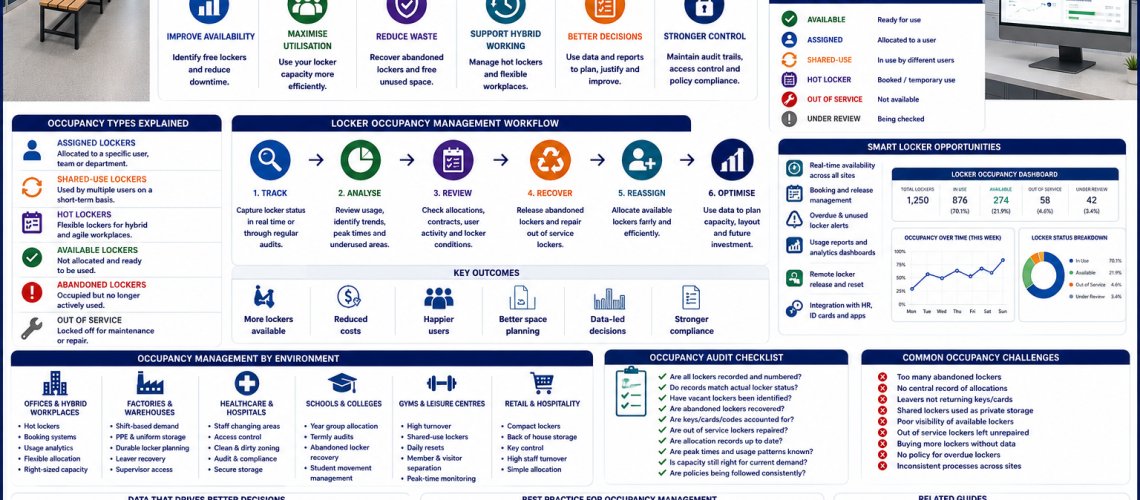
Locker occupancy management systems help organisations understand how much of a locker estate is actually being used, where usable capacity is available, when demand peaks and whether shared or assigned lockers are performing as expected.
Occupancy is different from allocation. An allocation record shows who should have a locker. Occupancy evidence shows whether the locker is genuinely in use, how long it remains occupied, how frequently shared lockers turn over and how much capacity is unavailable because of faults or maintenance.
This guide focuses specifically on locker usage, availability and utilisation. For allocation rules and day-to-day administration, use the Locker Management Systems UK guide. For calculating how many lockers are required, use How Many Lockers Do You Need?.
Occupancy management answers one question: how much of the usable locker estate is actually being used, when and where?
Quick Answer: What Is Locker Occupancy Management?
Locker occupancy management is the process of measuring occupied, vacant, inactive, shared, abandoned and temporarily unavailable locker capacity. The objective is to distinguish real usage from theoretical capacity or historic allocation records.
| Status | Meaning | Occupancy treatment |
|---|---|---|
| Occupied | Locker is actively in use | Count as occupied usable capacity |
| Vacant | Locker is usable and available | Count as available capacity |
| Assigned but inactive | Locker has an allocation but shows little or no actual use | Review before treating as genuine demand |
| Shared use | Different users occupy the locker at different times | Measure turnover, duration and peak occupancy |
| Abandoned or overheld | Normal use appears to have ended but the locker remains blocked | Escalate through the organisation’s clearance process |
| Unavailable | Fault, damage or maintenance prevents use | Exclude from usable capacity until returned to service |
What This Page Owns, and What It Hands Off
- Who is allocated each locker: Locker Management Systems UK
- How many lockers are required: Locker Capacity Planning
- Room layout, dimensions and physical placement: Locker Planning UK
- Physical condition and estate diagnosis: Locker Estate Audit UK
- Physical asset records: Locker Asset Management UK
- CAFM maintenance workflows: Locker CAFM Integration UK
- Repair, refurbish or replace decisions: Locker Lifecycle Management UK
- Replacement phasing and budgeting: Locker Replacement Planning UK
- Lock-system choice: Locker Locking Systems
- Healthcare changing-room workflow: NHS & Healthcare Changing Room Planning UK
Occupancy Is Not the Same as Allocation
An organisation can have a nearly full allocation register while still having significant unused storage. Former employees may remain assigned, hybrid staff may rarely attend, temporary allocations may not have expired correctly and some lockers may be unavailable because of faults.
Conversely, a shared locker estate can have relatively few permanent allocations while experiencing very high peak occupancy during certain periods.
| Measure | Question answered |
|---|---|
| Allocation | Who has been given access to this locker? |
| Occupancy | Is the locker in use now or during the measured period? |
| Utilisation | How frequently is the locker actually used? |
| Turnover | How often does a shared locker return to availability and get reused? |
| Capacity | How many usable lockers exist? |
| Demand | How many users require storage at the same time? |
The Most Useful Locker Occupancy Metrics
A useful occupancy system does not need dozens of KPIs. Start with measures that support actual decisions.
| Metric | What it measures | Why it matters |
|---|---|---|
| Usable capacity | Lockers currently capable of being used | Prevents damaged lockers inflating capacity |
| Occupied capacity | Usable lockers currently or genuinely in use | Shows active demand |
| Vacant capacity | Usable lockers available for use | Shows recoverable space before expansion |
| Peak occupancy | Highest occupied level during the relevant period | Reveals shortages hidden by averages |
| Inactive allocation rate | Assigned lockers with little evidence of use | Highlights potentially recoverable capacity |
| Usage duration | How long a locker stays occupied | Identifies overheld shared lockers |
| Turnover | Completed use cycles in shared lockers | Shows whether shared capacity is recycling effectively |
| Unavailable rate | Capacity lost to faults or maintenance | Separates maintenance problems from true shortages |
| Location utilisation | Usage by bank, room, department or zone | Finds local shortages beside underused areas |
A Simple Occupancy Rate Calculation
For a defined point in time, a basic occupancy rate can be calculated as:
Occupancy rate = occupied usable lockers ÷ total usable lockers × 100
If a room contains 120 physical compartments but 10 are out of service, usable capacity is 110. If 88 of those are occupied at the measured time, occupancy is 80% of usable capacity, not 73% of the physical total.
The measurement period matters. A single observation at 10:00 may not represent a shift-change peak at 14:00 or a busy Tuesday in a hybrid office. Define the period and the decision the data is intended to support.
Peak Occupancy Matters More Than a Simple Average
Average occupancy can hide real shortages. A locker bank may average 55% use across a week while reaching 98% during the busiest shift change or office attendance day.
- Measure relevant arrival and departure periods.
- Include shift overlap where two groups are present together.
- Review high-attendance office days rather than a quiet weekly average.
- For leisure sites, check class, event or session peaks.
- For schools, distinguish ordinary storage occupancy from short periods of concentrated access.
Peak occupancy is an input to capacity planning. The decision about how many lockers should ultimately be installed belongs in the Locker Capacity Planning guide.
Vacant Locker Identification
Vacant capacity is only useful if users or administrators know it exists. An estate can appear full because available compartments are badly recorded, concentrated in the wrong area or still shown against obsolete allocations.
- Identify genuinely vacant and usable lockers.
- Separate vacant lockers from lockers awaiting repair.
- Check whether old allocations are blocking available capacity.
- Compare vacancy between different rooms and departments.
- Return repaired lockers to available status promptly.
- Keep temporarily reserved lockers separate from genuinely unavailable capacity.
Inactive Allocations
An assigned locker is not necessarily an actively used locker. Inactive allocations are particularly important in estates where staff, pupils, contractors or departments change frequently.
Occupancy evidence can flag an allocation for review, but it should not automatically remove the user’s locker. Absence, accessibility needs, irregular attendance or legitimate long-term storage can all explain low apparent activity.
The occupancy system should therefore identify the signal; the Locker Management process should control any reassignment or clearance action.
Usage Duration and Overheld Lockers
Duration means different things in different operating models. A locker occupied for six months may be normal for permanent assigned storage but unacceptable for a day-use locker intended to release after each visit.
- Define expected use duration by locker type.
- Identify shared lockers held beyond that period.
- Flag temporary allocations that have passed their expiry date.
- Identify day-use lockers that fail to return to availability.
- Separate legitimate long-term storage from abandoned use.
Shared-Use Locker Turnover
Shared lockers only create additional effective capacity when they are released and reused. Turnover therefore matters as much as the number of physical compartments.
- Uses per day or shift
- Average occupation time
- Peak simultaneous occupancy
- Percentage never used during the review period
- Percentage held beyond the expected period
- Availability during the busiest period
- Clearance or abandoned-use incidents
Low turnover can indicate insufficient capacity, but it can also indicate poor release rules, unsuitable operating procedures or users treating shared lockers as permanent storage. Occupancy data identifies the pattern; Locker Management owns the operational response.
Location Utilisation
Estate-wide occupancy percentages can hide local problems. One changing room may be consistently full while another floor has substantial unused capacity.
| Zone | Usable lockers | Peak occupied | Peak occupancy |
|---|---|---|---|
| Zone A | 80 | 76 | 95% |
| Zone B | 70 | 34 | 49% |
| Zone C | 50 | 42 | 84% |
A total-estate figure would suggest spare capacity, but users in Zone A may still experience a real shortage. Before relocating lockers or redesigning the room, pass the evidence to Locker Planning UK.
Unavailable Capacity
A locker that physically exists but cannot be used should not be counted as available capacity.
- Failed lock
- Damaged door
- Unsafe or unstable cabinet
- Missing component preventing normal use
- Electronic access failure
- Locker isolated for maintenance
- Locker removed from service pending lifecycle review
Occupancy reporting should show the lost capacity. The repair workflow belongs in Locker CAFM Integration UK or the appropriate maintenance process, while repeated failures may need escalation to Locker Lifecycle Management UK.
Manual Locker Occupancy Measurement
Smart technology is not required to measure occupancy. A small or stable estate can often obtain enough evidence through structured manual reviews.
- Count usable lockers.
- Record occupied and vacant status at defined times.
- Compare observations with allocation records.
- Record lockers unavailable because of faults.
- Repeat observations during expected peak periods.
- Review temporary and inactive allocations separately.
- Compare results by room or locker bank.
Manual observations should respect the organisation’s privacy and access procedures. Occupancy measurement does not require opening lockers or identifying contents unless an authorised operational process separately permits that action.
Electronic and Smart Occupancy Measurement
Electronic systems can provide more frequent occupancy data where shared use, high turnover or estate scale makes manual measurement inefficient.
- Current available / occupied state
- Reservation state where supported
- Usage duration
- Release events
- Peak simultaneous occupancy
- Location-level utilisation
- Out-of-service status
- Historical occupancy trends
Do not assume access events are a perfect proxy for occupancy. A credential event proves that an access action was recorded; it does not always prove that belongings remained in the locker for a particular period. The meaning of each data field should be understood before it is used as an occupancy measure.
For the technology platform itself, use the relevant smart-locker guidance rather than turning this occupancy page into a product or software comparison.
Manual vs Electronic Occupancy Measurement
| Method | Can suit | Main limitation |
|---|---|---|
| Manual observation | Small or stable estates | Limited number of measurement points |
| Allocation-register review | Assigned locker estates | Shows administrative status, not necessarily real use |
| Key / credential activity | Selected electronic or controlled estates | Access event may not equal occupancy |
| Connected locker status | Shared or high-turnover estates | Requires compatible hardware/software |
| Occupancy analytics | Large estates needing trend analysis | Only useful if measurements are correctly defined |
Historical Occupancy Trends
A single occupancy snapshot answers what happened at one moment. Trend data shows whether demand is changing.
- Compare peak occupancy month by month.
- Compare days of the week in hybrid workplaces.
- Compare shifts in industrial sites.
- Track recovery of capacity after inactive allocations are cleared.
- Measure the effect of returning damaged lockers to service.
- Identify sustained growth rather than short-term peaks.
Use enough history to reflect the operating pattern. A week may be adequate for a stable high-turnover leisure area but misleading for a workplace affected by holidays, project cycles or seasonal attendance.
Occupancy Dashboards: Show Decisions, Not Decoration
A useful dashboard should make a small number of decisions easier rather than display every available data point.
- Usable locker count
- Current or peak occupied count
- Vacant usable capacity
- Unavailable capacity
- Inactive-allocation flags
- Shared-use turnover
- Overheld lockers
- Location utilisation
- Trend against the previous comparable period
Keep physical condition, maintenance history and lifecycle status in their asset-management systems. The occupancy dashboard should remain centred on usage and availability.
Occupancy Evidence Before Adding More Lockers
A reported locker shortage should trigger an occupancy review before it automatically triggers procurement.
- Is usable capacity genuinely full at peak?
- Are inactive allocations blocking capacity?
- Are shared lockers being released correctly?
- Are abandoned lockers reducing availability?
- Are damaged lockers still counted as capacity?
- Is spare capacity located somewhere users cannot reasonably use it?
- Is the shortage limited to one department, shift or zone?
If the evidence shows a genuine shortage, pass the occupancy findings into Locker Capacity Planning. That page owns the decision about how much additional capacity is required.
Hybrid Workplace Occupancy
Hybrid workplaces are a strong use case for occupancy measurement because total headcount can differ substantially from simultaneous attendance.
- Measure peak locker occupancy by day.
- Compare permanent assignments with actual attendance.
- Measure whether shared lockers remain available during peak periods.
- Compare demand between departments and floors.
- Track whether reduced attendance is temporary or sustained.
Occupancy evidence can show that the current operating model deserves review, but the decision to move from assigned to shared lockers belongs with Locker Management Systems UK. For the wider workplace requirement, use Workplace Lockers UK.
Shift-Based and Industrial Occupancy
Factories, warehouses and other shift-based workplaces should measure the short periods when locker demand is highest rather than relying on all-day averages.
- Peak occupancy before and after shift change
- Overlap between outgoing and incoming shifts
- Capacity temporarily unavailable for repair
- Temporary contractor or agency-worker demand
- Location differences between changing areas
- Storage retained between shifts
Physical staff flow, benches and changing-room layout belong in the Workplace Lockers UK guide and wider Locker Planning content.
Healthcare Occupancy Evidence
Healthcare estates can use occupancy evidence to understand locker demand across departments, staff groups and shifts, but this page does not own the clinical or staff-changing workflow.
- Measure peak simultaneous locker use.
- Separate permanent from temporary or rotating demand.
- Record lockers unavailable because of faults.
- Compare utilisation between changing areas.
- Identify sustained shortages before expanding capacity.
For uniforms, shift-change flow, department zoning, benches, cleaning access and staff-changing design, use NHS & Healthcare Changing Room Planning UK.
School Occupancy Evidence
In schools, occupancy analysis should remain narrow: which lockers are actually active, which are unused, which are unavailable and how demand differs by location or year-group area.
- Identify unused or unclaimed lockers.
- Separate physical faults from genuine lack of capacity.
- Review vacancy before the next allocation cycle.
- Compare utilisation between buildings or zones.
- Record peak demand where a particular area appears short of storage.
Pupil allocation, key procedures, safeguarding and corridor planning belong in School Lockers UK and the relevant school-management guidance.
Data Quality: Know What the Measurement Actually Represents
Occupancy data can be misleading when the source is poorly understood.
- An allocation record does not prove use.
- A lock opening does not always prove continuing occupancy.
- A closed door does not prove that belongings are inside.
- A locker marked vacant may actually be unavailable because of a fault.
- A single quiet observation does not represent peak demand.
- Different sites may define “occupied” differently.
Define status rules before comparing locations or reporting percentages.
How to Carry Out a Locker Occupancy Review
- Define the decision. Establish whether the review is testing shortage, underuse, shared turnover or another specific question.
- Define usable capacity. Exclude lockers that cannot currently be used.
- Define occupancy states. Agree what occupied, vacant, inactive, unavailable and abandoned mean.
- Choose the measurement period. Include relevant peak days, shifts or sessions.
- Record occupancy. Use manual observations or system data appropriate to the estate.
- Compare with allocation records. Identify assigned lockers that appear inactive.
- Measure turnover where lockers are shared. Record duration and return to availability.
- Compare locations. Identify high-demand and underused zones.
- Separate maintenance loss. Show capacity unavailable because of faults.
- Review anomalies. Investigate data that does not match the observed operation.
- Pass findings to the correct owner. Allocation issues go to Locker Management; genuine shortages go to Capacity Planning; repeated faults go to Lifecycle or Maintenance.
- Repeat when needed. Trend data is more useful than one isolated snapshot where demand changes over time.
Common Locker Occupancy Management Mistakes
- Treating allocation as occupancy. Assigned does not automatically mean used.
- Counting broken lockers as available capacity. Measure usable capacity.
- Using averages while ignoring peaks. Shortages often happen at specific times.
- Buying more lockers before recovering inactive capacity. Establish the real shortage first.
- Assuming access events equal occupancy. Understand what the system actually measures.
- Collecting data without defining the decision. Reporting should have a purpose.
- Comparing sites with different status definitions. Standardise the measurement.
- Letting occupancy pages decide allocation policy. That belongs to Locker Management.
- Letting occupancy pages decide replacement. That belongs to Lifecycle Management.
- Using one observation to represent a variable workplace. Measure relevant periods.
Locker Occupancy Management Checklist
| Question | Why it matters |
|---|---|
| How many lockers are usable? | Establishes real capacity |
| How many are occupied? | Shows active use |
| How many are genuinely vacant? | Shows available capacity |
| Which allocations appear inactive? | Finds potential capacity for review |
| How long are shared lockers held? | Measures turnover |
| When does peak occupancy occur? | Prevents average data hiding shortages |
| Which locations are consistently full? | Finds local demand pressure |
| Which locations are underused? | Finds stranded capacity |
| How much capacity is unavailable because of faults? | Separates maintenance from demand |
| What does the data source actually measure? | Prevents false conclusions |
| Does the evidence justify more lockers? | Creates a clean handoff to capacity planning |
Where Occupancy Questions Go Next
| Question | Next guide |
|---|---|
| Who should have each locker? | Locker Management Systems UK |
| How many lockers are actually required? | Locker Capacity Planning |
| Where should lockers be positioned? | Locker Planning UK |
| What condition is the locker estate in? | Locker Estate Audit UK |
| How should physical locker assets be recorded? | Locker Asset Management UK |
| How should faults enter facilities workflows? | Locker CAFM Integration UK |
| Should repeated faults lead to repair, refurbishment or replacement? | Locker Lifecycle Management UK |
| How should confirmed replacement be phased? | Locker Replacement Planning UK |
| What is the wider workplace requirement? | Workplace Lockers UK |
| How should NHS staff changing be planned? | NHS & Healthcare Changing Room Planning UK |
Locker Occupancy Management Systems UK FAQs
What is locker occupancy management?
Locker occupancy management measures how much usable locker capacity is occupied, vacant, inactive, shared or unavailable. It helps organisations understand real use rather than relying only on installed capacity or allocation records.
What is the difference between locker allocation and occupancy?
Allocation records who has been given a locker. Occupancy measures whether the locker is actually being used, when it is used and whether it is available to other users.
How is locker occupancy rate calculated?
A simple point-in-time occupancy rate is occupied usable lockers divided by total usable lockers, multiplied by 100. Lockers that are out of service should normally be excluded from usable capacity.
Should occupancy be checked before buying more lockers?
Yes. Inactive allocations, abandoned use, poor shared-locker turnover, local distribution problems and lockers awaiting repair can all create an apparent shortage without the estate being genuinely under-capacity.
Do locker occupancy systems need smart technology?
No. Small or stable locker estates can often be reviewed manually. Electronic or smart systems become more useful where shared use, high turnover, multiple sites or frequent reporting make manual measurement inefficient.
Does a lock-opening event prove that a locker is occupied?
Not necessarily. An access event proves that an access action was recorded. Whether that represents continuing occupancy depends on the locker system and how the data is generated.
Why is peak locker occupancy important?
Average occupancy can hide short periods when nearly all lockers are required. Peak occupancy is particularly important for shift changes, hybrid-office attendance, leisure sessions and other concentrated demand periods.
What should a locker occupancy report include?
Useful measures include usable capacity, occupied and vacant lockers, peak occupancy, inactive allocations, usage duration, shared-use turnover, unavailable capacity and utilisation by location.
Summary
Locker occupancy management should remain focused on evidence: what is in use, what is available, when demand peaks, how shared lockers turn over and where usable capacity is being lost or underused.
Occupancy data should inform other decisions without taking ownership of them. Allocation belongs to Locker Management, quantity belongs to Capacity Planning, physical condition belongs to the Estate Audit and intervention decisions belong to Lifecycle Management.
Use occupancy evidence before assuming that a reported shortage requires more lockers. Where the evidence confirms genuine additional demand, continue to How Many Lockers Do You Need? and the wider Locker Planning UK guide.
Discover more from Blog Total Locker Service
Subscribe to get the latest posts sent to your email.