Locker Estate Decision Framework UK
May 14, 2026
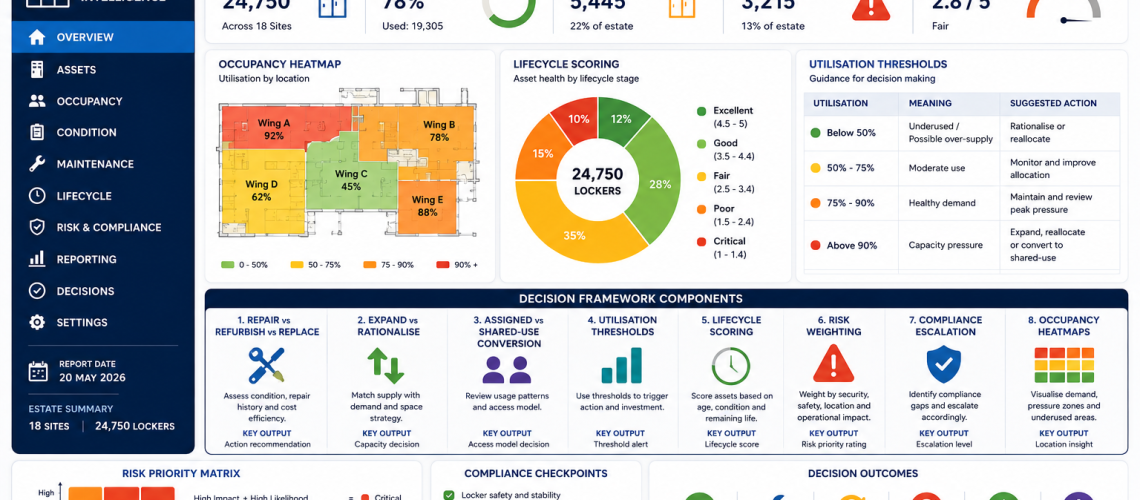
A locker estate decision framework helps organisations make structured, evidence-based decisions about locker repair, refurbishment, replacement, expansion, rationalisation and long-term estate planning.
This moves locker management beyond simple maintenance. It turns locker data into facilities management intelligence. It helps estates teams understand what action is needed, why it is needed, and how urgent it is.
For workplaces, schools, NHS estates, leisure centres, councils and multi-site organisations, lockers are operational assets. They affect space use, welfare, security, maintenance budgets, compliance evidence and capital planning.
What Is a Locker Estate Decision Framework?
A locker estate decision framework is a structured method for turning locker condition, occupancy, lifecycle, maintenance and risk data into clear decisions.
It helps answer practical questions such as:
- Should this locker bank be repaired, refurbished or replaced?
- Should the estate be expanded or rationalised?
- Should assigned lockers be converted to shared-use lockers?
- Which sites need investment first?
- Which faults create the highest operational risk?
- What evidence supports the next procurement decision?
Why Locker Decisions Need a Framework
Without a framework, locker decisions are often reactive. A visible problem receives attention, while a deeper estate issue remains hidden.
A framework prevents this. It uses consistent scoring, reporting and thresholds. This makes decisions easier to justify to facilities managers, finance teams, procurement teams and senior stakeholders.
Locker Estate Decision Framework: Core Model
| Decision area | Data required | Possible action |
|---|---|---|
| Condition | Damage, corrosion, lock faults, door alignment | Repair, refurbish or replace |
| Utilisation | Occupied, vacant, inactive and abandoned lockers | Expand, rationalise or reallocate |
| Lifecycle | Age, repair history, parts availability, remaining service life | Plan phased replacement |
| Risk | Security, safety, location, compliance and user impact | Escalate priority |
| Access model | Assigned use, shared use, keys, RFID, PIN or smart access | Convert or upgrade |
| Financial impact | Repair cost, replacement cost, downtime and capital forecast | Justify budget |
Repair vs Refurbish vs Replace
This is the first major decision layer. Not every damaged locker needs replacement. Equally, repeated repair can become poor value when the estate has reached the end of its useful life.
Repair
Repair is suitable when the issue is isolated and the main locker structure remains sound. Examples include replacing a lock, fixing a hinge, adjusting a door or replacing a missing key.
Refurbish
Refurbishment is suitable when the locker body still has value, but several components need improvement. This may include new locks, replacement doors, new numbering, cleaning, repainting or hardware updates.
Replace
Replacement becomes stronger when repair frequency is high, corrosion is spreading, doors no longer align, security is weak, user confidence is low or the locker specification no longer suits the environment.
| Action | Best evidence | Trigger point |
|---|---|---|
| Repair | Low-cost isolated fault | Single issue with good remaining life |
| Refurbish | Multiple worn parts but sound frame | Moderate wear with recoverable value |
| Replace | High repair cost, poor condition, repeated failure | Ongoing spend exceeds practical asset value |
Expand vs Rationalise
Expansion should be based on proven demand. Rationalisation should be based on proven underuse.
A locker estate may have shortage and surplus at the same time. One department may be short of lockers while another area has empty or abandoned units. A decision framework helps separate real capacity problems from poor allocation or poor location.
Expand When:
- utilisation remains consistently high
- users cannot access suitable storage
- waiting lists exist
- peak demand creates congestion
- new staff, pupils or users are being added
Rationalise When:
- large numbers of lockers are vacant
- assigned lockers are rarely used
- locker banks are poorly located
- duplicate provision exists across nearby areas
- space could be used more effectively
Assigned vs Shared-Use Conversion
Assigned lockers give one user long-term control of a locker. Shared-use lockers allow different users to use lockers at different times.
The right model depends on the organisation. Schools, workplaces, hospitals, gyms, warehouses and hybrid offices all use lockers differently.
Conversion from assigned to shared-use can improve availability where lockers are allocated but not used every day. This is especially useful in hybrid workplaces, leisure environments and flexible staff areas.
| Model | Best for | Decision risk |
|---|---|---|
| Assigned lockers | Regular users with repeated storage needs | Hidden vacancy if users attend irregularly |
| Shared-use lockers | Flexible, temporary, visitor or shift-based use | Needs stronger access control and user process |
| Hybrid model | Mixed estates with different user groups | Requires clear zoning and reporting |
Utilisation Thresholds
Utilisation thresholds help convert occupancy data into action. They give estates teams a practical way to decide when to expand, rationalise, reallocate or investigate.
| Utilisation level | Likely meaning | Suggested action |
|---|---|---|
| Below 50% | Possible over-supply or poor location | Review allocation and rationalise |
| 50% to 75% | Moderate use | Monitor demand and improve allocation |
| 75% to 90% | Healthy demand | Maintain and review peak pressure |
| Above 90% | Capacity pressure | Consider expansion, reallocation or shared-use conversion |
These thresholds should be adjusted for each environment. A school corridor, staff changing room, warehouse, hospital or gym may need different target levels.
Lifecycle Scoring
Lifecycle scoring helps organisations understand where each locker bank sits in its useful life. It should not rely on age alone.
A strong lifecycle score includes:
- locker age
- condition rating
- repair history
- lock reliability
- parts availability
- environmental exposure
- current suitability
- future capacity need
This creates a fairer replacement plan. A locker bank in a wet changing room may age faster than one in a dry staff area. Lifecycle scoring captures that difference.
Risk Weighting
Risk weighting prevents all faults from being treated equally. Some locker issues are inconvenient. Others create security, safety, safeguarding, welfare or operational concerns.
| Risk factor | Example | Priority effect |
|---|---|---|
| Security | Failed locks, uncontrolled keys, weak access control | Raises urgency |
| Safety | Sharp edges, unstable units, blocked routes | Immediate escalation |
| Welfare | No usable storage for staff or pupils | Raises operational importance |
| Compliance | No inspection record or unresolved faults | Requires documented action |
| Business continuity | Locker failure affecting shift change or site operation | Raises service priority |
Compliance Escalation
Compliance escalation means identifying locker issues that need formal attention, documentation or senior review.
This may include unresolved safety faults, access-control weaknesses, poor inspection records, repeated maintenance failures, blocked circulation routes or unsuitable storage for the environment.
A decision framework should define when an issue remains local, when it moves to facilities management, and when it requires procurement, finance or senior management involvement.
Occupancy Heatmaps
Occupancy heatmaps show where locker demand is high, low or uneven. They are especially useful across large buildings, campuses and multi-site estates.
A heatmap can show:
- shortage zones
- underused locker banks
- abandoned locker clusters
- peak demand areas
- poorly located lockers
- departments needing reallocation
This gives visual evidence for estate decisions. It also helps explain the decision to non-technical stakeholders.
Example Locker Estate Decision Matrix
| Scenario | Evidence | Decision |
|---|---|---|
| High faults, poor condition, high utilisation | Repeated repairs and strong demand | Replace as priority |
| Good condition, low utilisation | Vacant lockers and low demand | Rationalise or relocate |
| Fair condition, rising demand | Moderate wear and growing occupancy | Refurbish and expand selectively |
| Assigned lockers with irregular use | Low daily occupancy but high allocation | Convert some lockers to shared use |
| Old lockers with low risk and low faults | Stable condition and low repair spend | Monitor through lifecycle plan |
Internal Links for This Page
This framework should connect closely with the wider locker management and FM intelligence canister:
- Locker Estate Reporting and Decision Systems UK
- Locker Management Systems UK
- Locker Lifecycle Management UK
- Locker Occupancy Management Systems UK
- Locker Estate Audit UK
- Locker CAFM Integration UK
- Locker Asset Register UK
- Locker Predictive Maintenance UK
Summary
A locker estate decision framework is the point where locker data becomes FM intelligence. It turns audits, occupancy records, lifecycle scores, maintenance trends and risk data into clear operational decisions.
The framework helps organisations decide when to repair, refurbish, replace, expand, rationalise or convert locker systems. It also supports procurement justification, capital planning and board-level reporting.
Very few locker estates are managed at this level. For organisations that want stronger control, better evidence and smarter long-term planning, this framework is the next step.
Discover more from Blog Total Locker Service
Subscribe to get the latest posts sent to your email.