Locker Estate Reporting and Decision Systems UK
May 13, 2026
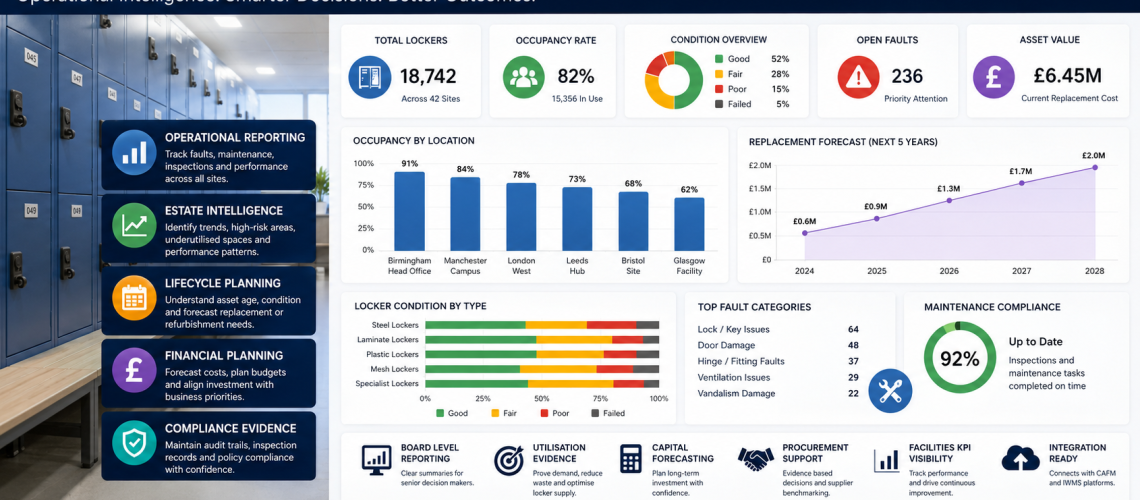
Structure Locker Estate Reporting Around Decisions
Locker estate reporting should present existing asset, condition, occupancy, maintenance, lifecycle and cost evidence to the people who need to act on it. Reporting should not create another version of the source data or make technical decisions that belong to specialist processes.
Reporting should present the evidence clearly enough for the right decision to be made, recorded and followed through without becoming a second source of truth.
Use Different Reporting Levels for Different Decisions
| Reporting level | Main purpose |
|---|---|
| Operational | Show current faults, unavailable lockers, overdue actions and immediate work |
| Management | Show performance changes, recurring issues, exceptions and site priorities |
| Executive | Show material risks, investment requirements, decisions required and expected outcomes |
| Project / procurement | Provide traceable evidence for approved scope, quantities, phasing and procurement |
The same locker information should not be presented at the same level of detail to every audience. A maintenance export may be useful to an engineer but unsuitable as an estate or executive report.
| Audience | Typical information required |
|---|---|
| Maintenance team | Open faults, location, priority, required parts and current action |
| Facilities manager | Availability, repeat faults, overdue actions and local exceptions |
| Estates manager | Condition, lifecycle position, performance and multi-site priorities |
| Finance | Evidence supporting forecast expenditure and expected timing |
| Procurement | Approved scope, quantities, assumptions and phasing |
| Senior management | Material exceptions, consequences, cost range and decisions required |
Keep a Clear Reporting Evidence Chain
A material statement in a locker-estate report should be traceable backwards to the evidence that produced it and forwards to the decision, action and outcome that followed.
- Source record: the underlying asset, fault, work order, occupancy, cost or other record.
- Verified evidence: checked asset data, audit evidence, completed work order or another verified source.
- Measurement or analysis: the agreed KPI, comparison or analytical result.
- Specialist conclusion: the conclusion produced by the process that owns the subject.
- Management report: the relevant evidence and context presented to the appropriate audience.
- Decision pack: the evidence required for approval or direction where needed.
- Decision: approval, rejection, deferral or instruction from the authorised role.
- Action: the investigation, repair, procurement, project or follow-up created by the decision.
- Outcome: what happened and whether the intended result was achieved.
This prevents the report from becoming a second source of truth. Estate reporting should retain enough references to reconstruct the evidence behind a significant conclusion.
Operational Locker Reports
Operational reports support immediate or short-term action and should remain concise enough for teams to use.
- Unavailable lockers.
- Open urgent faults.
- Overdue maintenance tasks.
- Access failures requiring support.
- Lockers awaiting parts.
- Inspection actions due.
- Temporary mitigations still in place.
- Other locally defined material exceptions.
Where practical, show the asset or bank reference, location, issue, current status, owner and next action.
Management Locker Reports
Management reporting should move beyond individual incidents and show patterns or exceptions that require oversight.
- Material KPI movement since the previous period.
- New exceptions.
- Persistent exceptions.
- Repeat faults.
- Unusual downtime.
- Physical-condition deterioration.
- Unresolved actions.
- Emerging budget pressure.
- Decisions approaching an approval point.
The report should use the KPI definitions already adopted by the estate rather than recalculating them differently in the reporting layer.
Executive and Senior Locker Estate Reporting
Executive reporting should focus on material issues, consequences and decisions rather than component-level detail.
| Section | Purpose |
|---|---|
| Estate position | Summarise estate scale and current operating position |
| Material exceptions | Show issues requiring management attention |
| Consequence | Explain the likely operational effect if no action is taken |
| Evidence | Show the relevant condition, maintenance, KPI or lifecycle evidence |
| Options | Present feasible routes already assessed by the relevant specialist owner |
| Decision required | State precisely what approval or direction is required |
| Cost and timing | Show the current estimate, assumptions and expected delivery period |
| Next review | State when progress or the decision should be reviewed |
An executive report should not create its own repair, refurbishment or replacement conclusion. Those decisions remain with Locker Lifecycle Management UK.
Use Exception Reporting to Reduce Noise
Exception reporting highlights issues requiring attention instead of reproducing every normal estate record.
- Unavailable capacity outside the locally accepted range.
- Repeat faults increasing.
- Inspection completion behind plan.
- Maintenance resolution time materially worsening.
- Condition deterioration requiring follow-up.
- Maintenance cost changing materially without an obvious change in estate size.
- Required asset information incomplete.
- Approved actions overdue.
- Estate-standard exceptions requiring review.
The reporting process should use thresholds already defined by the estate. It should not invent universal red, amber or green thresholds.
Traffic-light status can still be useful where each status has a written local meaning, for example green for no escalation required, amber for review required and red for a material exception requiring defined escalation.
Create Focused Decision Packs
A locker decision pack should contain only the evidence needed to make a particular decision while preserving links to the source material.
- Decision required.
- Reason the decision is required now.
- Sites, assets or users affected.
- Current condition and availability evidence.
- Relevant performance or trend evidence.
- Maintenance history where relevant.
- Lifecycle conclusion where applicable.
- Options already assessed.
- Cost assumptions.
- Operational consequence.
- Dependencies.
- Authorised decision owner or approving body.
- Required next step.
The purpose is not to make a report longer. It is to reduce the evidence to the material required for the specific approval.
Package Evidence for Refurbishment and Replacement Approval
- Verified scope.
- Condition evidence.
- Maintenance and recurring-fault history.
- Current capacity and demand evidence where relevant.
- Current lifecycle status.
- Reason continued repair is insufficient where replacement is proposed.
- Proposed project quantities.
- Phasing.
- Budget basis and exclusions.
- Operational consequence of delay.
Detailed project scope and phasing belong in Locker Replacement Planning UK. Estate reporting packages approved evidence for the appropriate management or investment decision.
Maintain an Action Register
A management report loses value if its decisions disappear after the meeting. Material actions should remain visible until completed, superseded or formally closed.
| Field | Purpose |
|---|---|
| Action ID | Provides a stable reference |
| Issue / decision | States what the action relates to |
| Owner | Identifies responsibility |
| Due date | Records the agreed timing |
| Status | Shows open, complete, blocked or superseded |
| Evidence reference | Connects the action to the source report or decision |
| Outcome | Records what happened |
Keep Material Decisions Traceable
For larger locker estates, material decisions can also be recorded separately from actions.
- Decision reference.
- Date.
- Decision made.
- Decision owner or approving body.
- Evidence-pack reference.
- Key assumptions.
- Approved cost or scope where relevant.
- Conditions attached to approval.
- Review date.
This helps explain later why a locker bank was retained, refurbished, replaced, relocated or deferred.
Preserve Evidence Traceability
| Reported statement | Evidence route |
|---|---|
| Fault rate is increasing | CAFM records → agreed KPI → estate report |
| A locker bank is deteriorating | Asset reference → Estate Audit evidence → estate report |
| Demand exceeds usable capacity | Occupancy evidence → agreed occupancy definition → estate report |
| Replacement review is justified | Condition and maintenance evidence → Lifecycle conclusion → decision pack |
| Replacement should be phased | Approved Lifecycle outcome → Replacement Planning → project decision pack |
Where a report may later support procurement, budget review or audit, preserve enough references to reconstruct the evidence chain rather than copying an unsupported conclusion into the report.
Show Current Position and Direction of Travel
- Current value.
- Previous-period value.
- Baseline where relevant.
- Local target or threshold.
- Direction of travel.
- Reason for material change where known.
Detailed trend analysis, segmentation, heatmaps and analytical interpretation remain with Smart Locker Analytics UK. Estate Management should use the resulting evidence without recreating the analytical process.
Report What Happened After the Decision
Where an intervention has been completed, later reporting should show whether the intended outcome occurred.
- Fault performance before and after a repair programme.
- Availability before and after lock replacement.
- Condition before and after refurbishment.
- Peak capacity before and after relocation or reconfiguration.
- Maintenance cost before and after parts standardisation.
Do not assume that an observed change was caused solely by the intervention. User numbers, operating conditions, reporting practice and other factors may also have changed.
Discover more from Blog Total Locker Service
Subscribe to get the latest posts sent to your email.