Locker Predictive Maintenance UK: Forecasting Faults, Wear and Replacement Needs
May 13, 2026
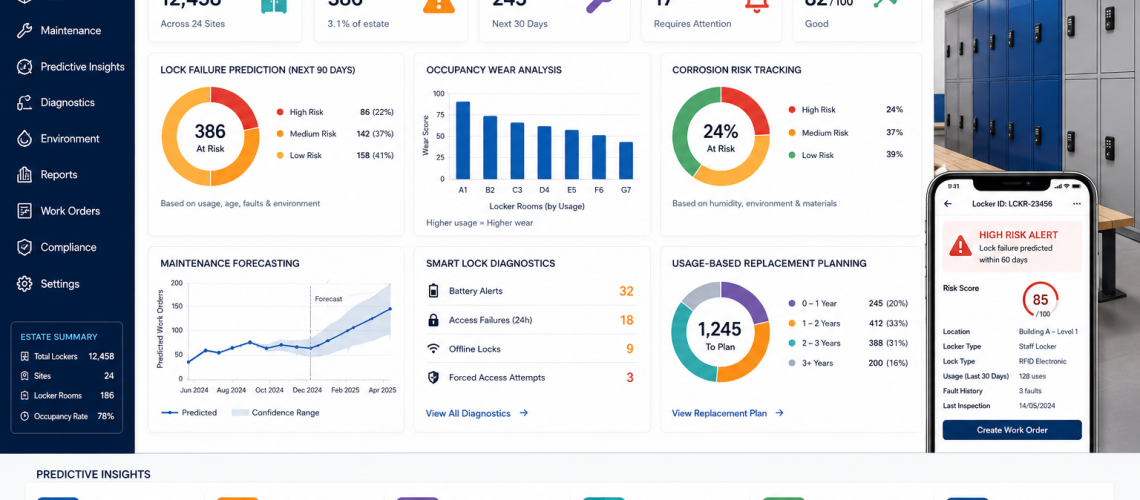
Locker predictive maintenance uses repeated fault, condition, usage and environmental evidence to identify lockers or components that may deserve earlier inspection or planned intervention.
Its purpose is not to claim certainty about which locker will fail next. Instead, it helps facilities teams recognise patterns such as repeated lock faults, worsening door alignment, recurring battery alerts, corrosion progression or unusually heavy use, then decide where inspection effort should be concentrated.
This guide focuses on maintenance-risk signals, recurrence patterns, trend confidence, inspection prioritisation and uncertainty. For wider trend comparison, use Smart Locker Analytics UK. For work orders and maintenance workflows, use Locker CAFM Integration UK.
Predictive Maintenance does not diagnose the fault in depth and does not author the final intervention status. Its output is a prioritised evidence signal that can be handed to CAFM for work execution, Estate Audit for physical verification or Parts & Servicing for technical diagnosis.
Predictive maintenance should answer “what deserves earlier inspection?” rather than pretending to know exactly what will fail next.
Quick Answer: What Is Locker Predictive Maintenance?
Locker predictive maintenance is the use of repeated evidence to identify assets with a higher apparent maintenance risk than comparable lockers. That evidence may include fault history, condition changes, maintenance recurrence, usage intensity, environmental exposure, battery warnings or diagnostic alerts.
| Evidence | Possible signal | Next step |
|---|---|---|
| Repeated lock faults | Recurring mechanism or compatibility problem | Inspect lock, cam, door alignment and use |
| Increasing door adjustment | Hinge wear, frame distortion or repeated misuse | Inspect door, hinges and cabinet condition |
| Repeated low-battery alerts | High use, battery issue or electronic fault | Check battery history and lock performance |
| Progressive corrosion | Environmental exposure or material deterioration | Inspect affected area and room conditions |
| High use plus repeated faults | Possible wear concentration | Prioritise physical inspection |
What This Page Owns, and What It Hands Off
- Repeated-fault patterns, maintenance-risk signals and inspection prioritisation: this page
- Trend analysis, comparisons and heatmaps: Smart Locker Analytics UK
- Occupied, vacant, usable and utilisation definitions: Locker Occupancy Management Systems UK
- Physical condition diagnosis and estate baseline: Locker Estate Audit UK
- Overall estate coordination: Locker Estate Management UK
- Detailed locker IDs and stable physical fields: Locker Asset Register UK
- Maintenance tickets, planned inspections and work orders: Locker CAFM Integration UK
- Fault diagnosis and initial repair / refurbish / replace routing: Locker Parts & Servicing Guide
- Approved refurbishment delivery: Locker Refurbishment UK
- Approved replacement programme scope and phasing: Locker Replacement Planning UK
- Lock replacement procedure: Locker Lock Replacement Guide UK
- Access technology choice: Locker Access Control Systems UK
Predictive Maintenance Is Not Failure Certainty
Locker maintenance data is usually incomplete and affected by several variables. A repeated fault can indicate a worn component, but it can also reflect poor door alignment, incorrect replacement parts, unusually heavy use, environmental exposure or inconsistent reporting.
- A high-use locker may remain reliable.
- An older locker may outperform a newer one.
- A single access failure may be user error rather than hardware failure.
- A low-battery warning does not automatically mean the lock itself is defective.
- Corrosion in one locker may not represent the whole bank.
Predictive maintenance should therefore be treated as risk prioritisation, not certainty.
The Evidence Chain
A useful predictive-maintenance process normally combines several evidence types rather than relying on one signal.
| Evidence layer | Example | What it contributes |
|---|---|---|
| Asset identity | Locker ID, bank, site, lock type | Shows which physical asset the evidence belongs to |
| Condition evidence | Door alignment, corrosion, hinge wear | Shows physical deterioration |
| Fault history | Sticking lock, failed cam, damaged hinge | Shows recurrence |
| Maintenance history | Repeated adjustment or part replacement | Shows intervention frequency |
| Usage evidence | High turnover or repeated access | Adds operating context |
| Environmental evidence | Moisture, dust, cleaning chemicals | Adds exposure context |
| Diagnostic data | Battery warnings or controller faults | Adds electronic-system evidence |
Repeated Faults Matter More Than Isolated Faults
A single fault may be random. Repeated faults on the same asset, component type or location are more useful for prioritisation.
- Same lock fails repeatedly.
- Same door requires repeated alignment.
- Same locker bank generates repeated hinge repairs.
- Same model shows more faults than comparable models.
- Same wet-area bank develops repeated corrosion.
- Same electronic-lock type generates frequent battery alerts.
Repeated faults should still be checked for reporting bias. A well-managed site may appear to have more faults simply because staff record problems more consistently.
Fault Recurrence Interval
The time between faults can be useful evidence. If a locker repeatedly returns to the same problem after shorter and shorter intervals, that may justify earlier inspection or a wider root-cause review.
For example:
- first lock adjustment lasts 18 months;
- second adjustment lasts 7 months;
- third adjustment lasts 6 weeks.
That pattern is more informative than simply recording “three repairs”. It suggests the previous intervention may no longer be resolving the underlying issue.
Worsening Fault Frequency
Predictive maintenance should look for direction of travel, not just total historic faults.
- Are faults becoming more frequent?
- Are repairs lasting for less time?
- Are more components becoming involved?
- Is the same issue appearing across neighbouring lockers?
- Is the fault becoming more disruptive?
A worsening pattern can justify inspection even where the locker is still operational.
Lock Failure Risk Signals
Locker locks can generate several maintenance-risk signals.
- Repeated sticking or difficult operation
- Repeated cam adjustment
- Loose lock body
- Key difficult to insert or turn
- Repeated broken or bent keys
- Frequent electronic reset
- Repeated credential failures linked to one lock
- Unusual battery-consumption pattern
- Mechanical play or movement in the lock
- Visible corrosion around the lock opening
Do not assume the lock is always the root cause. Door alignment, cam engagement, cabinet distortion and incorrect replacement components can all create apparent lock faults.
Door and Hinge Risk Signals
Door and hinge deterioration often develops gradually.
- Door begins to rub against the frame.
- User must lift or push the door to lock it.
- Hinge fixings repeatedly loosen.
- Door alignment changes after each repair.
- Lock cam engagement becomes inconsistent.
- Door skin or frame shows distortion.
- Repeated slamming damage appears in the same area.
Repeated alignment faults can indicate a wider structural issue. Replacing the lock alone may not resolve it.
Battery Warning Patterns
Electronic locker locks can provide useful maintenance evidence where battery status is recorded consistently.
- Battery life shorter than comparable locks
- Repeated low-battery warnings soon after replacement
- One bank consuming batteries faster than others
- Battery alerts associated with high use
- Battery replacements not restoring expected performance
A short battery interval may indicate usage intensity, battery quality, environmental conditions or a lock/electronic issue. It is a signal for investigation, not proof of a specific fault.
Corrosion Progression
Corrosion becomes more useful for predictive maintenance when its progression is recorded rather than noted only once.
- Rust around lock holes
- Corrosion at hinge points
- Base corrosion
- Bubbling or lifting paint
- Rust spreading from scratches or damaged coatings
- Increasing stiffness after wet cleaning
- Repeated corrosion in the same room or bank
Photographs taken at consistent intervals can help show whether deterioration is stable or progressing.
Environmental Exposure as a Risk Signal
Some environments increase the likelihood of particular maintenance problems.
- High humidity
- Direct water exposure
- Pool or leisure environments
- Industrial dust
- Cleaning chemicals
- Salt-laden coastal air
- PPE drying rooms
- Poor ventilation
- High temperatures where electronics are present
Environmental exposure should add context to condition evidence. It should not be treated as proof that damage will occur.
Usage Intensity as a Wear Signal
Heavy use can increase wear, but occupancy alone does not prove maintenance risk.
- Shared lockers may open many times per day.
- Shift-change lockers may experience concentrated use.
- School lockers may experience high short-period demand.
- Leisure lockers may turn over rapidly.
- Low-use lockers may still deteriorate through corrosion or poor environment.
Use occupancy and turnover as context alongside actual fault and condition evidence. For the underlying utilisation definitions, use Locker Occupancy Management Systems UK.
Smart Locker Diagnostic Signals
Connected electronic systems may generate diagnostics that can support maintenance prioritisation.
- Battery status
- Repeated failed lock actuation
- Door-open warning
- Controller fault
- Connectivity fault
- Repeated access failure linked to one unit
- Offline device status
The smart-locker platform owns how those alerts are generated and displayed. Predictive maintenance owns how repeated alerts are interpreted as maintenance-risk evidence.
Minimum Data Before Calling Something a Trend
There is no universal minimum number of faults that proves a predictive trend. The amount of evidence needed depends on the size of the estate, fault type, reporting quality and consequence of failure.
- One serious structural defect may justify immediate inspection.
- Several minor lock faults may be needed before a pattern is meaningful.
- A low-frequency fault across many identical lockers may still be important.
- A high-frequency fault in one location may reflect local environment or misuse.
Record confidence explicitly rather than forcing every signal into “predictive” or “not predictive”.
A Simple Maintenance-Risk Classification
| Signal level | Typical evidence | Response |
|---|---|---|
| Low | Single minor issue with no recurrence | Record and observe |
| Moderate | Repeated issue or worsening condition | Schedule inspection |
| High | Frequent recurrence, rapid deterioration or operational disruption | Prioritise inspection and intervention review |
| Immediate | Unsafe condition, loss of secure closure or serious access failure | Take appropriate immediate operational action |
This is a practical prioritisation model, not a statutory grading system.
False Positives and Misleading Signals
Predictive maintenance can become unreliable if apparent patterns are accepted without checking the context.
- One site records every minor issue while another records only failures.
- A recently installed lock appears fault-prone because old door alignment was not corrected.
- High battery consumption is caused by usage rather than defective electronics.
- Repeated access failures are caused by expired credentials rather than the lock.
- Corrosion reports increase because a new inspection programme identifies existing damage.
The stronger the signal, the more valuable a physical inspection becomes.
Predictive Maintenance Data Fields
| Field | Use |
|---|---|
| Locker / compartment ID | Links evidence to a specific asset |
| Site / building / room / bank | Allows location patterns to be compared |
| Locker type | Adds product context |
| Lock type | Allows component-specific comparison |
| Fault category | Shows recurrence by failure type |
| Fault date | Allows recurrence interval to be measured |
| Repair action | Shows what intervention was attempted |
| Repeat fault flag | Highlights recurring problems |
| Condition observation | Adds physical evidence |
| Usage context | Adds intensity or turnover context |
| Environmental exposure | Adds moisture, dust or chemical context |
| Diagnostic alert | Adds electronic evidence where available |
The detailed estate register belongs in Locker Asset Register UK. Predictive maintenance only needs the fields necessary to interpret maintenance risk.
Predictive Maintenance Workflow
- Identify the asset. Use a stable locker or compartment ID.
- Record the fault or condition observation. Use consistent categories.
- Check history. Look for recurrence, previous repair and elapsed time.
- Add context. Review usage, environment and known component type.
- Compare. Check whether similar lockers show the same pattern.
- Classify the signal. Low, moderate, high or immediate.
- Inspect where justified. Verify the physical condition.
- Hand the action into maintenance workflow. Use CAFM or the relevant local process.
- Review the outcome. Did the intervention resolve the pattern?
How Analytics and Predictive Maintenance Differ
| Analytics | Predictive maintenance |
|---|---|
| Identifies trends and differences | Interprets selected trends as maintenance-risk signals |
| Compares sites, zones and time periods | Prioritises assets for earlier inspection |
| Can cover occupancy, access and faults | Focuses on maintenance-related evidence |
| Does not own intervention | Does not own work-order execution |
For wider trend analysis, heatmaps and normalisation, use Smart Locker Analytics UK.
How CAFM Fits Into Predictive Maintenance
Once a maintenance-risk signal justifies action, the operational task should enter the normal facilities workflow.
- Create inspection task
- Assign responsible person or contractor
- Record findings
- Record repair or component change
- Close the work order
- Retain outcome for future recurrence analysis
Work orders, planned-maintenance schedules and helpdesk integration belong in Locker CAFM Integration UK.
Predictive Maintenance and Intervention Decisions
Predictive maintenance can supply evidence that an asset deserves review, but it should not decide by itself whether the locker should be repaired, refurbished or replaced.
- Repeated faults may justify repair review.
- Progressive corrosion may justify condition reassessment.
- Recurring lock issues may justify a lock upgrade.
- Widespread structural deterioration may justify refurbishment or replacement review.
Predictive Maintenance should stop at risk interpretation and inspection prioritisation. Use Locker Parts & Servicing for fault diagnosis and initial intervention routing, Locker Estate Audit where wider physical verification is needed, Locker Refurbishment for approved renewal of retained assets and Locker Replacement Planning for approved replacement projects.
Workplace Locker Predictive Maintenance
Workplace estates may have a mixture of permanently assigned, shared, hot and temporary lockers. Predictive maintenance should focus on the physical evidence created by those operating patterns rather than drifting into allocation policy.
- Repeated faults in shared locker banks
- High-use electronic lock battery patterns
- Door alignment problems in busy changing areas
- Recurring lock faults after department moves or reconfiguration
- Comparisons between high-turnover and low-turnover banks
School Locker Predictive Maintenance
School locker banks can experience concentrated use during lesson changes, repeated key problems and higher physical wear in busy corridors.
- Repeated door damage
- Recurring lock or key problems
- Hinge loosening
- High-fault corridor banks
- Worsening condition between termly inspections
For wider school locker planning, use School Lockers UK.
Healthcare Locker Predictive Maintenance
Healthcare staff-changing areas may combine high use, shift changes, temporary staff and strict operational expectations. Predictive maintenance can help identify repeated physical faults before they create avoidable disruption.
- Repeated lock faults
- Door and hinge deterioration
- Electronic-lock battery patterns
- Fault concentration by department or changing room
- Corrosion or cleaning-related deterioration where relevant
For the wider staff-changing requirement, use NHS & Healthcare Changing Room Planning UK.
Leisure and Wet-Area Predictive Maintenance
Wet and humid environments deserve particular attention because corrosion and moisture-related deterioration can progress even where usage is moderate.
- Corrosion progression
- Repeated coin-lock or latch faults
- Electronic-lock reliability
- Hinge corrosion
- Door swelling or distortion where relevant
- Deterioration associated with cleaning or chemical exposure
Industrial Locker Predictive Maintenance
Industrial lockers may face dust, impact, PPE contamination, heavy use and frequent shift changes. Maintenance signals should be interpreted alongside the actual environment.
- Dust entering mechanisms
- Repeated hasp or cam damage
- Door deformation
- Lock loosening
- Heavy-use hinge wear
- Corrosion in washdown or humid areas
Reactive, Preventive and Predictive Maintenance
| Approach | Trigger | Typical locker example |
|---|---|---|
| Reactive | Failure has occurred | Replace failed lock after user loses access |
| Preventive | Planned interval or routine inspection | Inspect locker banks each scheduled maintenance round |
| Predictive | Repeated evidence suggests higher maintenance risk | Inspect a lock bank early because faults are recurring faster |
These approaches can coexist. Predictive maintenance does not eliminate preventive inspection or reactive repair.
Common Predictive Maintenance Mistakes
- Claiming certainty. Maintenance signals indicate risk, not guaranteed failure.
- Using one fault as a trend. Separate isolated incidents from recurrence.
- Ignoring physical inspection. Data should guide inspection, not replace it.
- Assuming high use causes every fault. Environment, alignment and parts may matter more.
- Using occupancy as a maintenance decision by itself. Usage is context, not diagnosis.
- Mixing predictive maintenance with replacement planning. Predictive Maintenance identifies risk; Parts & Servicing diagnoses the fault and approved refurbishment or replacement then moves to its specialist project process.
- Ignoring reporting quality. Sites that record more faults can appear worse than poorly recorded sites.
- Ignoring repair outcome. A repeated fault after repair is valuable evidence.
- Using broad risk scores without traceable evidence. Keep the underlying observations visible.
- Sending every alert straight to replacement. Inspect and diagnose first.
Predictive Maintenance Checklist
- Does each locker or compartment have a stable ID?
- Are fault categories consistent?
- Can repeat faults be identified?
- Is the time between faults visible?
- Are repair actions recorded?
- Is condition evidence available?
- Is usage intensity known where relevant?
- Is environmental exposure known?
- Are diagnostic alerts linked to the correct asset?
- Can similar lockers be compared?
- Is reporting quality consistent between sites?
- Is uncertainty stated?
- Does a risk signal lead to physical inspection?
- Does confirmed work enter the normal CAFM process?
- Is the outcome reviewed for recurrence?
Where Predictive Maintenance Questions Go Next
| Question | Next guide |
|---|---|
| How do we compare trends across sites and time? | Smart Locker Analytics UK |
| How is locker use and occupancy defined? | Locker Occupancy Management Systems UK |
| How do we establish current physical condition? | Locker Estate Audit UK |
| Where should overall estate status be coordinated? | Locker Estate Management UK |
| Which register fields and IDs should be used? | Locker Asset Register UK |
| How should inspection and repair work orders be managed? | Locker CAFM Integration UK |
| Should this remain a repair, move to refurbishment or enter replacement review? | Locker Parts & Servicing Guide, supported by Locker Estate Audit where wider condition evidence is needed |
| How should replacement be phased? | Locker Replacement Planning UK |
| How do we replace a failed locker lock? | Locker Lock Replacement Guide UK |
| Which lock or access technology should we use? | Locker Access Control Systems UK |
Locker Predictive Maintenance UK FAQs
What is locker predictive maintenance?
Locker predictive maintenance uses repeated fault, condition, usage and environmental evidence to identify lockers or components that may deserve earlier inspection or planned intervention.
Can predictive maintenance tell which locker will fail next?
Not reliably in most locker estates. It is better used to identify higher-risk patterns and prioritise inspection than to claim certainty about the next failure.
What data is useful for locker predictive maintenance?
Useful data can include stable locker IDs, fault history, repair history, condition observations, usage context, environmental exposure and electronic diagnostic alerts where available.
Does high locker use mean the locker will fail sooner?
Not necessarily. High use can increase wear, but condition, environment, product design, maintenance and user behaviour also affect reliability. Usage should be treated as context rather than proof.
What is a repeated-fault pattern?
A repeated-fault pattern occurs when the same locker, component type or location develops similar faults more than once, especially where recurrence becomes more frequent or repairs last for shorter periods.
How does predictive maintenance differ from CAFM?
Predictive maintenance identifies maintenance-risk signals and inspection priorities. CAFM manages the operational workflow such as inspection tasks, work orders, contractors and completed repairs.
Does predictive maintenance decide whether lockers should be replaced?
No. Predictive evidence can trigger earlier inspection or a wider review, but it should not make the repair, refurbishment or replacement decision by itself. Use Locker Parts & Servicing for diagnosis and initial routing, with Estate Audit supporting wider condition evidence where required.
Can corrosion be used as a predictive maintenance signal?
Yes. Repeated inspections can show whether corrosion is stable or progressing. Environmental conditions should also be checked because moisture, cleaning chemicals and salt exposure can affect deterioration.
Summary
Locker predictive maintenance should remain focused on maintenance-risk evidence: repeated faults, shortening recurrence intervals, condition deterioration, battery-warning patterns, environmental exposure and other signals that justify earlier inspection.
Keep trend analysis with Smart Locker Analytics, occupancy definitions with Occupancy Management, verified physical condition with Estate Audit, work orders with CAFM, fault diagnosis with Parts & Servicing, approved refurbishment with Locker Refurbishment and approved replacement with Replacement Planning.
The objective is not to predict failure with false precision. It is to use evidence to inspect the right assets sooner and reduce avoidable disruption.
Discover more from Blog Total Locker Service
Subscribe to get the latest posts sent to your email.