Locker Estate Governance UK
May 14, 2026
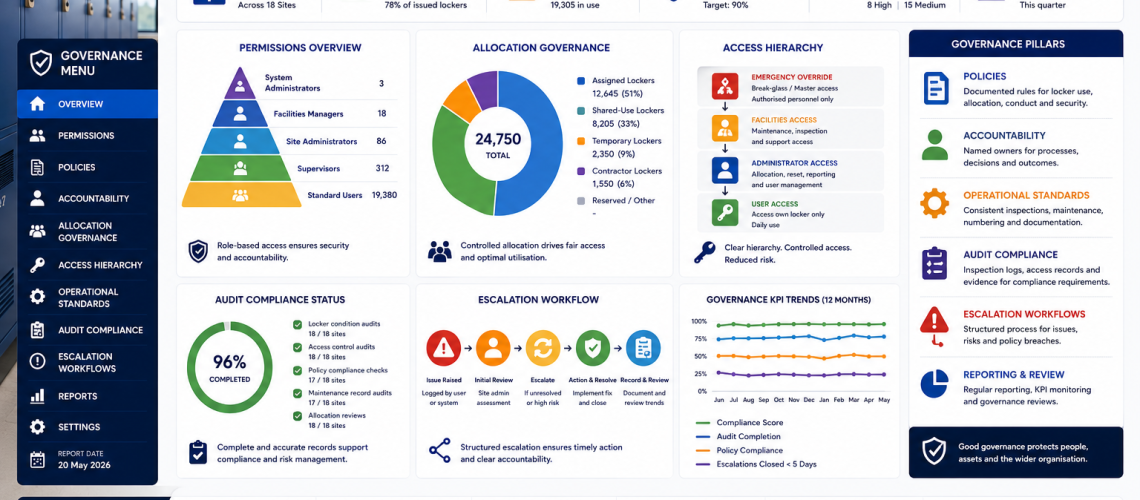
Locker estate governance defines who owns the locker estate, which organisation-wide standards apply, who can approve exceptions, how unresolved issues escalate and how important decisions are recorded and reviewed.
It sits above day-to-day locker administration. Governance does not decide which individual user gets a locker, which administrator may perform a reset or which technician closes a repair job. Instead, it defines the policy, accountability and assurance framework within which those activities take place.
This guide focuses on policy ownership, organisational accountability, minimum standards, approval authority, exception control, escalation, assurance, review and decision records. Detailed access permissions, allocation methods, reporting and multi-site coordination each have their own dedicated pages.
Estate governance defines the rules, owners and escalation routes. Specialist processes then operate within that framework.
Quick Answer: What Is Locker Estate Governance?
Locker estate governance is the organisation-level framework used to control policy, accountability, standards, exception approval and escalation for a locker estate.
| Governance layer | What it controls |
|---|---|
| Ownership | Who is ultimately accountable for the locker estate |
| Policy | Which organisation-wide rules apply |
| Standards | Which minimum operating and data standards must be followed |
| Approval | Who can approve exceptions or major changes |
| Escalation | Where unresolved or material issues go next |
| Assurance | How the organisation checks that agreed controls are being followed |
| Decision record | How important decisions and exceptions are documented |
What This Page Owns, and What It Hands Off
- Estate ownership, policy, standards, exceptions, assurance and escalation: this page
- User, administrator, reset, override and revocation permissions: Locker Access Permissions & Governance UK
- Assigned, shared, hot and temporary operating models: Locker Allocation Systems UK
- Daily administration and onboarding/offboarding: Locker Management Systems UK
- Coordination across several locations: Multi-Site Locker Estate Management UK
- KPI definitions, formulas and targets: Locker KPI & Performance Metrics UK
- Reporting and executive decision packs: Locker Estate Reporting & Decision Systems UK
- Physical audit and condition evidence: Locker Estate Audit UK
- Maintenance workflow and work orders: Locker CAFM Integration UK
- Repair, refurbish or replace decisions: Locker Lifecycle Management Systems UK
- Replacement programme scope and phasing: Locker Replacement Planning UK
Estate Governance vs Access Governance
These two subjects are related but should not be merged.
| Estate Governance | Access Permissions Governance |
|---|---|
| Who owns locker policy | Who may open, reset, override or revoke access |
| Who approves estate standards | Which administrator role can perform which access action |
| Who approves policy exceptions | Who may authorise an emergency or management override |
| How issues escalate organisationally | How access authority is separated and controlled |
| How governance is reviewed | How access permissions are reviewed |
Estate Governance owns the organisational framework. Locker Access Permissions & Governance UK owns the detailed authority model for access actions.
Estate Governance vs Multi-Site Management
Governance and multi-site management also have different jobs.
| Estate Governance | Multi-Site Management |
|---|---|
| Defines policy and authority | Coordinates application across locations |
| Approves standards | Implements approved standards across sites |
| Approves exceptions | Records and manages approved local variation |
| Defines escalation principles | Routes local and regional issues through them |
| Reviews governance effectiveness | Reviews portfolio consistency |
Define the Estate Owner
Every locker estate should have a clearly identifiable organisational owner, even where daily tasks are distributed between departments.
- Facilities management
- Estates
- Workplace services
- School or trust administration
- Healthcare estates
- Site operations
- Property or asset management
The important point is not the job title. It is that responsibility is visible and that other teams know where policy ownership sits.
Define Governance Roles
A governance framework can separate accountability from operational delivery.
| Role | Governance responsibility |
|---|---|
| Estate owner | Accountable for the overall locker framework |
| Policy owner | Maintains organisation-level locker policy |
| Standards owner | Maintains minimum operating and technical standards |
| Exception approver | Approves justified departures from the standard |
| Reporting owner | Ensures governance reports reach the correct audience |
| Local owner | Applies the agreed framework at site level |
| Assurance reviewer | Checks whether agreed controls are being followed |
One person may hold more than one role in a smaller organisation. The important point is that each responsibility has an owner.
Create an Organisation-Level Locker Policy
The estate policy should define the organisation-wide principles that specialist procedures must follow.
- Who owns the locker estate
- Which sites or user groups the policy covers
- Which specialist procedures support the policy
- Which minimum records are required
- Which standards require central approval
- How exceptions are requested
- How unresolved issues escalate
- How governance decisions are recorded
- How often the policy is reviewed
The policy should not try to contain every operational detail. Detailed allocation, access, maintenance and reporting procedures should remain in their specialist owners.
Minimum Estate Standards
Governance can define a minimum level of control that applies across the estate.
- Every locker bank must be identifiable.
- Every site must maintain the agreed minimum asset data.
- Faults must use approved categories.
- Condition assessments must use the approved framework.
- Approved product and lock standards must be followed unless an exception is recorded.
- Material decisions must be documented.
- Unresolved serious issues must have an escalation route.
- Governance reviews must occur at an agreed interval.
The detailed methods behind these standards should remain in Asset Management, Audit, KPI, Access Governance and other specialist pages.
Standards Approval
Governance should define who has authority to approve or change an organisation-wide standard.
- Approved locker families
- Approved lock families
- Asset-identification structure
- Minimum data fields
- Condition framework
- Fault categories
- Reporting requirements
- Escalation thresholds
Changes should not happen informally because one site buys a different product or one team changes terminology.
Exception Governance
Some sites or departments will have legitimate reasons to depart from the normal standard. Governance should control the approval process rather than attempt to eliminate every exception.
| Exception field | Purpose |
|---|---|
| Standard affected | Shows what the request departs from |
| Reason | Explains the operational need |
| Alternative | Shows the proposed solution |
| Impact | Records support, cost or compatibility implications |
| Approver | Records decision authority |
| Review date | Shows whether the exception remains justified |
Examples may include wet-area lockers, specialist PPE storage, charging lockers, accessibility requirements or a local access system that differs from the normal estate standard.
Escalation Governance
Governance should define where unresolved or material issues go when they cannot be closed through the normal process.
| Issue | Possible escalation owner |
|---|---|
| Routine local fault | Local FM / maintenance |
| Repeated component problem | Facilities or technical owner |
| Cross-site recurring issue | Central estate owner |
| Policy exception | Standards or governance owner |
| Material access-control concern | Security / access governance owner |
| Capital decision | Estates / finance / approving group |
| Unresolved material risk | Senior management or relevant governance body |
The trigger should come from the relevant specialist process. Governance owns the route and accountability for escalation.
Decision Authority
Governance should make clear which decisions need which level of approval.
- Routine maintenance approval
- Local specification exception
- Change to an approved lock family
- Change to the organisation’s locker policy
- Major refurbishment programme
- Multi-site replacement programme
- Material capital expenditure
- Change to central data or reporting standards
The detailed commercial, technical or lifecycle case should be prepared by the relevant process. Governance defines who has authority to approve it.
Decision Records
Important governance decisions should be recorded so the organisation can later understand what was approved and why.
- Decision reference
- Date
- Issue considered
- Decision made
- Approver
- Evidence reference
- Conditions attached to approval
- Review date if required
Detailed report structure belongs in Locker Estate Reporting & Decision Systems UK.
Assurance Reviews
Governance should include a way to check whether agreed controls are actually being followed.
- Are estate owners still assigned?
- Are minimum records being maintained?
- Are approved standards being followed?
- Are local exceptions recorded?
- Are overdue decisions visible?
- Are escalation routes being used?
- Are policy and standards still suitable?
An assurance review is not the same as a physical locker audit. The physical condition belongs in Locker Estate Audit UK. Governance assurance checks whether the management framework itself is operating.
Governance Meetings
Where the locker estate is large enough to justify formal review, a governance meeting can focus on issues that require ownership or authority rather than routine maintenance detail.
- Policy changes
- Standards changes
- Outstanding exceptions
- Material unresolved actions
- Recurring cross-site issues
- Major investment decisions
- Data-quality concerns affecting assurance
- Upcoming governance reviews
Routine operational reports should remain in the appropriate facilities or management forum.
Policy Review Cycle
Locker governance should be reviewed when the estate changes materially rather than relying only on a fixed calendar.
- Major change in user population
- New sites or acquisitions
- Move from keys to electronic access
- Introduction of shared or hot lockers
- New CAFM or workplace software
- Major refurbishment or replacement programme
- Recurring exceptions showing that the standard may no longer fit
- Change in organisational ownership
A periodic review can still be useful, but the interval should reflect the organisation rather than an invented universal requirement.
Governance Interfaces With Other Departments
Locker estates often cross departmental boundaries. Governance should define where those interfaces sit.
| Function | Possible governance interface |
|---|---|
| Facilities / Estates | Estate ownership, maintenance, lifecycle and reporting |
| HR / People | Eligibility or employment-status inputs where relevant |
| Security | Access policy, incidents and override governance |
| IT | Connected locker systems, identity integration and platform support |
| Procurement | Approved standards, suppliers and exception routes |
| Finance | Approval levels and capital expenditure |
| Local management | Day-to-day operation and escalation |
Governance should avoid duplicating the detailed procedure owned by each function.
Governance for Multi-Site Estates
Multi-site estates need a clear relationship between central policy and local operation.
- Central owner approves standards.
- Regional or business-unit owners coordinate where required.
- Local owners apply the standards.
- Local exceptions use the agreed approval route.
- Cross-site issues escalate centrally.
- Portfolio reporting uses the same governance definitions.
Detailed coordination across sites belongs in Multi-Site Locker Estate Management UK.
Governance for Healthcare Estates
Healthcare organisations may need locker governance across hospitals, community facilities and staff-changing areas. The governance layer should define organisational ownership, approved standards, exception authority and escalation while leaving the detailed changing-room and storage workflow to the relevant healthcare pages.
For staff-changing planning, use NHS & Healthcare Changing Room Planning UK.
Governance for Education
Schools, colleges and trusts may need clear ownership for locker policy, approved products, exception handling and escalation while retaining local responsibility for pupil allocation, keys and day-to-day administration.
For school locker planning and product requirements, use School Lockers UK.
Governance for Enterprise Workplaces
Enterprise workplaces may combine facilities, HR, security, IT and workplace-services responsibilities. Governance should make ownership and approval routes visible without trying to place every daily locker task into one central team.
For assigned, shared, hot and temporary operating models, use Locker Allocation Systems UK.
Common Locker Estate Governance Mistakes
- Mixing estate governance with access permissions. Keep organisation-level authority separate from reset and override roles.
- Putting every operational procedure into the policy. Keep detailed processes with their specialist owners.
- No named estate owner. Shared responsibility often becomes no responsibility.
- Creating standards without an exception route. Sites will create informal workarounds.
- Allowing exceptions without review. Temporary variation can become permanent drift.
- Using governance meetings for routine maintenance detail. Keep governance focused on authority and unresolved issues.
- Approving major changes without traceable evidence. Link decisions to reports or lifecycle evidence.
- Confusing assurance with physical audit. One checks the management framework, the other checks the physical estate.
- No review trigger. Governance can become outdated as systems and users change.
- No escalation owner. Serious issues remain unresolved because everyone assumes another team owns them.
Locker Estate Governance Checklist
- Is there a named estate owner?
- Is there a named policy owner?
- Are minimum estate standards documented?
- Is standards approval authority clear?
- Is there a controlled exception process?
- Are important exceptions reviewed?
- Are escalation routes documented?
- Are major decisions recorded?
- Can decisions be traced to evidence?
- Is assurance separate from physical audit?
- Are specialist processes clearly handed off?
- Is access governance separate from estate governance?
- Is multi-site coordination separate from policy ownership?
- Are unresolved actions visible?
- Are governance roles reviewed when the organisation changes?
Where Locker Estate Governance Questions Go Next
| Question | Next guide |
|---|---|
| Who may open, reset, override or revoke locker access? | Locker Access Permissions & Governance UK |
| Should lockers be assigned, shared, hot or temporary? | Locker Allocation Systems UK |
| How should day-to-day locker administration work? | Locker Management Systems UK |
| How should several sites apply the same framework? | Multi-Site Locker Estate Management UK |
| How should KPIs be defined? | Locker KPI & Performance Metrics UK |
| How should management reports and decision packs be structured? | Locker Estate Reporting & Decision Systems UK |
| What is the physical condition of the estate? | Locker Estate Audit UK |
| How should maintenance tasks be executed? | Locker CAFM Integration UK |
| Should an asset be repaired, refurbished or replaced? | Locker Lifecycle Management Systems UK |
| How should replacement work be scoped and phased? | Locker Replacement Planning UK |
Locker Estate Governance UK FAQs
What is locker estate governance?
Locker estate governance is the organisation-level framework that defines ownership, policy, minimum standards, exception approval, escalation, assurance and decision accountability for a locker estate.
What is the difference between locker estate governance and access governance?
Estate governance controls organisation-level policy, standards and accountability. Access governance controls who may perform actions such as opening, resetting, overriding or revoking locker access.
Who should own locker estate governance?
Ownership may sit with facilities, estates, workplace services, school or trust administration, healthcare estates or another suitable function. The important point is that accountability is explicit.
Should locker policy contain every operational procedure?
No. The estate policy should define organisation-level principles and ownership while detailed allocation, access, maintenance and reporting procedures remain with their specialist process owners.
How should exceptions to locker standards be managed?
Exceptions should record the standard affected, reason, proposed alternative, operational or support impact, approving authority and any future review date.
What is locker governance assurance?
Governance assurance checks whether agreed policies, ownership, standards, exceptions and escalation controls are being followed. It is different from a physical locker audit.
How does locker governance work across several sites?
Central governance defines policy, standards and approval authority, while multi-site management coordinates how those rules are applied across local sites and regional structures.
Does estate governance decide which lockers should be replaced?
No. Governance defines who has authority to approve major changes. The repair, refurbishment or replacement decision should come from the relevant lifecycle process, with project scope and phasing handled through replacement planning.
Summary
Locker estate governance should remain focused on organisation-level policy, ownership, accountability, standards, exceptions, assurance and escalation.
Keep access permissions with Access Permissions & Governance, allocation models with Allocation Systems, daily administration with Locker Management Systems, site coordination with Multi-Site Management, reporting with Estate Reporting, maintenance execution with CAFM and intervention decisions with Lifecycle Management.
A strong governance framework makes the locker estate easier to control because everyone knows which rules apply, who owns them, who can approve change and where unresolved issues go next.
Discover more from Blog Total Locker Service
Subscribe to get the latest posts sent to your email.