Blog Total Locker Service

Blog storage solutions

Fire Safe Ratings Explained UK: 30, 60, 90 and 120 Minute Guide

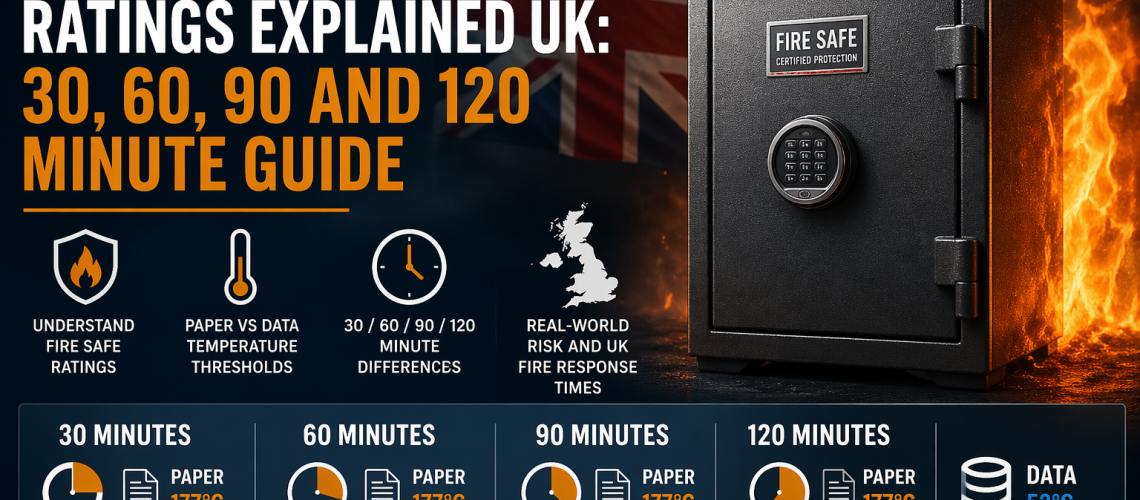
Infographic of UK fire safe ratings showing 30–120 minute protection, paper at 177°C and data at 52°C, with a fireproof safe against flames.

Fire safe ratings show how long a safe or cabinet is designed to protect its contents during a fire. For UK businesses, the right rating depends on what you store, where the safe is installed and whether you need protection for paper documents, digital media, cash or valuables.

A 30-minute fire safe may be enough for some low-risk offices, while a 60-minute, 90-minute or 120-minute model may be more suitable where documents are business-critical, access is restricted, emergency response may take longer or replacement would be difficult.

This guide explains fire safe ratings in plain English. It compares 30, 60, 90 and 120 minute protection, explains the difference between paper and data media protection, and shows why real-world fire risk should shape the final decision.

Quick Answer: What Fire Safe Rating Do I Need?

Many UK businesses choose a 60-minute fire safe as a practical starting point for paper documents. A 30-minute rating may suit lower-risk storage, while 90-minute and 120-minute ratings are better for higher-risk sites, remote buildings, valuable records or contents that would be difficult to replace.

Paper documents, digital media and magnetic media do not all need the same protection. Paper can tolerate higher temperatures than USB drives, hard drives, backup tapes and other data media, so a standard document safe is not always suitable for digital storage.

Stored contentsTypical protection needBest product type
Paper documentsProtection from heat and flamesFire safe or fire-resistant cabinet
USB drives and hard drivesLower internal temperature protectionData safe
Backup tapes or magnetic mediaVery low temperature and humidity controlSpecialist media safe
Cash and valuablesFire resistance plus theft resistanceFire and security safe
Fire safe ratings should be matched to the contents, not just the size of the safe.

The most important rule is simple: choose the rating around the contents you cannot afford to lose.


What Fire Safe Ratings Mean

A fire safe rating usually describes the period of time the safe has been tested to protect its contents under controlled fire conditions. Common ratings include 30 minutes, 60 minutes, 90 minutes and 120 minutes.

The rating does not mean the outside of the safe stays cool. In a fire, the external temperature can become extremely high. The purpose of the safe is to slow heat transfer and keep the internal environment within a safer range for the contents inside.

That distinction matters because contents fail at different temperatures. Paper documents are far more tolerant of heat than some digital media. A safe that protects paper may still become too hot for drives, discs or tapes.

Fire rating should therefore be read alongside three other factors: the type of contents, the fire test standard and the location where the safe will be installed.

Fire duration

The duration tells you how long the product is designed to provide protection during the test period. A 60-minute fire safe is designed to protect for longer than a 30-minute fire safe, but that does not automatically make it the right choice for every site.

Internal temperature

The internal temperature limit is just as important as the duration. Paper protection, data protection and media protection may involve different temperature thresholds. Always check what the rating is protecting, not just the number of minutes.

Certification and testing

Certified products are tested under defined conditions. When comparing safes, check the test standard, duration, contents type and any additional claims such as drop resistance, water resistance or security rating.


Paper vs Data: Why Contents Matter

The biggest mistake when choosing a fire safe is assuming that all contents need the same level of protection. Paper files, certificates, deeds, contracts, USB drives, hard drives and backup tapes behave differently during a fire.

A paper document safe is designed around the protection of paper records. This may be suitable for contracts, personnel records, accounts, policies, certificates, property documents and other printed records.

Digital media needs more careful treatment. Drives, discs, USB sticks and other media can fail at lower temperatures than paper. Some media may also be affected by humidity, steam and rapid temperature changes.

If you store digital backups inside a standard document safe, you may have fire protection for paper but not the correct protection for the media. In that case, a data safe or specialist media safe is usually the safer option.

Content typeRisk during fireRecommended approach
Paper documentsCharring, ignition and heat damageDocument fire safe or fire-resistant cabinet
USB drives and hard drivesHeat damage and data lossData-rated safe
Backup tapesHeat, humidity and magnetic media damageSpecialist media safe
Cash and valuablesFire damage plus theft riskFire safe with suitable security rating
The correct safe depends on whether you are protecting documents, data, media or valuables.

For many businesses, the best answer is not one safe for everything. A fire-resistant filing cabinet may store active paper records, while a smaller data safe protects backup drives and a security-rated fire safe protects valuables.

For a wider comparison of storage type, see our guide to choosing between a fire safe and a fire-resistant filing cabinet.


30 Minute Fire Safes

A 30-minute fire safe is designed for shorter-duration fire protection. It can be suitable for lower-risk environments where the building has good fire detection, clear evacuation routes, fast response expectations and contents that are important but not mission-critical.

This rating is often considered for small offices, home offices, reception areas, branch locations and storage of duplicate documents. It may also suit documents that are backed up elsewhere or can be replaced without major business interruption.

The main advantage is cost and size. Many 30-minute fire safes are compact, easier to position and more affordable than higher-rated models. For businesses with limited storage needs, that may make them practical.

The limitation is protection margin. Real fires are unpredictable. Heat build-up, delayed discovery, access difficulties and building layout can all increase risk. A 30-minute safe should not be treated as a universal solution.

When a 30-minute fire safe may be suitable

  • Small quantities of paper records
  • Documents with digital backups
  • Low-risk office environments
  • Sites with good fire detection and management procedures
  • Home office storage for passports, policies and certificates

When to consider a higher rating

  • Original records are difficult to replace
  • The building is remote or response could be delayed
  • The safe is in a higher-risk area
  • The contents include critical contracts, deeds or business records
  • The contents include digital media

In simple terms, 30 minutes can be useful for basic protection, but it should be chosen deliberately rather than because it is the cheapest option.


60 Minute Fire Safes

A 60-minute fire safe is a common choice for business document protection. It provides a stronger margin than a 30-minute safe while still remaining practical for many offices, shops, healthcare settings, education environments and professional practices.

For many UK organisations, 60-minute protection is a sensible baseline for important paper records. It offers additional time for discovery, response and fire control, while avoiding the size and cost increase that can come with some higher-rated models.

A 60-minute fire safe may be suitable for contracts, certificates, personnel records, insurance documents, business continuity records, accounts records and key operational files.

However, the same content rule applies. A 60-minute paper fire safe is not automatically a 60-minute data safe. If the safe is intended for USB drives, hard drives or backup media, confirm the data protection rating before ordering.

When a 60-minute fire safe is a strong choice

  • Important paper documents are stored on site
  • Records need better protection than a basic fire safe can offer
  • The business wants a practical balance of cost, rating and size
  • The safe is part of a wider business continuity plan
  • Contents are valuable but not necessarily irreplaceable

60 vs 30 minute fire safes

The difference between 30 and 60 minutes is not just double the time. It is also a larger safety margin. If a fire starts outside working hours, if detection is delayed or if the safe is located away from the entrance, the extra rating may matter.

For many businesses, 60 minutes is the point where fire protection begins to feel suitable for meaningful operational records rather than basic personal or duplicate document storage.


90 Minute Fire Safes

A 90-minute fire safe sits between common 60-minute and 120-minute options. It is useful where a business wants a higher protection margin but does not necessarily need a full two-hour rating.

This rating can be useful for sites where fire detection is good but the contents are especially important. It can also suit locations where access for emergency services may be more difficult, such as larger buildings, multi-floor premises, rural sites or industrial estates.

A 90-minute safe may be considered for original contracts, legal documents, financial records, sensitive HR files, insurance records, title documents and operational continuity packs.

The main question is whether the added protection justifies the extra size, weight and cost. For documents that can be replaced easily, a 90-minute rating may be more than the business needs. For documents that are hard to replace, it may be a sensible upgrade.

When 90 minutes may be justified

  • The documents are important to business continuity
  • The site has a higher fire-risk profile
  • The building layout could delay firefighting access
  • The business is located in a more remote area
  • Replacement of records would be costly or slow

A 90-minute rating is often about risk tolerance. It gives more margin than 60 minutes without always moving to the largest or heaviest product category.


120 Minute Fire Safes

A 120-minute fire safe provides two-hour fire protection under the relevant test conditions. This rating is often chosen where the stored contents are critical, irreplaceable, high-value or linked to legal, financial or operational continuity.

For some businesses, a 120-minute safe may appear excessive at first. However, fire risk is not only about flame exposure. It also includes delayed discovery, building layout, surrounding materials, fire load, access routes, firefighting water, heat soak and post-fire conditions.

A higher-rated safe gives more time and a stronger protection margin. That can be valuable when contents include original documents, long-retention records, high-value papers, sensitive archives or records needed immediately after an incident.

The trade-off is usually cost, size and weight. Two-hour fire safes can be heavier and harder to position. Before ordering, check delivery access, floor loading and final placement.

When a 120-minute safe makes sense

  • Documents are original, critical or difficult to replace
  • The building has a higher fire load
  • The safe is installed in a remote or harder-to-access location
  • The organisation has strict continuity requirements
  • The cost of losing the contents is much higher than the cost difference

60 vs 120 minute fire safe

The choice between a 60-minute and 120-minute fire safe should be based on risk and consequence. A 60-minute safe may suit many business environments. A 120-minute safe is more appropriate where the consequences of loss are severe or where site conditions increase uncertainty.

If the contents are replaceable and the site has strong fire management, 60 minutes may be enough. If the contents are irreplaceable, needed for recovery or stored in a higher-risk location, 120 minutes may be the safer long-term choice.

Decision factor60-minute safe120-minute safe
Typical useImportant business documentsCritical or irreplaceable records
CostUsually lowerUsually higher
WeightOften easier to positionMay need more installation planning
Protection marginStrong practical baselineHigher-risk or higher-value storage
A 60-minute safe is often a practical business baseline, while a 120-minute safe offers a stronger protection margin.

Real-World Risk and UK Fire Response Times

Fire safe ratings should not be chosen in isolation. Real-world risk depends on how quickly a fire is discovered, how fast emergency services can arrive, where the fire starts, how the building is laid out and what materials are burning nearby.

Published UK fire statistics show that response times are measured in minutes, not seconds. In England, the average total response time to primary fires was reported as 9 minutes and 23 seconds in the year ending September 2025. Dwelling fires averaged 8 minutes and 13 seconds over the same period.

Those figures do not mean a fire safe only needs to protect contents for that period. Response time is only one part of the event. A fire may burn before it is discovered, emergency crews need time to assess and act, and heat can remain dangerous even after active flames are reduced.

For business premises, additional factors can increase the need for a higher rating. Out-of-hours fires may not be noticed quickly. Locked buildings may delay access. Industrial units may contain higher fire loads. Rural or edge-of-town locations may have longer travel times than urban premises.

Why response time does not equal safe rating

A 60-minute rating does not mean the fire service is expected to take 60 minutes to arrive. It means the safe has been tested to provide a defined level of protection under fire conditions for that period.

The extra time creates a buffer. That buffer helps cover delayed discovery, delayed access, fire spread, heat soak and post-fire conditions. This is why a business may choose 60, 90 or 120 minutes even if local fire response is normally much faster than that.

Business risk factors to consider

  • Is the building occupied throughout the day?
  • Could a fire start outside working hours?
  • Is there automatic fire detection?
  • Is the safe close to an exit or deep inside the building?
  • Is the site rural, industrial or difficult to access?
  • Are the contents original, sensitive or hard to replace?
  • Does the business need the contents immediately after an incident?

The more questions that raise concern, the stronger the case for a higher fire rating.


Fire Safe Standards and Certification

Fire safe certification helps you compare products more reliably. Rather than relying only on marketing descriptions such as fireproof or fire-resistant, look for stated standards, test duration and contents type.

Common references in the UK market include standards for document protection and data protection. These may include European or international test standards depending on the product range and manufacturer.

When reviewing specifications, check whether the safe is rated for paper, data media or both. Also check the stated duration, internal temperature limit, any drop test claims and whether the safe also carries a cash or security rating.

What to look for on a specification

  • Fire rating duration, such as 30, 60, 90 or 120 minutes
  • Contents type, such as paper documents or data media
  • Test standard or certification reference
  • Internal capacity and usable storage space
  • Lock type and access control
  • Cash rating or security rating where theft protection matters
  • Weight, external dimensions and installation requirements

If a product only says fireproof but does not clearly explain the rating, duration or content type, treat the claim cautiously. Precise specifications matter because the wrong safe can give a false sense of protection.


How to Choose the Right Fire Safe Rating

Choosing the right fire safe rating is not only a product decision. It is a risk decision. The correct rating depends on the value of the contents, the difficulty of replacement, the building risk and the role the contents play in recovery after a fire.

Step 1: Identify what you are storing

List the actual contents before choosing a safe. Separate paper documents, data media, cash, valuables and items that need restricted access. This prevents one product being used for several incompatible storage needs.

Step 2: Decide how replaceable the contents are

If a document can be downloaded again, the risk may be lower. If it is original, signed, legal, sensitive or needed for continuity, the risk is higher. Higher consequence usually justifies a stronger rating.

Step 3: Consider the building

Building layout, occupancy pattern, fire detection, surrounding materials and access routes all matter. A safe in a small staffed office is not the same risk as a safe in a remote warehouse or storage area.

Step 4: Check installation practicalities

Higher-rated safes may be heavier. Before ordering, check doorway widths, stairs, lifts, floor loading and where the safe will sit. A safe should be practical to deliver, position and use.

Step 5: Match fire protection with security

If the contents include cash, valuables or sensitive records, fire rating alone may not be enough. You may need a safe that also provides suitable theft resistance, locking control and insurance acceptance.

Risk levelTypical contentsPossible rating approach
LowerDuplicate documents, low-value records30 or 60 minutes
MediumBusiness records, accounts, HR files60 minutes
HigherOriginal documents, legal records, continuity files90 or 120 minutes
SpecialistData media, tapes, backup drivesData or media safe
Use content value and replacement difficulty to guide the fire safe rating.

Common Mistakes When Comparing Fire Safe Ratings

  • Choosing by minutes alone: the rating must match the contents, not just the duration.
  • Storing data media in a paper safe: digital media may need a specialist data safe.
  • Ignoring installation weight: higher-rated safes may need delivery and floor loading checks.
  • Assuming all fire safes resist theft: fire resistance and burglary resistance are separate considerations.
  • Buying too small: overfilled safes are harder to use and may lead staff to store items elsewhere.
  • Forgetting business continuity: the most important records are often the ones needed immediately after an incident.

Most mistakes happen when a safe is chosen by price, size or headline duration alone. A better method is to work backwards from the contents and the consequences of loss.


Frequently Asked Questions

What does a fire safe rating mean?

A fire safe rating shows how long the safe is designed to protect specific contents during a fire test. The rating should be checked alongside the content type, such as paper documents or data media.

Is a 60-minute fire safe enough?

A 60-minute fire safe is a practical baseline for many business environments. However, higher-risk sites, critical documents or hard-to-replace records may justify a 90-minute or 120-minute safe.

What is the difference between a 60-minute and 120-minute fire safe?

A 120-minute safe offers a longer protection period and a larger safety margin than a 60-minute safe. It is usually better for critical, original or difficult-to-replace records, but may be larger, heavier and more expensive.

Can I store USB drives in a fire safe?

Only if the safe is suitable for data media. Standard document fire safes are designed for paper protection and may become too hot for USB drives, hard drives or backup media.

Do fire safes protect against theft?

Some fire safes also provide theft protection, but fire resistance and theft resistance are separate ratings. If cash or valuables are stored inside, check the security or cash rating as well as the fire rating.

Is a fire-resistant filing cabinet the same as a fire safe?

No. Fire-resistant filing cabinets are usually designed for high-volume paper storage and frequent access. Fire safes are usually better for smaller volumes, valuables and higher-security storage.

What fire safe rating is best for business records?

Many business records suit 60-minute protection, but critical or irreplaceable files may need 90 or 120 minutes. The right rating depends on how valuable, sensitive and replaceable the records are.

Should I choose a fire safe or a data safe?

Choose a document fire safe for paper records. Choose a data safe or specialist media safe for digital media, backup drives, tapes and other heat-sensitive storage.


Conclusion: Match the Rating to the Risk

Fire safe ratings are not just numbers. They are a way of matching protection time, content type and business risk. A 30-minute safe may suit lower-risk storage, a 60-minute safe may suit many everyday business records, and a 90 or 120-minute safe may be better where contents are critical or hard to replace.

The most important step is to identify what you are storing. Paper documents, digital media, cash and valuables may all need different forms of protection. A standard fire safe is not always a data safe, and a fire rating is not always a security rating.

For most UK businesses, the best decision comes from balancing contents, fire duration, building risk, access needs, security requirements and installation practicalities.

For wider protection planning, these guides help compare fire safes, cabinets, data protection and secure business storage.

“`

[1]: https://www.gov.uk/government/statistics/fire-and-rescue-incident-statistics-year-ending-september-2025/fire-and-rescue-incident-statistics-year-ending-september-2025?utm_source=chatgpt.com “Fire and rescue incident statistics, year ending September …”


Discover more from Blog Total Locker Service

Subscribe to get the latest posts sent to your email.