Keyed vs Digital Fire Safes: Fire Safe Lock Types Guide UK
April 26, 2026
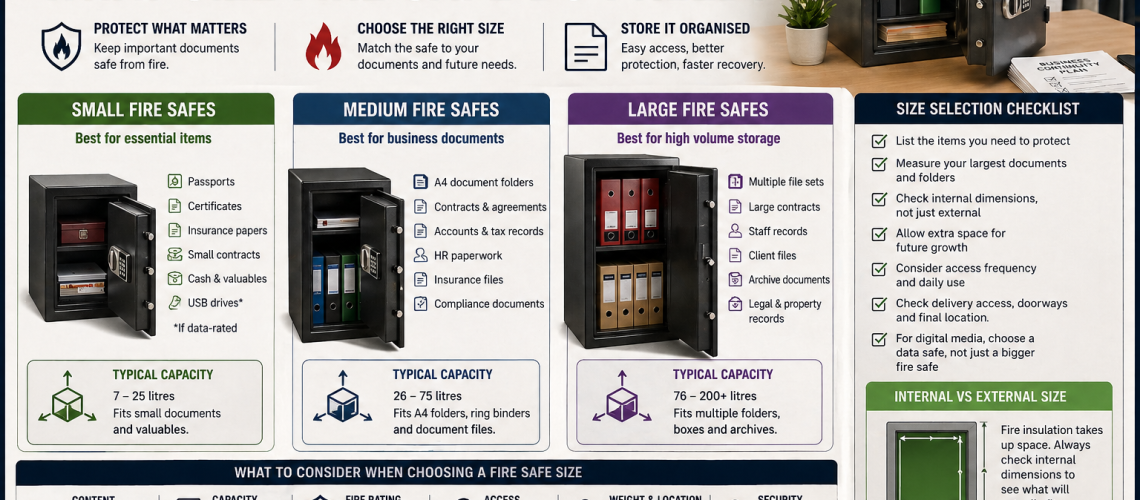
The right fire safe size depends on the usable internal space, the largest documents or binders you need to store and how much capacity you expect to need later. External dimensions alone can be misleading because fire insulation takes up a substantial part of the cabinet body.
This guide focuses on the capacity and dimensions question: internal vs external size, quoted litres, A4 folders and binders, shelf layout, spare capacity, document measurement and when a larger filing cabinet becomes more practical than a conventional fire safe.
For fire-rating interpretation, use the Fire Safe Ratings UK guide. For the safe vs filing-cabinet decision, use Fire Safe vs Fire-Resistant Filing Cabinet.
Quick Answer: What Size Fire Safe Do I Need?
Start with the largest item you need to store, check the safe’s internal height, width and depth, then allow extra capacity for future documents. Do not choose from external dimensions alone, and do not rely on quoted litres without checking the internal layout.
- Measure the largest folder, binder or document pack.
- Check the internal dimensions, not only the external cabinet size.
- Confirm A4 folders and lever-arch files fit in the required orientation.
- Check shelf positions and clearances.
- Allow room for future records rather than filling the safe on day one.
Internal vs External Fire Safe Dimensions
Fire safes have insulated walls, doors and structural layers designed to slow heat transfer. This means the usable space inside can be much smaller than the external footprint suggests.
When comparing sizes, treat the two measurements separately:
- External dimensions: tell you whether the safe will fit in the room and whether it can be delivered through the building.
- Internal dimensions: tell you whether the actual documents, folders and binders will fit.
A safe can appear generous externally while still having a relatively compact interior. Internal dimensions therefore matter more for storage capacity.
Why Fire Insulation Reduces Usable Space
Unlike an ordinary storage cabinet, a fire safe needs insulated construction around the protected compartment. That wall thickness reduces the difference between the outside size and the space available inside.
This is why two safes with similar external dimensions can have noticeably different internal capacities. Always compare the usable interior rather than assuming a larger outside case automatically provides proportionally more document space.
Quoted Litres vs Usable Capacity
Manufacturers may quote capacity in litres, which is useful for comparing overall internal volume. However, litres do not tell you whether a particular binder, folder or document box will fit.
A safe with a larger litre figure can still be unsuitable if the internal width, depth or shelf spacing does not match the items you need to store.
| Measure | Useful for | Limitation |
|---|---|---|
| Quoted litres | Comparing overall internal volume | Does not show document orientation or shelf fit |
| Internal width | Checking folders, binders and document boxes | Must be considered with depth and shelf layout |
| Internal depth | Checking A4 files, folders and binders fit properly | Can be reduced by door or internal fittings |
| Internal height | Checking shelf spacing and stacked storage | Depends on shelf positions and internal fittings |
Will A4 Files, Folders and Binders Fit?
A4 paper itself is compact, but folders and binders are larger than the sheet size they contain. This is where many sizing mistakes happen.
- Loose A4 sheets: usually need relatively little depth.
- A4 folders: require more width and depth than the paper alone.
- Lever-arch files: need enough height, width and shelf depth to fit without forcing the spine or cover.
- Document wallets and archive files: may be wider or deeper than standard office folders.
Measure the actual item, not the nominal paper size. If documents must remain flat or binders must stand upright, check those dimensions directly against the safe interior.
Measure the Largest Item Before Buying
The safest sizing method is to identify the largest object that must fit inside and measure it before comparing products.
- Largest lever-arch file
- Largest document wallet
- Largest certificate folder
- Largest archive box or file bundle
Then add clearance so the item can be inserted and removed without forcing it past the door frame, shelf edge or internal fittings.
Shelf Spacing and Internal Layout
Capacity is not only about the size of the empty compartment. Shelves, trays and internal fittings determine how efficiently that volume can be used.
- Check whether shelves are fixed or adjustable.
- Check the clear height between shelves.
- Confirm binders can stand upright if that is how staff will store them.
- Check whether removing a shelf improves capacity for taller files.
- Look for projections, lock housings or door fittings that reduce usable space.
A well-arranged smaller safe can sometimes hold documents more effectively than a nominally larger model with a less suitable internal layout.
How Much Spare Capacity Should You Allow?
A fire safe should not be full on the day it is installed. Protected paper records often grow over time, particularly contracts, accounts, HR files and compliance paperwork.
Allow enough spare space for foreseeable growth while avoiding unnecessary oversizing.
- Estimate how many new files are added each year.
- Consider retention periods for existing records.
- Allow room for new contracts, accounts and personnel records.
- Keep enough clearance for files to be removed without unpacking the whole safe.
The aim is usable growth capacity, not empty space for its own sake.
When Is a Compact Fire Safe Enough?
A compact fire safe can be enough where the protected paper records are limited in quantity and the largest items fit comfortably within the internal dimensions.
- A small set of certificates or policies
- A limited number of contracts or original documents
- Several document wallets rather than a full filing system
- Records with slow expected growth
The key test is not whether the safe is labelled small or compact. It is whether the actual contents fit properly with useful spare capacity.
When Do You Need a Larger Fire Safe?
A larger safe becomes more practical when the business needs to store several folders, binders or document sets and those items still suit shelf-based storage.
- Several A4 binders or lever-arch files
- Multiple contract or account folders
- Several categories of business records
- Higher expected document growth
If the records become numerous enough that staff are effectively creating a working filing system inside the safe, that is the point to consider whether drawer-based fire-resistant filing is more practical.
When Is a Fire-Resistant Filing Cabinet More Practical?
A fire-resistant filing cabinet may be more practical when capacity is driven by large numbers of active paper files rather than a smaller collection of critical documents.
Drawer-based storage can make better use of space where records need to remain organised and frequently accessed. This page only flags that capacity threshold; the detailed comparison belongs in the Fire Safe vs Fire-Resistant Filing Cabinet guide.
Size, Weight and Delivery Implications
As capacity increases, the safe will usually become larger and heavier. This matters because a model that fits the documents still needs to reach the final position.
- Check external width against doorways and corridors.
- Check overall height for lifts, landings and restricted access points.
- Check weight where floors, stairs or lifts may impose limits.
- Allow enough room for the safe door to open fully.
These are sizing consequences rather than separate installation decisions. A larger capacity is only useful if the safe can be delivered and positioned successfully.
Common Fire Safe Sizing Mistakes
- Choosing by external dimensions: the internal compartment is what determines usable storage.
- Relying on litres alone: volume does not prove a binder or folder will fit.
- Measuring A4 paper instead of the folder: office files are larger than the sheets they contain.
- Ignoring shelf spacing: internal fittings can make a nominal capacity difficult to use.
- Buying with no growth allowance: a safe that starts full has no useful future capacity.
- Using a conventional safe for a filing-system-sized workload: high-volume active files may be more practical in a fire-resistant filing cabinet.
- Ignoring delivery dimensions: the selected capacity still has to fit through the building.
Fire Safe Size Checklist
- List the paper records that need protected storage.
- Measure the largest folder, binder or document pack.
- Check internal height, width and depth.
- Check shelf positions and usable clearances.
- Use litres only as a secondary comparison.
- Allow capacity for future records.
- Decide whether shelf storage is still practical at the required volume.
- Check external dimensions and weight against the delivery route.
Compare Fire Safe Sizes and Cabinets
Total Locker Service supplies fire-protected storage in a range of sizes for commercial paper records. Check each product’s internal dimensions, capacity, shelf layout, external dimensions and weight before ordering.
- Fireproof Safes and Cabinets – compare fire-protected storage ranges and sizes.
- 4-Drawer Fire-Resistant Filing Cabinet – drawer-based protected storage where paper-file volume is high.
Frequently Asked Questions
Should I choose a fire safe by internal or external dimensions?
Use the internal dimensions to confirm that your folders, binders and documents will fit. Use the external dimensions to confirm that the safe will fit the room and delivery route.
Are quoted litres enough to choose a fire safe?
No. Litres are useful for comparing overall volume, but you should also check the internal height, width, depth and shelf arrangement against the actual items you need to store.
Will A4 folders fit in a compact fire safe?
Not always. Measure the actual folder or binder and compare it with the internal dimensions. A4 folders and lever-arch files are larger than the sheets they contain.
How much spare capacity should I allow?
Allow enough room for foreseeable record growth and for documents to be removed easily. Avoid choosing a safe that will be full as soon as it is installed.
When is a fire-resistant filing cabinet more practical than a larger safe?
A fire-resistant filing cabinet can be more practical when the storage requirement consists of large volumes of active paper files that need organised drawer access rather than shelf storage.
Conclusion: Size the Safe Around the Documents, Not the Cabinet
The right fire safe size comes from the actual records you need to store. Measure the largest folders and binders, check the internal dimensions and shelf layout, then allow sensible spare capacity for future growth.
Use external dimensions and weight to confirm the product can be delivered and positioned. If the required capacity becomes large enough to resemble an active filing system, consider whether a fire-resistant filing cabinet is the more practical format.
Related Guides
Discover more from Blog Total Locker Service
Subscribe to get the latest posts sent to your email.