Office Fire Protection: What Should You Actually Protect?
April 26, 2026
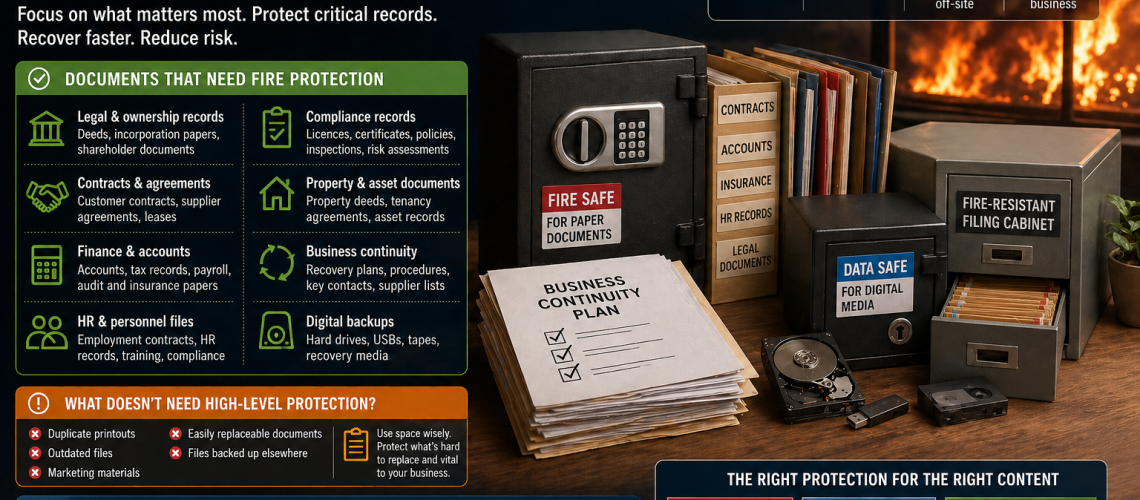
Office fire protection should focus on the documents, records and digital assets that would be difficult, costly or impossible to replace after a fire. Not every item needs the same level of protection, so the best approach is to prioritise what matters most.
A fire can damage more than the building. It can destroy contracts, accounts, staff records, certificates, insurance papers, backup drives and business continuity documents. Some records can be replaced. Others may delay recovery, create compliance problems or leave the business exposed.
This guide explains what documents need fire protection, which items usually matter most and how to choose between a fire safe, data safe and fire-resistant filing cabinet.
What should an office protect from fire?
An office should protect records that support legal ownership, finance, compliance, staff management, customer service and business recovery. These are the items that may be hard to reconstruct after a fire.
The aim is not to lock away every piece of paper. Instead, fire protection should cover the records that carry the highest consequence if lost.
Specification consequence: choose fire protection by replacement difficulty and business impact, not by volume alone.
Documents that usually need fire protection
Most offices should review the following categories first. The exact list depends on the business type, sector and legal responsibilities.
- Company records: incorporation documents, shareholder records, partnership agreements and ownership papers.
- Contracts: signed customer agreements, supplier contracts, leases and service agreements.
- Finance records: accounts, tax records, audit papers, payroll records and insurance documents.
- HR records: employment contracts, disciplinary records, training evidence and sensitive staff files.
- Property documents: deeds, tenancy agreements, asset records and warranty documents.
- Compliance records: inspection reports, certificates, risk assessments and statutory documents.
- Business continuity plans: emergency contacts, recovery procedures and critical supplier details.
- Digital backups: hard drives, USB drives, tapes and portable recovery media.
Key takeaway: protect records that prove rights, obligations, ownership, compliance or recovery capability.
What matters most after an office fire?
After a fire, the most important records are the ones that help the business recover quickly. Insurance papers, customer commitments, staff records, financial information and recovery plans can all affect how fast normal operations resume.
Some documents are important because they prove a legal position. Others matter because they keep the business moving. A practical fire protection plan should consider both.
| Priority level | Protect first | Why it matters |
|---|---|---|
| High | Legal, insurance, finance and ownership records | Hard to replace and critical after a fire |
| High | Business continuity plans and emergency contacts | Needed immediately during recovery |
| High | Digital backups and recovery media | May be essential for restoring systems |
| Medium | Current HR and customer records | Important for continuity and compliance |
| Medium | Product, asset and warranty records | Useful for claims, repairs and replacement |
| Low | Copies, outdated files and easily replaced paperwork | Usually lower business impact |
This priority approach helps avoid overspending on low-value storage while under-protecting the records that matter most.
Paper documents vs digital media
Paper and digital media need different forms of fire protection. A fire safe designed for documents may not be suitable for hard drives, USB drives or backup tapes.
Paper records need protection from heat, flames, smoke and water. Digital media needs tighter internal temperature and humidity control because electronic and magnetic storage can fail at lower temperatures.
Specification consequence: use a document fire safe for paper records and a data safe for digital backups.
What does not always need fire protection?
Not every office item needs to be stored in a fire safe. Many records are already digital, duplicated elsewhere or easy to reproduce from suppliers, banks, accountants or cloud systems.
Items that may not need high-level fire protection include spare stationery, duplicate printouts, obsolete files, general marketing material, old drafts and documents already backed up securely elsewhere.
This does not mean those items have no value. It means they may not justify taking up limited fire-rated storage space.
How to decide what needs protection
A simple risk test can help decide what belongs in fire-rated storage. For each item, ask what would happen if it was destroyed overnight.
- Can the item be replaced quickly?
- Is there a verified copy elsewhere?
- Would losing it delay an insurance claim?
- Could losing it create a legal or compliance problem?
- Would it stop payroll, customer service or operations?
- Does it support disaster recovery?
If the loss would create serious cost, delay, exposure or disruption, the item should be considered for fire protection.
Choosing between a fire safe, data safe and filing cabinet
The right product depends on what you are protecting. Small volumes of important paper documents usually suit a fire safe. Digital media should be stored in a data safe. Large volumes of active paperwork may need a fire-resistant filing cabinet.
| Protection type | Best for | Typical use |
|---|---|---|
| Document fire safe | Small to medium volumes of critical paper records | Contracts, deeds, certificates, accounts and insurance files |
| Data safe | Digital media and recovery backups | Hard drives, USB drives, memory cards and backup tapes |
| Fire-resistant filing cabinet | Large volumes of paper documents | Active files, client records, HR folders and office records |
Key takeaway: choose the storage type by content, access need and recovery impact.
Business fire protection essentials
Fire-rated storage is only one part of office fire protection. A stronger plan combines prevention, protection, backup and recovery procedures.
- Use fire-rated storage for critical records.
- Keep digital backups in suitable data-rated protection.
- Store separate backup copies off-site or in secure cloud systems.
- Review document retention and remove obsolete files.
- Keep emergency contacts and insurance details accessible.
- Train staff on what must be protected and where it belongs.
The aim is continuity. A business should be able to prove, claim, restore and operate after a fire with minimum delay.
Common mistakes in office fire protection
- Protecting too much low-value paperwork while missing critical records.
- Storing backup drives in a standard paper fire safe.
- Choosing a safe by size without checking the fire rating.
- Keeping all copies of important records in the same building.
- Forgetting that water and smoke can damage records even without direct flames.
- Not reviewing the contents of the safe as the business changes.
Most mistakes happen because storage is treated as a capacity issue rather than a recovery issue. Fire protection should always start with consequence.
Final thoughts
Office fire protection should focus on the records that keep the business legally protected, financially stable and able to recover. The most important items are usually legal documents, insurance records, financial papers, HR files, continuity plans and digital backups.
Use a document fire safe for critical paper records, a data safe for digital media and a fire-resistant filing cabinet for larger volumes of active paperwork. By protecting what matters most, a business avoids wasting space on replaceable items while reducing the real risk of disruption after a fire.
FAQs
What documents need fire protection in an office?
Offices should protect legal documents, insurance papers, finance records, HR files, contracts, property documents, compliance records and business continuity plans.
Do all business documents need to go in a fire safe?
No. Fire-rated storage should be prioritised for documents that are hard to replace or would cause serious disruption if lost. Duplicate, obsolete or easily replaceable paperwork may not need the same level of protection.
Should digital backups be kept in a fire safe?
Digital backups should usually be kept in a data safe, not a standard paper fire safe. Data media needs tighter temperature and humidity control than paper documents.
What is the best fire protection for office records?
The best option depends on the records. Use a document fire safe for critical paper files, a data safe for backup media and a fire-resistant filing cabinet for larger volumes of paperwork.
How often should office fire protection be reviewed?
Office fire protection should be reviewed at least once a year, or whenever the business changes its systems, premises, records, insurance requirements or backup arrangements.
“`
Discover more from Blog Total Locker Service
Subscribe to get the latest posts sent to your email.