Data Safes vs Fire Safes UK: Media Temperature Limits and Digital Storage Protection Guide
April 24, 2026
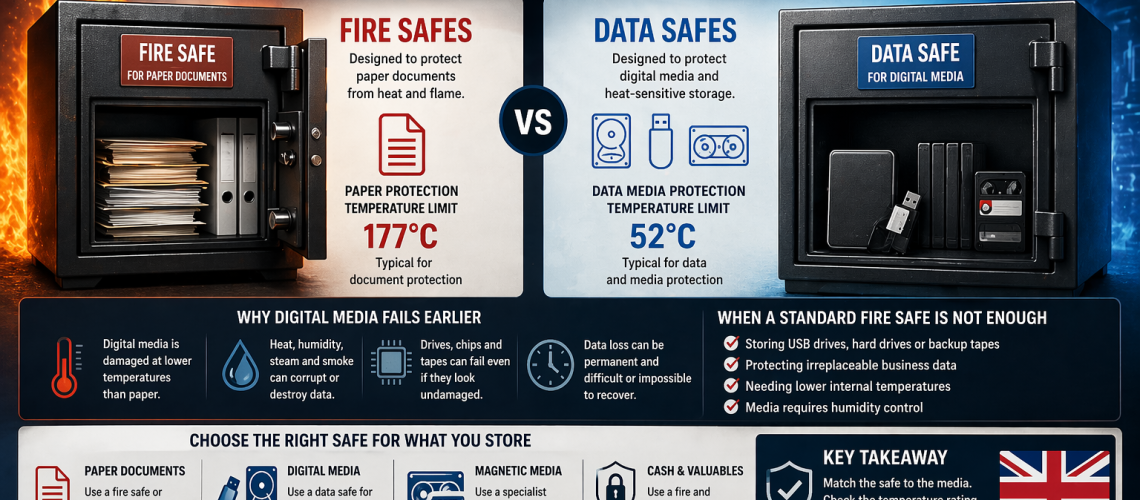
Data safes and fire safes are not always the same thing. A standard fire safe may protect paper documents during a fire, but digital media can fail at much lower temperatures. If you store USB drives, hard drives, backup tapes or other media, you need to check whether the safe is rated for data protection, not just document protection.
The key difference is internal temperature. Paper documents can tolerate higher heat than data media. A fire safe designed for paper may allow internal temperatures that are too high for drives, tapes, discs or other heat-sensitive storage.
This guide explains the difference between data safes and fire safes, why digital media fails earlier, what media safe temperature limits mean and when a standard fire safe is not enough.
Quick Answer: Data Safe or Fire Safe?
Choose a standard fire safe for paper documents. Choose a data safe or media safe for USB drives, hard drives, backup tapes, discs, memory cards and other digital media. Digital media can be damaged at lower temperatures than paper, so a document fire safe is not always suitable.
| Stored item | Typical choice | Main reason |
|---|---|---|
| Paper files and contracts | Document fire safe or fire-resistant cabinet | Designed around paper fire protection |
| USB drives and hard drives | Data safe | Requires a lower internal temperature limit than paper |
| Backup tapes and sensitive media | Data or specialist media safe | May require tighter temperature and humidity control |
| Cash and valuables | Security safe, with fire protection where required | Theft resistance and fire resistance are separate specifications |
For a broader explanation of fire durations, see our Fire Safe Ratings UK guide.
If the requirement is specifically for USB drives, hard drives, backup tapes or other digital media, compare the commercial data safe range.
What Is a Fire Safe?
A fire safe is designed to protect contents from heat and flame for a stated period. Common ratings include 30, 60, 90 and 120 minutes. The rating should always be checked against the content type it is designed to protect.
Many standard fire safes are designed around paper document protection. This makes them suitable for contracts, certificates, deeds, personnel records, financial records, business continuity documents and other paper files.
The important limitation is that a paper-rated safe may not keep the internal temperature low enough for data media. The safe may succeed at protecting documents while still allowing enough heat to damage digital storage.
Good uses for a standard fire safe
- Paper documents
- Business records
- Certificates and deeds
- Insurance documents
- Cash and valuables, where the safe also has suitable security protection
If the safe is being used for both paper and valuables, check the fire rating and the security or cash rating. Fire resistance and theft resistance are separate protections.
What Is a Data Safe?
A data safe is designed to protect heat-sensitive media during a fire by keeping the internal environment within a lower temperature range than a standard document fire safe. Depending on the tested standard and product, humidity limits may also form part of the protection requirement.
Data safes are used for USB drives, hard drives, memory cards, discs, backup tapes, magnetic media and other storage formats that may fail before paper documents are damaged.
This matters because digital media can become unreadable even if it does not burn. Heat can warp components, damage magnetic layers, affect flash memory, deform plastic and corrupt stored data.
Good uses for a data safe
- USB backup drives
- External hard drives
- Memory cards
- CDs and DVDs
- Backup tapes
- Microfilm and other specialist media
- Business continuity data packs
If your business relies on local backups, a data safe may be more appropriate than a standard fire safe. This is especially important where the stored data is needed after an incident.
Paper vs Media Safe Temperature Limits
The main difference between document fire safes and data safes is temperature tolerance. Paper can survive higher internal temperatures than many digital and magnetic media formats.
Paper document protection is commonly associated with an internal limit around 177°C, while data and media protection can require substantially lower limits. Depending on the media and test classification, commonly referenced limits include around 120°C for some digital media, around 66°C for film and around 52°C for more temperature-sensitive data media.
That means a safe can be correctly fire-rated for paper and still be unsuitable for some digital media. The label, test standard and product specification must confirm what the safe is designed to protect.
| Content type | Approximate protection threshold | Suitable safe type |
|---|---|---|
| Paper documents | Up to about 177°C internal limit | Document fire safe |
| Digital media | Lower than paper, often around 120°C depending on media type | Digital media safe |
| Film and some specialist media | Around 66°C | Media-rated safe |
| Backup tapes and sensitive data media | Around 52°C | Data safe or specialist media safe |
Use these figures only as a comparison guide. The tested classification and manufacturer specification for the exact safe should confirm which contents it is designed to protect.
Why Digital Media Fails Earlier Than Paper
Digital media does not need to catch fire to become useless. It only needs to be damaged enough that the stored data becomes unreadable or unreliable.
Paper damage is often visible. It may char, discolour or burn. Digital media can fail less visibly. A drive casing may look intact while the internal components, magnetic layer, controller board or memory cells are damaged.
Several fire conditions can damage media before paper is destroyed. These include heat, humidity, steam, smoke, corrosive gases, water from firefighting and thermal shock after the fire.
Heat damage
Heat can warp plastic, damage circuit boards, affect magnetic storage and weaken adhesives or seals. Even if the media does not melt, it may no longer read correctly.
Humidity and steam
Fires create moisture as materials burn and as firefighting water turns to steam. Some data safe standards control humidity because moisture can damage media and make data recovery harder.
Smoke and corrosive gases
Smoke and gases can contaminate media surfaces and electronics. Even small residues may affect drives, discs, tapes and other storage formats.
Post-fire conditions
Damage can continue after flames are out. Heat soak, condensation and exposure during recovery can still affect contents. This is one reason specialist media protection matters for critical backups.
When a Standard Fire Safe Is Not Enough
A standard fire safe is not enough when the stored contents need lower internal temperatures, humidity control or specialist media protection. The issue is not whether the safe is fire-resistant. The issue is whether it is fire-resistant for the contents inside.
If the safe specification only refers to paper documents, it should not be assumed suitable for USB drives, hard drives or backup tapes. A paper-rated safe and a data-rated safe are solving different problems.
For the narrower USB question, see Can You Store USB Drives in a Fire Safe?.
Use a data safe when storing:
- USB drives used for business backups
- External hard drives
- Backup tapes
- Memory cards
- Archived discs
- Media used for legal, financial or operational recovery
- Digital records that are not reliably backed up elsewhere
A standard fire safe may still be useful for paper records in the same business. However, media should be protected separately if data recovery is important.
| Question | If yes, consider |
|---|---|
| Are you storing backup drives or tapes? | Data safe or media safe |
| Would the data be needed after a fire? | Data-rated protection |
| Is the safe only rated for paper? | Do not rely on it for media |
| Are the contents mixed? | Separate paper and data storage |
Data Safe vs Fire Safe: Main Differences
Both product types protect against fire, but they are designed around different contents. A fire safe usually focuses on paper documents, cash or valuables. A data safe focuses on heat-sensitive media and data recovery.
| Feature | Fire safe | Data safe |
|---|---|---|
| Main purpose | Protect paper documents and valuables | Protect data media and backups |
| Typical contents | Contracts, deeds, certificates, cash | USB drives, hard drives, tapes, discs |
| Temperature requirement | Higher internal limit for paper | Lower internal limit for media |
| Humidity control | May not be designed for media humidity limits | More likely to include media protection requirements |
| Best use | Document protection | Business continuity data protection |
The safest approach is to match the safe to the most sensitive item being stored. If a safe holds both paper records and backup media, choose the rating around the media, not the paper.
Business Use Cases
Different businesses need different forms of fire protection. The right choice depends on the type of records, the backup process and how quickly the business needs access after an incident.
Small offices
A small office may need a document fire safe for contracts, certificates and insurance papers. If local backups are stored on USB drives or external hard drives, those media should be stored in a data safe instead.
Accountants and solicitors
Professional practices often hold paper files, signed documents and digital records. A fire-resistant filing cabinet may suit active paper records, while a data safe protects backup media or archived digital evidence.
Healthcare and care settings
Healthcare environments may store sensitive paper records, digital backups and restricted access documents. The storage system should separate active paper access from protected media storage where required.
Retail and service businesses
A retail business may use a fire and security safe for cash and documents. If till backups, stock systems or operational data are stored locally, media protection should also be considered.
Schools and offices with shared systems
Schools and offices may rely on network backups or external drives. If any recovery media is stored on site, it should be protected according to its media type rather than placed in a standard document safe by default.
How to Choose Between a Data Safe and Fire Safe
Choosing between a data safe and a fire safe starts with contents. Do not start with size or price. Start with what would happen if the contents were lost.
Step 1: Separate paper from data
List the paper documents, cash, valuables and digital media separately. This will show whether one safe is suitable or whether separate protection is needed.
Step 2: Check the safe rating
Look for the content type on the specification. If the product is rated for paper only, do not assume it protects media.
Step 3: Consider recovery needs
Ask whether the media would be needed after a fire. If the answer is yes, data-rated protection becomes more important.
Step 4: Check access frequency
Frequently used paper records may suit a fire-resistant filing cabinet. Backup media that is rarely accessed may suit a smaller data safe.
Step 5: Combine fire and security where needed
If the contents include cash, sensitive records or high-value items, consider whether theft resistance is needed as well as fire protection.
If the choice also includes fire-resistant filing cabinets, use Fire Safe vs Data Safe vs Filing Cabinet.
| Need | Best choice |
|---|---|
| Daily paper files | Fire-resistant filing cabinet |
| Important paper documents | Document fire safe |
| Backup drives or USB media | Data safe |
| Backup tapes or magnetic media | Specialist media safe |
| Cash plus documents | Fire and security safe |
Common Mistakes When Choosing Data Safes and Fire Safes
- Assuming all fire safes protect data: many fire safes are designed for paper, not digital media.
- Choosing by minutes alone: the internal temperature limit matters as much as the duration.
- Storing backup drives in a document safe: paper protection does not automatically mean data protection.
- Ignoring humidity: moisture and steam can damage media even when heat is controlled.
- Mixing too many contents in one safe: the most sensitive item should determine the safe rating.
- Forgetting recovery planning: media protection matters most when the stored data is needed after an incident.
Most selection mistakes come from treating fire safes as one product type. In practice, paper protection, data protection and theft protection are separate requirements.
Data Safes vs Fire Safes FAQs
What is the difference between a data safe and a fire safe?
A standard document fire safe is generally designed around paper protection. A data safe is designed for heat-sensitive media such as USB drives, hard drives, backup tapes and other digital storage that may require a lower internal temperature limit.
Can I store hard drives in a normal fire safe?
Only where the safe specification confirms protection for the relevant data media. A document fire safe may allow internal temperatures that are acceptable for paper but too high for hard drives.
Are USB drives safe in a fireproof safe?
Do not assume that a paper-rated fire safe is suitable for USB drives. Check for a data or media rating that matches the contents being stored.
Does a data safe also protect paper documents?
Many data safes can also protect paper documents, but the product specification should be checked. The reverse is not automatically true because a document fire safe may not provide the lower internal temperature required for data media.
Do I need a data safe if I use cloud backup?
Cloud backup reduces reliance on local recovery media, but a data safe may still be relevant where important local drives, encrypted backups, tapes or archived media are kept on site.
Is a media safe the same as a data safe?
The terms can overlap, but the important point is the tested protection class and the media type covered. Check the exact safe specification for tapes, film, digital media or other sensitive formats.
Conclusion: Match the Safe to the Media
The difference between a data safe and a fire safe comes down to what is being protected. A document fire safe may protect paper, but digital media can fail at lower temperatures and may also be vulnerable to humidity, steam and post-fire conditions.
If your business stores USB drives, hard drives, backup tapes or other recovery media on site, check the safe is rated for data or media protection. A standard paper fire safe should not be treated as a universal solution.
The safest approach is to separate paper records, data media, cash and valuables, then choose the safe type around the most sensitive contents.
Related Data Safe and Fire Safe Guides
- Can You Store USB Drives in a Fire Safe? – focused guidance for USB drives, hard drives and other heat-sensitive media.
- Fire Safe vs Data Safe vs Filing Cabinet – compare paper-document, data-media and higher-volume filing protection.
- Fire Safe Ratings UK – understand fire-protection durations and document-safe ratings.
- What Fire Safe Do I Need for My Business? – broader fire-safe selection for paper documents and business records.
- View Data Safes – compare commercial data safes for digital media and backup storage.
Discover more from Blog Total Locker Service
Subscribe to get the latest posts sent to your email.