How Fires Damage Documents and Digital Media
April 26, 2026
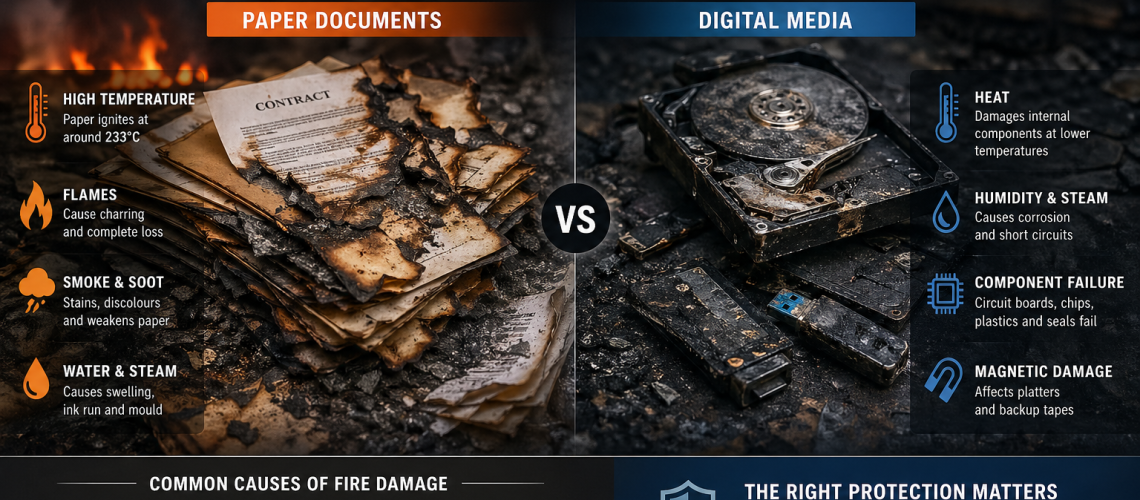
Fire damages documents and digital media in different ways. Paper can be destroyed by heat, flames, smoke and water, while hard drives, USB drives and backup media can fail at lower temperatures than paper.
This difference matters when choosing a safe. A standard fire safe may protect paper documents, but it may not protect digital media. Hard drives, memory sticks and backup tapes usually need a data safe with a lower internal temperature rating.
This guide explains what temperature damages paper, what happens to digital media in a fire and why fire ratings should match the contents being stored.
What temperature destroys paper?
Paper is often linked with ignition at around 233°C, although the exact point can vary depending on the paper type, thickness, moisture level and exposure time.
However, paper can suffer serious damage before it fully ignites. Heat can dry the fibres, brown the surface, weaken the sheet and make printed information difficult to read.
Specification consequence: a document fire safe must keep the internal temperature low enough to stop paper records becoming damaged, unreadable or destroyed.
How fire damages paper documents
Fire damage is not only caused by direct flames. Important records can be ruined by several linked hazards during and after a fire.
- Heat can brown, dry and weaken paper.
- Flames can burn documents completely.
- Smoke can stain documents and leave acidic residues.
- Soot can make paper dirty, fragile and hard to handle.
- Water from firefighting can cause swelling, ink run and mould.
- Steam can damage contents inside poor-quality storage.
For business records, survival means more than avoiding flames. Documents must remain readable, usable and suitable for future reference.
What damages hard drives in a fire?
Hard drives are vulnerable to heat, humidity, smoke, steam and rapid temperature change. Even when the drive casing looks intact, the internal components may be damaged beyond recovery.
A hard drive contains circuit boards, magnetic surfaces, bearings, seals, plastics and adhesives. These parts can fail before paper would ignite. Solid-state drives and USB drives are also vulnerable because chips, solder joints and plastic housings can be damaged by heat.
Backup tapes are especially sensitive. Heat and humidity can distort the tape, damage the magnetic layer and make the stored data unreadable.
Specification consequence: digital media should not be stored in a normal document fire safe unless the safe is specifically rated for data protection.
Why digital media needs a data safe
Paper can tolerate higher temperatures than many types of digital media. A fire safe designed for paper may allow internal conditions that are acceptable for documents but too severe for drives, tapes and memory devices.
A data safe is designed to control internal temperature and humidity more tightly. This helps protect electronic and magnetic media during a fire.
This is why the safe type should be chosen by content, not just by size. A safe that is suitable for certificates and contracts may not be suitable for hard drives or backup media.
Paper fire safe vs data safe
| Stored item | Main fire risk | Recommended protection |
|---|---|---|
| Paper documents | Heat, flames, smoke and water | Document fire safe |
| Certificates and contracts | Heat damage and loss of readability | Document fire safe |
| Hard drives | Heat, humidity and internal component failure | Data safe |
| USB drives and memory cards | Heat damage to chips and plastics | Data safe |
| Backup tapes | Heat, humidity and magnetic media damage | Data media safe |
| Large paper filing systems | Bulk record loss and water damage | Fire-resistant filing cabinet |
Key takeaway: choose a fire safe for paper documents, a data safe for digital media and a fire-resistant filing cabinet for larger volumes of active paper records.
Why fire ratings matter
A fire rating shows how long a safe is designed to protect its contents under controlled test conditions. Common ratings include 30, 60, 90 and 120 minutes.
The correct rating depends on the contents, the building risk and the importance of the stored records. A small office storing copies may need a different level of protection from a business storing contracts, accounts, staff records or recovery backups.
For digital media, the rating must specifically support data protection. A document fire rating alone does not automatically mean that drives, USB sticks or backup tapes are protected.
Common mistake: putting backups in a standard fire safe
One of the most common mistakes is storing hard drives, USB drives or backup tapes in a standard fire safe designed for paper. This can create a false sense of security.
The safe may protect paper correctly while still allowing internal temperatures or humidity levels that damage digital media. In that case, documents may survive but the backup may fail.
Where business recovery depends on digital backups, a data safe is the safer choice.
How to choose the right fire protection
Start by separating what needs to be protected. Paper, digital media and bulk filing should not be treated as the same storage problem.
- Document fire safe for contracts, certificates, deeds and important paperwork.
- Data safe for hard drives, USB drives, memory cards and backup tapes.
- Fire-resistant filing cabinet for larger volumes of paper files.
- Use off-site or cloud backup as part of a wider recovery plan.
The strongest approach is layered. Physical records need fire-resistant storage, while digital records need both protected local storage and separate backup copies.
Final thoughts
Fire does not damage every item in the same way. Paper records are mainly threatened by heat, flames, smoke and water. Digital media is more sensitive and can fail at lower temperatures due to damage to electronics, plastics, magnetic surfaces and internal components.
Paper documents are best protected with a properly rated fire safe.
Hard drives and backup media require a data safe designed for digital protection.
Large filing systems are better suited to a fire-resistant filing cabinet. Matching the protection to the contents avoids a costly specification mistake.
FAQs
What temperature destroys paper?
Paper is commonly associated with ignition at around 233°C. However, heat can damage, brown and weaken paper before it fully catches fire.
Can hard drives survive a fire?
A hard drive may look intact after a fire but still be unreadable. Heat, humidity, smoke and rapid temperature change can damage the internal components and stored data.
Is a normal fire safe suitable for hard drives?
Not usually. A standard fire safe may be designed for paper documents, not digital media. Hard drives, USB drives and backup tapes should normally be stored in a data safe.
What is the difference between a fire safe and a data safe?
A fire safe is usually designed to protect paper from heat and flames. A data safe is designed to protect more sensitive digital media by controlling internal heat and humidity more tightly.
Should business backups be kept in a data safe?
Yes. Important backup drives, tapes and portable media should be stored in a data safe. Businesses should also keep separate off-site or cloud backups for stronger recovery protection.
Discover more from Blog Total Locker Service
Subscribe to get the latest posts sent to your email.