Do Fire Safes Protect Against Water Damage?
April 27, 2026
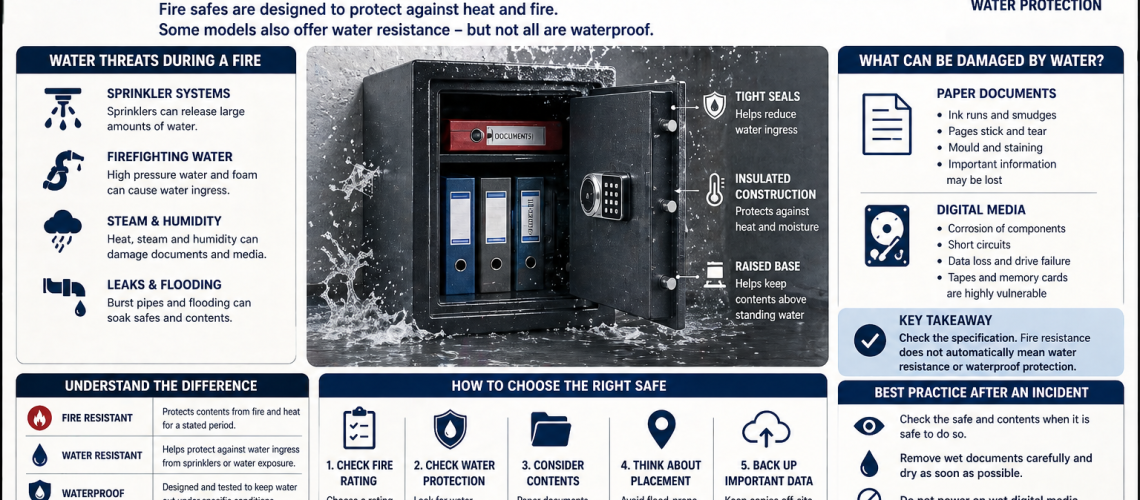
Some fire safes offer water resistance, but not all fire safes are waterproof. A fire safe is primarily designed to protect contents from heat and fire, so water protection should always be checked separately before buying.
Water damage matters because documents and digital media can be harmed during a fire even if flames never reach them. Firefighting water, sprinklers, leaks, steam and humidity can all affect what is stored inside a safe.
This guide explains whether fire safes protect against water damage, what can happen to documents and digital media, and how to choose the right protection for your home or business.
Are fire safes waterproof?
Not always. A fire safe may be fire resistant without being waterproof. Some models include water-resistant seals or tested water protection, but others are only designed around heat resistance.
The safest approach is to check the product specification. Look for clear wording such as water resistant, water protection, waterproof testing or protection against sprinkler and firefighting water.
Specification consequence: do not assume a fire rating includes water protection. Fire resistance and water resistance are separate requirements.
Why water damage matters after a fire
A fire incident often includes more than heat and smoke. Water may be used to control the fire, sprinklers may activate and nearby pipes or building services may fail.
Even where the safe survives the fire, moisture can still damage the contents if the safe is not suitable for water exposure or if damp contents are left inside for too long after the event.
- Firefighting water can soak paperwork and packaging.
- Sprinkler water can enter weak seals or damaged storage.
- Steam can create moisture inside unsuitable containers.
- Humidity can affect paper, photographs and digital media.
- Leaks and flooding can damage safes placed in poor locations.
How water damages documents
Paper records can be damaged quickly by moisture. Water can cause swelling, ink run, staining, sticking pages and mould. Important documents may survive the fire but still become hard to read or difficult to handle.
Photographs, certificates, handwritten records and signed documents can be especially vulnerable because the value often depends on the physical original remaining legible and intact.
Key takeaway: for documents, protection from fire is important, but protection from water and damp storage can also affect whether the contents remain usable.
How water damages digital media
Digital media is vulnerable to water, humidity and steam. Hard drives, USB drives, memory cards and tapes can suffer corrosion, short circuits, contamination and component failure.
A device may look undamaged from the outside but still fail when accessed. Backup tapes and magnetic media can be particularly sensitive to moisture and heat together.
For important digital backups, use a data safe designed for digital media, and keep a separate off-site or cloud backup as part of the recovery plan.
Fire resistant vs waterproof vs water resistant
The terms are not the same. Understanding the difference helps prevent the wrong safe being specified.
| Term | What it usually means | What to check |
|---|---|---|
| Fire resistant | Designed to protect contents from heat and fire for a stated period | Fire rating, contents type and test standard |
| Water resistant | Designed to reduce water ingress under certain conditions | Type of water exposure covered and test details |
| Waterproof | Often used for stronger water protection claims | Whether it is tested, for how long and under what depth or pressure |
| Data safe | Designed for digital media, usually with tighter heat and humidity protection | Data media rating and whether water exposure is covered |
Specification consequence: match the wording in the product specification to the risk you are trying to control.
Do fire safes protect against sprinklers?
Some fire safes may protect against limited sprinkler exposure, but this depends on the model. A general fire rating does not automatically prove protection from sprinkler water.
For offices, shops, schools and commercial premises with sprinkler systems, water resistance should be checked as part of the safe specification. This is especially important where the contents are original records, signed documents or backup media.
Can a fire safe protect against flooding?
Some safes may offer limited protection from water exposure, but a fire safe should not be assumed suitable for flood risk unless the product is specifically rated for it.
Flooding creates different pressures and exposure times from sprinklers or firefighting water. If flood risk is a concern, choose a product with clear water protection claims and place the safe above likely water levels where possible.
Where to place a fire safe to reduce water risk
Safe placement can reduce the chance of water damage. Avoid putting important records where leaks, damp or flooding are more likely.
- Avoid basements where flooding is a known risk.
- Keep safes away from visible damp areas.
- Do not place the safe directly under vulnerable pipework where avoidable.
- Allow access for inspection after an incident.
- Use internal folders or sealed sleeves for extra document organisation.
- Keep digital backups duplicated away from the building.
What to do after a fire or water incident
After a fire or water incident, contents should be checked as soon as it is safe and permitted. Damp documents and media can continue to deteriorate if left inside a closed safe for too long.
- Wait until the area is declared safe before retrieving the safe or contents.
- Check whether the outside of the safe is wet, damaged or deformed.
- Remove damp paper carefully and avoid tearing weakened pages.
- Dry documents according to their importance and condition.
- Do not power up wet hard drives or electronic media.
- Use a professional data recovery service for critical wet media.
Important: wet digital media should not be tested casually. Powering a damp device can cause further damage.
How to choose a fire safe with water protection
Choose by contents first. Paper documents, digital media and large filing systems all have different needs. Then check whether the safe also provides water resistance for the likely risk.
- Check the fire rating for paper documents or data media.
- Confirm whether water resistance is included.
- Look for clear test information, not vague wording.
- Check internal dimensions and capacity.
- Consider safe placement and flood risk.
- Use off-site or cloud backup for critical digital records.
The best protection comes from layering: fire-rated storage, sensible placement, water awareness and separate backup copies.
Common mistakes
- Assuming every fire safe is waterproof.
- Buying by fire rating without checking water resistance.
- Storing hard drives in a document fire safe.
- Putting the safe in a damp or flood-prone area.
- Leaving damp contents sealed inside after an incident.
- Keeping all digital backups in one physical location.
Most water damage mistakes come from assuming one type of protection covers every risk. Fire, water and data protection should be checked separately.
Final thoughts
A fire safe may offer some water resistance, but it should not be treated as automatically waterproof. Fire protection, water resistance and data protection are separate specification points.
Paper documents should be stored in a fire safe with a suitable document rating, and water protection should be checked in the specification.
Hard drives and backup media are better protected in a data safe, with separate backups kept elsewhere.
In areas with flood or sprinkler risk, review the product specification carefully before relying on the safe.
FAQs
Are fire safes waterproof?
Some fire safes are water resistant, but not all are waterproof. Always check the product specification rather than assuming fire resistance includes water protection.
Can water get into a fire safe?
Water can enter some safes depending on the seal, exposure level, pressure, damage and product design. Water resistance varies by model.
Will a fire safe protect documents from sprinklers?
Only if the safe offers suitable water resistance. A fire rating does not automatically mean the safe is protected against sprinkler water.
Can wet documents inside a safe be saved?
Sometimes. Damp documents should be handled carefully and dried as soon as practical once the area is safe. Valuable or legal originals may need specialist recovery advice.
Should hard drives be tested after water damage?
No. Wet hard drives or digital media should not be powered up casually. For important data, use a professional recovery service and rely on separate backups where available.
“`
Discover more from Blog Total Locker Service
Subscribe to get the latest posts sent to your email.