How Long Do Fire Safes Last?
April 27, 2026
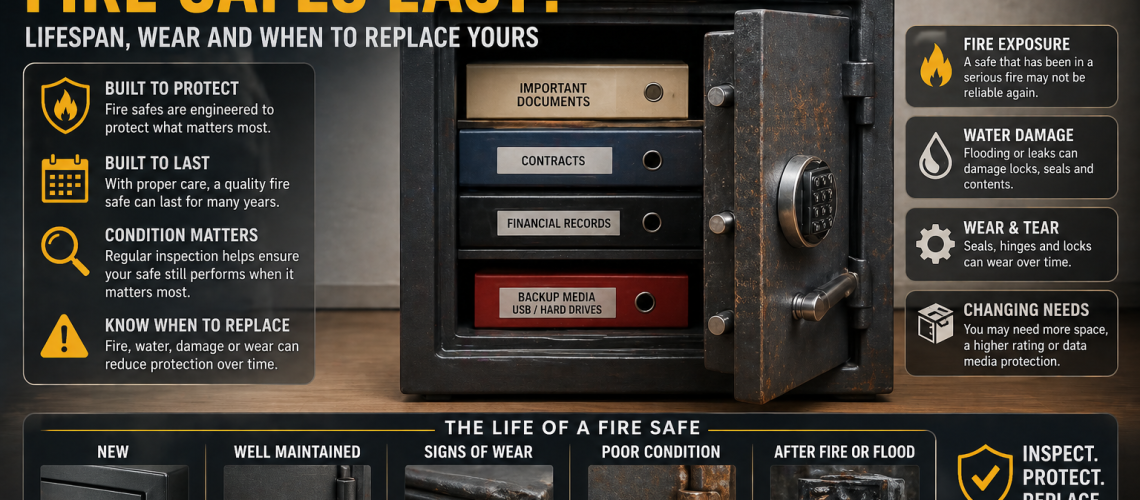
There is no single age at which every fire safe should be replaced. A safe can remain serviceable for many years if it is undamaged, correctly maintained and still suitable for the job, while a newer safe may need replacement after fire exposure, flooding, corrosion, impact damage or serious operational faults.
This guide focuses on the lifespan, inspection and replacement-cycle question: how to judge whether an existing fire safe is still serviceable, what condition checks matter, when repair is reasonable and when replacement is the safer option.
For rating interpretation, use the Fire Safe Ratings UK guide. For capacity and dimensions, use Fire Safe Sizes Explained.
How Long Do Fire Safes Last? Quick Answer
Age alone does not determine whether a fire safe should be replaced. The more important factors are condition, incident history, door alignment, seals, hinges, lock operation, corrosion, moisture damage, structural damage and whether the original model and fire specification can still be identified.
| Condition | Likely interpretation | Action |
|---|---|---|
| Older but dry, undamaged and operating correctly | Age alone does not prove end of life | Inspect, identify model/specification and continue monitoring |
| Minor serviceable lock or handle fault | Safe may still be repairable | Arrange competent assessment and repair if appropriate |
| Door misalignment, damaged hinges, severe corrosion or structural distortion | Protective performance may be uncertain | Assess and usually replace if integrity cannot be confirmed |
| Significant fire exposure | Do not assume the original tested protection remains available | Follow manufacturer guidance and normally replace |
| Repeated moves or impact damage | Alignment and structure may have changed | Inspect before returning to service |
| Unknown model or unknown incident history | Performance may be difficult to verify | Consider replacement where the consequence of failure is significant |
Does a Fire Safe Expire?
Many fire safes do not have a simple universal expiry date. A safe can remain mechanically usable for many years, but that does not mean its condition should be ignored indefinitely.
The useful question is whether the safe still operates as intended and whether its physical condition remains consistent with the product design that was originally tested.
- Does the door close fully and evenly?
- Are the hinges secure and aligned?
- Are seals and closure components present and undamaged?
- Is there corrosion, distortion or impact damage?
- Does the lock operate reliably?
- Can the make, model and stated fire specification still be identified?
An older safe that passes those checks may still be serviceable. A newer safe that has suffered serious damage may not be.
What Affects the Service Life of a Fire Safe?
Door alignment and closure
The door should close without unusual force, visible gaps or obvious distortion. Misalignment can indicate hinge wear, impact damage, settlement or damage from relocation.
Seals and closure components
Inspect any visible seals, strips or closure components around the door interface. Missing, damaged, detached or deteriorated parts should be investigated because they may form part of the safe’s protective construction.
Hinges
Hinges should remain secure and allow the door to open and close smoothly. Movement, looseness, distortion or damage after relocation should not be ignored.
Locking mechanism
A lock that becomes unreliable does not automatically mean the whole safe is at the end of its life. Some lock, handle or boltwork faults may be repairable. The important point is to have the fault assessed rather than continuing to rely on erratic operation.
Corrosion and moisture damage
Damp environments, leaks and previous flooding can cause corrosion and deterioration. Check the body, door edges, hinges, lock area and interior for rust, staining, swelling or other signs of moisture exposure.
Physical damage
Dents, cracks, distorted panels, damaged frames or evidence that the safe has been dropped or struck should trigger further assessment. Cosmetic marks are not the same as structural damage, but obvious deformation should not be dismissed.
Can Moving a Fire Safe Shorten Its Useful Life?
Relocation can affect a heavy safe if it is dropped, tilted badly, struck or handled in a way that damages the door, hinges, frame or locking components.
After a major move, check:
- door alignment;
- hinge security;
- lock and handle operation;
- new dents, cracks or distortion;
- whether the safe still sits level and closes correctly.
Repeated moves increase the importance of maintaining a clear condition history, especially across multi-site estates.
Should a Fire-Exposed Safe Stay in Service?
Do not assume that a safe can simply be returned to normal service after significant fire exposure.
The safe may have performed exactly as intended during the incident, but heat, firefighting water and structural stress can affect materials and components. The original tested performance should not automatically be assumed available for a second fire.
- Wait until the site is safe to access.
- Follow the manufacturer’s post-fire procedure for the exact make and model.
- Record the extent of exposure where possible.
- Arrange specialist assessment where required.
- Expect replacement to be the normal route after serious fire exposure unless the manufacturer confirms otherwise.
A fire-exposed safe should therefore be treated as an incident-recovery issue, not as an ordinary maintenance problem.
What About Flooding, Sprinkler Water or Firefighting Water?
Significant water exposure can affect steel components, locks, hinges, internal fittings and stored records. Drying the outside does not prove that the safe is back to its previous condition.
- Check for corrosion or staining.
- Inspect hinges and door movement.
- Test the lock and handle operation.
- Inspect the interior for damp or damage.
- Seek manufacturer or competent technician advice after significant exposure.
How Often Should a Fire Safe Be Inspected?
There is no single inspection interval that applies to every safe. Follow the manufacturer’s maintenance and servicing guidance for the exact model.
For estate management, it is sensible to review the safe periodically and whenever a significant event occurs.
- During planned facilities or asset inspections
- After relocation
- After impact or suspected damage
- After fire, flooding or serious water exposure
- When the door, hinge, handle or lock behaviour changes
- When the safe’s identification or specification becomes unclear
The aim is to spot deterioration before a fault becomes normalised.
Fire Safe Inspection Checklist
- Door: closes fully and evenly.
- Hinges: secure, aligned and operating smoothly.
- Seals and closure components: present and visibly intact.
- Lock: operates consistently.
- Handle and boltwork: move without unusual stiffness or looseness.
- Body: no serious corrosion, cracking, distortion or impact damage.
- Interior: dry and free from significant corrosion or visible deterioration.
- Identification: make, model and fire specification can still be confirmed.
- History: fire, flood, relocation and impact events are recorded.
When Is Repair Reasonable?
Repair can be reasonable where the fault is limited, the safe can still be positively identified and a competent technician can restore the affected component without compromising the product.
- Serviceable lock fault
- Handle or operating-mechanism fault
- Minor alignment issue that can be corrected properly
- Replaceable component covered by manufacturer support
Repairs should not involve improvising structural changes to the safe body, door or protective construction.
When Is Replacement the Safer Choice?
- After significant fire exposure
- After serious flooding or water damage where condition cannot be confirmed
- Where the door or body is structurally distorted
- Where hinges or closure points are damaged
- Where severe corrosion is present
- Where the safe has suffered major impact or drop damage
- Where the model, rating or previous incident history cannot be established and the records are important
- Where repair would leave uncertainty about the safe’s protective integrity
Replacement is about restoring confidence in the protection, not simply replacing something because it looks old.
Record Fire Safes as Managed Assets
For businesses with more than one safe, basic asset records make replacement decisions much easier.
- Manufacturer
- Model
- Serial number where available
- Fire rating or certification marking
- Installation or acquisition date
- Location
- Inspection or service history
- Relocation history
- Fire, flood or impact incidents
- Repairs or component replacements
This prevents an older safe becoming an unidentified piece of equipment with no reliable history.
Replacement Fire Safes and Cabinets
If an existing safe has reached the point where its condition, history or protective integrity can no longer be relied upon, Total Locker Service supplies replacement fire safes and fire-resistant cabinets for commercial paper records.
Fire Safe Lifespan FAQs
How long does a fire safe last?
There is no single lifespan that applies to every fire safe. Condition, incident history, maintenance, manufacturer guidance and the ability to identify the original model and specification are more important than age alone.
Do fire safes have an expiry date?
Many fire safes do not have a universal age-based expiry date. They should still be inspected for door alignment, hinge condition, seals, corrosion, lock operation and previous incident damage.
Can a fire safe be reused after a fire?
Do not assume that a fire-exposed safe can be returned to normal service. Follow the manufacturer’s post-fire procedure and normally expect replacement after significant fire exposure unless the manufacturer confirms another approved route.
When should a fire safe be replaced?
Replacement is usually appropriate after serious fire exposure, severe water damage, structural distortion, major impact damage, severe corrosion or where the safe’s model, condition or protective history cannot be confirmed reliably.
Can a faulty fire safe be repaired?
Some limited faults, such as serviceable lock or operating-mechanism problems, may be repairable by a competent technician. Structural damage or uncertainty about protective integrity is more likely to justify replacement.
Conclusion: Replace on Condition and History, Not Age Alone
A fire safe does not become obsolete simply because it reaches a particular age, and it should not remain in service indefinitely simply because the door still opens.
Inspect the door, seals, hinges, locking mechanism, body and interior. Record relocation, fire, flood and impact history. Repair limited serviceable faults where appropriate, but replace the safe where structural condition or protective integrity can no longer be relied upon.
Related Guides
Discover more from Blog Total Locker Service
Subscribe to get the latest posts sent to your email.