Care Home Medicine Storage UK: Safe Handling, Access Control and Storage Setup
May 5, 2026
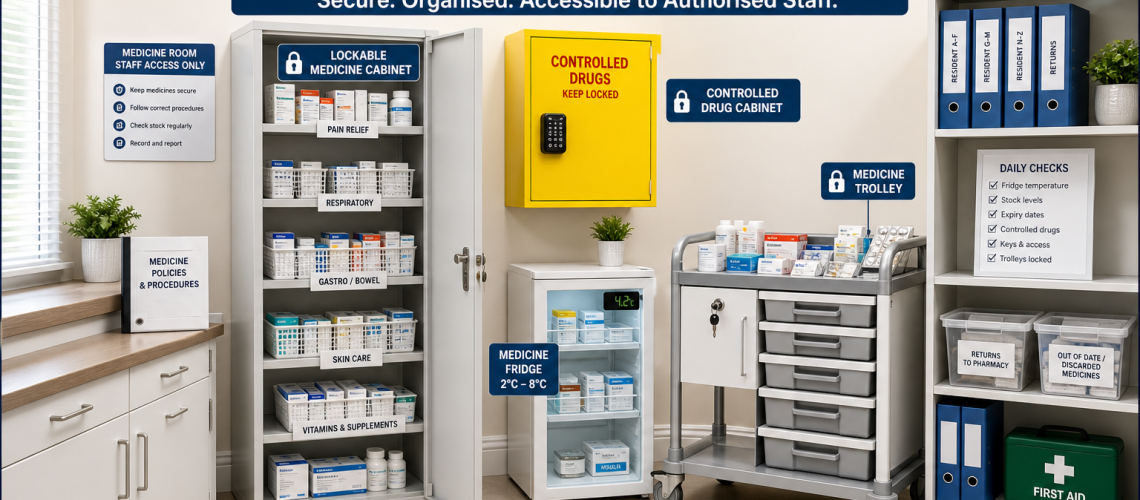
Care home medicine storage must keep medicines secure, organised, accessible to authorised staff and protected from avoidable risks. A good storage system includes the medicine room, cabinets, trolleys, controlled drug storage, staff access controls, audits and daily safe storage routines.
This guide explains medicine storage rules for UK care homes, including secure cabinet requirements, controlled drug storage, temperature control, key management, stock control and common compliance risks. For a full overview of cabinet types, compliance and secure storage design, see the medical cabinets UK guide.
Care home medicine storage starts with the wider medical cabinet framework. Use the Medical Cabinets UK: Medicines Storage, Compliance and Security Guide to choose the correct storage type, then apply the care-home-specific guidance on this page.
Start here: This page forms part of the main Medical Cabinets UK: Medicines Storage, Compliance and Security Guide, which explains how to choose, plan and manage secure medicine storage.
Care homes often require multiple storage types, including medical cabinets, medicine trolleys, staff lockers and secure storage. If you are unsure which storage type is required, see our storage comparison guide.
This page applies the wider medical cabinets and medicine storage systems guide to care homes. For compliance rules, use the medical storage compliance UK guide.
It supports the wider Medical Storage Compliance UK guide and the product-focused Medicine Storage Cabinets UK guide.
Why medicine storage matters in care homes
Medicine storage in care homes is not just a cupboard choice. It affects resident safety, staff accountability, medicine administration, audit trails, stock checks, expiry date control and controlled drug security.
CQC guidance says care providers should assess each person’s medicine storage needs and provide storage that reflects their needs, choices and risk assessment. The risk assessment should consider temperature requirements, who needs access, how access is restricted, legal storage requirements and who the medicines are for.
This care-home guide applies the wider medical cabinets and medicine storage systems guide to residential care settings. For compliance detail, see medical storage compliance UK.
Main medicine storage areas in a care home
Most care homes use several storage points rather than one single cabinet. Each storage area should have a clear purpose.
- Medicine room: central secure area for medicine storage and administration preparation.
- Medicine trolley: mobile storage used during medicine rounds.
- Lockable medicine cabinet: fixed cabinet for secure general medicine storage.
- Controlled drug cabinet: higher-security storage for controlled drugs where required.
- Medicine fridge: refrigerated storage for medicines that need cold chain control.
- Resident room storage: lockable storage for self-administered medicines where suitable.
- Returns storage: separated storage for medicines awaiting return or disposal.
Care home medicine room planning
A medicine room should be secure, clean, organised and easy for authorised staff to use. It should support safe stock handling rather than becoming a general store.
The room should have enough space for cabinets, trolleys, records, stock checks and safe movement. It should also allow staff to separate current medicines, returned medicines, controlled drugs, refrigerated medicines and other healthcare items.
Medicine room checklist
- Restricted access for authorised staff only.
- Clear separation between current medicines and returns.
- Suitable cabinet space for resident-specific medicines.
- Controlled drug cabinet where required.
- Medicine fridge where refrigerated medicines are stored.
- Clean work surface for medicine handling tasks.
- Good lighting for reading labels and records.
- Temperature monitoring where medicines are stored.
- Secure key or access control process.
- Clear audit routine for stock, keys and expiry dates.
Medicine cabinets for care homes
Cabinets should match the number of residents, the type of medicine system used and the level of access control required.
Wall-mounted medicine cabinets can work in small rooms or where floor space is limited. Floor-standing medicine cabinets are better for larger care homes, higher stock volume and more structured storage.
Care home storage should be planned as a controlled system. For the full planning model, see medicine storage systems UK.
| Cabinet type | Best use in care homes | Main benefit |
|---|---|---|
| Wall-mounted medicine cabinet | Small medicine areas or low-volume storage | Saves floor space |
| Floor-standing medicine cabinet | Larger medicine rooms and higher stock levels | More capacity and clearer organisation |
| Controlled drug cabinet | Controlled drugs with safe custody requirements | Restricted high-security storage |
| Lockable resident cabinet | Self-administered medicines in resident rooms | Supports individual access and risk assessment |
| Returns cabinet or section | Medicines awaiting return or disposal | Prevents mixing with current stock |
For cabinet types, sizing and buying decisions, see the Medicine Storage Cabinets UK buying guide.
Medicine trolleys in care homes
Medicine trolleys are commonly used during medicine rounds. They allow staff to move medicines safely between residents while keeping items organised and locked when not in direct use.
A trolley should be easy to clean, easy to manoeuvre and suitable for the medicine system used by the home. It should not be left unattended and unlocked. When not in use, it should be stored securely.
Medicine trolley buying checklist
- Lockable design.
- Enough capacity for the medicine round.
- Clear internal organisation.
- Easy-clean surfaces.
- Stable movement through corridors and doorways.
- Secure parking position when not in use.
- Suitable access control for authorised staff.
- Compatible with blister packs, original packs or resident-specific systems.
Controlled drug storage in care homes
Controlled drugs need particular care. If a controlled drug has safe custody requirements, it must be stored securely and access should be restricted to authorised people.
CQC guidance states that controlled drug cupboards should not be used for unrelated items such as jewellery or money. It also states that access should be restricted and keys should be managed securely.
If a controlled drug with safe custody requirements needs refrigeration, CQC guidance says it should be stored in a locked medicine fridge. Other medicines can be stored in the same fridge, but controlled drugs should be stored separately and access should be restricted.
Medicine fridges and temperature control
Some medicines must be stored in a fridge to remain safe and effective. CQC guidance says medicines requiring cold chain storage should usually be kept between 2°C and 8°C. Examples can include insulin, some antibiotic liquids, injections, eye drops and some creams.
Care homes should check the medicine packaging, patient information leaflet or recognised medicines information source to confirm whether refrigeration is required.
A medicine fridge should be used only for medicines and managed with a clear temperature checking routine. Staff should know what to do if the fridge temperature moves outside the required range.
Staff access and key control
Access control is one of the most important parts of care home medicine storage. A locked cabinet is only effective if keys and access rights are controlled properly.
- Only authorised staff should access medicine storage areas.
- Medicine room keys should not be left unattended.
- Controlled drug keys should have tighter control than general storage keys.
- Spare keys should be stored securely.
- There should be a clear process for lost keys.
- Access responsibilities should be included in staff training.
- Agency staff should understand the home’s medicine access rules before use.
Audits and safe storage checks
Regular checks help identify problems before they become safety issues. Audits should check the physical storage, records, access control and daily medicine routines.
Care home medicine storage audit checklist
- Are medicines stored in the correct place?
- Are current medicines separated from returns?
- Are controlled drugs stored correctly?
- Are fridge temperatures recorded and reviewed?
- Are expired medicines identified and removed from current stock?
- Are cabinet and trolley keys controlled?
- Are medicine trolleys locked when not in use?
- Are resident-specific medicines clearly separated?
- Are medicines stored according to the person’s risk assessment?
- Are staff following the home’s medicine storage policy?
Daily safe storage routine for care homes
A simple daily routine helps staff keep medicine storage consistent. The routine should be easy to follow and built into normal medicine handling tasks.
- Check medicine room access at the start of the shift.
- Confirm trolleys and cabinets are locked when not in use.
- Check fridge temperature records where relevant.
- Keep current medicines separate from returns.
- Report damaged packaging, missing stock or unclear labels.
- Return medicines to secure storage immediately after use.
- Check controlled drug storage according to the home’s policy.
- Record and escalate any storage concern.
Common care home medicine storage mistakes
- Using one cabinet for current medicines, returns and unrelated items.
- Leaving medicine trolleys unlocked or unattended.
- Poor separation between residents’ medicines.
- Weak key control for medicine rooms or controlled drug cabinets.
- Not checking fridge temperature records consistently.
- Keeping controlled drugs in unsuitable storage.
- Storing medicines in places not covered by a risk assessment.
- Not updating storage routines after resident needs change.
Best storage setup by care home need
| Care home need | Recommended storage | Why it helps |
|---|---|---|
| Small residential care home | Lockable medicine cabinet and secure trolley | Supports controlled access and routine medicine rounds |
| Larger care home | Medicine room with floor-standing cabinets and trolleys | Improves stock separation and staff workflow |
| Controlled drugs stored | Controlled drug cabinet | Provides higher-security dedicated storage |
| Refrigerated medicines | Medicine fridge with temperature routine | Supports cold chain storage |
| Self-administering residents | Lockable storage in resident room where risk assessed | Supports independence while protecting others |
| Medicines awaiting return | Separated returns storage | Prevents returned medicines mixing with current stock |
If you are unsure which cabinet type fits your site, use the what medical cabinet do I need guide before choosing a product.
Related care home and medical storage guides
- Medical Storage Compliance UK
- Medicine Storage Cabinets UK
- Care Home Medicines Storage UK
- Storage Systems UK
- Storage Access Control Guide UK
- Medical cabinets and medicine storage cabinets
- Storage cabinets
Final advice
A safe care home medicine storage system combines the right products with clear routines. Cabinets, trolleys, medicine rooms, fridges and controlled drug storage should all support resident safety, staff accountability and daily medicine handling.
Start by assessing what needs to be stored, who needs access, which medicines need special storage and how the home will audit the system. Then choose cabinets, trolleys and room layouts that make safe routines easier to follow.
For support choosing suitable care home medicine storage, contact Total Locker Service for advice on medical cabinets, medicine storage cabinets and secure healthcare storage.
Care home medicine storage next steps
- Care home medicine storage risk assessment
- Medicine storage audit checklist UK
- Medical storage compliance UK
- Medical cabinets and medicine storage systems guide
Care home medicine storage next steps
- Care home medicine storage risk assessment
- Medicine storage audit checklist UK
- Medical storage compliance UK
- Medical cabinets and medicine storage systems guide
Care home medicine storage next steps
- Care home medicine storage risk assessment
- Medicine storage audit checklist UK
- Medical storage compliance UK
- Medical cabinets and medicine storage systems guide
For wider cabinet selection, controlled access and medicine storage planning, return to the medical cabinets UK guide.
FAQ: Care home medicine storage UK
How should medicines be stored in a care home?
Medicines should be stored securely, clearly organised and only accessible to authorised people. Storage should reflect each resident’s needs, choices and risk assessment. Current medicines, returns, controlled drugs and refrigerated medicines should be managed separately where required.
Does a care home need a medicine room?
Many care homes use a medicine room because it provides a central secure area for cabinets, trolleys, records, stock checks and refrigerated storage. Smaller services may use secure cabinets, but the setup still needs clear access control and safe storage routines.
Can medicines be stored in residents’ rooms?
Yes, where this matches the resident’s needs and risk assessment. For example, self-administered medicines may be kept in a lockable cupboard or drawer in the person’s room. Other people must not be able to access those medicines.
What cabinet is needed for controlled drugs in a care home?
Controlled drugs with safe custody requirements should be stored in a suitable controlled drug cabinet with restricted access. Controlled drug cupboards should not be used for unrelated items, and key control should be clearly managed.
Should medicine trolleys be locked?
Yes. Medicine trolleys should be locked when not in direct use and should not be left unattended and unlocked. When the round is finished, the trolley should be returned to a secure location.
How often should care homes audit medicine storage?
Care homes should check medicine storage regularly as part of their medicine management process. Daily checks, stock checks, fridge temperature checks, expiry date checks and controlled drug checks should all follow the home’s medicine policy.
Discover more from Blog Total Locker Service
Subscribe to get the latest posts sent to your email.