Medicine Storage Cabinets UK: Types, Uses and Buying Guide
May 5, 2026
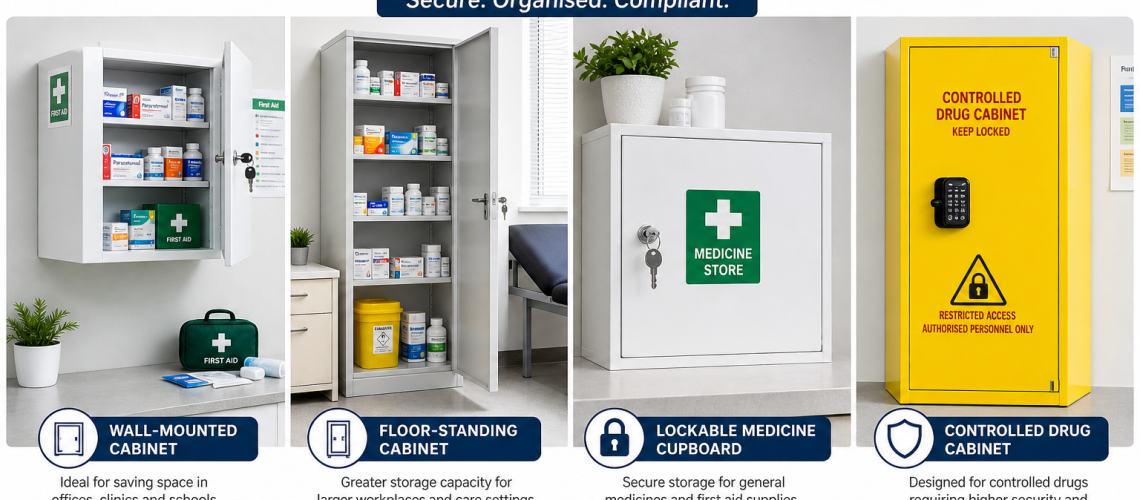
Medicine storage cabinets help UK workplaces, care settings, schools, clinics and medical rooms keep medicines secure, organised and accessible only to authorised people. The right cabinet depends on what is being stored, who needs access, the level of risk, the available space and whether controlled storage is required.
This guide explains the main types of medicine storage cabinets used in the UK, including wall-mounted cabinets, floor-standing cabinets, lockable medicine cupboards, controlled drug cabinets, first aid cabinets and specialist storage for higher-risk items.
Start here: This page forms part of the main Medical Cabinets UK: Medicines Storage, Compliance and Security Guide, which explains how to choose, plan and manage secure medicine storage.
Use this page as a practical buying guide before choosing a cabinet for a workplace, care home, school, clinic, surgery, treatment room, staff medical area or facilities store.
What is a medicine storage cabinet?
A medicine storage cabinet is a lockable cabinet used to store medicines, treatments, first aid supplies or related medical items. It helps keep stock in one place, protects medicines from casual access and supports clear handling procedures.
Medicine cabinets are not all the same. Each type is used for personal medication, staff medication, school medical rooms or care settings.
The best choice depends on the risk level. A small office may only need a lockable first aid or medicine cupboard. A care setting may need separate storage for current medicines, returns, self-administered medicines and controlled drugs. A clinic may need a more structured system with clear segregation and restricted staff access.
Main types of medicine storage cabinets UK buyers should consider
Most medicine storage cabinets fall into a few clear groups. Choosing the right type is easier when each cabinet is matched to a specific storage purpose.
1. Wall-mounted medicine cabinets
Wall-mounted medicine cabinets are fixed to a wall and are useful where floor space is limited. They are common in offices, schools, treatment rooms, staff rooms, care settings and small medical areas.
They work well for smaller quantities of medicines or medical supplies that need to stay secure but easy to reach. Wall mounting also keeps the cabinet away from general cupboards, cleaning products and unrelated stock.
A wall-mounted cabinet is usually a good choice when the storage volume is modest, access is controlled by a small number of staff and the cabinet needs to be positioned near the point of use.
2. Floor-standing medicine cabinets
Floor-standing medicine cabinets offer more internal capacity. They suit larger workplaces, care homes, school medical rooms, clinics and facilities where medicines or medical stock are stored in greater quantities.
They can be easier to organise because they normally provide more shelf space, better separation and clearer stock visibility. This helps when medicines need to be grouped by person, department, use, expiry date or risk level.
Floor-standing cabinets are usually better when wall space is limited, the stock level is high or staff need a more structured storage system.
3. Lockable medicine cupboards
Lockable medicine cupboards are general-purpose secure cabinets used for everyday medicine storage. They help stop unauthorised access and keep medicines separate from ordinary office, cleaning or welfare supplies.
They are suitable for many low to medium-risk settings, provided the cabinet matches the medicines being stored and the organisation has suitable access procedures.
When buying a lockable medicine cupboard, check the lock type, construction, fixing method, shelf layout and whether the cabinet can be clearly assigned to medical storage only.
4. Controlled drug cabinets
Controlled drug cabinets are used where medicines require a higher level of secure storage. They should not be treated as ordinary lockable cupboards. They are designed for controlled storage, restricted access and stronger fixing.
Care homes that store controlled drugs with safe custody requirements must follow the relevant safe custody rules. CQC guidance also states that controlled drug cupboards should not be used to store unrelated items such as jewellery or money, and access should be restricted according to need.
If controlled drugs are part of your storage requirement, choose the cabinet based on the legal and operational requirements for your setting. Do not use a standard cupboard as a substitute.
5. First aid cabinets
First aid cabinets are designed for dressings, plasters, bandages, wipes, gloves and first aid equipment. They may sit alongside medicine storage, but they should not automatically be used for all medicines.
They are useful in offices, warehouses, schools, gyms, workshops and public-facing workplaces. In many sites, first aid storage and medicine storage should be separated so staff can find emergency supplies quickly without mixing them with personal or prescribed medicines.
6. Personal medication cabinets
Personal medication cabinets are used where medicines belong to a specific person. This is common in care settings, supported living, schools and some workplace welfare arrangements.
In care settings, storage should reflect the person’s needs, choices and risk assessment. Some people may self-administer medicines, while others need staff support. The cabinet choice should support that process without allowing other people to access medicines that are not theirs.
Wall-mounted vs floor-standing medicine cabinets
The first buying decision is usually whether to choose a wall-mounted or floor-standing cabinet.
| Cabinet type | Best for | Main advantage | Main limitation |
|---|---|---|---|
| Wall-mounted medicine cabinet | Small medical areas, offices, schools, treatment rooms | Saves floor space and keeps medicines visible | Limited capacity |
| Floor-standing medicine cabinet | Care homes, clinics, larger workplaces, medical rooms | Higher capacity and better organisation | Needs floor space and careful placement |
| Controlled drug cabinet | Settings storing controlled drugs with safe custody needs | Higher security and restricted access | Must be specified correctly |
| First aid cabinet | First aid supplies and emergency workplace items | Quick access to first aid equipment | Not suitable for every medicine storage need |
Where are medicine storage cabinets used?
Medicine storage cabinets are used in many UK environments. The cabinet should always match the setting, the people using it and the risk attached to the items being stored.
Care homes and supported living
Care homes often need structured storage for current medicines, controlled drugs, medicines awaiting return, self-administered medicines and emergency items. Storage should be planned around risk assessment, access control and clear staff procedures.
Schools and colleges
Schools may need secure storage for pupil medication, emergency medication, first aid supplies and staff-only medical items. Cabinets should be placed where authorised staff can access them quickly, but pupils and visitors cannot.
Workplaces and offices
Workplaces may need lockable storage for first aid supplies, personal medication, welfare items and emergency medical equipment. The main priority is usually clear access control, good organisation and separation from general storage.
Clinics and treatment rooms
Clinics and treatment rooms usually need a more formal storage system. Medicines may need to be separated by category, use, temperature requirement or risk level. Higher-risk items may need dedicated storage rather than a shared cupboard.
Factories, warehouses and industrial sites
Industrial sites often need robust first aid and medicine storage near welfare rooms, site offices or first aid points. Cabinets should be durable, clearly labelled and protected from impact, damp, dust and unauthorised access.
How to choose the right medicine storage cabinet
The right cabinet is not just the largest or strongest option. It is the cabinet that fits the medicines, users, access rules and room layout.
Step 1: List what needs to be stored
Start with the items. Are you storing first aid supplies, prescribed medicines, over-the-counter medicines, staff medication, pupil medication, controlled drugs, dressings, creams, nutritional products or medical devices?
Different items may need different storage. Do not assume one cabinet should hold everything.
Step 2: Decide who needs access
Access control is central to medicine storage. Decide who can open the cabinet, who holds keys or access credentials, how access is recorded and what happens if a key is lost.
For lower-risk workplace storage, a simple key lock may be enough. For higher-risk settings, stronger key control and tighter procedures may be required.
Step 3: Match the cabinet to the risk level
Low-risk items may only need basic lockable storage. Higher-risk medicines may need stronger construction, better fixing, restricted access and dedicated storage. Controlled drugs require particular care and should be handled under the correct rules for the setting.
Step 4: Check capacity and shelf layout
A cabinet should have enough space for current stock without becoming crowded. Crowded shelves make stock checks harder and increase the risk of errors.
Look for adjustable shelves if different pack sizes need to be stored. If medicines need to be separated by person, room, department or category, choose a cabinet with enough internal structure to support that.
Step 5: Check fixing and placement
Medicine cabinets should be positioned where they can be accessed by authorised staff but not by unauthorised users. Wall-mounted cabinets need suitable wall fixing. Floor-standing cabinets should be stable, practical to use and placed away from avoidable risks.
Avoid placing medicine cabinets in damp, overheated, exposed or high-traffic areas unless the cabinet and storage procedure are designed for that environment.
Medicine cabinet buying checklist
- What medicines or supplies will be stored?
- Does anything need separate or controlled storage?
- Who is authorised to access the cabinet?
- Is a wall-mounted or floor-standing cabinet better?
- Is the cabinet large enough for current and future stock?
- Can items be separated clearly inside the cabinet?
- Is the lock suitable for the risk level?
- Can keys or access credentials be controlled?
- Can the cabinet be fixed securely?
- Is the location suitable for safe day-to-day use?
- Will the cabinet support stock checks and expiry date checks?
- Does the site need a separate controlled drug cabinet?
Common mistakes when buying medicine storage cabinets
Many storage problems come from choosing a cabinet before defining the storage process. Avoid these common mistakes.
Buying one cabinet for every item
First aid supplies, prescribed medicines, controlled drugs, personal medication and returned medicines may need different handling. One cabinet may not be enough if the items have different risks or access rules.
Choosing by size only
A large cabinet is not always better. The internal layout, shelf spacing, lock type and location matter just as much as capacity.
Ignoring key control
A lockable cabinet is only effective if access is controlled. Decide who holds keys, where spare keys are kept and how access is managed before the cabinet is installed.
Using ordinary cupboards for higher-risk medicines
General cupboards are not suitable for every medicine storage need. Higher-risk medicines may need a purpose-made cabinet with stronger construction and restricted access.
Medicine storage cabinets and controlled storage
Controlled storage is not only about the cabinet. It also includes the access process, key control, record keeping, staff responsibility and how medicines are separated from other items.
If controlled drugs are stored, use a suitable controlled drug cabinet and follow the correct rules for your sector. In care homes, CQC guidance confirms that access should be restricted, spare keys should be stored securely and controlled drug cupboards should not be used for unrelated items.
For wider compliance planning, read our Medical Storage Compliance UK guide. For product options, see our medical cabinets and medicine storage cabinets.
Best cabinet type by use case
| Use case | Recommended cabinet type | Reason |
|---|---|---|
| Small office first aid point | Wall-mounted first aid cabinet | Compact, visible and easy to position |
| School medical room | Lockable medicine cabinet or floor-standing cabinet | Allows separation by pupil, item type or access need |
| Care home medicine storage | Floor-standing medicine cabinet plus controlled drug cabinet where required | Supports higher capacity and controlled access |
| Clinic or treatment room | Structured medicine cabinet system | Supports stock separation and staff-only access |
| Controlled drug storage | Controlled drug cabinet | Designed for higher-security storage requirements |
| Industrial first aid area | Robust first aid or medicine cabinet | Durable storage for busy workplace environments |
Internal links for related storage planning
Medicine storage often forms part of a wider workplace storage system. These guides may help you plan the full setup:
- Medical Storage Compliance UK
- Care Home Medicines Storage UK
- Storage Systems UK
- Workplace Storage Systems UK
- Storage Access Control Guide UK
- Medical cabinets and medicine storage cabinets
- Storage cabinets
Final buying advice
The best medicine storage cabinet is the one that matches the items, users, access rules and risk level. For simple first aid supplies, a small wall-mounted cabinet may be enough. Larger medical areas, a floor-standing cabinet may offer better organisation. For controlled drugs, a dedicated controlled drug cabinet is required where safe custody rules apply.
Before buying, list what needs to be stored, decide who needs access, check whether any items need controlled storage and choose a cabinet that supports safe daily use. This will create a cleaner, safer and easier-to-manage medicine storage system.
For help choosing suitable medicine storage, contact Total Locker Service for advice on medical cabinets, medicine storage cabinets and secure healthcare storage.
Discover more from Blog Total Locker Service
Subscribe to get the latest posts sent to your email.