What Medical Cabinet Do I Need? UK Guide to Choosing the Right Medicine Storage
May 5, 2026
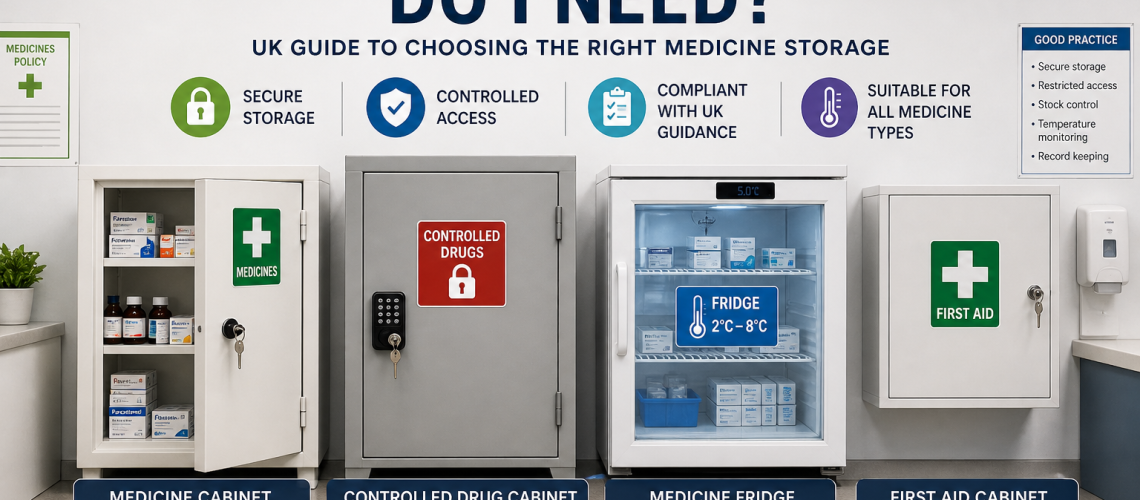
The medical cabinet you need depends on what you are storing, who needs access, where the cabinet will be fitted and whether the contents need specialist control. Most UK sites need separate storage for medicines, first aid supplies and controlled or refrigerated medicines.
This guide helps care homes, schools, clinics, workplaces and facilities teams choose the right medical cabinet setup without overcomplicating the decision.
Start here: This page forms part of the main Medical Cabinets UK: Medicines Storage, Compliance and Security Guide, which explains how to choose, plan and manage secure medicine storage.
Quick answer: use a lockable medical cabinet for general medicines, a controlled drug cabinet where safe-custody controls are required, a locked medicines fridge for refrigerated medicines and a separate first aid cabinet for emergency first aid supplies.
Note: This guide supports product selection and storage planning. Always follow your organisation’s medicines policy, risk assessments and current regulatory guidance.
Choose your medical cabinet in 10 seconds
| What are you storing? | Best cabinet type | Why |
|---|---|---|
| General medicines | Lockable medical cabinet | Restricts access and keeps stock organised |
| Controlled drugs | Controlled drug cabinet | Supports stricter access, fixing and record control |
| Refrigerated medicines | Locked medicines fridge | Keeps medicines within the required temperature range |
| First aid supplies | First aid cabinet | Keeps emergency supplies visible and accessible |
| Mixed medical storage | Separate cabinets by risk | Prevents confusion between medicines, first aid and supplies |
Need a cabinet now? View our medical cabinets UK range or continue reading to check which option fits your site.
What medical cabinet do I need?
You need a cabinet that matches the risk of the contents. First aid supplies need fast access. General medicines need restricted access. Controlled medicines may need specialist storage. Refrigerated medicines need suitable cold-chain storage.
For care homes, CQC guidance says medicines must be stored securely, only authorised care home staff should have access, and policies should cover how medicines storage keys are securely managed. HSE workplace first aid guidance also says first aid kit contents should be based on a first aid needs assessment and checked regularly for expiry dates. :contentReference[oaicite:0]{index=0}
Best medical cabinet by setting
| Setting | Typical need | Recommended setup |
|---|---|---|
| Care home | Resident medicines, controlled medicines and audit routines | Lockable medical cabinets, controlled drug storage where required and clear key control |
| School | Pupil medication, first aid supplies and medical room storage | Lockable medicine cabinet plus separate first aid cabinet |
| Workplace | First aid access and occasional staff health storage | First aid cabinet plus lockable storage if medicines are held |
| Clinic | Clinical supplies, medicines and treatment room stock | Cleanable medical cabinets with controlled access |
| Factory or warehouse | First aid coverage across larger sites | Multiple first aid points plus secure medicine storage where needed |
If you are storing general medicines
Use a lockable medical cabinet where general medicines need to be kept secure, organised and away from unauthorised access. This is common in care homes, clinics, medical rooms, schools and workplaces where medicines are stored for staff, pupils, residents or patients.
- Use controlled access.
- Keep stock organised and labelled.
- Check expiry dates regularly.
- Keep medicines away from avoidable heat, damp and public access.
- Record access and stock movement where your policy requires it.
For the main product route, view our secure medical cabinets.
If you are storing controlled drugs
Controlled drugs need stronger storage controls than ordinary medicine stock. CQC guidance says access to the controlled drugs cupboard should be restricted according to need, spare keys should be stored securely, and the controlled drugs cupboard should not be used to store other items such as jewellery or money. :contentReference[oaicite:1]{index=1}
Use a controlled drug cabinet or cupboard where your medicines policy, risk assessment or regulatory requirements say controlled drug storage is needed. Do not treat controlled drugs as ordinary cabinet stock.
For deeper guidance, use the controlled drug cabinet requirements UK guide.
If you are storing refrigerated medicines
Do not use a standard cabinet for medicines that need refrigeration. CQC guidance for care homes says medicines fridges should be secure, accessible only to authorised staff, able to maintain the correct temperatures for the medicines stored, and should not be used for food or biological samples. :contentReference[oaicite:2]{index=2}
Many refrigerated medicines are stored between 2°C and 8°C where required by the product information. Always check the packaging, patient information leaflet or medicines policy before choosing storage.
If you are storing first aid supplies
Use a first aid cabinet for first aid supplies such as dressings, plasters, bandages and emergency items. First aid storage should be easy to find and check. HSE says workplace first aid kit contents should be based on the first aid needs assessment and checked regularly, as many items have expiry dates. :contentReference[oaicite:3]{index=3}
First aid supplies and medicines should usually be separated. First aid supplies often need fast access, while medicines may need controlled access, stock checks and clearer responsibility.
Medicine cabinet vs first aid cabinet
| Feature | Medicine cabinet | First aid cabinet |
|---|---|---|
| Main purpose | Secure medicine storage | Emergency first aid access |
| Access level | Restricted | Accessible to trained or responsible staff |
| Best for | Medicines, controlled health items and staff-only stock | Dressings, plasters, bandages and first aid supplies |
| Main risk | Unauthorised access | Delayed emergency access |
| Should they be mixed? | Usually no. Separate storage keeps responsibilities clearer. | |
Choose by risk level
| Risk level | Example | Recommended storage |
|---|---|---|
| Low | Basic first aid supplies | Clearly labelled first aid cabinet |
| Medium | General medicines in a school or workplace | Lockable medical cabinet with controlled access |
| High | Care home medicines | Secure cabinet, key control, audit routine and stock checks |
| Very high | Controlled drugs | Controlled drug cabinet with restricted access and records |
| Temperature-sensitive | Medicines requiring refrigeration | Locked medicines fridge with temperature monitoring |
What size medical cabinet do I need?
Choose cabinet size by stock volume, not by wall space alone. A cabinet should hold the required stock without overcrowding. Overfilled storage makes expiry checks, separation and stock rotation harder.
- Small site: one compact lockable medical cabinet may be enough.
- Medium site: use a central medicine cabinet plus separate first aid storage.
- Large site: use multiple first aid points and controlled medicine storage where needed.
- Care home or clinic: plan storage around stock control, access, audits and medicine type.
Where should a medical cabinet be fitted?
Fit the cabinet where authorised staff can use it safely and where the contents are protected from avoidable risks. Avoid placing medicine storage near heat sources, damp rooms, direct sunlight or unsupervised public access routes.
- Use a stable, suitable wall or storage area.
- Keep access controlled but practical for authorised staff.
- Avoid heat, damp and direct sunlight.
- Do not block emergency access to first aid supplies.
- Use clear procedures for keys, codes and spare access.
Common mistakes when choosing a medical cabinet
- Using one cabinet for everything → medicines, first aid supplies and PPE become confused.
- Choosing size only → access control, temperature and stock checks may be ignored.
- Putting medicines in a first aid cabinet → access may be too open.
- Locking first aid supplies too tightly → emergency access may be delayed.
- Ignoring refrigerated medicines → medicines may be stored outside the required conditions.
- Not planning key control → cabinet security becomes weak in daily use.
Recommended next step
Start by listing the items you need to store. Separate them into general medicines, controlled drugs, refrigerated medicines and first aid supplies. Then choose the cabinet type, access level and checking routine for each group.
Ready to choose? View our medical cabinets UK range, or read the full medical storage compliance UK guide for deeper planning.
Related medical storage guides
| If you need help with | Read this guide |
|---|---|
| Full medical storage planning | Medical storage compliance UK |
| Controlled drug storage | Controlled drug cabinet requirements UK |
| Care home medicines | Care home medicine storage UK |
| Key control | Medical cabinet key management |
| Access records and audits | Medical cabinet access and audit |
| Wider storage planning | Storage systems UK |
What medical cabinet do I need FAQs
What medical cabinet do I need for general medicines?
For general medicines, use a lockable medical cabinet with controlled access. The cabinet should be suitable for the stock held, easy to check and positioned away from avoidable heat, damp and public access.
Do I need a controlled drug cabinet?
You may need a controlled drug cabinet if the medicines stored have safe-custody or controlled-drug storage requirements. Access should be restricted according to need and records should be managed in line with your policy.
Can medicines be stored in a first aid cabinet?
Medicines and first aid supplies should usually be separated. First aid supplies often need fast access, while medicines may need restricted access, clearer responsibility and stock checks.
What cabinet do I need for refrigerated medicines?
Use a suitable locked medicines fridge. A standard cabinet is not suitable for medicines that require refrigerated storage.
What medical cabinet does a care home need?
A care home usually needs secure medicine storage with controlled access, key control, stock checks and separate storage for controlled or refrigerated medicines where required.
Discover more from Blog Total Locker Service
Subscribe to get the latest posts sent to your email.