Controlled Drugs Cabinet Guide UK: Secure Storage, Access Control and Safe Custody (2026)
May 5, 2026
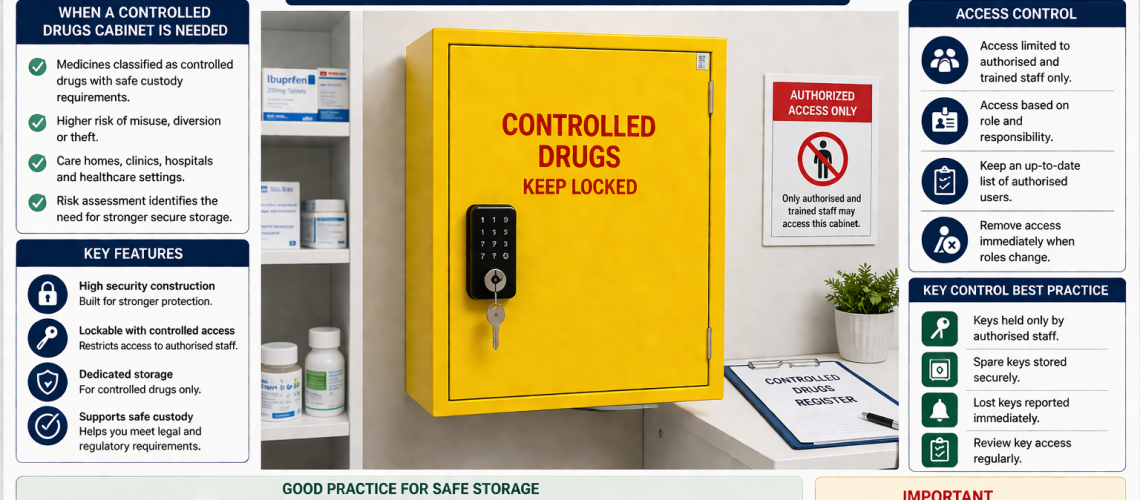
Controlled-drug cabinets are specialist medical storage units used where medicines require a higher level of secure storage than a standard medical cabinet can provide. The decision starts with the medicine, the applicable safe-custody requirement, the setting and the way authorised access will be controlled.
This guide explains when controlled-drug storage needs to be treated as a separate specification problem, how these cabinets differ from ordinary medicine cabinets, what to consider for access and key control, and how the cabinet fits into a wider medical-storage system.
For broad medical-cabinet selection, including wall-mounted and floor-standing formats, first aid storage, personal medication and clinical consumables, start with the Medical Cabinets UK buying guide.
If you are planning several storage units together, use Medicine Storage Systems UK for the wider system question.
Quick Answer: When Is a Controlled-Drug Cabinet Needed?
A controlled-drug cabinet should be considered where the medicines being stored are subject to controlled-drug safe-custody requirements or where a higher-security medicine-storage arrangement is required by the setting and applicable procedures.
Do not assume that any lockable steel medical cabinet is suitable. The required product specification depends on the medicines, the environment, the applicable requirements and the organisation’s medicine-management procedures.
What Is a Controlled-Drug Cabinet?
A controlled-drug cabinet is a secure cabinet intended for medicines that require stronger access restriction and storage control than general medicine stock.
It should be treated as a specialist storage category rather than simply a more secure version of a general-purpose cupboard.
When Controlled-Drug Storage Becomes a Separate Requirement
The need for specialist controlled-drug storage should be established before choosing the cabinet.
- Identify the medicines that will be stored.
- Establish whether controlled-drug safe-custody requirements apply.
- Consider the healthcare, care or workplace setting.
- Check local medicine-management procedures.
- Define who must have authorised access.
- Confirm any installation, fixing or product-specific requirements before ordering.
Where the requirement is uncertain, clarify the medicine and storage obligation first rather than selecting a cabinet from appearance or dimensions alone.
Controlled-Drug Cabinet vs Standard Medical Cabinet
| Decision | Standard medical cabinet | Controlled-drug cabinet |
|---|---|---|
| Primary use | General medicines, first aid stock or clinical supplies | Medicines requiring specialist controlled-drug storage |
| Specification | Matched to general medical-storage requirement | Matched to the applicable controlled-drug requirement |
| Access | Controlled according to normal site procedure | More tightly restricted |
| Key or credential control | Important | Critical to the storage system |
| Fixing and installation | Depends on cabinet and application | May be subject to more specific requirements |
For broad cabinet selection, use the Medical Cabinets UK guide. Use this page when the storage requirement becomes a specialist controlled-drug question.
How to Specify a Controlled-Drug Cabinet
Once the requirement for specialist storage is established, work through the cabinet specification in a fixed order.
- Contents: confirm exactly which medicines are being stored.
- Capacity: allow enough usable internal space for the normal stock requirement.
- Location: choose a position appropriate for authorised staff access and the room workflow.
- Access: define who is authorised before deciding how keys or credentials will be managed.
- Fixing: confirm the cabinet’s installation requirements and the suitability of the wall or other mounting surface.
- Procedure: integrate the cabinet into the site’s wider medicine-storage and audit process.
Access Control for Controlled-Drug Cabinets
Physical cabinet security only works if access is controlled properly.
- Define which roles are authorised to access the cabinet.
- Keep access limited to the people who genuinely require it.
- Review access when staff roles change.
- Make the responsibility for keys or credentials clear.
- Include the cabinet in the organisation’s normal medicine-storage procedures.
For broader lock types and routine authorised-access governance, use Medical Cabinet Locks & Access Control UK. This page focuses on the tighter access expectations that can apply to controlled-drug storage.
Key Control
Key control is part of the controlled-drug storage specification, not an afterthought.
- Keep cabinet keys under the control of authorised staff.
- Do not leave keys in or next to the cabinet.
- Control spare keys.
- Have a clear procedure for lost or compromised keys.
- Avoid informal sharing arrangements that make responsibility unclear.
Fixing and Installation
A specialist cabinet still needs to be installed correctly. Check the manufacturer’s instructions and any applicable storage requirements before ordering.
- Confirm the proposed mounting surface.
- Check the loaded cabinet weight.
- Use the correct fixing method for the cabinet and surface.
- Position the cabinet so authorised access is practical without making it unnecessarily exposed.
What About Controlled Drugs That Require Refrigeration?
If a medicine requires refrigeration as well as controlled-drug security, the storage arrangement must address both requirements. A normal room-temperature controlled-drug cabinet is not a substitute for suitable refrigerated medicine storage.
Confirm the storage requirement for the medicine itself and use an appropriate secure refrigerated arrangement where necessary.
Controlled-Drug Storage Is Part of the Wider Medicine-Storage System
The cabinet is one part of a larger process involving authorised access, stock control, records, handling procedures and routine checks.
For the wider system, use Medicine Storage Systems UK. For compliance and inspection context, use Medical Storage Compliance UK.
Routine Checks
The storage arrangement should remain secure and usable over time.
- Check the cabinet and lock for damage.
- Check that keys or credentials remain controlled.
- Review who remains authorised to access the cabinet.
- Check fixings and door operation.
- Include storage checks within the site’s wider medicine-audit process.
For detailed stock, expiry and recurring cabinet checks, use the Medicine Cabinet Audit Checklist UK.
Common Controlled-Drug Storage Mistakes
- Assuming any lockable cabinet is suitable: controlled-drug storage can require a more specific cabinet specification.
- Choosing the cabinet before confirming the medicine requirement: establish the storage obligation first.
- Weak key control: cabinet security is undermined if keys are not controlled.
- Too many authorised users: access should reflect actual operational need.
- Ignoring fixing requirements: confirm installation before purchase.
- Treating the cabinet as the whole solution: procedures, records and routine checks remain part of the system.
Controlled-Drug Cabinet Decision Checklist
- Which medicines will be stored?
- Do controlled-drug safe-custody requirements apply?
- How much stock must be stored?
- Who needs authorised access?
- How will keys or credentials be controlled?
- Where will the cabinet be installed?
- What fixing arrangement is required?
- Does any medicine also require refrigeration?
- How will the cabinet fit into the wider medicine-storage and audit process?
Related Medical Storage Guides
- Medical Cabinets UK – broad cabinet selection and buying guide.
- Medicine Storage Systems UK – wider system planning.
- Medical Cabinet Locks & Access Control UK – general lock and access governance.
- Medical Storage Compliance UK – governance and inspection readiness.
- Medicine Cabinet Audit Checklist UK – stock, expiry and recurring checks.
- Medical Cabinets for Clinics UK – clinic and treatment-room application.
Medical Cabinets from Total Locker Service
Total Locker Service supplies secure medical-storage products for UK healthcare, care, education and workplace environments.
Before ordering controlled-drug storage, confirm the exact storage requirement and required specification for the medicines and setting.
Controlled-Drug Cabinet FAQs
When should a controlled-drug cabinet be considered?
It should be considered where the medicines being stored are subject to controlled-drug safe-custody requirements or where the setting requires a specialist higher-security medicine-storage arrangement.
Is any lockable medical cabinet suitable for controlled drugs?
No. Suitability depends on the medicine, applicable requirements, cabinet specification, fixing, setting and access arrangements. Confirm the requirement before selecting the product.
Who should have access to a controlled-drug cabinet?
Access should be limited to authorised staff whose role requires it and should be managed through the organisation’s medicine-storage procedures.
How should controlled-drug cabinet keys be managed?
Keys should remain under authorised control, spare keys should be secured, lost or compromised keys should trigger a defined procedure, and informal uncontrolled sharing should be avoided.
Can controlled drugs require refrigerated storage?
Yes. Where a controlled drug also has a refrigeration requirement, the storage arrangement must address both the temperature requirement and the required level of access control.
Conclusion: Treat Controlled-Drug Storage as a Specialist Requirement
The key decision is not whether a cabinet looks secure enough. It is whether the medicines and setting require a specialist controlled-drug storage specification.
Use the Medical Cabinets UK guide for broad buying decisions. Use this guide when the question is controlled-drug storage, tighter access restriction, key control, fixing and specialist installation considerations.
Discover more from Blog Total Locker Service
Subscribe to get the latest posts sent to your email.