Padlocks vs Built-In Locker Locks UK: Pros, Cons and Which Is Best?
May 7, 2026
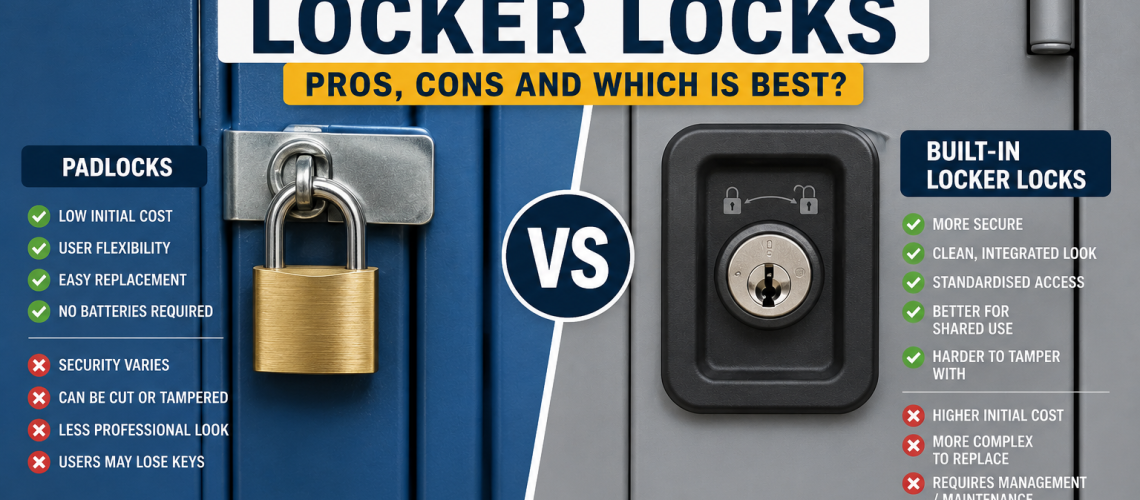
Padlock-based lockers and built-in locker locks differ mainly in where the locking hardware sits and who is responsible for it. A padlock arrangement uses a separate removable lock attached to a locker-mounted fitting. A built-in lock is integrated into the locker door and remains part of the locker installation.
This guide owns the direct comparison between separate padlocks and built-in locker locks. It compares hardware ownership, standardisation, support, reassignment, maintenance responsibility, failure scenarios and replacement workflow.
If a removable padlock arrangement suits your installation, explore our padlocks for lockers, including keyed and combination models for schools, gyms and workplaces. Select a padlock that fits your existing locker hasp and meets your site’s access-management requirements.
Once you have identified a compatible locker hasp or fitting, browse our locker padlocks to compare key-operated and combination options. Check the shackle diameter, internal clearance and padlock body dimensions against your fitting before ordering.
It does not decide whether a site should choose padlock, key, combination, coin, RFID or electronic access overall. That broader decision belongs in Locker Access Control Systems UK.
Padlock system = separate removable lock + locker fitting. Built-in system = lock hardware remains integrated with the locker door.
Quick Answer: Padlocks vs Built-In Locker Locks
The practical difference is not simply “cheap vs premium” or “shared vs assigned”. The real comparison is who supplies, controls, replaces and supports the locking hardware.
| Factor | Padlock arrangement | Built-in locker lock |
|---|---|---|
| Lock hardware | Separate removable padlock | Integrated with locker door |
| Hardware owner | User or site, depending on policy | Normally site / estate |
| Standardisation | Can vary if users supply their own padlocks | Usually defined by the locker specification |
| Lost-access event | Missing key, forgotten padlock code or absent padlock | Depends on built-in lock type |
| Physical replacement | Replace padlock, unless fitting is damaged | Replace or service installed lock hardware |
| Locker fitting | Hasp / latch required | Built-in lock footprint / preparation required |
What This Page Owns, and What It Hands Off
- Separate removable padlock vs integrated lock comparison: this page
- User-supplied vs site-supplied lock consequences: this page
- Standardisation and maintenance responsibility: this page
- Abandoned padlocks and removal workflow: this page
- Mixed estates using both approaches: this page
- Padlock fitting mechanics: Padlock Fittings for Lockers UK
- Keyed lock mechanics: Keyed Locker Locks UK
- Mechanical combination lock mechanics: Mechanical Combination Locker Locks UK
- Electronic lock hardware: Electronic Locker Locks UK
- RFID credential layer: RFID Locker Locks UK
- Shared-use vs assigned-use model: Shared-Use vs Assigned Locker Locks UK
- Overall access-technology choice: Locker Access Control Systems UK
- Lock ownership cost: Locker Lock Cost UK
- Upgrade and conversion: Locker Lock Upgrade Guide UK
- Physical adaptation: Retrofit Locker Locks UK
What Is a Padlock Locker Arrangement?
A padlock locker arrangement uses a locker-mounted fitting that accepts the shackle of a separate padlock.
- The locker provides the hasp, latch or padlock-compatible fitting.
- The padlock is a separate item.
- The padlock may be supplied by the user or by the site.
- The padlock can normally be removed completely from the locker.
For shackle diameter, body clearance, door thickness, fitting movement and conversion details, use Padlock Fittings for Lockers UK.
What Is a Built-In Locker Lock?
A built-in locker lock remains fitted to the locker door as part of the locker installation.
- Keyed cam lock
- Mechanical combination lock
- Coin-operated lock
- Electronic keypad lock
- RFID locker lock
- Other integrated lock hardware
The exact support and failure profile depends on the built-in lock type, so this page does not treat all built-in locks as though they behave identically.
User-Supplied vs Site-Supplied Hardware
One of the largest differences is who owns the user lock.
| Model | Main consequence |
|---|---|
| User-supplied padlock | Users choose, carry and replace their own padlock |
| Site-supplied padlock | Site controls padlock specification but still uses removable hardware |
| Built-in lock | Site normally owns and supports the installed lock hardware |
This ownership difference affects standardisation, replacement stock, support calls and how lockers are returned to service after a problem.
Standardisation Across the Locker Estate
Built-in systems are usually easier to standardise because the same lock model can be specified across a locker range.
Padlock arrangements can also be standardised if the site defines:
- maximum shackle diameter;
- minimum or maximum body size;
- permitted lock type;
- whether users may supply their own padlocks;
- and whether site-issued padlocks are used instead.
So “padlock” does not automatically mean uncontrolled variation. It depends on the site’s policy.
User-Supplied Padlocks Create Variable Hardware
If users bring their own padlocks, the locker estate may contain many different lock sizes and designs.
- Different shackle diameters
- Different body widths
- Different key types
- Different combination mechanisms
- Different levels of wear
- Different levels of compatibility with the fitting
The practical issue is consistency and compatibility, not a blanket assumption that every user-supplied padlock is weak or unsuitable.
Built-In Locks Create a More Defined Hardware Estate
Built-in locks usually give the site a clearer inventory of installed hardware.
- Known manufacturer and model
- Known replacement parts
- Known key or code system
- Known battery type where electronic
- Known door preparation
- Known support procedure
That can simplify maintenance, but it also means the site retains responsibility for keeping those locks operational.
Lost Padlock vs Built-In Lock Failure
The failure event is different.
| Problem | Padlock arrangement | Built-in lock |
|---|---|---|
| User loses access | Lost padlock key, forgotten padlock code or missing padlock | Lost key, forgotten code, dead battery, credential or mechanism fault depending on lock type |
| Lock hardware unavailable | User may need another compatible padlock | Installed lock must be serviced, reset or replaced |
| Locker fitting damaged | Hasp/latch may need repair or replacement | Door-mounted lock or preparation may need repair |
Abandoned Padlocks
A removable padlock can remain attached after the user has left or stopped using the locker.
The site therefore needs a defined process for abandoned locks.
- Confirm the locker is genuinely abandoned.
- Follow the site’s authorised access procedure.
- Remove the padlock without unnecessarily damaging the fitting or locker door.
- Inspect the hasp after removal.
- Return the locker to its normal available state.
This is a different operational problem from resetting or replacing a built-in lock.
Removing a Lost or Unavailable Padlock
If a padlock cannot be opened normally, removal should avoid damage to the locker fitting and door.
- Confirm authorisation before removal.
- Assess shackle and fitting clearance.
- Avoid twisting the hasp or loading the door unnecessarily.
- Inspect the fitting after the padlock is removed.
- Replace damaged hasp hardware before returning the locker to service.
Padlock Fitting Damage
With a padlock arrangement, the fitting becomes part of the failure chain.
- Hasp bent by user force
- Fitting loosened in the door
- Door aperture enlarged
- Rear cam or latch bent
- Padlock body fouling neighbouring doors
Use Padlock Fittings for Lockers UK for detailed fitting faults and compatibility.
Built-In Lock Failure
Built-in lock failure depends on the lock technology.
- Keyed lock: key, cylinder, cam or latch fault
- Mechanical combination: dial, wheel, button, reset or internal mechanism fault
- Coin lock: return, retain or coin-mechanism fault
- Electronic lock: battery, keypad, actuator or local programming fault
- RFID lock: credential, reader, battery or lock-level fault
Each of those belongs to its specialist lock page rather than being generalised here.
Visual Protrusion and Clearance
A separate padlock usually projects farther from the locker door than an integrated lock face.
- Check whether the padlock body can swing.
- Check whether adjacent locker doors can open.
- Check whether the padlock interferes with handles, labels or trims.
- Check whether protruding hardware matters in narrow circulation spaces.
Built-in locks can reduce external protrusion, but exact dimensions depend on the product.
Maintenance Responsibility
The maintenance split is different rather than simply “padlocks need less maintenance”.
| Task | Padlock arrangement | Built-in lock |
|---|---|---|
| User lock condition | User or site, depending on who owns the padlock | Normally site |
| Locker fitting | Site | Site |
| Lost-access support | Depends on padlock ownership and policy | Site normally supports installed lock |
| Replacement stock | Padlocks and fittings if site-supplied | Lock models, keys, parts, batteries or credentials depending on system |
Replacement Workflow
Replacing a padlock is normally separate from replacing the locker fitting.
- Padlock problem only: replace the compatible padlock.
- Hasp/fitting problem: replace or repair the locker fitting.
- Built-in lock problem: service or replace the installed lock hardware.
Use Locker Lock Replacement Guide UK for the physical replacement process.
Locker Reassignment
When a locker changes user, the two arrangements reset differently.
- User-owned padlock: previous user removes the entire padlock.
- Site-owned padlock: site recovers, resets or reissues the padlock as appropriate.
- Built-in keyed lock: key is recovered, replaced or lock is changed if needed.
- Built-in combination lock: code is changed or reset.
- Built-in electronic/RFID lock: credential or programming is changed.
The reassignment model itself belongs in Shared-Use vs Assigned Locker Locks UK.
Initial Hardware Requirement
A padlock arrangement requires a compatible locker fitting and a separate padlock. A built-in arrangement requires the integrated lock hardware and any supporting components associated with that lock type.
This page does not turn that difference into a universal cost conclusion because actual ownership cost depends on hardware price, fitting, replacement, administration, batteries, credentials and support. Use Locker Lock Cost UK for that comparison.
Security Consistency vs Security Quality
Built-in systems can make security specification more consistent because the site can standardise the installed lock. That does not mean every built-in lock is automatically more secure than every padlock.
Padlock arrangements can also be standardised if the site specifies permitted padlock dimensions or supplies the padlocks itself.
Overall security depends on the lock, fitting, locker construction, installation, user behaviour and management controls rather than the built-in/removable distinction alone.
Mixed Locker Estates
Some estates use both padlock fittings and built-in locks.
- Older locker banks may retain hasp fittings.
- Newer areas may use built-in keyed, combination or electronic locks.
- Different operational zones may use different arrangements.
- Temporary migration periods may contain both.
A mixed estate is not automatically a problem, but the site should know which areas use which support model and hold the correct replacement hardware for each.
Converting Between Padlocks and Built-In Locks
Changing from a padlock fitting to a built-in lock, or from an integrated lock to a hasp, is an access-method change.
Use Locker Lock Upgrade Guide UK to define the change. If the door needs drilling, cutting, adaptor plates or other physical modification, use Retrofit Locker Locks UK.
Do Not Use Sector Labels as the Decision
Schools, gyms, workplaces, factories, healthcare sites and leisure facilities can all use padlocks or built-in locks depending on the actual operating model.
The comparison should therefore be based on hardware ownership, support, standardisation, reassignment and operational requirements rather than assumptions about the sector name.
Common Padlocks vs Built-In Comparison Mistakes
- Assuming padlocks are always cheaper overall.
- Assuming built-in locks are always more secure.
- Assuming padlocks mean no site maintenance.
- Ignoring hasp fitting maintenance.
- Ignoring abandoned-padlock removal.
- Assuming user-supplied padlocks cannot be standardised by policy.
- Treating every built-in lock as the same technology.
- Using sector labels instead of the actual operating requirement.
- Confusing shared-vs-assigned policy with padlock-vs-built-in hardware.
Padlocks vs Built-In Locker Locks Checklist
- Who owns the user lock?
- Will padlocks be user-supplied or site-supplied?
- Does the site need one standard lock specification?
- How will abandoned padlocks be handled?
- Who deals with lost padlock keys or forgotten padlock combinations?
- Who maintains hasp fittings?
- Who maintains built-in locks?
- What happens when the locker changes user?
- Is external padlock clearance acceptable?
- Do neighbouring doors remain unobstructed?
- What replacement stock is required?
- Is the estate mixed?
- Would conversion require door modification?
Where Padlock vs Built-In Questions Go Next
| Question | Next guide |
|---|---|
| What are the operational differences between removable padlocks and integrated locks? | This guide |
| How does the locker hasp or fitting work? | Padlock Fittings for Lockers UK |
| How does a keyed built-in lock work? | Keyed Locker Locks UK |
| How does a mechanical combination lock work? | Mechanical Combination Locker Locks UK |
| How does an electronic built-in lock work? | Electronic Locker Locks UK |
| How does RFID access work at lock level? | RFID Locker Locks UK |
| Should lockers be shared or assigned? | Shared-Use vs Assigned Locker Locks UK |
| Which access technology should we choose? | Locker Access Control Systems UK |
| What will the chosen lock hardware cost to own? | Locker Lock Cost UK |
| How do we change from one arrangement to another? | Locker Lock Upgrade Guide UK |
| What if the door needs modification? | Retrofit Locker Locks UK |
Padlocks vs Built-In Locker Locks FAQs
What is the main difference between a padlock locker and a built-in locker lock?
A padlock arrangement uses a separate removable padlock attached to a locker fitting. A built-in lock remains integrated with the locker door as part of the locker installation.
Are padlocks always cheaper than built-in locker locks?
Not necessarily over the full ownership period. Hardware, fitting, replacement, administration, abandoned-padlock handling and site support can all affect cost.
Are built-in locker locks always more secure than padlocks?
No. Security depends on the specific lock, fitting, locker construction, installation and management. Built-in systems can provide more consistent specification, but that is not the same as universal superiority.
Who maintains a user-supplied padlock locker?
The user may maintain or replace their own padlock, while the site still remains responsible for the locker door, hasp or fitting and any authorised abandoned-lock removal process.
What happens if a padlock is abandoned on a locker?
The site needs an authorised process to confirm abandonment, remove the padlock without unnecessary damage and inspect the locker fitting before returning the locker to service.
Can a locker with a padlock fitting be converted to a built-in lock?
Often, but compatibility depends on the existing door preparation, fitting aperture, lock footprint, rear clearance and latch geometry. Physical modification may be required.
Can built-in and padlock lockers exist in the same estate?
Yes. Mixed estates are common during phased replacement, in different operational zones or where older and newer locker banks use different hardware.
Summary
Padlocks and built-in locker locks are best compared by hardware ownership, standardisation, support responsibility, reassignment, clearance and replacement workflow.
Padlock arrangements separate the user lock from the locker fitting. Built-in arrangements keep the lock hardware as part of the locker door. Neither is automatically better, cheaper or more secure in every application.
Keep padlock-fitting mechanics with the Padlock Fittings guide, lock-type mechanics with their specialist pages, shared-versus-assigned policy with its operating guide and the overall access choice with Access Control.
Discover more from Blog Total Locker Service
Subscribe to get the latest posts sent to your email.