Locker Combination Locks UK: Mechanical Dial Locks Guide
May 7, 2026
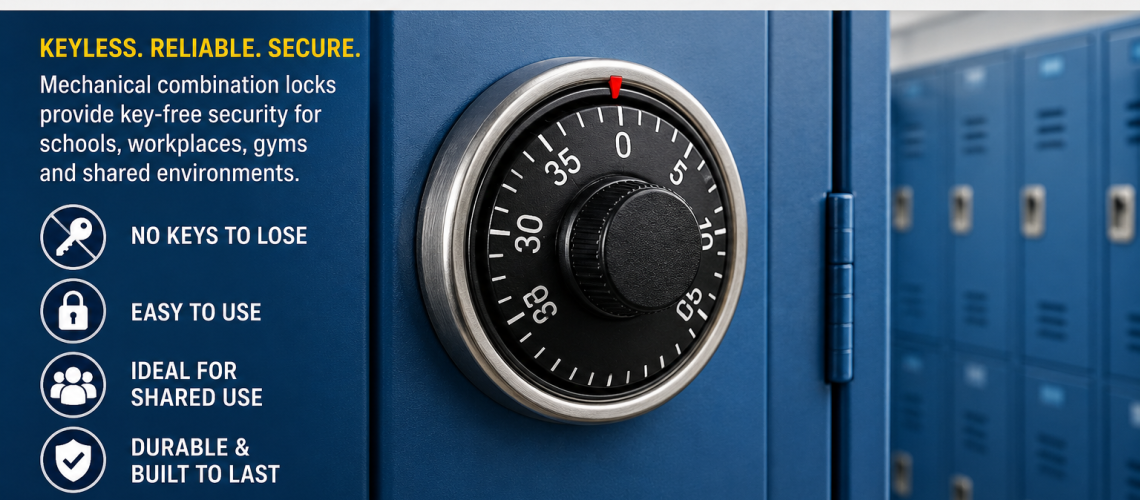
Mechanical combination locker locks open using a code entered through a dial, numbered wheels or mechanical push-buttons instead of a conventional user key. Their locker-level requirements include the code mechanism, fixed or resettable operation, assigned or shared-use mode, management override, forgotten-code recovery, wear, physical fit and the way the cam or latch secures the door.
This guide owns the mechanical combination lock itself. It explains how the mechanism works, how different code modes operate, what happens when a code is forgotten, how staff override should be controlled and what faults to check before replacing the lock.
It does not decide whether a combination lock is better than a keyed, coin, RFID or electronic lock. That wider technology choice belongs in Locker Access Control Systems UK.
Mechanical Combination Lock = code mechanism and local operation. Access Control = whether combination access is the right technology.
Quick Answer: How Do Mechanical Combination Locker Locks Work?
A mechanical combination lock releases only when its internal components are aligned by the correct code sequence. Depending on the product, the user may turn a dial, line up numbered wheels or press a sequence of buttons.
- The user enters the code.
- The internal mechanism aligns.
- The handle, knob, cam or latch can move.
- The locker opens.
- The mechanism then returns to its normal locked or reset state according to the lock design.
Mechanical combination locks do not normally require batteries or fixed electrical power.
What This Page Owns, and What It Hands Off
- Mechanical dial, wheel and push-button code mechanisms: this page
- Fixed-code and resettable mechanical modes: this page
- Forgotten-code recovery and local management override: this page
- Mechanical wear, stiff controls and unreliable release: this page
- Whether to choose combination, key, coin, RFID or electronic access: Locker Access Control Systems UK
- Shared-use versus assigned-use operating model: Shared-Use vs Assigned Locker Locks UK
- Electronic keypad and PIN locks: Electronic Locker Locks UK
- Mechanical versus electronic comparison: Mechanical vs Electronic Locker Locks UK
- Wet-area environmental specification: Locker Locks for Wet Areas UK
- Repeated-use duty: Locker Locks for High-Traffic Areas UK
- Physical lock replacement: Locker Lock Replacement Guide UK
- Changing to another access method: Locker Lock Upgrade Guide UK
Main Types of Mechanical Combination Locker Lock
| Type | How the code is entered | What to establish |
|---|---|---|
| Dial combination lock | Rotating dial through a number sequence | Sequence, reset procedure, override method |
| Wheel combination lock | Individual numbered wheels aligned to the code | Number of wheels, code-change method, reset access |
| Mechanical push-button lock | Buttons pressed in the required sequence | Code format, change procedure, management access |
| Fixed-code lock | Same programmed mechanical code remains in use | Who knows the code and how it is changed |
| Resettable/public-use lock | User sets a temporary code for the current use cycle where supported | How the code clears or resets between users |
Not every product supports every operating mode. The exact lock specification should be checked before assuming that a fixed-code model can be converted to shared use or that a resettable lock can operate as a permanent assigned lock.
Fixed-Code Combination Locks
A fixed-code mechanical combination lock keeps the same user code until an authorised person changes it using the lock’s permitted reset process.
- The user normally returns to the same locker.
- The code does not automatically clear after every opening.
- Staff need a controlled method for changing or recovering the code.
- The site should know whether the user may choose the code or whether it is assigned by management.
Fixed-code operation can support assigned use, but whether a locker should be assigned is a separate operating decision. Use Shared-Use vs Assigned Locker Locks UK for that question.
Resettable or Public-Use Combination Locks
Some mechanical combination locks support a temporary-use cycle in which one user sets a code, uses the locker and releases it for the next user.
- The locker is available.
- The user enters or sets a temporary code.
- The locker is locked.
- The same code reopens the locker.
- The lock clears, resets or returns to available mode according to the product design.
- A new user can then set a different code.
The important specialist question is how the selected lock performs that reset. The broader decision about whether temporary shared use is appropriate belongs outside this page.
Multi-User Mechanical Combination Locks
Some products are designed specifically for successive users and include management functions that allow staff to recover lockers after forgotten or abandoned codes.
Before specifying one, establish:
- how each user sets the temporary code;
- how the code is cleared after use;
- whether staff can identify or recover the current code;
- how management override is performed;
- and whether the user can accidentally leave the lock in an unavailable state.
Dial Combination Locks
Dial locks use a rotating dial and a defined sequence of turns and numbers. The internal wheels or gates align only when the correct sequence is entered.
- Users need clear instructions on direction and sequence.
- Rushing the sequence can cause an apparent code failure.
- Wear in the dial or internal mechanism can make alignment less precise.
- Repeated forcing can damage the spindle or internal components.
Number-Wheel Combination Locks
Wheel locks use a row of numbered wheels that are aligned to the correct code.
- Check that each wheel moves freely.
- Check that numbers align clearly with the index mark.
- Check whether the code can be changed only while the lock is open.
- Check whether a reset pin, lever or management key is required.
- Do not force a wheel that has become stiff or obstructed.
Mechanical Push-Button Combination Locks
Mechanical push-button locks use a sequence of buttons instead of a dial or wheels.
- Buttons should return cleanly after use.
- Users need to understand whether order matters.
- Buttons can wear differently if the same code is used for a long period.
- Management should know the code-change and recovery process.
Mechanical push-button locks should not be confused with battery-powered electronic PIN locks. For electronic keypads, use Electronic Locker Locks UK.
How Combination Codes Are Changed
The code-change process depends on the lock model. It may require:
- the locker to be open;
- a reset button or lever;
- a change key or management tool;
- a specific dial sequence;
- or a manufacturer-specific procedure.
Never assume that two visually similar locks use the same reset process. Record the correct procedure for each model installed on the site.
Forgotten Combination Codes
Forgotten codes are one of the main support issues with combination locks.
The recovery method may include:
- management override key;
- code-finding tool;
- master combination;
- reset procedure while the locker is open;
- or another manufacturer-specific recovery method.
Not every lock provides every recovery method. Confirm the actual product before relying on a master key or code-recovery facility.
Management Override Needs to Be Controlled
An override tool or management key may provide access to many lockers, so it should be treated differently from a normal user code.
- Limit who holds management override.
- Store spare override keys or tools securely.
- Record which lock range they belong to.
- Define when staff may use override access.
- Replace or secure lost management tools promptly.
Code Sharing Is an Operational Risk
A mechanical combination removes the ordinary locker key, but the access code itself can be shared.
- Users should avoid codes that are obvious or widely known.
- Assigned-user codes should be changed when the locker changes user.
- Temporary shared-use codes should clear correctly after the use cycle.
- Staff should not publish management codes in user instructions.
The security effect therefore depends partly on how codes are managed, not only on the mechanism.
Mechanical Combination Locks Still Depend on Cam and Latch Alignment
A correct code does not guarantee the locker will open if the physical locking point is binding.
- Door pressure can hold the cam against the frame.
- A bent cam can miss the normal release position.
- A dropped door can load the latch.
- An internal obstruction can stop full movement.
- The combination mechanism can release correctly while the door remains mechanically trapped.
Test the lock with the door open before assuming the code mechanism itself has failed.
Common Mechanical Combination Lock Faults
| Symptom | Initial checks |
|---|---|
| Correct code does not release | Code sequence, door pressure, cam/latch alignment, internal wear |
| Dial feels rough or stiff | Contamination, wear, corrosion, spindle condition |
| Number wheel is difficult to turn | Debris, damage, misalignment, corrosion |
| Push-button sticks | Wear, contamination, damage, moisture exposure |
| Code can no longer be changed | Reset lever/tool, lock-open position, damaged change mechanism |
| Shared-use lock will not clear | Reset sequence, user cycle, mechanism wear |
| Lock releases with door open but not closed | Cam length, latch engagement, door distortion |
Wear Can Make Code Entry Less Reliable
Mechanical combination locks contain moving parts. Repeated operation can eventually affect how precisely they move and align.
- Dial movement becomes loose or rough.
- Number wheels no longer align cleanly.
- Buttons do not return fully.
- The handle or knob requires increasing force.
- The correct code works only after repeated attempts.
Repeated unreliable release should be investigated as a fault rather than treated as normal behaviour.
Wet Areas Need Separate Environmental Checks
Mechanical operation avoids batteries and electronic components, but it does not make the lock immune to humidity, splash, chlorine or cleaning chemicals.
- Dials and wheels can become stiff.
- Internal components can corrode.
- Cams and fasteners can deteriorate behind the door.
- Buttons can become contaminated.
Use Locker Locks for Wet Areas UK for the environmental specification.
High-Traffic Use Is a Separate Requirement
A combination lock may be used by one person occasionally or by many users repeatedly throughout the day. Those duty cycles are not equivalent.
For repeated operation, vandal resistance, service frequency and heavy-use durability, use Locker Locks for High-Traffic Areas UK.
Physical Fit and Replacement
A replacement combination lock should be checked against the existing locker before ordering in quantity.
- Door material
- Door thickness
- Existing lock hole or cut-out
- Fixing method
- Front-face footprint
- Rear lock-body clearance
- Cam length and orientation
- Door handing where relevant
- Frame or strike position
If the intention is simply to replace a failed lock with an equivalent unit, use Locker Lock Replacement Guide UK. If the access method is changing, use Locker Lock Upgrade Guide UK.
Test One Combination Lock Before a Bulk Order
- Identify the existing locker door and lock preparation.
- Fit one representative combination lock.
- Check front and rear clearance.
- Check cam engagement.
- Set the intended operating mode.
- Test code entry repeatedly.
- Test code change or reset.
- Test management override.
- Test with the door open.
- Test with the door closed.
- Confirm the result before approving the larger quantity.
Do Not Use Sector Labels as Combination-Lock Recommendations
A school, gym, workplace, hospital or warehouse may all use combination locks, but the sector name alone does not determine whether they are the right choice.
The operating requirement should be defined first. This page then explains how a mechanical combination lock behaves if that technology is being considered.
Do Not Let This Page Decide Combination vs Keyed or Electronic Access
Mechanical combination locks remove the ordinary user key and avoid batteries, but they introduce code memory, code-change and override requirements.
Whether that trade-off is appropriate belongs in Locker Access Control Systems UK. For electronic PIN locks, use Electronic Locker Locks UK.
Mechanical Combination Lock Checklist
- Dial, number wheel or mechanical push-button?
- Fixed code or resettable code?
- Assigned or shared operating mode?
- How is the user code changed?
- Can the code be changed only while the locker is open?
- How is a forgotten code recovered?
- What management override exists?
- Who controls the override key or tool?
- Does the code clear correctly after shared use?
- Do dials, wheels or buttons move freely?
- Does the cam or latch engage correctly?
- Is the environment dry, humid or wet?
- How frequently will the lock be operated?
- Does the replacement physically fit the locker?
- Has one representative lock been tested before bulk order?
Where Combination Lock Questions Go Next
| Question | Next guide |
|---|---|
| How does the mechanical combination lock itself work? | This guide |
| Should we choose combination, key, coin, RFID or electronic access? | Locker Access Control Systems UK |
| Should lockers be shared or assigned? | Shared-Use vs Assigned Locker Locks UK |
| How do electronic PIN locks work? | Electronic Locker Locks UK |
| How do electronic and mechanical locks compare? | Mechanical vs Electronic Locker Locks UK |
| What does a wet environment change? | Locker Locks for Wet Areas UK |
| What does repeated heavy use change? | Locker Locks for High-Traffic Areas UK |
| How do we replace a failed lock? | Locker Lock Replacement Guide UK |
| How do we change to another access method? | Locker Lock Upgrade Guide UK |
| Where can we view current locker-lock products? | Locker Locks |
Mechanical Combination Locker Lock FAQs
What is a mechanical combination locker lock?
It is a locker lock that releases when the correct code is entered through a dial, numbered wheels or mechanical push-buttons, without requiring a normal user key or electrical power.
Do mechanical combination locker locks need batteries?
No. Mechanical combination locks normally operate through physical internal components and do not require batteries or fixed electrical power.
What is the difference between fixed-code and resettable combination locks?
A fixed-code lock keeps the same code until it is deliberately changed. A resettable or public-use model can allow a temporary user to set a code for one use cycle and then release the locker for another user.
What happens if a user forgets the combination?
The recovery method depends on the product. It may use a management key, code-finding tool, master combination or another manufacturer-specific reset procedure.
Can mechanical combination locks be used for shared lockers?
Some models support a shared or public-use mode where a temporary code is used for one locker session and the lock then resets for the next user.
Can combination locks be permanently assigned?
Yes. Fixed-code or private-use models can remain associated with one user until the code is deliberately changed or the locker is reassigned.
Why will a combination lock not open even when the code is correct?
The problem may be mechanical rather than code-related. Check door pressure, cam or latch alignment, contamination, wear and whether the mechanism releases correctly with the door open.
Are mechanical combination locks suitable for wet areas?
Some may be suitable, but mechanical operation alone does not make a lock resistant to humidity, splash, chlorine or cleaning chemicals. The exact environmental specification should be checked.
Summary
Mechanical combination locker locks should be specified around the code mechanism, operating mode, reset method, management override, forgotten-code recovery, physical fit and mechanical locking point.
Keep the wider access-technology decision with Access Control, the shared-versus-assigned decision with its own operating guide, electronic PIN locks with Electronic Locker Locks and environmental or heavy-use requirements with their specialist pages.
Discover more from Blog Total Locker Service
Subscribe to get the latest posts sent to your email.