Coin Operated Locker Locks UK: Return vs Retain Systems Explained
May 7, 2026
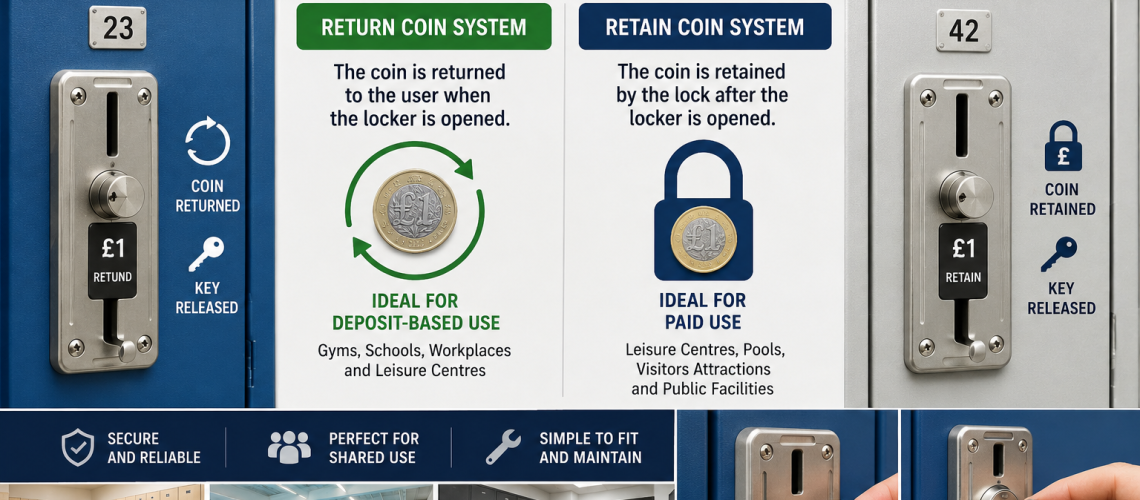
Coin-operated locker locks use a coin or token as part of the locking cycle. The main formats are return-coin, retain-coin and token-operated systems, each with a different effect on user behaviour, cash handling and locker turnover.
This guide owns the specialist topic of how coin and token locker mechanisms work: the operating sequence, return versus retain operation, token use, coin collection, jams, override, signage, inspection and replacement considerations.
It does not decide whether coin operation is the best access technology for a particular site. For that wider comparison, use Locker Access Control Systems UK. For leisure-site operating requirements, use Leisure Locker Access Systems UK.
Coin Lock = how the coin or token mechanism works. Access Control = whether coin operation is the right technology for the operating model.
Quick Answer: How Do Coin-Operated Locker Locks Work?
A coin-operated locker lock requires a coin or token before the user can complete the locking cycle. Depending on the mechanism, the coin is either returned when the locker is opened, retained for collection by the site, or replaced by a site-issued token.
| Type | What happens to the coin or token? | Operating effect |
|---|---|---|
| Return coin | Returned when the user reopens the locker | Deposit-style temporary use |
| Retain coin | Kept by the mechanism or collection system | Paid-use model |
| Token operated | Uses a site-issued token rather than ordinary cash | Controlled temporary use without normal coin handling |
Exact operation varies by manufacturer and model, so the installed mechanism should always be identified before parts or replacement locks are ordered.
What This Page Owns, and What It Hands Off
- Return-coin, retain-coin and token mechanism operation: this page
- Choosing coin vs key, combination, PIN, RFID or another technology: Locker Access Control Systems UK
- Temporary/shared-use operating model: Shared-Use vs Assigned Locker Locks UK
- Leisure-centre operating requirements: Leisure Locker Access Systems UK
- Physical lock replacement procedure: Locker Lock Replacement Guide UK
- Changing to another access method: Locker Lock Upgrade Guide UK
- Wet-area lock requirements: Locker Locks for Wet Areas UK
- Heavy-use lock requirements: Locker Locks for High-Traffic Areas UK
- Current locker lock products: Locker Locks
Main Parts of a Coin Locker Lock
Although designs vary, a coin-operated locker lock usually combines several functional parts:
- User lock mechanism: key, knob, handle or other user-operated locking element.
- Coin or token slot: accepts the required coin or token.
- Coin validator or mechanical gate: controls whether the correct item has been inserted.
- Retention path: temporarily holds or permanently diverts the coin depending on the model.
- Cam or latch: secures the locker door.
- Override or service access: allows authorised staff to open or service the mechanism where supported.
- Collection box or container: used on some retain-coin systems.
Not every lock uses every component in the same way, so manufacturer-specific parts should not be assumed interchangeable.
Return-Coin Locker Locks
A return-coin lock uses the coin as a temporary deposit rather than a charge.
A typical sequence is:
- The user finds an available locker.
- The required coin is inserted.
- The locker is locked.
- The coin remains held while the locker is in use.
- The user returns and opens the locker.
- The mechanism returns the coin.
- The locker becomes available for another user.
The key operational feature is that the user has an incentive to complete the cycle because the deposit is recovered only when the locker is reopened correctly.
Retain-Coin Locker Locks
A retain-coin lock keeps the coin after use. This supports a paid locker model where the site charges for each use or locking cycle.
A typical sequence is:
- The user inserts the required coin.
- The locker is locked.
- The coin is transferred into the retention path or collection system.
- The user later opens the locker.
- The coin is not returned.
- The site collects retained coins through the service arrangement.
The exact collection method depends on the lock and installation. Some systems retain coins within each lock, while others use a separate collection container.
Token-Operated Locker Locks
Some coin mechanisms can be configured for site-issued tokens instead of ordinary currency.
Token operation can be useful where the organisation wants the physical simplicity of a mechanical coin-style lock without asking users to carry a particular coin.
- Tokens can be issued at reception.
- Tokens can be restricted to authorised users.
- The site can avoid ordinary cash handling.
- The mechanism can still support temporary locker turnover.
Compatibility between a lock and a particular token still depends on the mechanism specification.
Coin Value and Denomination Matter
Coin locks are generally configured around a particular coin or token size. The required value or denomination should be confirmed before locks or replacement parts are ordered.
- Record the current coin or token.
- Check whether the mechanism is return or retain.
- Check whether the site intends to keep the same deposit or charge.
- Confirm any planned move to a different token or denomination before ordering.
A change in coin or token requirement may involve more than relabelling the locker. The mechanism itself may need to be changed or reconfigured depending on the product.
Coin Return Is Not the Same as Free Locker Use
A return-coin mechanism usually means the user receives the coin back, but the organisation should still define the operating policy clearly.
- What coin or token is required?
- Is the coin purely a deposit?
- Does the user receive it back only after fully reopening the locker?
- What happens if the locker is opened by staff override?
- What happens if the mechanism jams?
Retain-Coin Systems Need a Collection Process
If the system keeps the coin, the site needs a controlled collection and reconciliation process appropriate to the installation.
- Who is authorised to collect retained coins?
- How often are collection boxes emptied?
- How are service keys controlled?
- What happens if the collection path becomes full?
- How is a jammed coin handled?
These are operational requirements of retain-coin mechanisms rather than reasons to select or reject coin operation in general.
Coin Jams and Misfeeds
Coin mechanisms can fail to complete the expected cycle if the wrong coin is inserted, a damaged coin is used, dirt enters the mechanism or internal wear affects movement.
- Do not force the user control if the mechanism will not move normally.
- Use the authorised service or override procedure.
- Check whether the inserted item matches the required coin or token.
- Inspect for visible debris or damage.
- Record repeated jams because recurrence may indicate wear or a mechanism fault.
Repeated problems should be treated as a servicing or replacement issue rather than a normal user inconvenience.
Lost Keys and Coin Locks
Many traditional coin locks still use a removable user key during the locking cycle. The coin mechanism does not eliminate the possibility of lost keys.
The site should understand:
- whether the user key can be removed when the locker is open;
- whether the key remains captive in one part of the operating cycle;
- whether replacement user keys are available;
- how staff override works;
- and how lost keys are handled without compromising other lockers.
Staff Override and Service Keys
Coin locks may provide one or more authorised management or service access methods depending on the model.
- Emergency or management opening
- Coin-box access
- Service access to the mechanism
- Replacement of a lost user key where supported
These higher-level keys or tools should be controlled because they may provide access to multiple lockers or to retained money.
User Instructions and Signage
Coin locks are simple only when the user understands the sequence.
- State the required coin or token clearly.
- Explain whether the coin is returned or retained.
- Show when the key can be removed.
- Explain what happens when the locker is reopened.
- Provide a clear route for help if the coin jams or access is lost.
Clear instructions can reduce forced operation, incorrect coins and unnecessary staff intervention.
Coin Locks in Wet and High-Use Areas
Coin locks are often found in leisure and changing environments, but the coin mechanism alone does not determine whether a lock is suitable for humidity, splash, cleaning chemicals or very high operating frequency.
Use Locker Locks for Wet Areas UK for environmental specification and Locker Locks for High-Traffic Areas UK for repeated-use considerations.
Routine Inspection of Coin Mechanisms
Coin locks benefit from simple routine checks, especially where they are operated frequently.
- Check the coin slot for damage or obstruction.
- Check that the correct coin or token passes through the expected cycle.
- Check that return-coin locks return the deposit correctly.
- Check that retain-coin systems transfer the coin into the collection path.
- Check user keys, cams and latches for wear.
- Check that service and override access still operates correctly.
- Record repeated faults rather than repeatedly resetting the same mechanism.
For the wider servicing process, use Locker Parts and Servicing Guide.
When a Coin Lock Needs Replacement
Replacement may be appropriate when the existing mechanism is worn, damaged, repeatedly jamming, no longer supported or no longer matches the site’s required coin or token arrangement.
- Identify the existing lock and manufacturer.
- Record the coin or token requirement.
- Record return or retain operation.
- Record the user-key and override arrangement.
- Record the cam, fixing and door preparation.
- Confirm the proposed replacement before ordering a large quantity.
The physical replacement procedure belongs in Locker Lock Replacement Guide UK.
Changing Coin Value, Token or Operating Model
A site may want to change from one coin denomination to another, move from coin to token, switch between return and retain operation or leave coin operation entirely.
These are different levels of change:
| Change | What to establish |
|---|---|
| Different coin value | Whether the existing mechanism can accept or be configured for it |
| Coin to token | Whether the mechanism supports the intended token |
| Return to retain | Whether the lock and collection arrangement support the new operating cycle |
| Retain to return | Whether the mechanism can return the deposit correctly |
| Coin to another lock technology | Whether this is an upgrade or retrofit project rather than a coin-lock service task |
If the intention is to move to a different access method, use Locker Lock Upgrade Guide UK.
Coin Locks Do Not Automatically Mean Shared Use Is Correct
Coin mechanisms are commonly associated with temporary lockers, but the allocation model should still be defined separately.
A site’s decision should start with whether the locker needs to return to availability for another user. Use Shared-Use vs Assigned Locker Locks UK for that operating question.
Common Coin Locker Lock Problems
- Wrong coin or token inserted
- Coin jams
- Return coin not released
- Retained coin not transferring correctly
- Collection box full or obstructed
- User key lost
- Key difficult to turn
- Cam not engaging the frame correctly
- Service key unavailable
- Instructions unclear
- Repeated faults on the same locker
- Replacement ordered without checking the original mechanism
Coin Locker Lock Checklist
- Return coin, retain coin or token?
- What coin or token is required?
- Is the coin a deposit or a charge?
- Does the lock use a removable user key?
- Is there management or service override?
- How are retained coins collected?
- How are jams resolved?
- Are instructions displayed clearly?
- Is the mechanism used in a wet area?
- How frequently is it operated?
- Are spare parts available?
- Is the existing mechanism still supported?
- If replacing, have the fixing, cam and door arrangement been recorded?
Where Coin Locker Lock Questions Go Next
| Question | Next guide |
|---|---|
| Should the site use coin, key, combination, PIN or RFID? | Locker Access Control Systems UK |
| Should the locker be shared or assigned? | Shared-Use vs Assigned Locker Locks UK |
| How should leisure lockers operate? | Leisure Locker Access Systems UK |
| How do I physically replace the lock? | Locker Lock Replacement Guide UK |
| How do I change to another access method? | Locker Lock Upgrade Guide UK |
| Which locks suit wet changing areas? | Locker Locks for Wet Areas UK |
| What does repeated heavy use change? | Locker Locks for High-Traffic Areas UK |
| Where can I view replacement locks? | Locker Locks |
Coin-Operated Locker Lock FAQs
What is a coin-operated locker lock?
A coin-operated locker lock uses a coin or token as part of the locking cycle. The mechanism may return the coin, retain it or use a site-issued token depending on the design.
What is the difference between return-coin and retain-coin locker locks?
A return-coin lock gives the coin back when the locker is reopened, while a retain-coin lock keeps the coin for collection by the site.
Can coin locker locks use tokens instead of money?
Some mechanisms can use compatible site-issued tokens. The exact token size and mechanism specification must be confirmed before ordering or conversion.
Why does a return-coin lock keep the coin while the locker is locked?
The coin acts as a deposit during use. When the normal unlocking cycle is completed, the mechanism returns it to the user.
What happens if a coin jams in a locker lock?
Use the authorised service or override procedure rather than forcing the control. Check the coin or token, inspect for obstruction and record repeated jams because they may indicate wear or a mechanism fault.
Can coin locker locks be replaced without replacing the locker?
Often, yes. The existing lock, fixing, cam, door preparation and coin or token arrangement should be recorded so a suitable replacement can be checked before ordering.
Are coin locks automatically the best option for gyms and leisure centres?
No. Coin operation is one access technology. The correct choice depends on the temporary-use model, user expectations, wet-area requirements, administration, maintenance and wider access needs.
Summary
Coin locker locks should be understood by mechanism rather than by sector stereotype.
Return-coin systems use a refundable deposit, retain-coin systems collect payment and token systems use a site-issued substitute for ordinary cash. Each needs the correct coin or token, clear user instructions, controlled service access and a practical process for jams and maintenance.
If the question is whether coin operation is the right access technology for the site, move to Access Control Systems UK. If the question is how the coin or token mechanism itself should operate, remain with this guide.
Discover more from Blog Total Locker Service
Subscribe to get the latest posts sent to your email.