Padlock Fittings for Lockers UK: Hasp & Staple Systems Explained
May 7, 2026
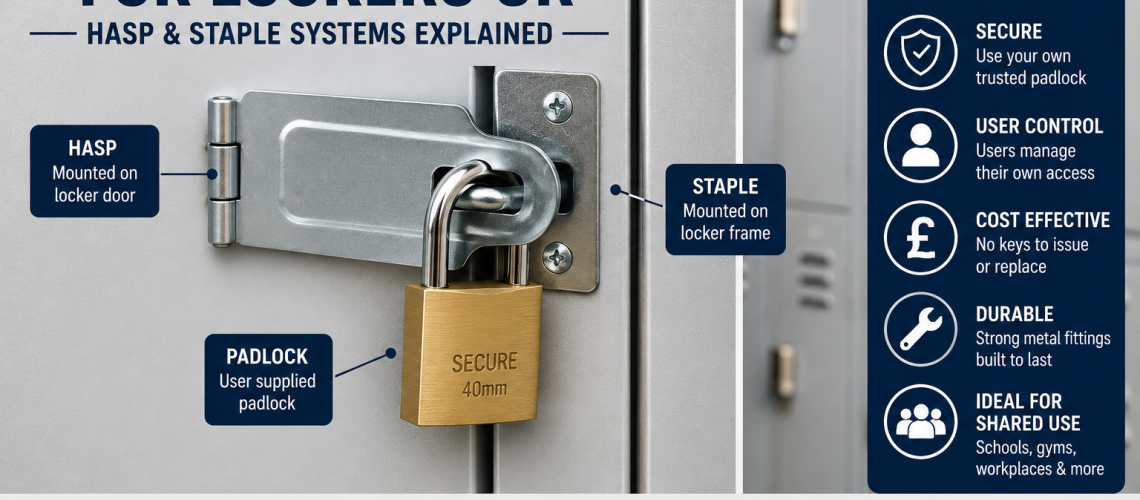
Padlock fittings for lockers are not the user lock itself. They are locker-mounted hasp, latch or padlock-compatible fittings that provide a secure opening for a separate padlock shackle. The fitting must match the locker door, fixing method, available clearance and the padlock that will be used with it.
If a removable padlock arrangement suits your installation, explore our padlocks for lockers, including keyed and combination models for schools, gyms and workplaces. Select a padlock that fits your existing locker hasp and meets your site’s access-management requirements.
Once you have identified a compatible locker hasp or fitting, browse our locker padlocks to compare key-operated and combination options. Check the shackle diameter, internal clearance and padlock body dimensions against your fitting before ordering.
This guide owns the locker padlock fitting hardware: how hasp and latch fittings work, how shackle diameter and clearance affect compatibility, how the fitting attaches to the locker door, what can go wrong mechanically and what should be checked before replacing or converting an existing lock.
It does not decide whether a padlock-based system is better than a keyed, combination, coin, RFID or electronic system. That access-technology decision belongs in Locker Access Control Systems UK.
Padlock Fitting = the locker-mounted anchor and latch mechanism. Padlock = the separate user lock. Access Control = whether this arrangement suits the operating model.
Quick Answer: What Is a Locker Padlock Fitting?
Once you have identified a compatible locker hasp or fitting, browse our locker padlocks to compare key-operated and combination options. Check the shackle diameter, internal clearance and padlock body dimensions against your fitting before ordering.
A locker padlock fitting is a mechanical fitting attached to the locker door that accepts the shackle of a separate padlock. Depending on the design, the fitting may rotate, push, latch or align with a fixed locking point when the door is closed.
- The locker door closes.
- The hasp or latch fitting moves into its locking position.
- The padlock shackle passes through the fitting.
- The padlock prevents the fitting from moving back to the release position.
- The locker remains secured until the padlock is removed.
The fitting and padlock are therefore two separate components and both must be compatible.
What This Page Owns, and What It Hands Off
- Hasp, latch and padlock-compatible locker fittings: this page
- Shackle diameter and shackle clearance: this page
- Door thickness, fixing style and fitting movement: this page
- Damaged, bent, loose or jammed hasp fittings: this page
- Whether padlock access is the right technology: Locker Access Control Systems UK
- Shared-use versus assigned-use operating model: Shared-Use vs Assigned Locker Locks UK
- Changing an existing keyed, coin or other lock to padlock use: Locker Lock Upgrade Guide UK
- Physical adaptation of an existing locker door: Retrofit Locker Locks UK
- Replacing a damaged fitting: Locker Lock Replacement Guide UK
- Identifying an unknown existing lock or fitting: Locker Lock Identification Guide UK
- Wet-area environmental specification: Locker Locks for Wet Areas UK
- Repeated-use duty: Locker Locks for High-Traffic Areas UK
Padlock Fitting vs Hasp and Staple
“Hasp and staple” is often used loosely, but locker fittings can differ from the traditional two-piece surface-mounted hasp-and-staple arrangement used on sheds, gates or boxes.
Locker padlock fittings may include swivel hasp fittings, push-to-turn latch fittings, nut-fixed padlock-compatible barrels, manufacturer-specific replacement fittings and conversion fittings designed to cover or reuse an existing lock aperture.
The important point is not the label but the actual geometry of the fitting and how it locks the door.
How Swivel Hasp Locker Fittings Work
A swivel hasp fitting usually rotates between an open and closed position. When the locker door is closed, the fitting is turned into the locked position and the padlock shackle passes through the exposed opening.
- The fitting must rotate freely.
- The locking aperture must remain accessible.
- The padlock shackle must pass through without binding.
- The padlock body must have enough space to hang or rotate naturally.
- The fitting must engage the locker frame or internal locking point correctly.
Push-to-Turn and Latch-Type Padlock Fittings
Some locker fittings combine a rotating latch or cam with an external padlock aperture. The fitting may need to be pushed, turned or aligned before the padlock can be inserted.
When replacing one of these fittings, check both the external padlock opening and the rear-side latch movement. A front fitting that accepts the padlock can still fail if the rear mechanism does not engage the locker frame correctly.
Padlock Shackle Diameter
Shackle diameter is one of the most important compatibility checks.
Total Locker Service currently lists several locker hasp fittings designed around padlocks with approximately 5 mm to 7 mm shackles. That is not a universal rule for every fitting, so the exact product specification should still be checked before ordering.
- A shackle that is too thick may not pass through the fitting.
- A very thin shackle may fit physically but may not suit the intended duty.
- The fitting aperture can vary by manufacturer and model.
- Paint, wear or distortion can reduce the usable opening on an old fitting.
Where a specific padlock is already standard on site, test that real padlock with the proposed fitting.
Shackle Clearance Matters as Much as Diameter
- Check the gap between the fitting and locker door.
- Check whether the shackle can approach at the required angle.
- Check whether the padlock body fouls the door, handle or adjacent locker.
- Check whether the shackle can be removed easily when the door is closed.
- Check whether users wearing gloves can manipulate the padlock where relevant.
Padlock Body Clearance
The padlock body hangs outside the locker. That makes its size and position part of the installation.
- Large padlocks can strike neighbouring locker doors.
- Long bodies can interfere with recessed handles or labels.
- Very wide padlocks may not hang naturally from a close-fitting hasp.
- Padlocks should not prevent a neighbouring locker from opening.
Always test the fitting and padlock together rather than checking only the shackle diameter on paper.
Door Thickness
Locker padlock fittings are not universal across all door thicknesses. Current Total Locker Service product listings include examples with specific maximum panel or door-thickness requirements, including fittings for metal doors and conversion fittings for thicker doors.
- Metal skin thickness
- Laminate or timber door thickness
- Reinforcement plates
- Rear fixing nut engagement
- Any spacer or backing plate
Fixing Method
- Nut-fixed body
- Screw-fixed fitting
- Clip or retained barrel
- Back plate
- Manufacturer-specific fixing arrangement
Before ordering, inspect the rear of the existing fitting if possible. A front view alone may not reveal the fixing method.
Existing Door Cut-Out
- Measure the width and height of the opening where relevant.
- Check whether the opening is round, double-D, rectangular or manufacturer-specific.
- Check whether the new front plate fully covers the old aperture.
- Check whether fixing holes remain usable.
- Check whether exposed metal edges need protection after modification.
If drilling, cutting or adaptor plates are required, the job moves into Retrofit Locker Locks UK.
Rear Clearance
- Check shelves and dividers.
- Check door stiffeners.
- Check internal hooks or rails.
- Check the full movement of any rotating cam or latch.
- Check that stored items cannot easily obstruct the mechanism.
Cam, Latch and Rotational Movement
Some padlock fittings rotate a rear cam or latch when the external fitting is turned. The replacement should match movement direction, rotation angle, cam length, cam offset where applicable, locker-frame position and door handing if the fitting is handed.
A fitting can accept the padlock perfectly and still fail to secure the locker if the rear latch geometry is wrong.
Left-Hand and Right-Hand Fittings
- Identify the locker hinge side.
- Check the manufacturer’s definition of left- and right-handed.
- Do not infer handing from a photograph alone.
- Test one fitting if the existing locker range is mixed.
Manufacturer-Specific Locker Hasp Fittings
Total Locker Service currently lists replacement hasp options including universal, Probe-compatible, Pure and Ojmar conversion fittings. Use Locker Hasp Locks for current product availability and specifications.
Do not assume that a fitting described as “universal” will suit every locker without checking the door aperture, thickness, fixing and latch movement.
Replacing a Damaged Hasp Fitting
- Manufacturer or locker range
- Door thickness
- Front aperture
- Fixing method
- Rear cam or latch
- Movement direction
- Padlock shackle size
- Door handing
- Environmental exposure
For like-for-like replacement procedure, use Locker Lock Replacement Guide UK.
Bent Hasp or Distorted Fitting
- Padlock shackle will no longer pass through cleanly.
- The fitting will not rotate fully.
- The rear latch no longer aligns with the locker frame.
- The padlock body sits against the locker door under load.
- The user needs excessive force to lock or unlock the compartment.
Repeated forcing can damage both the fitting and the padlock. Check the door and frame before simply fitting another hasp because the original damage may have been caused by misalignment.
Loose Padlock Fittings
- Check the fixing nut or screws.
- Check for damage around the door opening.
- Check whether a backing plate is required.
- Check whether the fitting body itself has worn.
- Do not keep tightening a fixing into damaged sheet metal without inspecting the door.
Padlock Trapped on the Fitting
- The shackle may be loaded sideways by the fitting.
- The fitting may be twisted or bent.
- The locker door may be pressing against the latch.
- The shackle may be too large for the usable opening.
- Corrosion or contamination may reduce clearance.
Relieve door pressure and inspect the fitting rather than forcing the padlock through a restricted opening.
Fitting Rotates but the Locker Will Not Open
- Is the rear cam actually rotating?
- Has the cam fixing loosened?
- Is the latch bent?
- Is the door under pressure?
- Has the locker frame distorted?
- Is an item inside the locker obstructing the latch?
Converting an Existing Keyed Lock to a Hasp
Some locker doors can accept a padlock fitting in place of an existing keyed cam lock where the aperture, fixing method and rear latch geometry are suitable.
That is an access-method change rather than a simple hasp replacement. Use Locker Lock Upgrade Guide UK to define the change and Retrofit Locker Locks UK if physical modification is required.
Converting a Coin-Lock Opening to Padlock Use
Selected coin-lock apertures can be converted to padlock use with a compatible conversion fitting and, where required, a supporting back plate. Check the existing aperture, door thickness, handedness, support around the old opening, rear latch engagement and intended padlock.
Current Total Locker Service product listings include selected Ojmar conversion fittings for this purpose. Check the exact product before ordering.
Wet-Area Hasp Fittings
A hasp fitting has no electronics, but the fitting, fixings, cam, latch and separate padlock can still be affected by humidity, splash, chlorine and cleaning chemicals.
Use Locker Locks for Wet Areas UK for environmental specification.
High-Traffic and Abuse
- Users may twist the fitting while the padlock is still attached.
- Heavy padlocks can load the fitting.
- Repeated slamming can stress rear latches and fixing points.
- Loose fittings can enlarge the door aperture.
For repeated-use duty and abuse resistance, use Locker Locks for High-Traffic Areas UK.
Do Not Let the Fitting Page Choose the Padlock Technology
A hasp can accept different compatible padlocks. The separate padlock may itself be keyed or combination operated. This page should confirm physical compatibility between fitting and padlock, not prescribe which user lock is operationally best.
Common Padlock-Fitting Mistakes
- Calling the hasp fitting the padlock itself.
- Checking shackle diameter but ignoring clearance.
- Ignoring padlock body size.
- Assuming one fitting suits every door thickness.
- Ordering from a front photograph without checking the rear fixing.
- Ignoring cam or latch movement behind the door.
- Assuming left- and right-handed conversion fittings are interchangeable.
- Converting a coin-lock aperture without checking support around the old opening.
- Replacing a bent fitting without checking why it bent.
Padlock Fitting Checklist
- What manufacturer or locker range is fitted?
- Is the fitting swivel, latch, push-to-turn or conversion type?
- What is the door thickness?
- What is the existing cut-out size and shape?
- How is the fitting fixed?
- Is a back plate required?
- What shackle diameter will be used?
- Is there enough shackle clearance?
- Is there enough padlock-body clearance?
- Does the rear cam or latch move correctly?
- Is the fitting handed?
- Is the environment wet or corrosive?
- Will the fitting be exposed to repeated heavy use?
- Has one fitting been tested with the real padlock before bulk order?
Test One Fitting and Padlock Before a Bulk Order
- Identify the locker door and existing aperture.
- Fit one representative hasp or latch fitting.
- Check the rear fixing and latch movement.
- Close the locker door.
- Insert the actual intended padlock.
- Check shackle diameter and clearance.
- Check padlock body clearance.
- Lock and unlock repeatedly.
- Check neighbouring locker doors.
- Confirm the result before approving the larger quantity.
Where Padlock-Fitting Questions Go Next
| Question | Next guide or page |
|---|---|
| How does the hasp or padlock fitting itself work? | This guide |
| Where can I view current locker hasp fittings? | Locker Hasp Locks |
| Should we use padlock, key, combination, coin or electronic access? | Locker Access Control Systems UK |
| Should lockers be shared or assigned? | Shared-Use vs Assigned Locker Locks UK |
| How do we change an existing lock to a hasp fitting? | Locker Lock Upgrade Guide UK |
| What if the door needs physical modification? | Retrofit Locker Locks UK |
| How do we replace a damaged fitting? | Locker Lock Replacement Guide UK |
| How do we identify an unknown lock or fitting? | Locker Lock Identification Guide UK |
| What changes in wet areas? | Locker Locks for Wet Areas UK |
| What changes under repeated heavy use? | Locker Locks for High-Traffic Areas UK |
| Where can I view other locker lock types? | Locker Locks |
Padlock Fittings for Lockers FAQs
What is a locker padlock fitting?
A locker padlock fitting is a mechanical fitting attached to the locker door that accepts the shackle of a separate padlock. The fitting itself is not normally the user’s lock.
What size padlock shackle fits a locker hasp?
It depends on the fitting. Several current Total Locker Service hasp fittings are designed around approximately 5 mm to 7 mm shackles, but the exact product specification should always be checked.
Does shackle diameter alone determine compatibility?
No. The shackle must also have enough clearance to enter and leave the fitting, and the padlock body must not foul the locker door, handle or neighbouring locker.
Can a keyed locker lock be replaced with a padlock fitting?
Often, where the existing aperture, door thickness, fixing method and rear latch geometry are compatible. If modification is required, treat it as a retrofit rather than a simple like-for-like replacement.
Can a coin-lock opening be converted to padlock use?
Selected coin-lock apertures can be converted with a compatible fitting and, where required, a supporting back plate. Suitability depends on the existing opening, door thickness and locker construction.
Why does a padlock fitting rotate but the locker stay closed?
The rear cam or latch may be loose, bent, obstructed or misaligned, or the door may be placing pressure on the locking point. Check the mechanism behind the door rather than the padlock aperture alone.
Are locker hasp fittings suitable for wet areas?
Some are suitable, but the fitting, fixings, rear mechanism and separate padlock all need materials and finishes appropriate to the actual humidity, splash, chlorine or cleaning exposure.
Should I test a padlock with the fitting before ordering many?
Yes. Test the real padlock and one representative fitting on the actual locker to confirm shackle diameter, clearance, body clearance, rear latch movement and neighbouring-door clearance.
Summary
Locker padlock fittings should be specified as mechanical locker hardware, not as a complete access system.
Check the door thickness, cut-out, fixing method, rear clearance, latch movement, handing, shackle diameter and padlock clearance. Then test the actual fitting and padlock together before a bulk order.
Keep the wider access-method decision with Access Control, shared-versus-assigned operation with its own guide, and physical conversion work with Upgrade and Retrofit.
Discover more from Blog Total Locker Service
Subscribe to get the latest posts sent to your email.