What Is the Best Locker Lock for Schools UK? Complete School Locker Lock Guide
May 7, 2026
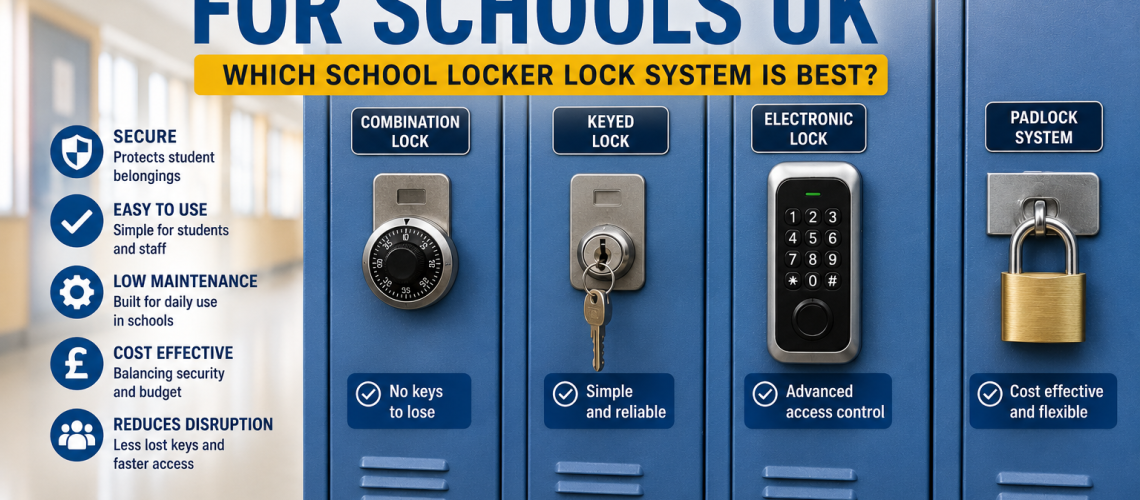
School locker access should be designed around pupil age, supervision, daily movement, locker allocation, staff administration and the way problems are resolved. No single lock technology is automatically the best choice for every primary school, secondary school, college or university.
This guide owns the school locker access requirement: what the locking system needs to support before keyed, padlock, combination, PIN, RFID or another access technology is selected.
For the wider locker specification, see School Lockers UK. For current products, see school lockers and locker locks.
School Access Requirements = define what pupils and staff need the locker system to do. Access Control = choose the technology that supports it.
Quick Answer: What Should a School Locker Locking System Support?
- Simple operation for the intended age group
- Fast access during lesson changes and break times
- Assigned or temporary locker use
- Lost-key, forgotten-code or failed-credential support
- Controlled staff override
- Term-end and year-end reassignment
- New pupils, leavers and timetable changes
- Resistance to misuse and repeated heavy use
- Appropriate support for SEND and accessibility needs
- Practical maintenance for the school’s available staff and resources
The aim is not to choose the most advanced lock. It is to choose the lowest-complexity system that reliably supports the school’s actual operating model.
What This Page Owns, and What It Hands Off
- School-specific locker access requirements: this page
- Whole school locker specification and planning: School Lockers UK
- Shared-use vs assigned-use: Shared-Use vs Assigned Locker Locks UK
- Choosing keyed, combination, PIN, RFID or another access technology: Locker Access Control Systems UK
- School key administration: Locker Key Management Systems UK
- Anti-vandal lock requirements: Anti-Vandal Locker Locks UK
- Accessibility planning: Accessible Locker Planning UK
- Replacement locker keys: Locker Keys
Start With the School Day, Not the Lock Type
School lockers are used within a timetable. Access demand can rise sharply before lessons, at break, at lunch, before PE and at the end of the day.
The first questions should therefore be operational:
- How old are the users?
- Will pupils keep the same locker for a term or academic year?
- Do any lockers need to circulate between different users?
- When are the busiest access periods?
- How much supervision is available?
- What happens when a pupil cannot open a locker?
- Who is authorised to override access?
- How are lockers reassigned at the end of the allocation period?
- What maintenance can site staff realistically provide?
These answers define the requirement. They do not automatically dictate whether the lock should use a key, code or electronic credential.
Pupil Age Affects Usability, Not a Preset Lock Choice
Younger and older pupils may differ in dexterity, memory, independence and familiarity with different access methods, but age alone should not be turned into a fixed rule such as “primary = keyed” or “secondary = combination”.
Instead, assess:
- how many steps the user must remember;
- whether small controls are easy to operate;
- whether a code must be remembered;
- whether a separate key or credential must be carried;
- how quickly staff can resolve access problems;
- and how much instruction is realistic.
A simple system that pupils can use consistently is usually more valuable than extra features they do not need.
Assigned Pupil Lockers
Many schools assign one locker to one pupil for a term, academic year or longer. The same pupil returns to the same compartment each day.
The access requirement normally includes:
- continuing access for one pupil;
- a clear pupil-to-locker assignment;
- staff support when access is lost or forgotten;
- controlled override;
- and a reliable year-end or leaver reassignment process.
Assigned use does not automatically require a keyed lock. It simply means the allocation remains with the same user until the school changes it.
Shared and Temporary School Lockers
Some school storage is temporary rather than permanently assigned.
- Visitor storage
- Temporary staff lockers
- Sports or activity areas
- Short-term device storage
- Exam or event storage
- Sixth-form or college spaces with flexible attendance
Where lockers circulate between users, the school needs a clear release or reset process so the locker returns to availability.
Use Shared-Use vs Assigned Locker Locks UK for the operating-model comparison.
Lesson Changes and Break Times Create Access Peaks
A locking system that works perfectly during a quiet demonstration can still create problems when many pupils need access at the same time.
- Queues can form in corridors.
- Pupils may rush the locking process.
- Forgotten keys or codes create delay at the busiest time.
- Staff support requests may arrive simultaneously.
- Repeated forced or hurried operation can increase wear.
School access design should therefore consider peak movement periods, not just individual lock operation.
PE and Changing Areas Can Have Different Requirements
PE and changing-room lockers may experience concentrated access before and after lessons, higher humidity, wet clothing and more frequent physical contact than lockers in a dry classroom corridor.
The access requirement should therefore be considered alongside:
- environmental exposure;
- frequency of use;
- supervision;
- speed of access;
- and the maintenance conditions in that area.
The lock technology still belongs to the Access Control decision rather than being assumed from the location alone.
Lost Keys Are an Administration Question Before They Are a Technology Question
Schools using keyed lockers should understand the real scale of lost-key administration before deciding that another technology is automatically necessary.
- How often are keys actually lost?
- Can replacement keys be cut from a valid code?
- Are spare keys controlled?
- Are master keys used?
- Who keeps the key records?
- How are keys recovered from leavers?
For ongoing administration, use Locker Key Management Systems UK. For replacement keys, use Locker Keys.
Forgotten Codes Create a Different Support Requirement
Removing physical keys does not remove administration. Combination and PIN-based access replace lost-key incidents with other support events.
- Forgotten codes
- Incorrect code entry
- Code sharing
- Reset requests
- Administrator override
- Users changing or leaving
The school should compare the likely support burden rather than assuming that keyless automatically means administration-free.
Electronic Credentials Also Need Management
Electronic access can provide useful capabilities, but it creates its own operating requirements.
- Credential issue and replacement
- Battery management where applicable
- Programming or administration
- Override procedures
- Support for failed or forgotten credentials
- Compatibility with any wider school systems where integration is intended
RFID, PIN and other electronic options should therefore be selected because they solve a defined problem, not because the setting is a college or university.
Staff Override Needs a Clear Purpose
Schools normally need a controlled way for authorised staff to resolve access problems.
- Lost key
- Forgotten code
- Failed credential
- Damaged lock
- Abandoned locker
- End-of-year clearance
- Maintenance
- Other situations covered by school policy
The requirement should define who may override lockers, why access may be used and how the school controls the override method.
Master Access Should Be Controlled
A master key, management key, override code or administrator credential can potentially provide access to multiple lockers. It should therefore be treated as a controlled management tool rather than an ordinary user credential.
- Limit who can hold or use it.
- Define where it is stored.
- Define what happens if it is lost or compromised.
- Keep appropriate records where the school’s process requires them.
Term-End and Year-End Reassignment
Assigned pupil lockers need an annual or term-based change process.
- Confirm which assignments are ending.
- Clear abandoned belongings under school procedure.
- Recover keys or close credentials as required.
- Inspect locks for faults or damage.
- Reset access where required.
- Update the pupil-to-locker record.
- Reassign lockers to the next users.
The process should be planned before the final day of term rather than improvised after pupils have left.
New Pupils, Leavers and Mid-Year Changes
School locker assignments rarely change only once per year. New starters, leavers, timetable changes and pastoral moves can create changes during the term.
The system should support:
- issuing a locker to a new pupil;
- ending an old assignment;
- moving a pupil to another locker where necessary;
- recovering or replacing the relevant access method;
- and updating the record so staff know the current assignment.
SEND and Accessibility Requirements Should Be Assessed Individually
Some pupils may find particular keys, dials, small buttons, code sequences or high/low lock positions difficult to use. The appropriate solution depends on the individual user and the physical locker layout.
- Consider reach height.
- Consider grip and dexterity.
- Consider visual and cognitive demands.
- Consider whether a code must be remembered.
- Consider whether a separate credential is practical.
- Consider the level of staff assistance required.
For the wider physical-accessibility topic, use Accessible Locker Planning UK.
Vandalism and Misuse Need a Specific Risk Assessment
Schools may experience deliberate misuse, forced operation, repeated code attempts, impacts to lock faces, damaged keys, hanging from doors or attempts to interfere with cams and latches.
The response should not simply be “fit the strongest lock available”. Consider the complete system:
- locker construction;
- door and frame strength;
- lock exposure;
- supervision;
- location;
- replacement and repair process;
- and the behaviour creating the damage.
For the specialist lock topic, use Anti-Vandal Locker Locks UK.
Repeated Daily Use Matters
A lock used several times each school day experiences a different duty cycle from one opened only occasionally.
Repeated use can affect:
- wear on keys and cylinders;
- combination mechanisms;
- buttons and keypads;
- cams and latches;
- door alignment;
- and the frequency of maintenance intervention.
For the specialist wear-and-duty topic, use Locker Locks for High-Traffic Areas UK.
Primary, Secondary, College and University Are Not Lock Categories
It is useful to understand the education setting, but the institution type should not be turned into a fixed lock recommendation.
| Setting | Questions that may matter |
|---|---|
| Primary school | User dexterity, supervision, simplicity, assignment duration |
| Secondary school | High daily use, lesson-change peaks, pupil independence, lost-access support |
| College / sixth form | Mixed attendance, shared and assigned use, temporary users, independent operation |
| University | Multiple user groups, flexible attendance, temporary storage, integration requirements where genuinely needed |
Each setting can still contain several different locker use cases.
School Access Requirements Matrix
| Requirement | Question to define | Next owner |
|---|---|---|
| Assigned or shared use | Does the same pupil keep the locker? | Shared vs Assigned |
| Pupil usability | Can the intended users operate it consistently? | School Access Requirements |
| Lost access | How does the school resolve keys, codes or credentials? | Key Management / Access Control |
| Staff override | Who may open lockers and why? | Access Control / Governance |
| Vandalism | What physical misuse must the lock withstand? | Anti-Vandal Locks |
| Accessibility | Can the user reach and operate the lock? | Accessible Locker Planning |
| Technology | Key, padlock, combination, PIN, RFID or other? | Access Control |
When Simple Access May Be Enough
A school does not need electronic or networked access simply because it wants reliable locker management.
A simpler system may be entirely appropriate where:
- locker assignments are stable;
- user numbers are manageable;
- lost-access incidents are infrequent;
- staff understand the support process;
- central monitoring is not required;
- and maintenance resources favour simple hardware.
When Additional Digital Capability May Be Worth Assessing
Electronic capability may be worth assessing when it addresses a defined operational problem.
- Frequent temporary allocation
- Large numbers of assignment changes
- A genuine requirement to use existing credentials
- Need for central management functions
- Need for controlled temporary access
- Need for better access-event evidence
That does not make electronic access automatically better. It means the additional capability has a specific job to perform.
Common School Locker Access Mistakes
- Choosing a lock purely because the site is a primary school, secondary school, college or university.
- Assuming combination locks eliminate administration.
- Assuming keyed locks are unsuitable because keys can be lost.
- Assuming electronic access is better because it is newer.
- Ignoring lesson-change and break-time peaks.
- No defined staff override process.
- No term-end reassignment process.
- No plan for forgotten codes or failed credentials.
- Ignoring SEND and accessibility requirements.
- Treating repeated vandalism as a lock-only problem.
- Choosing technology before defining who uses the locker and for how long.
School Locker Access Checklist
- What age group will use the lockers?
- Are lockers assigned or shared?
- How long does an assignment last?
- When are the busiest access periods?
- How much supervision is available?
- How are lost keys handled?
- How are forgotten codes handled?
- How are failed credentials handled?
- Who has authorised override access?
- How are new pupils and leavers handled?
- How are lockers reset at term or year end?
- Are there SEND or accessibility requirements?
- Is vandalism or misuse a material risk?
- What maintenance can the school support?
- Only after those points are defined: which lock technology fits the requirement?
Where School Locker Access Questions Go Next
| Question | Next guide |
|---|---|
| How should the whole school locker system be planned? | School Lockers UK |
| Should lockers be shared or assigned? | Shared-Use vs Assigned Locker Locks UK |
| Which lock or credential technology should we choose? | Locker Access Control Systems UK |
| How should keys be administered? | Locker Key Management Systems UK |
| How do we address deliberate misuse? | Anti-Vandal Locker Locks UK |
| How do we plan accessible lockers? | Accessible Locker Planning UK |
| Where do we order replacement locker keys? | Locker Keys |
| Where do we view school locker products? | School Lockers |
School Locker Access FAQs
What is the best locker lock for schools?
There is no single best lock for every school. First define pupil age, locker allocation, supervision, peak access times, lost-access support, staff override and maintenance capability. Then choose the access technology that fits those requirements.
Are combination locks always better for secondary schools?
No. Combination locks remove physical keys but introduce code memory, reset and override requirements. Suitability depends on the school’s users and administration process.
Are keyed locker locks suitable for schools?
They can be. Keyed locks may be suitable where assignments are stable and the school can manage keys effectively. Lost-key administration should be assessed rather than assumed.
Do colleges and universities need electronic locker locks?
Not automatically. Electronic access may be useful where flexible allocation, temporary credentials, management functions or integration solve a defined problem, but simpler systems may also meet the requirement.
How should schools handle lost locker keys?
The school should have a controlled process for confirming the user, providing authorised access, identifying the key code where relevant, replacing the key where possible and updating any key record.
Should school locker locks have staff override?
Schools commonly need a controlled way for authorised staff to resolve lost access, abandoned lockers, maintenance and reassignment. The school should define who may use override access and under what procedure.
How should schools plan locker access for pupils with additional needs?
Assess the individual user’s reach, grip, dexterity, visual and cognitive demands, ability to remember codes or carry credentials, and the amount of staff assistance required.
Summary
School locker access should start with pupils, staff and the school day rather than a preferred lock type.
Define assignment, age-related usability, lesson-change peaks, lost-access support, authorised override, year-end reassignment, accessibility, vandalism risk and maintenance capacity first.
Then use Access Control Systems UK to choose the lowest-complexity access technology that reliably supports those requirements.
Discover more from Blog Total Locker Service
Subscribe to get the latest posts sent to your email.