Keyed Locker Locks UK: Locks with Keys Guide for Schools, Workplaces and Staff Lockers
May 7, 2026
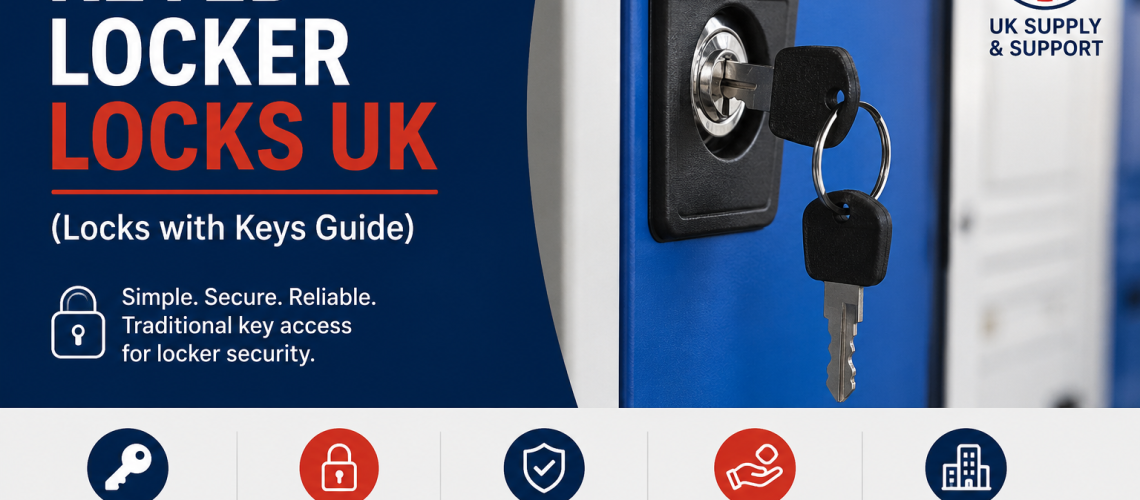
Keyed locker locks use a physical key to operate a cylinder, barrel or cam-lock mechanism that secures the locker door. Their locker-level requirements include the relationship between key and lock, key number or reference, keyed-to-differ or keyed-alike configuration, master-key capability where supported, cam movement, cylinder condition and replacement compatibility.
This guide owns the physical keyed locker lock: how the key operates the lock, how keys relate to individual cylinders, what happens when a key is lost or worn, how keyed-alike and keyed-to-differ arrangements differ, and how to diagnose common key-and-lock faults before replacing hardware.
It does not decide whether keyed access is better than combination, coin, RFID or electronic access. That wider choice belongs in Locker Access Control Systems UK.
Keyed Locker Lock = key + cylinder/barrel + cam/latch interaction. Access Control = whether keyed access is the right technology.
Quick Answer: How Does a Keyed Locker Lock Work?
Most keyed locker locks use a cylinder or cam-lock arrangement. The correct key aligns the internal mechanism so the plug can turn. That rotation then moves a cam, latch or other locking part behind the locker door.
- The correct key is inserted.
- The key aligns the lock mechanism.
- The cylinder or plug turns.
- The cam or latch moves away from the locking point.
- The locker door opens.
If the key turns but the locker stays shut, the problem may be the cam, latch or door alignment rather than the key code itself.
What This Page Owns, and What It Hands Off
- Key, cylinder/barrel and cam interaction: this page
- Keyed-to-differ and keyed-alike lock arrangements: this page
- Individual spare and replacement-key issues: this page, with ordering via Replacement Locker Keys
- Local master-key capability: this page at lock level
- Estate-wide key issue, logs, policy and administration: Locker Key Management Systems UK
- Whether to choose keyed, combination, coin, RFID or electronic access: Locker Access Control Systems UK
- Shared-use versus assigned-use operating model: Shared-Use vs Assigned Locker Locks UK
- Identifying an unknown existing lock: Locker Lock Identification Guide UK
- Measuring a cam lock: What Size Cam Lock Do I Need?
- Physical lock replacement: Locker Lock Replacement Guide UK
- Changing to another access method: Locker Lock Upgrade Guide UK
Main Parts of a Keyed Locker Lock
| Part | Role |
|---|---|
| Key | Provides the mechanical pattern required to operate the lock |
| Cylinder / barrel | Contains the locking mechanism that responds to the correct key |
| Plug | Rotating part of the cylinder operated by the key |
| Body / fixing | Secures the lock to the locker door |
| Cam / latch | Rotates or moves behind the door to secure or release it |
| Key number / lock reference | Identifies the key pattern or lock series where the manufacturer supports replacement by code |
Not every keyed locker lock uses identical parts or dimensions. Similar-looking barrels can have different body lengths, fixing methods, key series and cams.
Keyed to Differ
Keyed-to-differ locks use different key combinations so one normal user key does not open the neighbouring lockers.
- Each lock has its own key or key code.
- Replacement keys can often be ordered from the recorded key number where supported.
- A master key may still operate several locks if the lock range was designed for master-keying.
The important locker-level task is to keep the lock identity and key reference clear enough that the correct replacement can be obtained later.
Keyed Alike
Keyed-alike locks are configured so the same normal key operates more than one locker lock.
This can simplify access where one authorised user genuinely needs several lockers, but it also changes the consequence of a lost key because that key may open every lock in the keyed-alike group.
- Confirm how many locks are in the alike group.
- Record the relevant key reference.
- Understand which lockers are exposed if a key is lost.
- Do not assume a keyed-alike key is a master key. They are different arrangements.
Master-Key Capability at Lock Level
Some keyed locker lock ranges allow each user lock to have its own individual key while a separate master key can operate multiple locks in that series.
At lock level, establish:
- whether the lock range is actually master-keyed;
- which master-key series applies;
- whether replacement locks must match the existing master-key arrangement;
- and whether a replacement barrel can preserve the current hierarchy.
Estate-wide storage, issue, logging and control of master keys belongs with the wider key-management process rather than this hardware page.
Removable and Captive-Key Behaviour
Some keyed locker locks allow the key to be removed in both locked and unlocked positions. Others are designed so the key remains captive during part of the operating cycle.
Before replacing a lock, confirm:
- whether the user key is removable while unlocked;
- whether the key remains captive until the locker is secured;
- whether the replacement needs the same behaviour;
- and whether users are already trained around that sequence.
Captive-key behaviour is a property of the selected lock design, not a universal feature of keyed locker locks.
Key Numbers and Lock References
Many locker lock ranges use a key number, code or series reference that can help identify the correct replacement key.
- The number may appear on the key.
- It may appear on the lock face.
- It may be recorded in site documentation.
- Different manufacturers can use different numbering systems.
- The same-looking number should not be assumed to belong to the same key series without checking the manufacturer or lock range.
If you know the required key code, use Replacement Locker Keys. For code-based replacement guidance, see Replacement Locker Keys by Code UK.
Lost Locker Key: What Should Be Checked First?
A lost key does not automatically mean the lock needs replacing.
- Identify the locker.
- Check the lock face and any existing documentation for the key number or lock reference.
- Confirm the lock manufacturer or series where possible.
- Check whether a spare key is already held.
- Check whether the replacement can be cut to code.
- Only move to lock replacement if the correct key cannot reasonably be identified or another security reason requires the lock to change.
For estate-wide lost-key procedures and record keeping, use Locker Key Management Systems UK.
Worn Locker Keys
A worn key can become unreliable even when the lock itself remains serviceable.
- The key may need to be moved or lifted before it turns.
- The edges or cuts may appear rounded.
- The key may work in one direction but not consistently.
- A duplicate made from an already worn key may reproduce the wear.
Where a valid key number is known, a fresh key cut from the correct code can be preferable to repeatedly copying a worn example.
Bent Keys
A bent key should not be forced into or turned inside the lock.
- Forcing it can damage the cylinder.
- The key can snap inside the keyway.
- A partly distorted key may no longer align the internal mechanism correctly.
- A known key code can make replacement easier than trying to continue using the damaged key.
Key Inserts but Will Not Turn
If the key enters normally but does not turn, several causes are possible.
- The wrong key has been inserted.
- The key is worn or damaged.
- The cylinder is contaminated or corroded.
- The internal mechanism is worn.
- The door is loading the cam or latch.
- The cam is jammed against the frame.
Reduce pressure on the locker door and test gently. Do not use excessive force because a snapped key can turn a simple access problem into a lock-removal job.
Key Turns but the Locker Will Not Open
If the key turns through its expected movement but the locker remains locked, the key-and-cylinder portion may be working correctly.
- Check whether the cam is rotating.
- Check whether the cam reaches the correct release position.
- Check for a bent or loose cam.
- Check whether the door has dropped.
- Check whether belongings are pressing against the door.
- Check whether the latch or frame is obstructed.
This distinction helps avoid replacing a working cylinder when the real fault is behind the door.
Stiff or Seized Cylinders
A cylinder that becomes progressively harder to turn should be investigated before the key or lock fails completely.
- Check for corrosion or environmental exposure.
- Check whether the correct key still operates another matching lock where that comparison is valid.
- Check whether the door pressure changes the symptom.
- Follow the lock manufacturer’s maintenance guidance.
- Avoid applying unsuitable lubricants or cleaners.
Repeated stiffness can indicate wear, contamination, corrosion or mechanical loading rather than a simple key problem.
Broken Keys in Locker Locks
If a key snaps in the cylinder, avoid pushing the broken section further into the keyway.
- Stop using the lock.
- Assess whether the broken fragment is accessible.
- Avoid damaging the cylinder during extraction.
- Identify the lock and key code before deciding whether to replace the barrel.
- Check why the key broke, especially if the lock had already become stiff.
Cam and Latch Alignment
Most keyed locker cam locks secure the door by rotating a metal cam behind the locker front.
The cam must match:
- the required length;
- the required offset or crank where applicable;
- the lock rotation;
- the locker frame position;
- and the available internal clearance.
A replacement cylinder with the wrong cam can fit through the door perfectly and still fail to secure the locker correctly.
For measurements, use What Size Cam Lock Do I Need?.
Identifying an Existing Keyed Locker Lock
Before ordering a replacement lock or a large quantity of keys, identify as much of the existing hardware as possible.
- Manufacturer or logo
- Key number or lock-face number
- Lock-body shape
- Body length
- Fixing method
- Cam shape and length
- Rotation direction
- Master-key requirement
- Captive or removable-key behaviour
Use Locker Lock Identification Guide UK where the current lock is not known.
Replacing a Keyed Locker Lock
A keyed locker lock can often be replaced without replacing the locker, but the replacement should be checked against the existing door and locking arrangement.
- Door thickness
- Existing lock hole or cut-out
- Lock-body length
- Fixing nut, clip or other fixing method
- Cam length and shape
- Rotation direction
- Key series
- Master-key compatibility where required
- Available clearance behind the door
The physical replacement process belongs in Locker Lock Replacement Guide UK.
Changing from Keyed Access to Another Lock Type
If the intention is to move from a keyed lock to combination, coin, electronic or RFID access, that is an upgrade decision rather than a like-for-like keyed-lock replacement.
Use Locker Lock Upgrade Guide UK to define the change, then Retrofit Locker Locks UK if the locker door needs physical adaptation.
Wet Areas Need Separate Environmental Checks
A keyed lock has no battery or electronics, but the cylinder, keyway, cam, fasteners and rear mechanism can still corrode.
Use Locker Locks for Wet Areas UK where humidity, splash, chlorine or cleaning chemicals are material to the installation.
High-Traffic Use Is a Separate Duty Requirement
A keyed lock used twice per working day has a different wear pattern from a lock used repeatedly by many users.
For duty cycle, repeated key insertion, user force and heavy-use maintenance, use Locker Locks for High-Traffic Areas UK.
Key Management Is Larger Than the Lock Itself
A keyed lock needs a key, but estate-wide key management is a separate operational layer.
- Who receives keys?
- How are issues and returns recorded?
- Where are spare keys stored?
- Who controls master keys?
- How are leavers or reassigned lockers handled?
- When should a lock be changed rather than another key issued?
Those policy and administration questions belong in Locker Key Management Systems UK.
Do Not Use Sector Labels as Keyed-Lock Recommendations
Keyed locks are used in schools, workplaces, factories, healthcare sites and many other settings, but a sector name does not prove that keyed access is the correct technology.
The operating requirement should be defined first. This page then explains how a keyed lock behaves if keyed access is being considered or is already installed.
Common Keyed Locker Lock Mistakes
- Assuming a lost key means the lock must be replaced.
- Copying a badly worn key repeatedly instead of using the correct code where available.
- Forcing a bent or stiff key.
- Replacing the cylinder when the real problem is cam alignment.
- Ordering a replacement without checking body length and cam dimensions.
- Assuming keyed alike and master keyed mean the same thing.
- Failing to preserve an existing master-key series when replacing locks.
- Assuming a key number belongs to a particular manufacturer without checking.
- Letting this hardware page decide whether lockers should be shared or assigned.
- Using sector stereotypes instead of defining the actual access requirement.
Keyed Locker Lock Checklist
- Who manufactured the existing lock?
- What key number or lock reference is shown?
- Is the lock keyed to differ or keyed alike?
- Is master-key capability required?
- Is the key removable or captive in any operating position?
- Is the key worn, bent or damaged?
- Does the key insert fully?
- Does it turn normally?
- If it turns, does the cam or latch move?
- Is the door loading the locking mechanism?
- What is the lock-body length?
- What cam size and shape are fitted?
- What is the door thickness?
- Is the environment wet or corrosive?
- Is the lock exposed to very high operating frequency?
- If replacing, has one representative lock been checked before bulk order?
Where Keyed Locker Lock Questions Go Next
| Question | Next guide or page |
|---|---|
| How does the keyed lock itself work? | This guide |
| Should we choose keyed, combination, coin, RFID or electronic access? | Locker Access Control Systems UK |
| Should lockers be shared or assigned? | Shared-Use vs Assigned Locker Locks UK |
| How should keys be issued, logged and controlled across a site? | Locker Key Management Systems UK |
| Where can I order a replacement locker key? | Replacement Locker Keys |
| How do I identify an unknown lock? | Locker Lock Identification Guide UK |
| What cam dimensions do I need? | What Size Cam Lock Do I Need? |
| How do I replace the lock? | Locker Lock Replacement Guide UK |
| How do I change to another access method? | Locker Lock Upgrade Guide UK |
| What changes in wet environments? | Locker Locks for Wet Areas UK |
| What changes under repeated heavy use? | Locker Locks for High-Traffic Areas UK |
| Where can I view current locker locks? | Locker Locks |
Keyed Locker Locks FAQs
What is a keyed locker lock?
A keyed locker lock uses a physical key to operate a cylinder or barrel that moves a cam, latch or other locking part behind the locker door.
Can a lost locker key be replaced without changing the lock?
Often, yes. Where the manufacturer and key number or lock reference can be identified, a replacement key may be available without changing the lock.
What is the difference between keyed alike and keyed to differ?
Keyed-to-differ locks use different normal user keys. Keyed-alike locks are deliberately configured so the same normal key opens more than one lock.
Is a keyed-alike key the same as a master key?
No. A keyed-alike arrangement gives several locks the same normal operating key. A master-key system can allow different user keys on individual locks while a separate master key operates multiple locks.
Why does my locker key go in but not turn?
Possible causes include the wrong or worn key, cylinder wear, contamination, corrosion or pressure on the cam or latch. Avoid forcing the key because it may bend or snap.
Why does the key turn but the locker stay locked?
The key and cylinder may be operating correctly while the cam, latch or door is misaligned. Check whether the cam moves and whether the door is loading the locking point.
Can keyed locker locks be replaced without replacing the locker?
Often, yes. The replacement should match the door thickness, fixing, lock-body dimensions, cam or latch arrangement and any required key or master-key series.
Are keyed locker locks suitable for wet areas?
Some may be suitable, but keyed operation alone does not make the cylinder, cam, keyway or fasteners resistant to humidity, splash, chlorine or cleaning chemicals. The exact environmental specification should be checked.
Summary
Keyed locker locks should be understood as a mechanical relationship between the key, cylinder or barrel and the physical locking point.
Identify the lock and key series, record key numbers where available, distinguish keyed alike from keyed to differ, understand any master-key requirement, and diagnose the cylinder and cam separately before replacing hardware.
Keep estate-wide key policy with Key Management, access-technology choice with Access Control, shared-versus-assigned use with its own operating guide, and physical replacement, lock identification and cam sizing with their specialist pages.
Discover more from Blog Total Locker Service
Subscribe to get the latest posts sent to your email.