Locker Capacity Planning UK: How Many Lockers Do You Need?
May 12, 2026
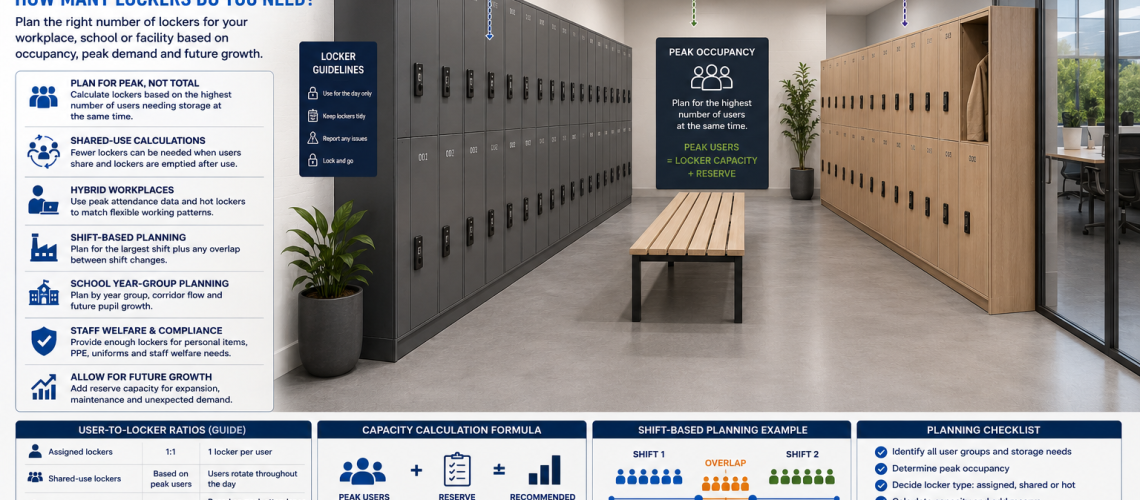
Locker capacity planning helps schools, workplaces, gyms, factories and public facilities decide how many lockers are needed, where they should go and how they should be managed.
The right number of lockers is not always the same as the number of people on site. Capacity depends on occupancy, shift patterns, shared-use rules, year groups, staff welfare needs, visitor use and whether lockers are assigned, temporary or hot lockers.
This guide explains how to plan locker numbers in the UK using user-to-locker ratios, peak occupancy, shared-use calculations, school planning and workplace forecasting.
For wider specification decisions, see our Locker Specification Planning UK guide. For system management, use our Locker Management Systems UK guide.
Quick Answer: How Many Lockers Do You Need?
You need enough lockers for peak users, not just total users. Assigned lockers usually need close to one locker per person. Shared-use lockers can need fewer lockers if users rotate through the site. Schools, factories and hybrid workplaces should calculate capacity by peak demand, not total headcount.
| Environment | Typical planning basis | Capacity note |
|---|---|---|
| Office workplace | Peak daily attendance | Hybrid working may reduce locker count |
| School | Year group, corridor or timetable demand | Allow for future pupil growth |
| Factory or warehouse | Largest shift plus overlap | Include PPE and welfare needs |
| Gym or leisure centre | Peak visitor occupancy | Shared-use lockers are common |
| Healthcare or care setting | Staff rota, visitors and departments | Access control and separation may be required |
Why Locker Capacity Planning Matters
Poor capacity planning causes daily operational problems. Too few lockers create queues, complaints and unmanaged storage. Too many lockers waste floor space and budget. Poorly placed lockers can also create congestion, block circulation and make cleaning harder.
A good locker capacity plan balances storage demand, available space, user behaviour and long-term growth. It also helps facilities managers plan allocation, audits, repairs and future expansion.
User-to-Locker Ratios
User-to-locker ratios are a useful starting point. They should not be used without checking real site behaviour. The right ratio depends on whether lockers are assigned, shared or used temporarily.
| Locker model | Typical ratio | Best for |
|---|---|---|
| Assigned lockers | 1 locker per assigned user | Staff, pupils, departments and long-term users |
| Shared-use lockers | Based on peak users | Gyms, leisure centres and visitor areas |
| Hot lockers | Based on peak attendance plus reserve | Hybrid offices and flexible workplaces |
| PPE lockers | Often 1 locker per worker or role | Industrial and welfare areas |
| Temporary lockers | Based on visitor or short-term demand | Events, reception areas and contractors |
Basic Locker Capacity Formula
Start with the highest number of users who need locker access at the same time. Then add a reserve allowance for growth, damage, maintenance and unexpected demand.
Basic calculation: Peak users needing storage + reserve allowance = recommended locker capacity.
For example, if 80 people need storage at peak time and you want a 10% reserve, you should plan around 88 locker compartments.
Peak Occupancy Planning
Peak occupancy is the most important number in locker capacity planning. It shows how many people need lockers at the busiest point, not across the full day.
- How many users are on site at the busiest time?
- How many need storage at the same time?
- Do users arrive and leave together?
- Are there shift overlaps?
- Are lockers assigned or shared?
- Does the site need spare capacity for growth?
For layout support, see the Locker Aisle Width Guide UK and Locker Room Layout Planning Guide UK.
Shared-Use Locker Calculations
Shared-use lockers can reduce the total number of lockers needed. This works where users do not need permanent storage and lockers are emptied after use.
Shared-use planning should be based on maximum simultaneous demand. A leisure centre may have hundreds of users across the day, but only a smaller number need lockers during the busiest session.
Shared-use lockers need clear rules. Users must know whether lockers are day-use only, whether locks reset automatically and how abandoned contents are managed.
Hot Locker Allocation for Hybrid Workplaces
Hybrid workplaces often do not need one locker for every employee. Instead, locker capacity should reflect peak office attendance, desk booking patterns, team days and visitor storage.
A hot locker system may suit workplaces where staff attend on different days. However, the system must be managed. Without allocation rules, popular locker areas can become overloaded while other areas stay unused.
- Use attendance data where available.
- Plan for busy team days.
- Keep spare lockers for visitors and new starters.
- Use clear locker release rules.
- Consider smart access where reporting is needed.
For access governance, see Locker Access Control Systems UK.
Shift-Based Locker Calculations
Factories, warehouses, hospitals and logistics sites often need shift-based locker planning. The key issue is overlap. If one shift leaves while another arrives, both groups may need lockers and changing space at the same time.
Capacity should be based on the largest shift plus any overlap period. Where PPE or uniforms are stored between shifts, assigned lockers may still be needed even if users are not on site together.
Shift planning example: If the largest shift has 70 workers and 20 workers overlap during handover, the peak storage demand may be 90 lockers, before reserve allowance.
School Year-Group Locker Planning
Schools should plan lockers around year groups, corridor flow, timetable pressure and future pupil numbers. A school may not need every pupil to access a locker at the same time, but it must avoid congestion during break, lunch and lesson changeover.
- Plan by year group or house group.
- Avoid placing too many lockers in narrow corridors.
- Allow for new pupil intake and expansion.
- Consider lower-height lockers for younger pupils.
- Place lockers where supervision is practical.
- Use clear allocation and lost key procedures.
Useful school planning links include School Locker Corridor Planning UK, Anti-Congestion Locker Planning for Schools and School Locker Key Management UK.
Staff Welfare Locker Planning
Staff welfare areas often need lockers for clothing, bags, phones, PPE, uniforms and personal items. Capacity planning should support safe storage and practical daily routines.
In industrial or healthcare settings, staff lockers may need to support clean and dirty separation, workwear storage or department-based access. This can increase the number or size of lockers required.
Reserve Capacity and Future Growth
Most sites should include reserve capacity. A common planning approach is to allow extra lockers for growth, damaged compartments, new starters, visitors and future department changes.
Reserve capacity is especially important for schools, expanding businesses, warehouses and public-sector sites. Adding lockers later can be harder if the room layout, finishes or access systems are not planned for expansion.
Locker Capacity Planning Checklist
- Count total users.
- Identify peak users needing storage at the same time.
- Separate assigned, shared and temporary locker needs.
- Check shift overlaps and arrival patterns.
- Plan by year group, department or user group.
- Decide whether hot lockers are suitable.
- Add reserve capacity for growth and maintenance.
- Check aisle width, door clearance and bench spacing.
- Plan access control and locker management rules.
- Allow for cleaning, repairs and future expansion.
Common Locker Capacity Mistakes
- Buying one locker per person without checking real occupancy.
- Ignoring peak demand during breaks, shifts or arrival times.
- Using shared lockers without clear emptying rules.
- Not allowing for future growth.
- Placing too many lockers in one congested area.
- Forgetting visitors, contractors and temporary users.
- Choosing locker sizes before confirming what users need to store.
Best Internal Links for This Page
| Link target | Suggested anchor text | Best placement |
|---|---|---|
| /blog/locker-specification-planning-uk/ | Locker Specification Planning UK | Introduction |
| /blog/locker-management-systems-uk/ | Locker Management Systems UK | Introduction and shared-use section |
| /blog/locker-occupancy-management-systems-uk/ | Locker Occupancy Management Systems UK | Peak occupancy section |
| /blog/locker-room-layout-planning-guide-uk/ | Locker Room Layout Planning Guide UK | Layout and capacity section |
| /blog/school-locker-corridor-planning-uk/ | School Locker Corridor Planning UK | School planning section |
| /blog/workplace-locker-layout-guide-uk/ | Workplace Locker Layout Guide UK | Staff welfare section |
| /blog/locker-access-control-systems-uk/ | Locker Access Control Systems UK | Hot locker and shared-use sections |
| /Lockers.php | workplace and commercial lockers | Final CTA |
Conclusion
Locker capacity planning should be based on real demand, not guesswork. The best plan considers peak occupancy, user groups, shift patterns, school movement, staff welfare needs and future expansion.
Assigned lockers, shared-use lockers and hot locker systems all need different calculations. By planning capacity early, facilities teams can reduce congestion, improve storage access and avoid expensive changes later.
For locker planning support, visit our workplace and commercial lockers page or contact Total Locker Service for help choosing the right locker capacity for your site.
FAQ: Locker Capacity Planning UK
How many lockers do we need?
You need enough lockers for the highest number of users who need storage at the same time, plus reserve capacity for growth, damage and unexpected demand.
Do we need one locker per person?
Not always. Assigned lockers often need one locker per person. Shared-use and hot locker systems can use fewer lockers if users rotate and the system is managed properly.
How do you calculate lockers for hybrid workplaces?
Hybrid workplace locker capacity should be based on peak office attendance, team days, visitor demand and the number of staff needing secure storage at the same time.
How should schools plan locker numbers?
Schools should plan by year group, corridor capacity, timetable pressure, break-time movement and future pupil growth. Placement is as important as the total number of lockers.
What is reserve locker capacity?
Reserve capacity is extra locker space kept for growth, new starters, damaged lockers, visitors or future changes. It helps avoid under-capacity after installation.
What is a hot locker?
A hot locker is a shared locker used temporarily rather than assigned permanently to one person. It is common in hybrid workplaces and flexible office environments.
Discover more from Blog Total Locker Service
Subscribe to get the latest posts sent to your email.