School Locker Key Management UK
May 11, 2026
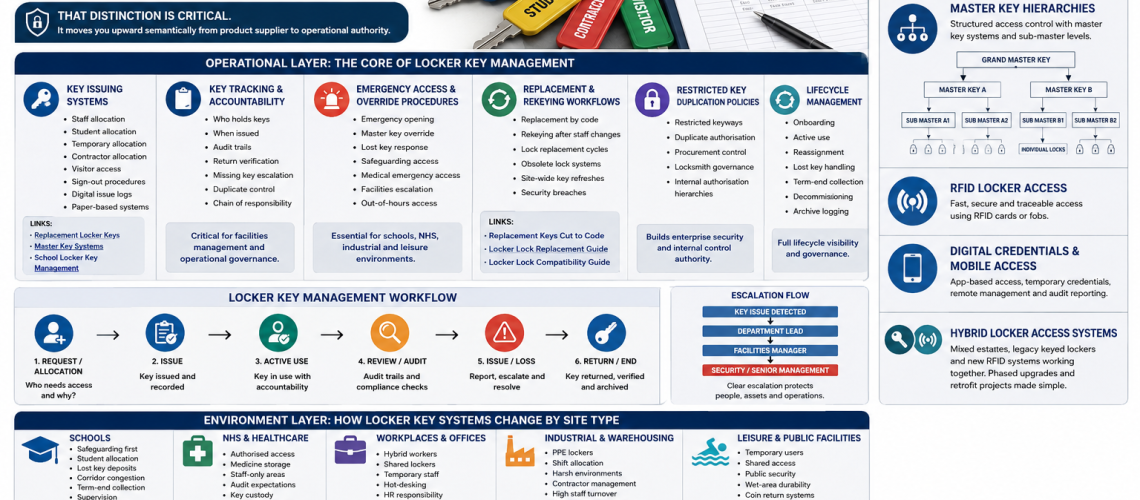
School locker key management helps schools issue and track student keys, control master-key access, handle lost keys and maintain accurate records. A consistent system reduces avoidable administration and helps ensure lockers are ready for the next group of pupils.
This UK guide explains student key issuing, locker registers, deposits, replacement procedures, spare-key stock, the costs associated with lost keys, safeguarding, emergency access and end-of-term collection.
Schools can arrange spare or replacement keys using confirmed manufacturer codes and their locker allocation records. Visit our replacement locker keys for schools to identify supported key ranges and arrange individual or bulk orders.
For advice on managing the entire locker installation, see our School Locker Systems UK guide. For replacement products, visit our replacement locker keys range.
What is school locker key management?
School locker key management is the process of controlling how keys are issued, recorded, replaced, stored and returned. It also covers authorised access through compatible master-key systems and the procedures followed when keys are lost or lockers need to be opened.
A practical system should establish who is responsible for each locker, which key operates it, who may authorise access and how records are updated when pupils change lockers or leave the school.
Why school locker key management matters
Schools may operate hundreds or thousands of lockers across corridors, changing rooms, sixth-form areas and staff facilities. Without consistent records, lost keys and changes of allocation can create unnecessary work for office and site-management teams.
Effective key management helps schools:
- Identify which pupil has been allocated each locker.
- Record the key number or lock reference needed for replacements.
- Apply consistent lost-key and replacement procedures.
- Maintain appropriate control over master keys.
- Track keys returned at the end of an allocation period.
- Identify recurring problems with particular lockers or key series.
- Reduce delays when lockers are reassigned.
What should a school locker key system include?
A school should establish one consistent process for key issuing, access, replacement and return. The records can be maintained by the school office, facilities team or another authorised department.
| Management area | Information required | Purpose |
|---|---|---|
| Student allocation | Student identifier, form and locker number | Identifies the authorised user |
| Key issuing | Key reference and issue date | Supports accountability |
| Lost keys | Incident date, key details and action taken | Creates a replacement history |
| Deposits | Payment and refund status where applicable | Supports consistent administration |
| Master keys | Authorised holder and access records | Controls wider locker access |
| Key returns | Return date, outstanding keys and locker status | Supports reallocation |
| Replacement stock | Available key and lock quantities | Supports stock planning |
Schools should avoid creating several separate registers that are not updated consistently. Where different departments handle key issuing, repairs and payments, their procedures should refer to the same locker number and allocation record.
Issuing student locker keys
Student locker keys should be issued through a documented process. Each key must be associated with the correct locker and recorded before it is handed to a pupil.
A suitable issue register can include:
- Student name or approved school identifier.
- Year group, tutor group or form.
- Locker number and location.
- Key number or compatible lock reference.
- Date the key was issued.
- Staff member responsible for issuing it.
- Deposit or payment status, where applicable.
- Expected return or review date.
- Actual return status.
Small schools may use a controlled paper register or spreadsheet. Larger installations may benefit from a digital system that allows authorised staff to search by locker number, student or key reference.
Registers containing pupil information should be protected according to the school’s data protection and information-management procedures. Access should be limited to staff who need the records for their duties.
Using locker key deposits in schools
Some schools operate a deposit or replacement-charge system for locker keys. Others provide keys without a deposit as part of the school’s storage arrangements.
Where payments are used, the school should establish a clear policy covering any applicable legal, funding and school-specific requirements. The procedure should also account for pupils who may need financial support.
A deposit register should record:
- The amount collected.
- The date and method of payment.
- The related student and locker reference.
- The agreed refund conditions.
- Any replacement charges applied in accordance with school policy.
- The refund or outstanding-payment status.
Key deposits should not replace accurate records. Even when a financial arrangement exists, the school still needs to identify which key was issued and whether it was returned.
Lost school locker key procedures
When a pupil loses a locker key, the school should restore appropriate access while maintaining an accurate record and assessing whether the missing key creates a security concern.
A practical procedure is:
- Confirm the allocation. Check the pupil’s identity, locker number and current assignment.
- Check the register. Identify the key number, manufacturer or lock series.
- Assess the circumstances. Determine whether the key is misplaced, believed stolen or identifiable to a particular locker.
- Arrange authorised access. Follow the school’s approved opening procedure if the pupil needs access before a replacement arrives.
- Select the replacement. Order the correct key by code where supported or arrange a compatible lock replacement.
- Update the record. Log the incident, costs, replacement reference and action taken.
- Review security. Consider whether the missing key could be used to access the locker without authorisation.
If the lock is functional and a recognised key code is available, replacement by number may be possible without changing the entire lock. However, replacing the lock may be appropriate where a missing key presents an identifiable security risk.
For replacement ordering, see our locker keys range. Key codes, profiles and manufacturers must be matched correctly before ordering.
Planning spare locker keys and replacement stock
Schools with large numbers of keyed lockers may benefit from holding a controlled stock of replacement keys and compatible locks. Suitable spare stock can reduce disruption when a pupil loses a key or a lock becomes damaged.
The quantity of spares should reflect previous key losses, the total number of lockers, the different lock series in use and supplier lead times. A fixed percentage of spare keys will not be appropriate for every school.
How to calculate spare-key requirements
Review the previous academic year’s replacement records and identify which types of keys were requested most frequently. This provides a more useful starting point than estimating stock solely from the number of lockers installed.
- Review previous losses: record how many keys were replaced during the last academic year.
- Identify key series: establish which locker ranges use compatible replacement keys.
- Check supplier lead times: determine whether keys can normally be obtained quickly or require advance ordering.
- Control spare stock: keep replacement keys in secure storage with an issue record.
- Hold compatible lock components: consider spare cylinders or complete locks for common models where practical.
- Review stock annually: adjust quantities according to actual usage rather than an assumed loss rate.
Replacement keys are not necessarily interchangeable between manufacturers or key series. Schools should avoid ordering quantities of keys without confirming the correct code or compatible lock system.
Keeping replacement keys secure
Spare keys should be stored securely and issued only to authorised staff. The stock record should show each key reference, quantity held, date issued and remaining balance.
Master keys should be managed separately from ordinary replacement keys. The number held should reflect authorised access requirements and the greater consequences of losing a master key.
Replacement keys are available through our locker keys range. Check the key number, lock manufacturer and series before ordering.
Calculating the cost of lost school locker keys
The cost of a lost locker key is not limited to the replacement itself. Schools may also spend staff time confirming ownership, arranging access, ordering replacements, updating records and distributing new keys.
Where a complete lock must be replaced, additional costs may include the replacement mechanism, fitting labour and any specialist attendance required.
Costs to include
| Cost category | What to record |
|---|---|
| Replacement keys | Key purchase cost and delivery |
| Staff administration | Time spent identifying, recording and resolving the incident |
| Lock replacement | Replacement lock and fitting where required |
| Emergency access | Authorised staff time and any specialist attendance |
| Year-end recovery | Time spent following up outstanding keys and updating records |
Measuring annual replacement costs
Schools can estimate annual expenditure by recording the number of lost-key incidents, the direct replacement cost and the average staff time required to resolve each case.
For example, the total cost of one incident can be estimated by adding the replacement key or lock cost, delivery charges and the cost of staff time. Annual costs can then be calculated from the school’s actual incident records.
This creates a measurable baseline for assessing whether revised issuing procedures, improved registers or alternative locking arrangements reduce expenditure.
Bulk ordering may be useful when several replacement keys or locks are required, but savings should be assessed against actual supplier pricing and the risk of holding unnecessary stock.
Schools should also distinguish between financial costs and operational disruption. A low-cost replacement key may still create considerable inconvenience if a pupil cannot access essential belongings and staff must arrange temporary access.
Safeguarding and student privacy
Schools need clear rules governing authorised access to student lockers. Locker management should support the school’s safeguarding responsibilities while respecting pupils’ privacy and handling personal belongings appropriately.
The school should establish who may authorise access, the circumstances in which a locker may be opened and how the decision should be recorded where appropriate.
- Define staff authority for non-routine locker opening.
- Restrict access to master keys and override equipment.
- Document the reason for access where required by school policy.
- Follow approved supervision or witness procedures where applicable.
- Use consistent procedures for suspected misuse or safeguarding concerns.
- Communicate relevant rules to students and parents where appropriate.
Master keys should not be used casually. Access to a student’s locker should follow school policy and applicable legal requirements.
Emergency access to school lockers
Authorised locker access may be required when a key is lost, a mechanism fails, essential belongings must be recovered urgently or a safety or safeguarding concern arises.
Schools should identify which roles can authorise access and how staff should proceed when the normal key is unavailable.
Where an access record is required, it can include:
- Date and time of access.
- Locker number and location.
- Reason for opening.
- Staff member authorising access.
- Staff member opening the locker.
- Whether the pupil was present.
- Any subsequent action required.
Emergency access arrangements should be tested operationally before a problem occurs. Staff should understand which keys or procedures apply to the different locker ranges installed across the school.
Master key governance in schools
A compatible locker master key can open several locks within a defined key system. It may be used for authorised administration, maintenance or emergency access.
Because one master key can provide access to multiple compartments, its loss can create a wider security problem than the loss of an individual locker key.
Master-key procedures should include:
- Secure storage in a suitable controlled location.
- Named authorised users.
- Sign-out and return records where appropriate.
- Regular checks to confirm keys remain accounted for.
- Procedures for reporting missing master keys.
- Review of access arrangements following staff changes.
Master keys are generally specific to compatible lock series. A single master key should not be assumed to operate lockers from different manufacturers or unrelated systems.
For further detail, read our Master Key Locker Systems UK guide.
Term-end and year-end locker key collection
Collecting keys when allocations end helps prepare lockers for the next group of pupils. Schools should establish a timetable that allows outstanding keys and damaged locks to be resolved before reassignment.
A practical collection process includes:
- Notify pupils and parents of the return arrangements in advance.
- Collect keys through an organised process, such as tutor groups or year groups.
- Match each returned key to the appropriate locker register entry.
- Record missing keys and arrange appropriate follow-up.
- Check that lockers are empty according to the school’s property-clearance policy.
- Inspect locks, doors, hinges and locker numbers before reallocation.
- Arrange replacements and repairs.
- Update any deposit or refund records where applicable.
- Confirm each locker is available before issuing it to another pupil.
Schools that retain the same locker allocation for several years may use a periodic key audit rather than collecting every key annually. The process should match the school’s actual allocation arrangements.
Working with school facilities and administration teams
Locker key management often involves more than one department. Office and pastoral teams may maintain student records, while site staff deal with damaged locks, emergency access and physical repairs.
Clear responsibilities help ensure changes are reflected in all relevant records. If a site manager replaces a locker cylinder, the administration register must be updated with the new key reference before the locker is reissued.
Schools may also benefit from reviewing key losses and repair records together. Repeated problems with one locker bank can indicate damaged hardware, an unsuitable locking system or inconsistent operating procedures.
For broader operational planning, read our School Locker Systems UK guide.
Should schools change to combination locker locks?
Key-operated locks remain a practical choice for many school locker installations. Their advantages include straightforward operation and the ability to replace keys by code where a compatible replacement system exists.
Schools experiencing persistent lost-key problems may wish to consider mechanical combination locks or electronic locking systems. However, moving away from keys changes the administration required rather than removing it entirely.
Combination systems require procedures for forgotten codes, resetting locks and authorised override. Electronic locks may also require battery maintenance or credential administration.
For a wider comparison, see our Locker Locking Systems UK guide or browse the locker locks range.
School locker key management checklist
Use this checklist when reviewing an existing locker key system or preparing for a new academic year.
- Every locker has a unique and legible number.
- Each issued key is recorded against the correct pupil and locker.
- Key references or codes are available where needed for replacement ordering.
- Lost-key procedures are documented and understood by relevant staff.
- Replacement stock is based on actual requirements.
- Spare keys are stored securely and issued through an authorised process.
- Master keys are restricted to appropriate staff.
- Non-routine locker access follows school policy.
- Lost-key and lock-replacement costs are recorded.
- Term-end key collection and reallocation procedures are established.
- Changes to lock cylinders and key codes are reflected in the register.
Common school locker key management mistakes
- Issuing keys without recording their numbers: makes replacement ordering more difficult.
- Using outdated registers: creates uncertainty about current locker allocation.
- Labelling keys with unnecessary identifying information: may make a lost key easier to associate with a locker.
- Uncontrolled master-key access: increases the consequences of a missing key.
- Ordering too many spare keys: ties up money in stock that may never be required.
- Failing to update lock changes: leaves replacement-key records inaccurate.
- Leaving collection until the last day: reduces time available to resolve missing keys.
Replacement school locker keys from Total Locker Service
Total Locker Service supplies replacement keys for a range of locker lock manufacturers and key series used in schools, workplaces and other commercial facilities.
To identify a replacement, check the original key number, any code on the lock and the locker manufacturer where known. The correct key profile and series must match the existing mechanism.
Browse our replacement locker keys range or visit our locker locks page where complete replacement mechanisms are required.
School Locker Key Management FAQs
How should schools issue locker keys to students?
Schools should record each issued key against the authorised student, locker number, key reference and issue date. The record should also identify the expected return date and whether the key has been returned.
What should happen when a student loses a locker key?
The school should verify the locker allocation, identify the existing key or lock reference, record the incident and arrange a replacement key or compatible lock change as appropriate. Authorised access should follow school procedures.
How many spare locker keys should a school keep?
There is no universal percentage suitable for every school. Stock should be based on previous key losses, the number of lockers, compatible key series and supplier lead times. Spare quantities should be reviewed against actual demand.
What is the cost of replacing a lost school locker key?
The total cost depends on the replacement key price, delivery, staff administration and whether a lock change or specialist access is required. Schools can estimate annual costs from their own incident and purchasing records.
Should schools charge deposits for locker keys?
Some schools use deposits, while others provide keys without a charge. Any payment arrangement should follow applicable requirements and school policy, with clear records of collection, refunds and replacement charges.
Who should hold school locker master keys?
Master keys should be restricted to authorised staff, such as nominated site managers, senior leaders or administrative personnel. They should be stored securely and used according to established access procedures.
Can school locker keys be replaced by number?
Many locker keys can be replaced using a recognised key or lock code. The manufacturer, key series and code must be identified correctly, and not every lock supports replacement by number.
How often should schools audit locker keys?
Schools should establish an audit schedule based on their allocation arrangements and risk assessment. Checks are particularly useful before reallocation, at term or year end and whenever significant changes are made to the locking system.
Summary: managing school locker keys
Effective school locker key management depends on accurate allocation records, consistent issuing procedures, appropriate master-key control and a clear process for lost or damaged keys.
Planning spare stock and recording the full cost of lost keys can also help schools make more informed purchasing and maintenance decisions. These processes should be reviewed alongside term-end key collection and locker reallocation.
For replacement products, visit the Total Locker Service replacement locker keys range.
Discover more from Blog Total Locker Service
Subscribe to get the latest posts sent to your email.