Coin Locks vs Free Locker Locks UK: What Works Best for Your Site?
May 7, 2026
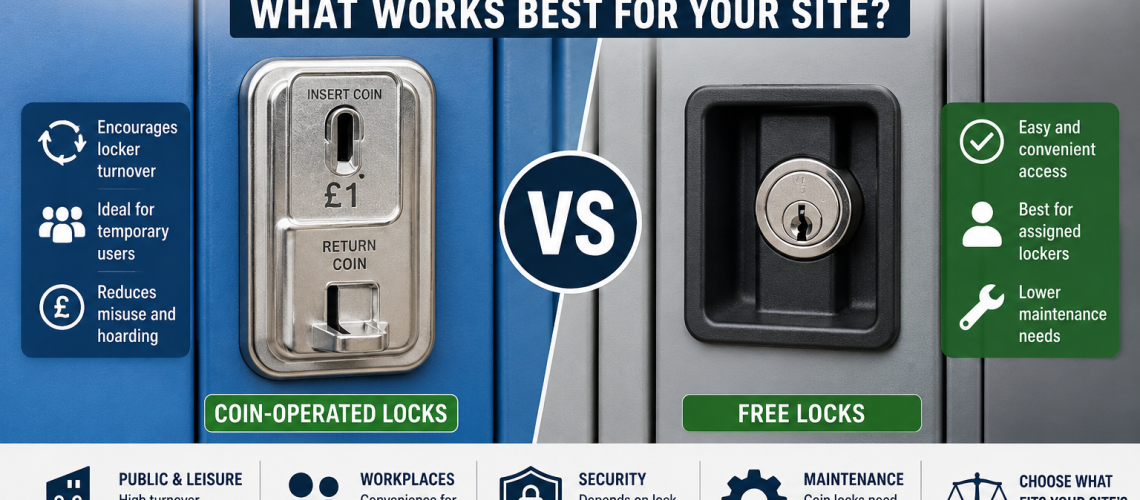
Coin-operated locker locks and free locker locks solve different operational problems. Coin locks help control locker turnover and encourage users to empty lockers after use, while free locks prioritise convenience, speed and simple access. The best option depends on your environment, user behaviour, supervision level and whether lockers are temporary or assigned.
This guide explains the differences between coin return locks, coin retain locks and free locker systems across UK workplaces, leisure centres, schools, gyms, swimming pools and public facilities. It also explains how locker turnover, maintenance, hygiene, administration and user behaviour affect lock choice.
Quick answer: Coin-operated locker locks work best where lockers are shared temporarily and need frequent turnover. Free locker systems work best where convenience, fast access or assigned personal storage are more important than locker circulation.
For broader lock guidance, see our Locker Locks UK master guide. You can also compare keyed vs combination locker locks, explore coin-operated locker locks UK or view our locker lock range.
What is a coin-operated locker lock?
A coin-operated locker lock requires the user to insert a coin or token before the locker can be locked. These systems are commonly used in shared environments where lockers are intended for temporary use.
There are two main types:
- Coin return locks → the coin is returned when the locker is reopened.
- Coin retain locks → the coin is retained by the site operator after use.
Coin locks are widely used in leisure centres, swimming pools, gyms, visitor facilities and temporary changing rooms because they discourage users from leaving lockers occupied unnecessarily.
What are free locker locks?
Free locker systems allow lockers to be used without requiring payment or coin insertion. The locker may still use a key lock, combination lock, digital lock or hasp fitting, but there is no usage charge or turnover mechanism.
These systems are commonly used in:
- Workplaces
- Schools
- Staff changing rooms
- Assigned personal lockers
- Low-supervision environments
- Internal staff-only areas
Coin locks vs free locks: core operational difference
The main difference is not security. It is locker behaviour and locker turnover.
| Factor | Coin Locks | Free Locks |
|---|---|---|
| Locker turnover | High | Lower |
| Temporary use | Excellent | Moderate |
| User convenience | Lower | Higher |
| Discourages abandoned use | Yes | No |
| Suitable for assigned lockers | No | Yes |
| Administrative overhead | Higher | Lower |
| Maintenance requirements | Higher | Lower |
| Public environment suitability | Very strong | Depends on supervision |
When coin-operated locker locks work best
Coin locks are most effective when lockers must circulate continuously throughout the day.
Typical examples include:
- Swimming pools
- Public leisure centres
- Gyms with transient users
- Visitor attractions
- Transport hubs
- Temporary workplace visitor storage
- Shared changing rooms
The coin mechanism encourages users to empty the locker after use because they want their coin returned or because a fee has been paid.
This reduces:
- Locker hoarding
- Long-term abandoned items
- Complaints about unavailable lockers
- Daily management intervention
When free locker systems work best
Free locker systems are usually better where users need simple, repeated or long-term access.
Typical examples include:
- Staff lockers
- School lockers
- Office personal storage
- Industrial workplace lockers
- Assigned user lockers
- Controlled-access facilities
In these environments, users often expect consistent access to the same locker without additional payment or coin handling.
For workplace-specific planning, see our Workplace Lockers UK guide and Locker layout planning guide UK.
Maintenance differences
Coin-operated systems usually require more maintenance because they contain moving mechanical parts that handle coins or tokens.
Potential issues include:
- Coin jams
- Damaged return systems
- Wear from heavy public use
- Incorrect coin insertion
- Token compatibility problems
Free locker locks are often simpler and easier to maintain, especially standard keyed or mechanical combination systems.
For lock type comparisons, read:
User experience considerations
Coin-operated systems create a stronger behavioural control system, but they also introduce friction.
Common user frustrations include:
- No suitable coin available
- Lost tokens
- Coin return confusion
- Queueing during busy periods
- Users unfamiliar with the mechanism
Free locker systems are faster and simpler, particularly in workplaces where lockers are part of daily staff operations.
Security comparison
Security depends more on the lock type and locker construction than whether the system is coin-operated or free.
A coin lock is not automatically more secure than a free locker lock. In many cases, the same lock body may exist in both coin-operated and non-coin-operated versions.
Security is influenced more heavily by:
- Locker material thickness
- Lock quality
- Master key control
- User supervision
- Public access level
- Access management procedures
Should you choose coin return or coin retain?
If you choose a coin-operated system, the next decision is whether the coin should be returned or retained.
| Type | Best For | Main Goal |
|---|---|---|
| Coin return | Gyms, leisure centres | Encourage locker turnover |
| Coin retain | Revenue contribution or strict temporary use | Reduce misuse and recover costs |
How to choose the right locker system
Start with the operational problem you are trying to solve.
- Need fast locker turnover? → Coin-operated locks
- Need simple daily staff access? → Free locker system
- Users frequently abandon lockers? → Coin return system
- Assigned personal lockers? → Free keyed or combination locks
- High public usage? → Coin-operated systems usually perform better
- Minimal maintenance priority? → Simpler free lock systems
You can also explore our broader Storage Systems UK guide for planning larger workplace and facility storage systems.
Related locker lock guides
- Locker Locks UK master hub
- Keyed locker locks UK
- Locker combination locks UK
- Coin-operated locker locks UK
- Electronic locker locks UK
- Padlock fittings for lockers UK
- Keyed vs combination locker locks
- Locker locks product range
Frequently Asked Questions
What is the difference between coin-operated and free locker locks?
Coin-operated locker locks require a coin or token to use the locker, while free locker locks allow access without payment or coin insertion.
Are coin-operated locker locks better for gyms?
Yes, coin-operated locks are often better for gyms and leisure centres because they encourage users to empty lockers after use and improve locker availability during busy periods.
Do coin locker locks improve security?
Not necessarily. Security depends more on lock quality, locker construction and supervision than whether the system is coin-operated or free.
What is a coin return locker lock?
A coin return locker lock gives the user’s coin back when the locker is reopened. This encourages temporary locker use without permanently charging the user.
What is a coin retain locker lock?
A coin retain locker lock keeps the inserted coin after the locker is opened. These systems are often used to recover maintenance costs or discourage misuse.
Are free locker systems better for workplaces?
Usually, yes. Workplace lockers are commonly assigned to individual users, making free locker systems more practical and convenient for daily staff access.
Which locker lock system requires less maintenance?
Free locker systems are usually easier to maintain because they contain fewer moving parts and no coin handling mechanisms.
Can coin-operated locks be fitted to existing lockers?
Many existing lockers can be retrofitted with coin-operated locks, although compatibility depends on the locker door preparation, lock footprint and locker construction.
Discover more from Blog Total Locker Service
Subscribe to get the latest posts sent to your email.