Keyed vs Combination Locker Locks UK: Which Locker Lock Should You Choose?
May 7, 2026
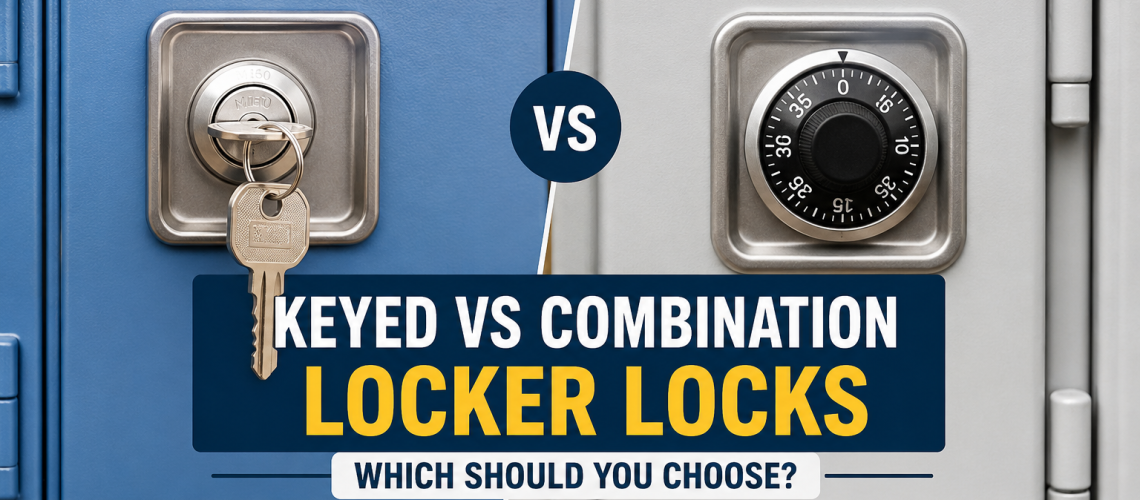
Keyed and mechanical combination locker locks solve the same basic problem in different ways. A keyed lock relies on possession of the correct physical key. A mechanical combination lock relies on knowledge of the correct code. The practical differences appear in lost-access recovery, user handover, administration, override, wear and day-to-day support.
This guide owns the direct comparison between keyed and mechanical combination locker locks. It compares consequences rather than deciding which technology is universally better.
Whether lockers should be assigned or shared belongs in Shared-Use vs Assigned Locker Locks UK. Whether keyed or combination access is the right technology overall belongs in Locker Access Control Systems UK.
Keyed = access depends on a physical key. Combination = access depends on a remembered or issued code. This page compares the consequences of that difference.
Quick Answer: Keyed vs Combination Locker Locks
Neither is automatically better. The main trade-off is what the organisation wants to manage.
| Issue | Keyed lock | Mechanical combination lock |
|---|---|---|
| Normal access | Physical key | Number code |
| Lost access problem | Lost, damaged or unavailable key | Forgotten, shared or incorrectly entered code |
| Recovery route | Spare key, replacement key, master key or lock replacement | Reset, code recovery, management override or lock replacement |
| User handover | Return / replace / reissue key | Change or reset code |
| Power | None for standard mechanical keyed locks | None for mechanical combination locks |
| Main user dependency | Possession of key | Memory / knowledge of code |
What This Page Owns, and What It Hands Off
- Direct keyed vs mechanical-combination comparison: this page
- Lost key vs forgotten code consequences: this page
- Replacement-key vs code-reset workflow: this page
- User handover and reassignment consequences: this page
- Master-key vs combination-override differences: this page
- Key sharing vs code sharing: this page
- Detailed keyed lock mechanics: Keyed Locker Locks UK
- Detailed mechanical combination mechanisms: Mechanical Combination Locker Locks UK
- Shared-use versus assigned-use operating model: Shared-Use vs Assigned Locker Locks UK
- Overall access-technology selection: Locker Access Control Systems UK
- Electronic PIN locks: Electronic Locker Locks UK
- Wet-area durability: Locker Locks for Wet Areas UK
- High-use duty: Locker Locks for High-Traffic Areas UK
How a Keyed Locker Lock Works
A keyed locker lock uses a physical key to operate a cylinder or barrel. When the correct key turns, the lock moves a cam, latch or other mechanical locking point behind the locker door.
The access dependency is therefore physical possession of the correct key.
For keyed-to-differ, keyed-alike, master-key capability, key references, worn keys, broken keys and cam-lock faults, use Keyed Locker Locks UK.
How a Mechanical Combination Locker Lock Works
A mechanical combination locker lock uses a dial, numbered wheels or mechanical push-buttons to align internal components. When the correct code is entered, the lock can release without a user key.
The access dependency is therefore knowledge of the correct code and correct entry sequence.
For fixed-code, resettable, public-use, dial, wheel, push-button and forgotten-code recovery details, use Mechanical Combination Locker Locks UK.
Physical Key vs Remembered Code
The fundamental difference is simple:
- Keyed: the user must possess the correct physical object.
- Combination: the user must know and correctly enter the code.
This shifts the most common support problem. Keyed systems tend to create lost-key, damaged-key and replacement-key events. Combination systems tend to create forgotten-code, reset and code-sharing events.
Lost Key vs Forgotten Code
| Problem | Keyed | Combination |
|---|---|---|
| User cannot access locker | Key may be lost, damaged or elsewhere | Code may be forgotten or entered incorrectly |
| First recovery check | Spare key, key number, master key | Correct code entry, reset or override method |
| Replacement item | Possible replacement key | Usually no physical replacement item |
| Hardware replacement | May be unnecessary if key can be replaced | May be unnecessary if code can be recovered/reset |
The comparison is not “lost keys are bad, combinations are better”. Combination locks simply replace one access-recovery problem with another.
Replacement Key vs Code Reset
When access needs to be restored, the support workflow is different.
- Keyed: identify the lock or key code, locate a spare, cut or order a replacement key, or replace the lock if necessary.
- Combination: confirm the correct procedure, use management override or recovery, reset the code, then verify normal operation.
For replacement keys, use Replacement Locker Keys. For detailed combination recovery, use the Mechanical Combination Locker Locks guide.
User Handover and Reassignment
When a locker changes user, keyed and combination systems require different handover steps.
| Task | Keyed | Combination |
|---|---|---|
| Remove previous user’s access | Recover old key or change lock if necessary | Change or reset code |
| Give new user access | Issue correct key | Provide or allow new code |
| Check access removal | Confirm old key no longer presents a risk where required | Confirm old code no longer works |
| Administration record | Key number / issue record where used | Reset / assignment record where used |
Whether lockers should be reassigned frequently is not decided here. Use Shared-Use vs Assigned Locker Locks UK for the operating model.
Key Sharing vs Code Sharing
Both technologies can be shared informally by users.
- A physical key can be handed to another person.
- A combination code can be told, messaged or written down.
The difference is how easily the shared access can be changed. A combination code may be reset without replacing hardware where the lock supports it. A compromised key may require key recovery, re-keying or lock replacement depending on the situation.
Spare Keys vs Management Override
Keyed systems commonly rely on spare keys, master keys or replacement-key capability. Combination systems commonly rely on a reset method, override key, recovery tool or master combination depending on the product.
Neither system should be specified without knowing how authorised staff regain access when normal user access fails.
Master Key vs Combination Override
A keyed master-key system and a combination override system solve similar support problems through different mechanisms.
- Master key: a physical key may operate multiple keyed locks in a designed hierarchy.
- Combination override: a management key, reset tool or recovery method may allow staff to open or reset a combination lock.
Both create elevated access and therefore need tighter control than ordinary user access.
Administration Burden
Both systems require administration, but not the same administration.
| Administration task | Keyed | Combination |
|---|---|---|
| Issue user access | Issue key | Assign / set code |
| Recover user access | Spare or replacement key | Reset / override |
| Support lost access | Track key number / lock | Know reset procedure |
| Reassign locker | Recover or replace key | Change code |
| Elevated staff access | Master / spare key control | Override / management tool control |
So “combination means no administration” is incorrect. It removes key administration, but introduces code and recovery administration.
User Learning Requirement
Keyed locks are familiar to most users. Mechanical combination locks can require a little more explanation, particularly dial locks and public-use resettable models.
- Dial direction and sequence may need explaining.
- Users may need to know how to clear a previous attempt.
- Shared-use resettable locks may require a specific lock / unlock cycle.
- Keyed locks may still require instructions where the key is captive or the cam movement is unusual.
No Batteries for Either Mechanical Option
Standard keyed cam locks and mechanical combination locks do not require batteries or fixed electrical power.
This distinguishes both from electronic PIN and RFID locks. If the comparison is actually mechanical combination vs electronic PIN, use Electronic Locker Locks UK.
Mechanical Wear: Different Components, Same Principle
Both technologies rely on mechanical parts and can wear over time.
- Keyed: key, cylinder, plug, cam, retaining hardware.
- Combination: dial, wheels, buttons, internal code mechanism, handle, cam or latch.
Repeated access problems should be diagnosed rather than accepted as normal ageing.
Wet-Area Comparison
Neither keyed nor mechanical combination operation automatically makes a lock suitable for humid or wet environments.
- Keyed locks can suffer cylinder, keyway, cam and fastener corrosion.
- Combination locks can suffer stiff wheels, buttons, dials and internal corrosion.
Use Locker Locks for Wet Areas UK for the environmental specification rather than choosing between keyed and combination from the technology label alone.
High-Use Comparison
High use changes wear patterns for both systems.
- Keyed locks experience repeated key insertion, turning and cam movement.
- Combination locks experience repeated dial, wheel, button and handle operation.
For duty cycle, user force, repeated abuse and maintenance implications, use Locker Locks for High-Traffic Areas UK.
Security Depends on More Than the Access Method
It is too simplistic to say keyed locks are more secure or combination locks are more secure as a class.
Security also depends on:
- lock quality;
- locker construction;
- cam or latch engagement;
- key or code control;
- override control;
- user behaviour;
- environment;
- and the consequence of unauthorised access.
Failure Scenario Comparison
| Scenario | Keyed | Combination |
|---|---|---|
| User loses normal access | Lost / damaged key | Forgotten / incorrect code |
| Normal access device damaged | Key may bend or snap | Dial, wheel or button may wear or jam |
| Management access fails | Spare / master key unavailable or wrong series | Override / reset method unavailable or incorrectly used |
| Door stays locked despite correct access | Cam / latch / door alignment fault | Cam / latch / door alignment fault |
| User changes | Recover / replace key | Reset / change code |
Support Scenario Comparison
Sites should compare what their staff are actually able to support.
- Can staff identify and order replacement keys?
- Can staff reset or recover combination codes correctly?
- Are master keys or override tools controlled?
- Can worn hardware be replaced quickly?
- Are user instructions clear enough to reduce avoidable support calls?
The lower-complexity option is the one the organisation can reliably administer, not automatically the one with fewer physical components.
What Changes When One User Keeps the Locker?
If one user keeps the same locker for a long period, both technologies can operate successfully.
- Keyed access means the user keeps the same physical key.
- Combination access means the user keeps the same code where the lock supports fixed/private mode.
The comparison then becomes key possession and replacement versus code memory and reset, not “assigned automatically means keyed”.
What Changes When Users Rotate?
If lockers change users regularly, both systems can still be used, but the turnover workflow differs.
- Keyed systems may require keys to be returned, checked and reissued.
- Combination systems may require codes to be reset, cleared or changed.
- Shared-use mechanical combination locks can support temporary-use cycles where designed for it.
- Keyed shared-use arrangements can also exist where keys are issued temporarily.
The allocation model itself belongs in Shared-Use vs Assigned Locker Locks UK.
Replacing Failed Hardware
Both keyed and combination locks can often be replaced without replacing the locker, subject to door preparation, fixing, cam or latch geometry and available clearance.
Use Locker Lock Replacement Guide UK for like-for-like replacement. If moving from keyed to combination or vice versa, use Locker Lock Upgrade Guide UK.
Do Not Turn This into an Overall Lock Buying Guide
This page compares only two technologies. Coin, padlock, RFID and electronic access belong in the wider Locker Access Control Systems UK decision framework.
Common Keyed vs Combination Comparison Mistakes
- Assuming keyed automatically means assigned use.
- Assuming combination automatically means shared use.
- Calling combination locks administration-free.
- Ignoring forgotten-code recovery.
- Ignoring replacement-key capability.
- Assuming one technology is inherently more secure.
- Confusing mechanical combination locks with electronic PIN locks.
- Ignoring master-key or override control.
- Using sector labels instead of actual operating requirements.
Keyed vs Combination Comparison Checklist
- Do users prefer carrying a key or remembering a code?
- How often are lockers reassigned?
- Can replacement keys be obtained easily?
- Can forgotten codes be recovered or reset easily?
- Who controls spare keys?
- Who controls override keys or reset tools?
- What happens if access credentials are shared?
- What user instructions are needed?
- What wear points are likely under the expected duty cycle?
- Is the environment wet or corrosive?
- Can failed locks be replaced without major locker modification?
Where Keyed vs Combination Questions Go Next
| Question | Next guide |
|---|---|
| What are the direct operational differences between keyed and combination? | This guide |
| How does a keyed locker lock work in detail? | Keyed Locker Locks UK |
| How does a mechanical combination lock work in detail? | Mechanical Combination Locker Locks UK |
| Should lockers be shared or assigned? | Shared-Use vs Assigned Locker Locks UK |
| Should we choose key, combination, coin, RFID, padlock or electronic access? | Locker Access Control Systems UK |
| How do electronic PIN locks work? | Electronic Locker Locks UK |
| What changes in wet areas? | Locker Locks for Wet Areas UK |
| What changes under heavy repeated use? | Locker Locks for High-Traffic Areas UK |
| How do we replace a failed lock? | Locker Lock Replacement Guide UK |
| How do we change from one lock type to another? | Locker Lock Upgrade Guide UK |
| Where can replacement locker keys be ordered? | Replacement Locker Keys |
Keyed vs Combination Locker Locks FAQs
Which is better: keyed or combination locker locks?
Neither is universally better. Keyed locks require physical-key management, while mechanical combination locks require code memory, reset and override processes. The better fit depends on the operating requirement and support model.
Do keyed locker locks have to be used for assigned lockers?
No. Keyed locks can be used in different operating models. Assigned use simply means the same user keeps the locker; it does not require one particular lock technology.
Do combination locker locks have to be used for shared lockers?
No. Fixed-code mechanical combination locks can support long-term assigned use, while some resettable models support shared or temporary use.
What happens if a keyed locker key is lost?
A spare or replacement key may be available if the lock and key code can be identified. Lock replacement is not always necessary.
What happens if a combination code is forgotten?
The recovery method depends on the lock. It may use a management key, master combination, code-finding tool or reset procedure.
Are combination locks more secure than keyed locker locks?
Not automatically. Security depends on lock quality, locker construction, user behaviour, key or code control, override control and the intended use.
Do keyed or mechanical combination locker locks need batteries?
Standard keyed cam locks and mechanical combination locks normally operate without batteries or fixed electrical power.
Can a keyed locker lock be changed to a combination lock later?
Often, depending on the locker door, cut-out, fixing method, cam or latch arrangement and available clearance. A representative conversion should be checked before a bulk change.
Summary
Keyed and mechanical combination locker locks are best compared by the consequences of physical-key access versus code access.
Keyed systems create key issue, spare-key, replacement-key and master-key considerations. Combination systems create code memory, reset, recovery and override considerations. Both are mechanical, both can wear, and either can support different operating models depending on the specific lock.
Keep the overall technology decision with Access Control, the shared-versus-assigned question with its own operating guide, and the detailed lock mechanics with the Keyed and Mechanical Combination specialist pages.
Discover more from Blog Total Locker Service
Subscribe to get the latest posts sent to your email.