
Probe Hazardous Substance Cabinets
Probe Hazardous Substance Cabinets
 Click to enlarge
Features
Probe Hazardous Substance Storage Cabinets
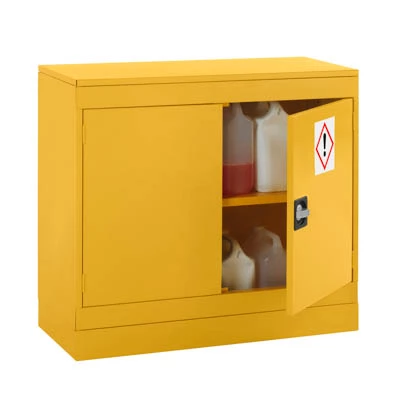
Probe hazardous substance cabinets provide secure, clearly identified storage for selected chemicals and dangerous substances in workplaces, laboratories, schools, workshops and industrial facilities. The high-visibility yellow cabinets help separate hazardous materials from general workplace storage and support site COSHH and DSEAR control arrangements.
Manufactured in the UK, the range includes compact, low-height, half-height and full-height steel cupboards. Different sizes and internal configurations are available to suit cleaning products, solvents, paints, oils and other substances identified by the site risk assessment as requiring secure, segregated storage.
A hazardous substance cabinet does not make a workplace automatically COSHH compliant. The correct cabinet, location and storage arrangement must be selected using the substance safety data sheets and a suitable workplace risk assessment.
Probe Hazardous Cabinet Features
| Feature | Specification |
|---|---|
| Construction | Durable steel cabinet with reinforced doors |
| Finish | High-visibility yellow matt textured powder coating |
| Surface protection | ActiveCoat antibacterial powder-coated finish |
| Shelves | Adjustable shelves positioned on a 25 mm pitch |
| Shelf loading | Up to 90 kg uniformly distributed load per shelf |
| Spill containment | Fully welded integral sump, with capacity dependent on cabinet model |
| Locking | Cam lock or three-point locking, depending on cabinet size |
| Keys | Two keys supplied with each lock |
| Identification | High-visibility labels supplied for the appropriate stored substance |
| Manufacture | United Kingdom |
Integral Spill-Containment Sump
Probe hazardous cabinets include a fully welded integral sump designed to retain leaks and spillages within the cupboard. Sump capacity varies by model, with larger cabinets providing capacity of up to approximately 35 litres.
A sump supports spill management but does not remove the need for suitable spill kits, emergency procedures and trained personnel. Any recovered liquid must be handled and disposed of in accordance with the substance safety data sheet and the site’s waste-management procedures.
Adjustable Heavy-Duty Shelving
The internal shelves can be repositioned on a 25 mm pitch to accommodate containers of different heights. Each shelf carries a uniformly distributed load of up to 90 kg, providing practical storage for containers used in commercial and industrial environments.
Shelf loads should be distributed evenly. The total weight, container type and compatibility of the stored substances must be considered before the cabinet is loaded.
Secure Locking and Controlled Access
Smaller Probe hazardous cupboards use a flush-fitting handle with a key-operated cam lock. Larger cabinets use a three-point locking system for additional security. Two keys are supplied with each cabinet.
An optional hasp and staple may be available on selected 915 mm wide cabinets for use with a customer-supplied padlock. Check the selected model before ordering if a particular locking method is required.
High-Visibility Finish and Hazard Labels
The cabinets have a high-visibility yellow finish, similar to RAL 1004, to make the designated storage area easier to identify. Each cabinet is supplied with labels for corrosive, highly flammable or harmful materials.
The correct label must be selected according to the substances stored. Labels do not replace the original product labels, safety data sheets or workplace signage required by the site risk assessment.
Probe Hazardous Cabinet Sizes
The range extends from compact cupboards for small quantities through to tall cabinets for larger workplace storage requirements. Available dimensions vary by model.
| Cabinet Type | Typical Height | Available Widths | Available Depths |
|---|---|---|---|
| Compact cupboard | 595 or 770 mm | 300 or 450 mm | 300 or 450 mm |
| Low-height cupboard | 790 mm | 915 mm | 355 or 505 mm |
| Half-height cupboard | 1070 mm | 477 or 915 mm | 505 mm |
| Full-height cupboard | 1905 mm | 477 or 915 mm | 505 mm |
Dimensions, shelf quantities, lock types and sump capacities differ between models. Check the individual product specification before placing an order.
Choosing the Correct Hazardous Substance Cabinet
The cabinet should be selected according to the substances being stored rather than by colour or cabinet size alone. Before ordering, review:
- The current safety data sheet for every substance
- The hazards and classifications of the stored materials
- Whether any substances are incompatible and require separate storage
- The quantity and size of each container
- The required sump capacity and spill-response arrangements
- The cabinet location and distance from heat or ignition sources
- Access restrictions and the people authorised to use the cabinet
- Applicable COSHH, DSEAR and fire-risk assessment requirements
Do Not Store Incompatible Substances Together
Hazardous products should not automatically be combined in the same cabinet. Flammable liquids, oxidising products, corrosive chemicals and other incompatible materials may need separate storage. Follow the compatibility and storage information supplied by the chemical manufacturer and recorded in the workplace risk assessment.
Where flammable liquids are involved, the employer or dutyholder must also consider the requirements of the Dangerous Substances and Explosive Atmospheres Regulations 2002. Only the quantity required for current workplace activities should normally be retained in the immediate work area.
Are Probe Hazardous Cabinets Fireproof?
Steel construction should not be interpreted as a certified fire-resistance rating. Where a specified fire performance or a cabinet tested to a particular standard is required, confirm the certification of the exact model before ordering.
A hazardous storage cupboard is not a substitute for a dedicated chemical store, external storage facility or fire-rated cabinet where these are required by the site-specific risk assessment.
Typical Applications
| Environment | Typical Storage Requirement |
|---|---|
| Manufacturing and engineering | Oils, solvents, paints and maintenance chemicals |
| Automotive workshops | Cleaning products, lubricants and workshop chemicals |
| Schools and colleges | Selected science, cleaning and technical-department chemicals |
| Laboratories | Secure, identified storage selected according to chemical compatibility |
| Healthcare facilities | Maintenance, cleaning and facilities-management chemicals |
| Warehouses and commercial premises | Controlled storage of hazardous workplace products |
COSHH and DSEAR Guidance
COSHH requires employers to assess and control health risks arising from hazardous substances, including risks connected with their storage, handling and disposal. Safety data sheets provide important storage and emergency information but do not replace a suitable and sufficient COSHH assessment.
For official guidance, visit the Health and Safety Executive COSHH guidance and the HSE DSEAR guidance .
Related Cabinet Ranges
View our complete range of safety cabinets or browse commercial storage cabinets for alternative workplace storage products.
Specification
Specification sheetProbe Hazardous Substance Cabinet Specification
Probe hazardous substance cabinets provide secure, clearly identified storage for selected flammable and hazardous substances in workplaces, workshops, laboratories, schools and industrial environments.
Manufactured in the United Kingdom, the range includes small, low-height, full-height and eight-compartment cabinets. Each model combines robust steel construction with adjustable shelving, spill containment, hazard identification and an internal smoke and fire alarm.
Important: A hazardous substance cabinet can support workplace COSHH and DSEAR control measures, but it does not make a workplace automatically compliant. Cabinet selection, positioning and use must be based on the substances stored, their safety data sheets and a suitable site-specific risk assessment.
Key Features
- Robust steel construction for commercial and industrial use
- Reinforced cabinet doors
- Removable 75 mm-deep sealed sump base tray
- Adjustable steel shelves
- Maximum shelf load of 85 kg UDL
- High-visibility 270-degree hazard labelling
- Internal smoke and fire alarm supplied as standard
- Four cabinet sizes and configurations available
- Manufactured in the United Kingdom by Probe Storage Solutions
Technical Specification
| Feature | Specification |
|---|---|
| Construction | Robust steel cabinet with reinforced doors |
| Spill containment | Removable sealed sump base tray, 75 mm deep |
| Shelving | Adjustable steel shelves |
| Shelf capacity | Up to 85 kg uniformly distributed load per shelf |
| Identification | High-visibility 270-degree hazard labelling |
| Alarm | Internal smoke and fire alarm |
| Available heights | 890, 1015 or 1780 mm |
| Available widths | 460 or 915 mm |
| Depth | 460 mm |
| Country of manufacture | United Kingdom |
Cabinet Sizes and Configurations
| Cabinet Type | Height | Width | Depth | Shelves | Typical Application |
|---|---|---|---|---|---|
| Small hazardous cabinet | 890 mm | 460 mm | 460 mm | 2 adjustable shelves | Compact storage for small quantities and restricted spaces |
| Low-height hazardous cabinet | 1015 mm | 915 mm | 460 mm | 1 adjustable shelf | Wide, low-level storage for workshops and maintenance areas |
| Standard hazardous cabinet | 1780 mm | 915 mm | 460 mm | 3 adjustable shelves | Centralised storage for several containers or product types |
| Eight-compartment hazardous cabinet | 1780 mm | 915 mm | 460 mm | 6 adjustable shelves | Organised storage across eight separate compartments |
Removable Spill-Containment Tray
Each cabinet includes a removable 75 mm-deep sealed sump base tray designed to retain minor leaks and spillages within the cabinet. Its removable construction allows the tray to be inspected and cleaned as part of the site’s regular maintenance procedures.
The tray provides secondary containment but does not replace suitable containers, spill kits, emergency procedures or employee training. Its suitability should be checked against the type and quantity of liquid being stored.
Adjustable 85 kg Shelves
Each adjustable shelf supports a maximum uniformly distributed load of 85 kg. Uniformly distributed load, or UDL, means that the weight must be spread evenly across the complete shelf rather than concentrated in one area.
Heavy containers should normally be positioned at a lower level to improve cabinet stability and reduce manual-handling risks. Always consider the total cabinet load as well as the capacity of each individual shelf.
High-Visibility Hazard Labelling
The 270-degree hazard labelling helps make the cabinet identifiable from several directions. The displayed label must be appropriate for the substances stored inside the cabinet.
Cabinet labelling does not replace the original labels on individual containers, safety data sheets or any additional workplace signage required by the site risk assessment.
Internal Smoke and Fire Alarm
An internal smoke and fire alarm is supplied as an additional local warning feature. The alarm does not give the cabinet a certified fire-resistance rating and must not be treated as a replacement for the building’s fire-detection system, emergency procedures or routine alarm testing.
Storing Different Hazardous Substances
Different hazardous products should only be stored together where they are compatible. Flammable liquids, oxidising substances, corrosive materials and other incompatible chemicals may require separate storage arrangements.
Before combining products within one cabinet, check each safety data sheet and the findings of the workplace COSHH and DSEAR assessments. The eight-compartment model can help organise products, but separate compartments do not automatically make incompatible substances safe to store within the same cabinet.
COSHH, DSEAR and HSG51 Guidance
COSHH requires employers to assess and control risks to health arising from hazardous substances. DSEAR covers risks from fire, explosion and substances that are corrosive to metals.
HSE publication HSG51 provides guidance on the storage of flammable liquids in containers at work. These requirements apply to the way substances are assessed, stored, handled and managed rather than acting as a product certification for an individual cabinet.
Read the official HSE HSG51 guidance and HSE DSEAR guidance before establishing a hazardous-substance storage arrangement.
Choosing the Correct Hazardous Cabinet
Before ordering, consider:
- The hazard classification of each substance
- The information contained in the relevant safety data sheets
- Whether any stored substances are chemically incompatible
- The size, type and quantity of the containers
- The required spill-containment capacity
- The maximum shelf and total cabinet load
- Potential heat, fire and ignition sources
- Ventilation and environmental conditions
- The people authorised to access the cabinet
- Inspection, spill-response and emergency procedures
Only the minimum quantity required for normal workplace activities should generally be retained in the immediate work area. Larger quantities may require a separate, purpose-designed storage location.
Related Safety Cabinet Ranges
View our complete range of safety cabinets and hazardous substance storage , including COSHH cabinets , toxic substance cabinets and acid and alkali cabinets .
Alternative workplace storage products are available from our commercial and industrial cabinet range .
Probe Hazardous Cabinet FAQs
What are Probe hazardous cabinets used for?
Probe hazardous cabinets provide secure, clearly identified storage for selected hazardous and flammable substances. The correct cabinet must be chosen according to the products, quantities, safety data sheets and workplace risk assessment.
Do hazardous cabinets make a workplace COSHH compliant?
No. A suitable cabinet can support COSHH control measures, but compliance also depends on risk assessment, safe procedures, exposure controls, employee training, spill response and ongoing management.
What sizes of Probe hazardous cabinet are available?
The range includes a 890 × 460 × 460 mm small cabinet, a 1015 × 915 × 460 mm low-height cabinet and 1780 × 915 × 460 mm standard and eight-compartment cabinets.
How much weight can each shelf support?
Each adjustable shelf supports up to 85 kg UDL. UDL means uniformly distributed load, so the weight must be spread evenly across the complete shelf.
Do the cabinets include spill containment?
Yes. Each cabinet includes a removable 75 mm-deep sealed sump base tray designed to retain minor leaks and spillages. Its suitability should be checked against the products and quantities being stored.
Is a smoke and fire alarm included?
Yes. A smoke and fire alarm is fitted internally as an additional local warning feature. It does not replace the building fire-alarm system or give the cabinet a certified fire-resistance rating.
Are Probe hazardous cabinets fireproof?
The supplied specification does not state a certified fire-resistance period. Steel construction and an internal alarm must not be interpreted as a fireproof or fire-rated cabinet unless separate certification is supplied for the exact model.
Can different hazardous substances be stored together?
Only where the substances are compatible. Flammable liquids, oxidisers, corrosive substances and other incompatible materials may require separate storage. Check the safety data sheets and workplace risk assessment before combining products in one cabinet.
What guidance applies to flammable liquid storage?
HSE publication HSG51 provides guidance on storing flammable liquids in containers at work. DSEAR requires employers to assess and control risks from fire, explosion and dangerous substances. Read the HSE HSG51 guidance and HSE DSEAR guidance .
Where can I find other hazardous storage cabinets?
View the safety cabinet range for alternative hazardous-material, COSHH, toxic-substance, acid and alkali storage cabinets.
Delivery
Delivery Information
The approximate lead time is 15 Days.
Delivery to Mainland UK only, without any restrictions.
Our delivery times are; Monday - Friday 8am to 5pm.
We will deliver using the most economical method, using either our own vehicles or a carrier.
Goods may be palletised and delivered on an articulated vehicle.
The deliveries are kerb side only, you will need to arrange to unload the vehicle.
If there are any delivery restrictions / specific dates / times / dedicated deliveries, or FORS Registered deliveries; please contact the sales department as there may be an additional cost.