Multi-Site Locker Estate Management UK: Standards, Reporting and Replacement Planning
May 14, 2026
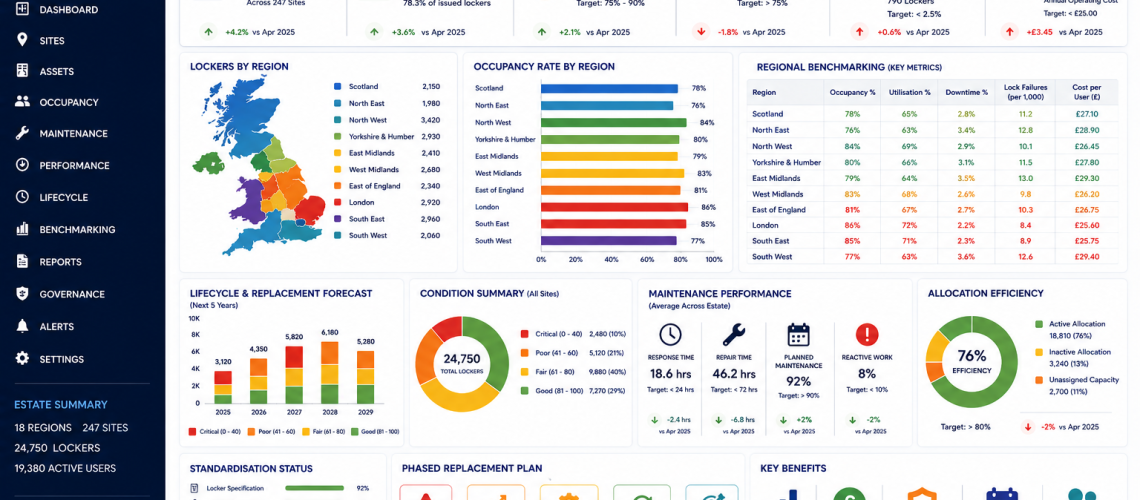
Multi-site locker estate management is the coordination process used to keep locker standards, responsibilities, records and local operating practices consistent across several locations without forcing every site to use identical equipment.
For school trusts, NHS estates, councils, warehouse groups, leisure operators and national workplace portfolios, the main challenge is deciding what should be standardised centrally, what should remain under local control and how justified differences between sites should be recorded and managed.
Locker Estate Management coordinates the whole physical estate. Multi-Site Locker Estate Management explains how that framework is applied consistently across several locations while preserving justified local differences.
Standardise the framework, records and decision rules. Do not force every site into the same locker specification.
Quick Answer: How Do You Manage Lockers Across Multiple Sites?
Manage a multi-site locker estate by giving every location a common structure for identifying locker assets, recording essential information, applying approved terminology, selecting supported locker and lock families, assigning responsibility and escalating problems.
| Estate requirement | Multi-site approach |
|---|---|
| Identify assets | Use a common organisation, region, site, building, area and locker-bank hierarchy |
| Maintain records | Require a consistent minimum dataset from every site |
| Compare locations | Use the same definitions before comparing condition, faults, capacity or utilisation |
| Manage products | Use approved locker, lock and component families rather than one universal model |
| Control differences | Record justified local exceptions rather than allowing invisible variation |
| Resolve problems | Define what remains local and what must escalate centrally |
What Multi-Site Locker Estate Management Owns
- Organisation, region, site, building and area structure.
- Consistent locker-bank and asset identification across locations.
- The minimum information every participating site must maintain.
- Common terminology and status definitions.
- Central, regional and local responsibilities.
- Approved locker, lock and component families.
- Controlled local exceptions.
- Site onboarding and removal from the estate.
- Cross-site operating consistency.
- Escalation of recurring or estate-wide problems.
- Making site information comparable before portfolio analysis.
- Coordinating approved replacement priorities across locations.
What This Page Hands Off
| Detailed subject | Specialist owner |
|---|---|
| Overall physical estate coordination, standards and governance | Locker Estate Management UK |
| Detailed asset IDs, locations and stable physical fields | Locker Asset Register UK |
| Physical verification and condition evidence | Locker Estate Audit UK |
| User allocation and administration | Locker Management Systems UK |
| Occupancy, vacancy and utilisation | Locker Occupancy Management Systems UK |
| Cross-site trends and analytical comparison | Smart Locker Analytics UK |
| Maintenance work orders and FM integration | Locker CAFM Integration UK |
| Repair, refurbishment and replacement decisions | Locker Lifecycle Management UK |
| Approved replacement scope, quantities and phasing | Locker Replacement Planning UK |
| Reset, override and administrator authority | Locker Access Permissions & Governance UK |
Why Multi-Site Locker Estates Become Difficult
A single site can often tolerate informal local practices. Across several buildings or locations, small differences accumulate into an estate-management problem.
- Different locker-numbering methods.
- Different definitions of faults or availability.
- Different condition terminology.
- Different lock manufacturers for similar applications.
- Incompatible master-key or key-numbering structures.
- Different asset-record formats.
- Different local purchasing decisions.
- Different escalation routes.
- Different reporting periods.
- Unrecorded local modifications.
- Recurring problems that remain isolated within individual sites.
The objective is not to eliminate every local difference. It is to make differences visible, intentional and manageable.
Create a Common Locker Estate Hierarchy
Every location should fit into the same basic portfolio structure so a locker bank can be identified consistently across schools, hospitals, warehouses, offices and other facilities.
| Level | Example |
|---|---|
| Organisation | Company, NHS organisation, council or academy trust |
| Region / division | Operating region, logistics division or academy cluster |
| Site | Hospital, school, depot, office or leisure centre |
| Building | Main building, warehouse, sports block or staff facility |
| Floor / department / area | Changing room, corridor, department or production area |
| Locker bank / asset | Identified physical group of lockers |
The detailed asset structure belongs in Locker Asset Register UK. Multi-site management owns the requirement that every participating site applies the agreed hierarchy consistently.
Define a Minimum Dataset for Every Site
The portfolio does not need to recreate every field in the Asset Register. It does need enough common information to understand and compare locations reliably.
- Organisation or region.
- Site.
- Building.
- Floor, room, department or area.
- Locker-bank or asset reference.
- Locker type.
- Number of compartments.
- Lock or access type.
- Principal user group.
- Assigned, shared or other operating model.
- Availability status.
- Current condition status.
- Known local exception.
- Date information was last verified.
More detailed information can remain in the Asset Register, CAFM system, Locker Management System or other specialist record. The multi-site layer should not become a second master database.
Separate Central and Local Responsibility
Successful multi-site management depends on separating decisions that need estate-wide consistency from tasks that are better handled locally.
| Area | Central responsibility | Local responsibility |
|---|---|---|
| Estate hierarchy | Define the common structure | Apply it accurately |
| Asset identification | Define the ID convention | Maintain local references |
| Minimum dataset | Define mandatory information | Keep records current |
| Terminology | Define common terms | Use them consistently |
| Product standards | Approve supported families | Select the suitable approved option |
| Routine faults | Define common categories and escalation rules | Manage routine local issues |
| Exceptions | Define the approval route | Provide justification and evidence |
| Recurring problems | Review estate-wide patterns | Escalate repeated local failures |
Central control should prevent uncontrolled fragmentation. Local responsibility should preserve enough flexibility for the real building, user group and environment.
Use Common Locker Terminology Across Sites
- Available.
- Unavailable.
- Occupied.
- Assigned.
- Shared.
- Fault.
- Repeat fault.
- Condition category.
- Temporary access.
- Local exception.
- Out of service.
- Replacement review.
The specialist process should define the detailed meaning. Multi-site management should require all participating sites to use the same approved definition where portfolio comparison is intended.
Standardise Product Families, Not Every Locker
Reducing unnecessary product variation can simplify procurement, training, spare parts, key control and future replacement, but forcing one specification into every environment can create new problems.
- Approved metal locker ranges.
- Approved laminate-door ranges.
- Approved wet-area products.
- Approved school locker specifications.
- Approved workplace and industrial ranges.
- Approved keyed, hasp, combination and electronic lock families.
- Approved numbering systems.
- Approved stands, plinths and sloping tops.
- Approved replacement components.
- Approved charging or specialist variants.
A school corridor, NHS staff changing room, warehouse and wet leisure environment can legitimately require different products. The estate standard should define approved options and the circumstances in which each can be used.
Why Product-Family Standardisation Helps
- Replacement parts are easier to identify.
- Sites are less likely to order incompatible locks.
- Maintenance teams encounter fewer unfamiliar products.
- Keys and lock components can be managed more consistently.
- Procurement teams have clearer approved options.
- New sites can adopt known specifications.
- Recurring problems within one product family are easier to detect across the estate.
Create a Controlled Local Exception Process
Local exceptions are not necessarily failures of standardisation. Some are essential. The important distinction is between a known, justified exception and uncontrolled local variation.
- Which site and locker bank are affected?
- Why is the normal approved option unsuitable?
- What local requirement creates the exception?
- What alternative is proposed?
- Does it introduce a different lock, key, spare part or maintenance requirement?
- Who approved it?
- Is the exception temporary or permanent?
- Should the alternative be considered for wider estate approval?
Typical exceptions can include wet areas, accessible storage, specialist PPE, unusually large equipment, charging lockers or site-specific access requirements.
Manage Legacy Variation Gradually
Established estates often contain several generations of lockers installed under different procurement policies. Different manufacturers, lock types, numbering systems and replacement parts may all remain in service.
- Record existing locker and lock families.
- Identify supported and unsupported products.
- Record known compatibility requirements.
- Standardise new purchases first.
- Use common replacement parts where technically compatible.
- Allow serviceable legacy assets to remain in use.
- Escalate repeated problems rather than replacing equipment merely for uniformity.
Whether an existing locker should actually remain in service, be repaired, refurbished or replaced belongs in Locker Lifecycle Management UK.
Onboard New Sites Into the Estate Framework
When a school, hospital, depot, office, leisure centre or acquired business joins the managed estate, the first objective should be visibility and management consistency rather than immediate physical standardisation.
- Define the scope. Identify which locker assets belong to the managed estate.
- Map the site. Establish building, floor, department and area references.
- Verify existing lockers. Use Locker Estate Audit UK where records cannot be trusted.
- Apply the common hierarchy. Map local locker banks into the estate structure.
- Identify locker and lock families. Separate approved, legacy and unsupported products.
- Record local exceptions. Preserve genuine requirements.
- Assign ownership. Name the local role responsible for maintaining information.
- Connect escalation routes. Ensure recurring or material problems can reach central review.
- Bring future purchases under the approved framework.
Make Sites Comparable Before Comparing Them
One of the main benefits of a common framework is meaningful site comparison. That is only possible when locations record the same thing in the same way.
- Use the same asset hierarchy.
- Use the same definitions of available and unavailable capacity.
- Use the same fault categories.
- Use the same physical-condition framework.
- Use the same reporting periods where comparison is intended.
- Use the same KPI definitions and denominators.
- Distinguish assigned, shared, shift and other operating models.
- Record when information was last physically verified.
Multi-site management creates the comparable foundation. Detailed cross-site trends, segmentation and interpretation belong in Smart Locker Analytics UK.
Use Like-for-Like Site Benchmarking
Raw totals can be misleading when locations differ substantially in size, environment or operating model.
| Comparison | Better basis | Context to retain |
|---|---|---|
| Fault volume | Common fault measure relative to an agreed locker population and period | Environment, product family and evidence quality |
| Maintenance spend | Common cost basis per agreed population | Included labour, parts and call-out scope |
| Occupancy pressure | Common occupancy or utilisation definition | Assigned, shared, shift or hybrid model |
| Condition | Same physical assessment framework | Inspection date and evidence quality |
| Downtime | Same definition of unavailable time | Fault severity and maintenance access |
The portfolio layer owns the rule that comparisons must be like-for-like. The detailed KPI framework now sits within Locker Estate Management UK.
Identify Recurring Problems Across the Estate
A problem that looks minor at one site can become important when the same failure appears repeatedly across several locations.
| Observed issue | Appropriate response |
|---|---|
| Single isolated lock failure | Manage through local maintenance |
| Several similar failures within one locker bank | Review locally and record recurrence |
| Same component failing at several sites | Escalate for estate-wide review |
| Repeated difficulty sourcing one spare part | Review whether the product should remain an approved family |
| Several sites requesting the same exception | Review whether it should become an approved option |
The eventual repair, refurbishment or replacement decision remains with Locker Lifecycle Management UK.
Escalate Local Problems to Central Review When Needed
- A recurring fault affects several locker banks.
- A lock or component repeatedly fails.
- An approved replacement component becomes unavailable.
- A site needs a product outside the approved family.
- A significant undocumented variation is discovered.
- Locker records cannot be reconciled with the physical estate.
- A local requirement may justify changing the estate standard.
- A similar problem appears at several separate sites.
The relevant specialist process should determine the action. Multi-site management owns the route by which a local observation becomes visible at portfolio level.
Manage Locker Parts and Compatibility Across Sites
- Record locker manufacturer or family where known.
- Record the lock family before ordering parts.
- Maintain known compatible replacement locks and cams.
- Identify common keys, hinges, number plates and other service components where appropriate.
- Keep site-specific exceptions visible.
- Do not assume visually similar components are interchangeable.
- Feed repeated compatibility problems into future product standards.
Detailed maintenance workflow and work-order history belong in Locker CAFM Integration UK.
Coordinate Replacement Priorities Across Sites
Multi-site management can bring approved lifecycle and replacement priorities together so finance, estates and procurement teams can see which locations may enter future renewal programmes.
- Site and project reference.
- Reason the site has entered review.
- Current lifecycle or audit evidence.
- Operational constraints.
- Indicative project window where one has been approved.
- Dependencies such as relocation or other building work.
- Decision owner and approval status.
- Whether work can be sequenced by site, building or locker bank.
The portfolio can coordinate which approved projects happen when, but it should not create another replacement scoring system. Use Locker Replacement Planning UK for quantities, project scope and phasing.
Regional and Local Locker Estate Ownership
| Role | Typical responsibility |
|---|---|
| Central estate owner | Common framework, approved families, cross-site standards and estate-wide escalation |
| Regional / division owner | Coordinates several sites and identifies recurring regional issues |
| Local site owner | Maintains records, operates the local system and reports exceptions |
| Specialist owner | Manages the detailed process such as Lifecycle, Access, CAFM or Occupancy |
The structure should remain proportionate. A five-site organisation may need only central and local ownership, while a national estate may benefit from a regional layer.
When a Site Closes, Moves or Changes Use
- Identify which locker assets are affected.
- Record whether they are remaining, relocating, being stored or leaving service.
- Update site, building, room and locker-bank references.
- Remove obsolete locations from active portfolio records.
- Update associated lock, key or access references.
- Transfer outstanding maintenance information where assets move.
- Retain relevant exceptions against the correct new location.
Detailed physical record changes remain with Locker Asset Register UK.
Multi-Site Locker Estate Management for School Trusts
Academy and school trusts may inherit different locker ranges, lock types, numbering conventions and maintenance practices at each school. Trust-level coordination can create a common asset structure and approved product families without requiring every building to use identical lockers.
- Common school and building hierarchy.
- Consistent locker-bank identification.
- Approved school locker families.
- Approved lock options.
- Common fault and condition terminology.
- Local responsibility at each school.
- Central visibility of recurring problems.
For education-specific locker requirements, use School Lockers UK.
Multi-Site Locker Estate Management for NHS and Healthcare Sites
Healthcare organisations may manage lockers across hospitals, clinics, staff changing areas and community locations. The estate framework can remain consistent while departments retain appropriate specifications for uniforms, PPE, shift patterns, wet environments and other local requirements.
- Common site, building and department structure.
- Consistent locker-bank references.
- Approved staff-locker families.
- Approved lock and access options.
- Common maintenance terminology.
- Controlled department-specific exceptions.
Multi-Site Locker Estate Management for Warehouses and Industrial Sites
Distribution centres, factories and depots may differ in shift patterns, PPE, workwear and changing-room design while still benefiting from common identification, lock families, fault categories and replacement-part standards.
- Common depot and area hierarchy.
- Approved robust locker families.
- Consistent lock references.
- Common fault categories.
- Controlled environmental exceptions.
- Cross-site identification of repeated component failures.
Multi-Site Locker Estate Management for Workplace Portfolios
Office portfolios may combine permanently assigned lockers, shared lockers, visitor storage and hybrid-working arrangements. The portfolio should coordinate the asset framework and approved technologies while individual locations operate the allocation model appropriate to their users.
- Common building and floor hierarchy.
- Consistent locker-bank identification.
- Approved locker families.
- Approved mechanical or electronic access technologies.
- Common availability terminology.
- Local responsibility for everyday operation.
For assigned, shared, temporary and hot-locker administration, use Locker Management Systems UK.
How to Implement Multi-Site Locker Estate Management
- Define the estate. Decide which sites and locker populations are included.
- Assign ownership. Name central, regional where appropriate, and local responsible roles.
- Create the hierarchy. Standardise organisation, region, site, building, area and locker-bank references.
- Define the minimum dataset. Decide what every location must maintain.
- Standardise terminology. Ensure sites use the same meanings for faults, condition and availability.
- Identify existing products. Record locker and lock families already in service.
- Create approved families. Control future variation without forcing unsuitable uniformity.
- Create an exception process. Make legitimate differences visible and controlled.
- Audit unreliable sites. Verify the physical estate before relying on weak records.
- Onboard each location. Map existing assets into the common structure.
- Define escalation routes. Make cross-site problems visible.
- Review the framework. Update approved families and standards as the portfolio develops.
Common Multi-Site Locker Estate Management Mistakes
- Forcing identical lockers into every environment. Standardise the framework and approved options instead.
- Allowing unrestricted local purchasing. This creates unnecessary product and parts variation.
- Using inconsistent asset references. Local names become unreliable at portfolio scale.
- Creating a second asset register. Keep one authoritative detailed physical record.
- Comparing sites before definitions are aligned. Common data definitions must come first.
- Ignoring legacy equipment. Existing variation needs to be visible before it can be managed.
- Replacing serviceable lockers purely for uniformity. Physical intervention should remain evidence-led.
- Failing to record exceptions. Hidden variation is harder to support than approved variation.
- Keeping recurring failures local. Cross-site patterns cannot be identified if problems never escalate.
- Having no named local owner. Central standards depend on reliable local information.
- Turning the page into KPI methodology. Multi-site management requires common definitions but should not duplicate Estate Management’s KPI framework.
- Turning the page into replacement planning. Coordinate approved projects without recreating Lifecycle or Replacement Planning.
Multi-Site Locker Estate Management Checklist
- Which sites are included in the locker estate?
- Who owns the estate centrally?
- Is regional ownership required?
- Who maintains locker information locally?
- Is the organisation/site/building/area hierarchy consistent?
- Can every locker bank be identified unambiguously?
- Is a minimum estate dataset defined?
- Are availability and fault terms consistent?
- Are condition categories consistent?
- Are approved locker families documented?
- Are approved lock families documented?
- Are known legacy products recorded?
- Are unsupported products visible?
- Is there a controlled exception process?
- Can new sites be onboarded consistently?
- Can closed or relocated sites be removed cleanly from the structure?
- Can recurring local problems be escalated centrally?
- Are sites using comparable KPI definitions and reporting periods?
- Can repeated product or component problems be identified across sites?
- Are specialist decisions handed to the correct process?
Related Locker Estate Management Guides
- Locker Estate Management UK – overall estate coordination, governance, KPIs and management reporting.
- Locker Asset Register UK – locker IDs, locations and detailed physical asset records.
- Locker Estate Audit UK – physical verification and condition evidence.
- Locker Management Systems UK – assigned, shared and temporary locker administration.
- Locker Occupancy Management Systems UK – occupancy, vacancy and utilisation.
- Smart Locker Analytics UK – cross-site trends and analytical comparison.
- Locker CAFM Integration UK – maintenance work orders and FM-system integration.
- Locker Lifecycle Management UK – repair, refurbishment and replacement decisions.
- Locker Replacement Planning UK – approved replacement scope and project phasing.
- Locker Access Permissions & Governance UK – reset, override and administrator authority.
Multi-Site Locker Estate Management UK FAQs
What is multi-site locker estate management?
Multi-site locker estate management is the coordinated management of lockers across several locations using common structures for asset identification, records, responsibilities, approved products, local exceptions and escalation.
Should every site use the same lockers?
No. Organisations can standardise asset structures, terminology, approved locker families and lock families while allowing different specifications where users, buildings, environments or operational requirements justify them.
What information should every locker site record?
A common minimum dataset can include the site, building, area, locker-bank reference, locker type, number of compartments, lock type, principal user group, operating model, availability, condition, known exceptions and last verification date.
What should be controlled centrally?
Central management can define the estate hierarchy, minimum dataset, common terminology, approved product families, exception process and escalation route for issues that affect more than one location.
What should remain under local site control?
Local teams can maintain records, operate lockers, manage routine issues, select suitable approved products and escalate recurring problems or requirements that fall outside the estate standard.
How should existing locker variation between sites be managed?
Record existing locker and lock families, identify unsupported products, standardise future purchases where practical and retain serviceable legacy equipment until lifecycle evidence supports intervention.
How should a new site be added to a multi-site locker estate?
Map the site into the common estate hierarchy, verify its locker assets, identify existing locker and lock families, record local exceptions, assign a responsible local owner and connect the location to the agreed escalation structure.
How can locker sites be compared fairly?
Sites should use the same definitions for assets, faults, condition, availability, KPI denominators and reporting periods before their performance is compared.
How can recurring locker faults across several sites be identified?
Use common fault categories and consistent product references so repeated failures involving the same locker, lock or component family can be escalated from individual sites for estate-wide review.
Summary
Multi-site locker estate management is primarily a coordination problem. The organisation needs consistent identifiers, minimum records, terminology, responsibilities, approved product families and escalation routes before information from different locations can be managed reliably as one portfolio.
Standardise the framework rather than every physical locker. Controlled product families reduce unnecessary variation, while documented exceptions preserve legitimate differences between schools, healthcare sites, workplaces, warehouses, leisure facilities and other environments.
Use Locker Estate Management UK for the overall estate framework, Locker Asset Register UK for detailed records, Locker Estate Audit UK for physical verification, Locker Lifecycle Management UK for intervention decisions and Locker Replacement Planning UK for approved renewal projects.
For a new multi-site locker project, estate-standardisation programme or replacement requirement, compare the current commercial locker ranges or contact Total Locker Service with the number of sites, existing locker types, user groups, lock requirements and any standards already in use.
Discover more from Blog Total Locker Service
Subscribe to get the latest posts sent to your email.