Locker Planning UK: Layout, Space, Compliance and Installation Guide (2026)
May 11, 2026
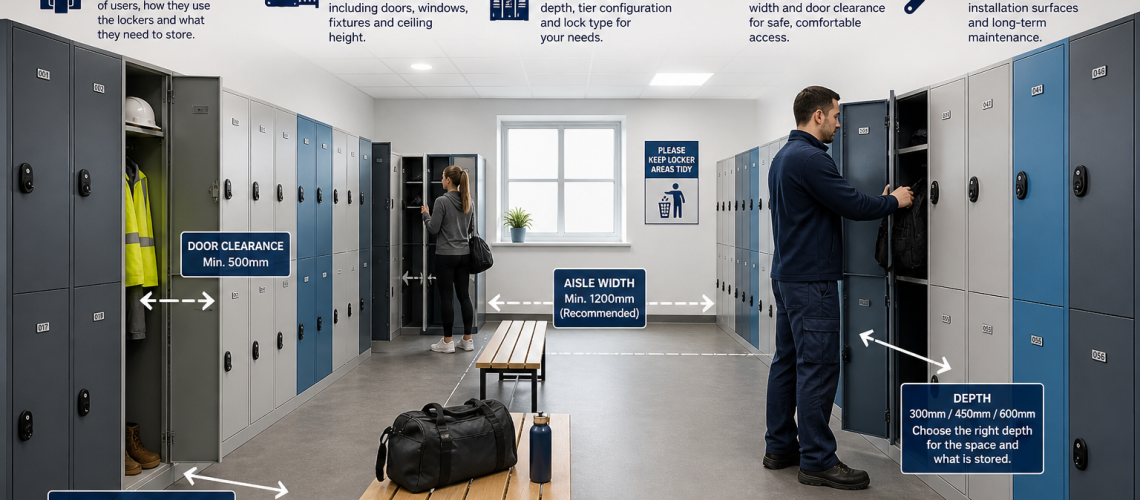
Locker planning is the process of deciding who will use the lockers, what they need to store, how much capacity is required and how the complete installation will work within the available space. A good locker plan considers dimensions, compartment configuration, aisle space, door opening, benches, traffic flow, accessibility, supervision, locking, delivery, installation and future management before products are ordered.
This is the main Total Locker Service planning guide for UK locker projects in schools, workplaces, factories, warehouses, healthcare facilities, gyms, leisure centres and commercial changing areas.
Use this page for the complete planning process, then follow the specialist guides where you need detailed information about room layout, capacity, locker dimensions, aisle width, door clearance, bench spacing, accessibility or installation.
Quick answer: start with the users and what they need to store. Decide whether lockers are assigned or shared, establish peak demand, choose a suitable locker size and configuration, then measure the complete usable space. After that, check locker depth, aisles, open-door clearance, benches, access routes, accessibility, lock choice, delivery and installation conditions.
Plan for the busiest realistic period, not simply how the lockers look in an empty room.
Ready to compare products? View our commercial locker range. For the physical arrangement of lockers, benches and circulation routes, use the locker room layout planning guide.
Locker Planning: What Should Be Checked?
| Planning area | What to check | Why it matters |
|---|---|---|
| User requirement | Who uses the lockers, what they store and when they need access | Determines capacity, configuration and operating method |
| Locker size | Height, width, depth and compartment count | Controls usable storage and the space occupied by the installation |
| Capacity | Peak simultaneous demand rather than total headcount alone | Prevents unnecessary lockers or insufficient provision |
| Door clearance | Open-door projection and user working space | Reduces clashes and blocked routes |
| Aisle space | Standing, passing and simultaneous use | Supports practical daily movement |
| Bench spacing | Seated users, standing users and locker access | Prevents changing activity consuming the main circulation route |
| Access routes | Entrances, exits, corridors and movement paths | Reduces congestion and local pinch points |
| Accessibility | Approach, reach, door operation, locks and manoeuvring space | Supports a wider range of users |
| Supervision | Visibility of locker areas and circulation routes | Particularly important in schools and high-use facilities |
| Zoning | Wet/dry, clean/dirty, PPE, staff and visitor areas | Separates activities that should not compete for the same space |
| Installation | Delivery access, floors, walls, services and fixing | Prevents avoidable problems when lockers arrive |
| Management | Numbering, keys, overrides, repairs and spare capacity | Keeps the locker system manageable after installation |
Locker Planning Roadmap
This page is the main planning hub. Use the specialist guides below when you reach a decision requiring more detailed measurements or calculations.
| Planning question | Detailed guide |
|---|---|
| How should the complete locker project be planned? | This Locker Planning UK guide |
| How should lockers and benches be physically arranged? | Locker Room Layout Planning Guide UK |
| How large should the overall room be? | Locker Room Size and Space Planning Guide |
| What size lockers should be used? | Locker Sizes UK |
| How many lockers are required? | Locker Capacity Planning Guide |
| What is a quick minimum-space estimate? | Minimum Space for Lockers UK |
| How wide should locker aisles be? | Locker Aisle Width Guide UK |
| How much space is required for open doors? | Locker Door Clearance Guide UK |
| How should benches be positioned? | Bench Spacing and Clearance Guide UK |
| How should activities or user groups be separated? | Locker Room Zoning Guide UK |
| How should busy locker areas be planned? | Locker Room Traffic Flow and Congestion Planning |
| How should accessible locker provision be planned? | Accessible Locker Planning UK |
| What should be checked before installation? | Locker Installation Planning UK |
What Is Locker Planning?
Locker planning means designing the complete storage arrangement before purchase and installation. It is different from simply selecting a locker product.
A product decision answers questions such as material, colour, size and lock type. A planning decision asks whether that locker will actually work for the users, room and operating conditions.
- Who will use the lockers?
- What will they store?
- How frequently will they use them?
- Are lockers permanently assigned or shared?
- How many people require storage simultaneously?
- What happens during peak periods?
- How much usable space is actually available?
- How will people move through the area?
- Are benches or changing facilities required?
- Does the area require supervision?
- What locking system is appropriate?
- How will the lockers reach the installation area?
- How will the system be maintained afterwards?
Step 1: Start With the Users
The people using the lockers should determine the storage system. Avoid choosing a locker first and then trying to make the users fit the product.
- Permanent staff
- Shift workers
- Pupils and students
- Visitors
- Contractors
- Gym and leisure users
- Healthcare staff
- Sports teams
Different groups create different requirements for storage volume, security, access, supervision and peak-time traffic.
For workplace-specific planning, see our workplace lockers guide. For education sites, see the school locker systems guide.
Step 2: Decide Whether Lockers Are Assigned or Shared
This decision affects locker quantity, lock type, numbering and ongoing management.
Assigned Lockers
An assigned locker remains allocated to one person for an extended period. This is common for permanent employees, pupils and users who need to leave permitted belongings between visits.
- Simple allocation and ownership.
- Suitable where belongings remain stored between uses.
- Keyed or individually controlled locks can work well.
- More compartments may be required because each locker remains reserved.
Shared or Temporary-Use Lockers
Shared lockers are released when one user finishes with them. This can suit gyms, leisure facilities, visitors and some flexible workplaces.
- Can reduce permanently reserved capacity.
- Requires a lock suited to changing users.
- Needs a clear abandoned-item procedure.
- May require reset or override management.
- Requires a clear rule for when a locker becomes available again.
Step 3: Define What Users Need to Store
The contents determine the locker dimensions and internal configuration. A large number of doors is not useful if the individual compartments are too small for the belongings users actually bring.
- Coats and uniforms
- Handbags and backpacks
- Books and school equipment
- Sports kit
- Boots and footwear
- PPE and workwear
- Helmets
- Laptops and electronic devices
- Small personal belongings
- Tools and equipment
Where possible, measure representative bags, boots, helmets, devices or equipment rather than estimating. External locker dimensions alone do not tell you whether the actual contents will fit comfortably.
Use the locker sizes UK guide when comparing dimensions and compartment formats.
Specialist Storage Requirements
Not every storage requirement should be forced into a standard personal locker. Identify specialist items early so the correct storage product can form part of the original plan.
- For laptops, tablets, phones, cordless tools and rechargeable equipment, consider charging lockers.
- For controlled organisational key storage, compare our key cabinets.
- For documents, valuables and items requiring a different level of secure storage, compare our safes.
- For bulky PPE, workwear or equipment, choose the locker around the actual item dimensions rather than standard compartment counts.
Separating these requirements at the planning stage prevents general-purpose lockers being specified for equipment that needs charging, specialist dimensions or a different security approach.
Step 4: Choose the Locker Configuration
| Configuration | Typical storage | Planning effect |
|---|---|---|
| Single tier | Coats, uniforms, bags and larger belongings | Provides the largest individual storage compartment |
| Two tier | Bags, clothing and general staff storage | Balances compartment size with user capacity |
| Multi-tier | Smaller personal belongings | Increases user capacity within a similar floor footprint |
| Z locker | Hanging garments and workwear | Combines hanging storage with increased user density |
| Specialist locker | PPE, equipment, charging or operational storage | Specification follows the item or process |
Increasing the number of tiers increases the number of compartments, but each compartment becomes smaller. Do not increase theoretical capacity at the expense of practical storage.
Step 5: Calculate Locker Capacity From Peak Demand
Locker quantity should normally be based on the number of people who genuinely require storage at the same time rather than automatically matching total staff, pupil or membership numbers.
- How many users are normally on site?
- How many need lockers simultaneously?
- Do work shifts overlap?
- Do school groups arrive together?
- Can appropriate lockers be shared?
- Are visitors and contractors included?
- What spare capacity is sensible?
- What happens when a locker is temporarily unavailable for repair?
For detailed calculations, use our locker capacity planning guide.
Step 6: Plan for Peak Conditions
A locker arrangement that works when one person uses it can fail when many people arrive together. Test the proposed layout around the busiest realistic period.
- Several locker doors may be open simultaneously.
- Users may stand directly in front of compartments.
- Bags, workwear and sports equipment may temporarily occupy floor space.
- Benches may be fully occupied.
- Incoming and outgoing users may cross.
- Groups may stop and talk beside lockers.
- Queues may form around entrances or popular locker positions.
This is particularly important for school breaks, shift changes, gym peaks, sports teams and other concentrated-use environments.
Step 7: Measure the Complete Usable Space
Do not calculate locker capacity from wall length alone. Record everything that reduces the usable space or affects installation.
- Room length, width and height
- Doors and door swings
- Windows
- Radiators and heaters
- Columns
- Pipework and service ducts
- Electrical sockets and controls
- Steps and floor-level changes
- Benches and other furniture
- Washroom or shower routes
- Entrances and exits
- Cleaning and maintenance access
For an early space calculation, see Minimum Space for Lockers UK.
Step 8: Check Locker Depth and Working Projection
Deeper lockers provide more storage but project further into the room. Assess the complete working space rather than cabinet depth alone.
- Closed locker body
- Open locker door
- User standing at the compartment
- Bags or equipment being handled
- Nearby benches
- Opposing locker banks
A locker can physically fit against a wall while leaving insufficient space for people to use it properly. Dimensions and circulation therefore need to be assessed together.
Step 9: Plan Locker Aisles and Working Space
Aisle space should allow people to stand at lockers while other users move through the room. The appropriate clearance depends on locker arrangement, door swing, user numbers, benches, accessibility and the activity taking place.
Do not treat the aisle simply as empty floor between two cabinet rows. During use it may contain standing users, open doors, bags and people passing in both directions.
Use the locker aisle width guide UK for detailed spacing guidance.
Step 10: Check Locker Door Clearance
Aisle width and door clearance are related but are not the same measurement. Door clearance is the space needed for the locker door to open and for a person to access the compartment.
- Check the actual locker door width.
- Allow for several doors being open simultaneously.
- Check doors close to walls and corners.
- Check interaction with benches.
- Check opposing locker rows.
- Allow users to stand, bend or crouch where necessary.
See the locker door clearance guide UK for this stage.
Step 11: Plan Benches at the Same Time as Lockers
Bench seating should form part of the original room layout rather than being added after all locker positions have been fixed.
An occupied bench requires considerably more usable space than its physical seat depth because users need legroom, space to stand up, room to change footwear and somewhere to handle clothing or bags.
- Keep benches out of important movement routes where practical.
- Check interaction with locker doors.
- Allow room around bench ends.
- Include seated and standing users in the calculation.
- Allow for bags, footwear and clothing.
- Maintain practical cleaning access.
See our bench spacing and clearance guide or browse changing room bench seating.
Step 12: Plan Zones, Not Just Locker Rows
Larger or more complex facilities can work better when activities and user groups are separated into logical zones.
| Zone | Typical purpose |
|---|---|
| Entrance zone | Arrival and orientation |
| Locker zone | Personal storage and locker access |
| Changing zone | Benches, clothing and footwear changes |
| Circulation zone | Movement through the room |
| Wet zone | Showers, swimming or damp activity |
| Dry zone | Personal belongings and clean clothing |
| Clean/dirty zone | Workwear, uniforms or PPE separation |
| Staff/visitor zone | Separating groups with different access requirements |
For more detailed separation and flow planning, use the locker room zoning guide UK.
Step 13: Consider Supervision and Visibility
Visibility is particularly important in schools and other high-use facilities where locker position can affect supervision and concentrated movement.
- Avoid concentrating too many lockers at narrow corridor points.
- Keep classroom and other important entrances reasonably clear.
- Group lockers logically where this reduces unnecessary movement.
- Plan for bags and open doors during busy periods.
- Avoid unnecessarily hidden locker areas where supervision is important.
- Use clear locker numbering and allocation records.
- Check how the space behaves at the busiest points of the day.
The aim is to make locker access easy to understand without creating unnecessary local congestion.
Step 14: Include Accessibility From the Beginning
Accessible locker provision should be integrated into the original layout rather than added after the remaining positions have already been allocated.
- Clear approach routes
- Usable locker positions
- Practical door operation
- Appropriate lock controls
- Movement and manoeuvring space
- Clear numbering and visual identification
- Interaction with nearby bench seating
Accessibility requirements depend on the building, users and project. Use the accessible locker planning UK guide for the detailed planning stage.
Step 15: Choose the Locker Locking System Before Ordering
The lock should match the way the locker system operates. It should not be treated as an accessory selected after the rest of the project has been decided.
| Lock type | Can suit | Main management consideration |
|---|---|---|
| Key lock | Assigned staff, pupil or member lockers | Replacement keys, spare keys and master-key control |
| Hasp and padlock fitting | Sites where users control their own padlock | Procedure for lost or abandoned padlocks |
| Coin lock | Leisure and shared-use applications | Coin operation, override and maintenance |
| Mechanical combination | Assigned or shared storage without user keys | Forgotten codes and reset procedures |
| Electronic or RFID | Managed shared-use or controlled-access applications | Credentials, overrides, batteries or power and administration |
Compare replacement and upgrade options through our locker locks range.
Step 16: Plan Delivery and Installation Before Ordering
A locker that fits perfectly in the finished room still needs to reach that room and be installed correctly.
- Vehicle and unloading access
- Building entrances
- Door and corridor dimensions
- Stairways and landings
- Lift dimensions
- Tight corners
- Assembly and working space
- Floor condition and level
- Wall condition
- Skirting and projections
- Hidden and visible services
- Linking, restraint and fixing requirements
For the detailed site-preparation stage, see our locker installation planning UK guide.
Step 17: Consider Phased Installation
Schools, workplaces, factories, healthcare sites and leisure facilities may need to remain operational while old lockers are removed and new lockers are installed.
- Install one room, zone or locker bank at a time where practical.
- Plan temporary storage if users still require access during the work.
- Coordinate removal of existing lockers with the new delivery.
- Keep installation materials away from normal users.
- Transfer locker numbers and allocations in a controlled sequence.
- Use lower-occupancy periods where practical.
Step 18: Plan Numbering, Keys and Ongoing Management
The locker project continues after installation. Numbering, key control, maintenance and spare capacity should therefore be planned before the system goes into use.
- Number lockers clearly.
- Keep an allocation record where appropriate.
- Control spare and master keys.
- Establish procedures for lost keys and forgotten codes.
- Keep suitable replacement parts available where practical.
- Record lockers temporarily unavailable for repair.
- Allow spare capacity for future users.
- Plan routine cleaning and inspection.
Replacement keys for many common locker locks are available through our replacement locker key service.
Locker Planning Priorities by Environment
| Environment | Main planning risk | Planning priority |
|---|---|---|
| Schools | Corridor congestion and supervision | Logical grouping, visibility, clear routes and peak-time movement |
| Workplaces | Staff changeovers and different storage requirements | Practical locker size, allocation and accessible routes |
| Factories and warehouses | PPE, bulky belongings and shift patterns | Suitable storage volume, working space and clean/dirty separation where required |
| Gyms and leisure centres | High turnover and changing-room pressure | Bench clearance, suitable locks, moisture conditions and traffic flow |
| Healthcare | Staff changing and operational workflow | Logical zoning, suitable access and manageable storage systems |
| Offices | Hybrid attendance and variable occupancy | Flexible allocation without unnecessary permanently reserved capacity |
Locker Planning for Workplaces
Workplace lockers may need to accommodate coats, bags, uniforms, PPE, safety footwear, helmets, tools or electronic equipment. The correct specification depends heavily on the type of workplace.
An office may prioritise compact personal storage and flexible allocation. A factory or warehouse may require larger compartments, PPE storage, footwear space and a room that can handle concentrated shift changes.
Use our Workplace Lockers UK guide for the wider workplace specification process.
Locker Planning for Schools
School locker planning needs to consider more than pupil numbers. Locker location affects corridor movement, supervision, classroom entrances, break-time congestion and the amount of equipment pupils carry.
Different year groups may also require different locker positions or compartment sizes. PE and changing-room storage can require a different solution from corridor storage for books, bags and coats.
See our School Locker Systems UK guide for school-specific planning and management.
Locker Planning for Changing Rooms
Changing rooms introduce additional pressures because locker access, clothing changes, footwear, benches and circulation all happen within the same area.
Plan the complete journey through the room rather than treating lockers and benches as unrelated pieces of equipment. Entrance zones, locker areas, changing space, wet areas and exits should connect logically without forcing several activities into the same narrow route.
For the broader design process, use our locker room design UK guide.
Allow for Future Capacity and Change
Locker requirements change as staffing, pupil numbers, membership, shift patterns and working practices change. A layout that uses every available centimetre on day one can leave no practical way to adapt later.
- Allow sensible spare capacity where possible.
- Consider whether another locker nest could be added later.
- Avoid filling every available wall simply because it is currently empty.
- Keep access to services and maintenance points.
- Choose locker systems that can be repaired and maintained.
- Consider future lock replacement and management requirements.
Common Locker Planning Mistakes
- Choosing lockers before defining the users and storage requirement.
- Measuring available wall length but not the complete room.
- Calculating capacity from total headcount rather than actual simultaneous demand.
- Choosing locker depth without considering circulation space.
- Using too many tiers and creating compartments that are too small.
- Ignoring open locker doors.
- Creating narrow or dead-end aisles in busy areas.
- Adding benches after locker positions have been fixed.
- Positioning too many school lockers at one corridor pinch point.
- Ignoring supervision and visibility.
- Planning for quiet conditions instead of peak use.
- Leaving accessibility until the end of the design process.
- Choosing the lock without deciding how the lockers will operate.
- Ignoring delivery routes, floors, walls and services.
- Using standard lockers where specialist storage is actually required.
- Failing to plan numbering, keys and ongoing management.
- Leaving no spare capacity for growth or temporary repairs.
Complete Locker Planning Checklist
- Confirm who will use the lockers.
- List what each user group needs to store.
- Measure representative bags, garments, footwear and equipment.
- Identify any charging, PPE, key-storage or specialist-security requirement.
- Decide whether lockers are assigned, shared or temporary use.
- Establish peak simultaneous demand.
- Allow appropriate spare capacity.
- Choose suitable locker dimensions.
- Select the correct compartment configuration.
- Measure the complete usable area.
- Record doors, windows, radiators, columns and services.
- Check locker depth and working projection.
- Check aisle and standing space.
- Check locker door clearance separately.
- Include benches from the beginning.
- Plan circulation and functional zones.
- Check supervision and visibility where relevant.
- Include accessible locker positions and routes.
- Choose the locking system around the operating method.
- Check entrances, exits and important movement routes.
- Check delivery and installation access.
- Confirm floor and wall conditions.
- Plan phased work where necessary.
- Plan numbering and allocation.
- Plan spare and master-key control.
- Plan cleaning, maintenance and repairs.
- Review future capacity.
- Test the complete plan during realistic peak use.
Detailed Locker Planning Guides
- Locker Room Layout Planning Guide UK
- Locker Room Size and Space Planning
- Locker Sizes UK
- Locker Capacity Planning Guide
- Minimum Space for Lockers UK
- Locker Aisle Width Guide UK
- Locker Door Clearance Guide UK
- Bench Spacing and Clearance Guide UK
- Locker Room Zoning Guide UK
- Locker Room Traffic Flow and Congestion Planning
- Accessible Locker Planning UK
- Locker Installation Planning UK
Plan the Complete Locker System Before Ordering
The strongest locker projects treat the lockers, room, users, locking system and installation as one connected system. Product choice matters, but it should follow a clear understanding of user demand, stored items, available space and how the facility will operate during everyday and peak use.
Once the planning requirements are established, compare our commercial locker ranges for schools, workplaces, healthcare, leisure and changing facilities.
For help with a locker project, call Total Locker Service on 01284 749211 or email sales@totallocker.co.uk.
Locker Planning FAQs
What should locker planning include?
Locker planning should include the users, stored items, locker dimensions, compartment configuration, capacity, room dimensions, aisle space, door clearance, benches, accessibility, supervision, zoning, locking, delivery, installation and ongoing management.
Should locker layouts be planned for peak use?
Yes. A locker area should be checked for its busiest realistic period, when several locker doors may be open, benches occupied and many users may need access at the same time.
How many lockers do I need?
Base the quantity on the number of people who require storage at the same time, whether lockers are assigned or shared and the amount of spare capacity required. Total headcount alone does not always represent the actual locker requirement.
Are more locker tiers always better?
No. More tiers increase the number of compartments within a similar footprint, but each compartment becomes smaller. The configuration should be selected around the belongings users actually need to store.
How much space should be allowed in front of lockers?
The required space depends on locker depth, door opening, user numbers, whether people need to pass behind users, bench positions and accessibility requirements. Aisle and door-clearance requirements should be checked for the individual room rather than using one dimension for every installation.
Should locker locks be chosen before ordering?
Yes. Lock choice should follow the intended operating method, including whether lockers are assigned or shared and how keys, codes, credentials and authorised override access will be managed.
Do locker layouts need to consider accessibility?
Yes. Accessible provision should be considered from the beginning, including approach routes, usable locker positions, door and lock operation, movement space and clear identification.
What should be checked before locker installation?
Check delivery routes, entrances, corridors, stairs, lifts, room dimensions, floor condition, walls, services, working space and the proposed method of linking, restraint or fixing before the lockers arrive.
Should spare locker capacity be planned?
Often yes. Sensible spare capacity can accommodate new users, visitors, future growth and lockers temporarily unavailable because of maintenance or repair.
When should specialist storage be used instead of standard lockers?
Specialist storage should be considered when the items require charging, unusual compartment dimensions, controlled key management, drying, specialist PPE storage or a different level of security from normal personal belongings.
Discover more from Blog Total Locker Service
Subscribe to get the latest posts sent to your email.