Workplace Locker Operations UK: Staff Storage, Access Control and Daily Management
May 12, 2026
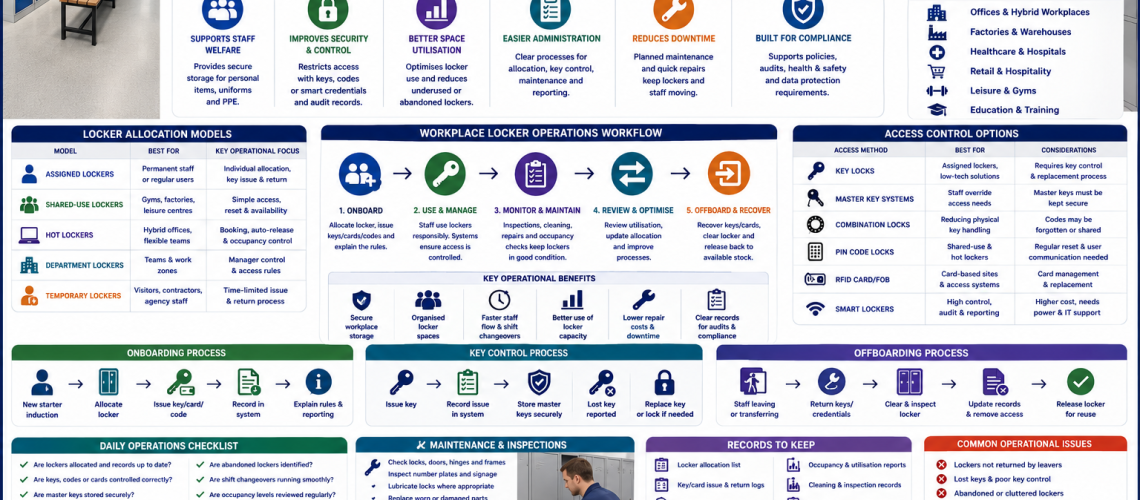
Workplace locker operations cover the daily systems used to assign lockers, control access, manage keys, support staff welfare, maintain locker areas and keep workplace storage organised, secure and reliable.
This guide explains how UK offices, factories, warehouses, healthcare sites, retail teams, leisure facilities and industrial workplaces can manage staff lockers as an operational system rather than a simple storage product.
Quick answer: what are workplace locker operations?
Workplace locker operations are the practical processes used to run staff locker areas every day. They include locker allocation, onboarding, offboarding, access control, key issue, shared-use management, cleaning, maintenance, audits, occupancy reviews and replacement planning.
What workplace locker operations include
| Operational area | What it includes | Why it matters |
|---|---|---|
| Locker allocation | Assigned lockers, shared lockers, hot lockers and department lockers | Keeps ownership and availability clear |
| Access control | Keys, master keys, PIN, RFID, smart credentials and admin rights | Controls who can open lockers |
| Staff onboarding | Issuing lockers, keys, codes or credentials to new starters | Makes storage part of the staff process |
| Staff offboarding | Returning keys, clearing lockers and removing access | Prevents abandoned lockers and uncontrolled access |
| Occupancy management | Vacant lockers, underused lockers and peak demand | Improves space use and planning |
| Cleaning and maintenance | Inspections, repairs, lock checks, doors, hinges and number plates | Keeps lockers safe and usable |
| Audit records | Assignment records, key logs, repairs and access reviews | Supports accountability |
Why workplace locker operations matter
Staff lockers affect welfare, security, shift changeovers, hygiene, personal storage and daily movement. Poor locker operations can create lost key problems, abandoned lockers, broken locks, overcrowded changing areas and unclear responsibility.
- Improves staff storage and workplace organisation.
- Reduces lost keys and unmanaged access.
- Supports staff onboarding and leaver processes.
- Improves locker availability and space use.
- Helps facilities teams plan maintenance.
- Supports PPE, uniform and personal item storage.
- Creates clearer records for audits and internal reviews.
1. Staff locker allocation
Locker allocation decides who uses each locker and for how long. The right model depends on staff numbers, shift patterns, hybrid working, storage needs and available space.
| Allocation model | Best for | Operational requirement |
|---|---|---|
| Assigned lockers | Permanent staff and regular users | Named records and key issue control |
| Shared-use lockers | Gyms, factories, warehouses and changing rooms | Reset process and clear usage rules |
| Hot lockers | Hybrid offices and flexible workplaces | Booking, release and occupancy monitoring |
| Department lockers | Teams, work zones and operational areas | Supervisor responsibility and access rules |
| Temporary lockers | Contractors, visitors and agency staff | Time-limited issue and return checks |
For wider system planning, use the locker management systems UK and locker occupancy management systems UK guides.
2. Workplace locker access control
Access control defines how staff open lockers and how managers handle override access. The best access method depends on staff turnover, risk level, maintenance workload and whether lockers are assigned or shared.
- Keyed locks: simple option for assigned staff lockers.
- Master keys: controlled override access for authorised staff.
- Combination locks: useful where key handling should be reduced.
- PIN locks: useful for shared-use or flexible locker areas.
- RFID locks: suitable where staff cards or fobs are already used.
- Smart lockers: useful for audit trails, occupancy and remote administration.
For access strategy, see locker access control systems UK and locker access governance UK.
3. Key control and replacement procedures
Key control is a core workplace locker operation. A clear process helps avoid uncontrolled spare keys, repeated key loss, poor master key security and slow access recovery.
- Record issued keys against staff names or locker numbers.
- Store master keys securely.
- Define who can approve replacement keys.
- Use a clear lost key process.
- Change locks where key control is compromised.
- Review repeated losses by department or site.
- Update records when staff move roles or leave.
Useful supporting guides include locker key management systems UK, locker keys UK and replacement locker keys cut to code UK.
4. Staff onboarding and locker issue
Locker issue should be part of the new starter process where staff need personal storage, uniform storage, PPE storage or changing room access.
- Assign a locker before or during induction.
- Record the locker number and access method.
- Issue keys, codes, cards or credentials clearly.
- Explain locker use rules.
- Record any key deposit or return requirement.
- Show staff where to report faults or lost keys.
5. Offboarding, leavers and locker recovery
Leaver procedures are essential for workplace locker control. If lockers are not recovered properly, organisations can lose capacity and retain uncontrolled access.
- Recover keys, fobs or access credentials.
- Clear the locker after the agreed process.
- Update the locker assignment record.
- Remove digital permissions.
- Check the locker condition.
- Release the locker back into available stock.
- Change the lock where security is uncertain.
6. Shift work and high-turnover locker operations
Factories, warehouses, healthcare sites and leisure centres often have peak locker demand during shift changeovers. These sites need strong routines for access, cleaning, inspection and availability.
- Plan locker banks around shift flow.
- Keep PPE lockers close to work zones where practical.
- Allow enough aisle space for busy changeovers.
- Use durable locks and fittings.
- Separate clean and dirty storage where needed.
- Review locker damage by area and shift pattern.
For layout support, use the workplace locker layout guide UK and locker planning standards UK guides.
7. Hybrid office and hot locker operations
Hybrid offices often need fewer assigned lockers and more flexible storage. Hot lockers, shared-use lockers and smart locker systems can support flexible working, but only when allocation and release rules are clear.
- Set rules for daily or short-term locker use.
- Prevent long-term occupation of shared lockers.
- Use clear reset or release procedures.
- Monitor occupancy where demand changes often.
- Use smart access where audit trails are needed.
- Review locker numbers before adding more storage.
For digital and flexible systems, see smart locker systems UK.
8. Cleaning, inspections and daily checks
Locker operations should include routine cleaning and condition checks. This is especially important in changing rooms, healthcare settings, wet areas, gyms and industrial workplaces.
- Check damaged doors, locks and hinges.
- Look for missing number plates.
- Remove abandoned items through an agreed process.
- Clean external surfaces and shared touch points.
- Inspect wet-area lockers for corrosion or moisture damage.
- Keep aisles clear of bags and obstructions.
- Record repairs and recurring issues.
9. Maintenance and lifecycle planning
Locker maintenance should be planned, not left until lockers fail. Regular maintenance improves reliability and reduces emergency repairs.
- Keep replacement keys and common locks available.
- Replace damaged cams, barrels and number plates.
- Review lock compatibility before upgrades.
- Replace unreliable lock types in phases.
- Repair hinges and doors before they become unsafe.
- Plan replacement for ageing locker banks.
- Review whether locker numbers still match staff demand.
For technical support, see locker lock maintenance guide UK, replacement locker locks UK and locker lock compatibility guide UK.
10. Audit records and operational reporting
Records help facilities teams manage lockers across time. They also help identify problems, plan maintenance and reduce repeated access issues.
- Locker assignment records.
- Key issue and return logs.
- Lost key reports.
- Replacement key and lock records.
- Master key holder records.
- Maintenance logs.
- Occupancy reports.
- Leaver clearance records.
- Cleaning and inspection records.
Workplace locker operations by environment
| Workplace type | Main locker challenge | Best operational focus |
|---|---|---|
| Offices | Hybrid working and flexible storage | Hot lockers, smart access and occupancy reviews |
| Factories | Shift changeovers, PPE and heavy use | Durable lockers, supervisor access and planned maintenance |
| Warehouses | Staff turnover, PPE and security | Clear allocation, key control and shift-based planning |
| Healthcare sites | Staff changing, hygiene and restricted areas | Controlled access, clean storage and audit records |
| Retail teams | Shared staff rooms and changing users | Assigned lockers, leaver checks and compact storage |
| Leisure centres | High turnover and wet changing areas | Shared-use locks, cleaning and moisture-resistant planning |
Workplace locker operations checklist
- Are staff lockers assigned, shared or managed as hot lockers?
- Is there a clear locker allocation record?
- Are keys, codes, fobs or credentials recorded?
- Are master keys controlled securely?
- Are lockers included in staff onboarding?
- Are lockers recovered during offboarding?
- Are abandoned lockers checked and released?
- Are broken locks and doors logged?
- Are locker areas cleaned and inspected regularly?
- Are occupancy levels reviewed before buying more lockers?
Best workplace locker system by need
| Need | Recommended locker operation | Why |
|---|---|---|
| Permanent staff storage | Assigned lockers with key issue records | Simple and accountable |
| High staff turnover | Managed allocation with leaver checks | Prevents abandoned lockers |
| Hybrid office use | Hot lockers or smart locker system | Supports flexible working |
| PPE and uniform storage | Durable lockers near work zones | Supports daily routines |
| Shared changing rooms | Shared-use locks with clear reset procedures | Supports high turnover |
| Multi-site workplace | Standardised records and access policy | Improves consistency across locations |
Common workplace locker operation problems
- Lockers assigned informally with no central record.
- Keys issued but not recovered when staff leave.
- Master keys stored without control.
- Too many lockers marked as occupied but not actively used.
- Repairs reported verbally but not tracked.
- Shared-use lockers becoming permanent personal storage.
- Cleaning teams unable to access or inspect problem areas.
- Locker numbers not matching records.
- Buying more lockers before checking abandoned use.
Related workplace locker guides
Use these guides to build a complete workplace locker operation:
- Locker Management Systems UK
- Locker Access Control Systems UK
- Locker Access Governance UK
- Locker Key Management Systems UK
- Locker Occupancy Management Systems UK
- Smart Locker Systems UK
- Locker Planning Standards UK
- Workplace Locker Layout Guide UK
- Locker Lock Compatibility Guide UK
- Workplace Lockers
- Work Lockers
Final advice
Strong workplace locker operations make staff storage easier to run every day. The best systems define who uses each locker, how access is controlled, how keys or credentials are managed, how lockers are recovered, and how maintenance is planned.
For smaller workplaces, a clear locker list and key issue record may be enough. Larger sites may need smart lockers, occupancy reporting, digital credentials, standardised access procedures and planned lifecycle reviews. In every case, the aim is simple: secure, available and well-managed staff storage.
Discover more from Blog Total Locker Service
Subscribe to get the latest posts sent to your email.