Locker Depth and Projection Guide UK: Planning Safe, Practical Locker Room Layouts
April 29, 2026
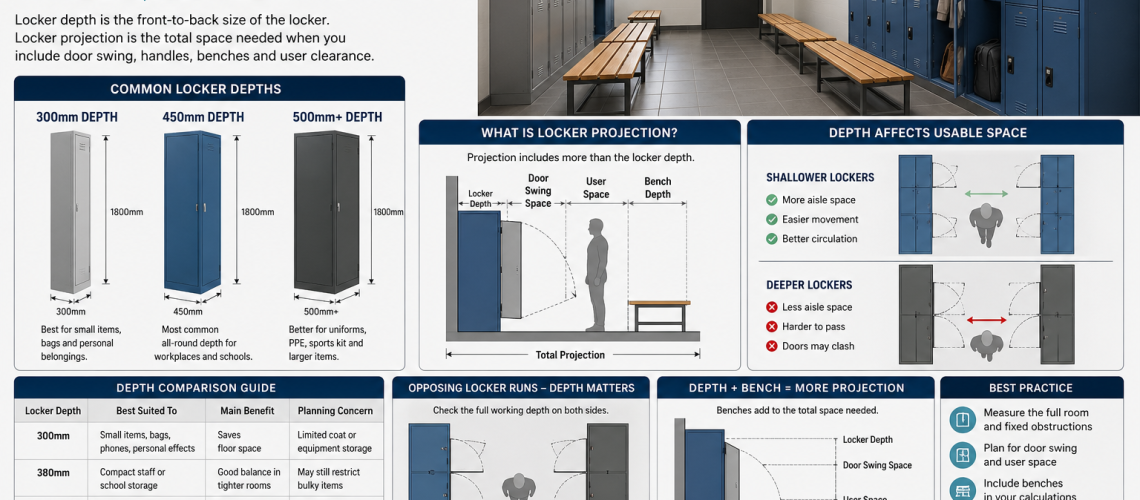
Locker depth is the front-to-back size of a locker. Locker projection is the total space the locker occupies once door swing, handles, locks, plinths, benches and user clearance are considered. Planning both measurements helps create safer, easier and more practical locker rooms.
This guide explains how locker depth affects layout, walkway space, door clearance, bench positioning and room capacity. It also shows how to avoid common projection problems before lockers are installed.
What locker depth should you choose?
Choose 300 mm lockers for small personal items and tight spaces. Choose 450 mm lockers for most general workplace, school and staff storage. Choose 600 mm lockers for coats, uniforms, PPE, sports bags and changing rooms.
The right locker depth depends on what users store and how much clear space remains in front of the locker. A deeper locker gives more storage, but it also reduces walkway space and increases the working projection of the locker area.
This depth guide supports the wider locker planning guide. If you are still comparing locker types and environments, start with the lockers UK guide before choosing a depth.
Locker depth comparison
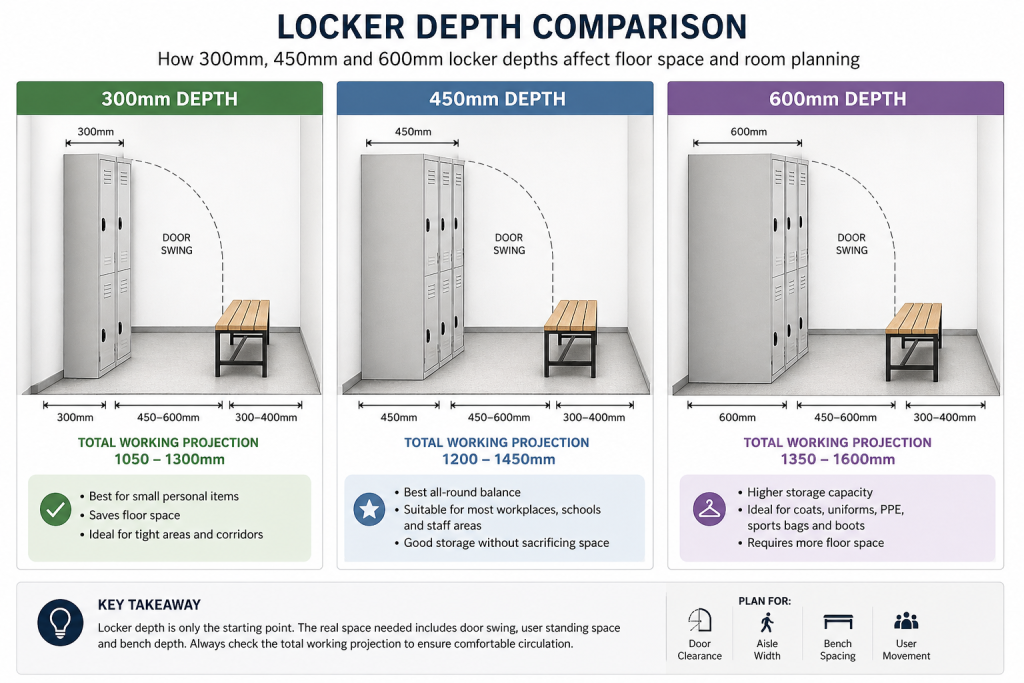
Most locker depth decisions can be planned around three practical options: 300 mm, 450 mm and 600 mm. Other depths may be available, but these three sizes cover most UK workplace, school, leisure and changing room layouts.
| Locker depth | Best suited to | Main benefit | Planning concern |
|---|---|---|---|
| 300 mm | Small personal items, phones, wallets, keys and light bags | Saves floor space and reduces projection | Limited storage for coats, PPE and bulky items |
| 450 mm | General workplace, school, office and staff storage | Best all-round balance of storage and space use | Still needs clear aisle and door planning |
| 600 mm | Coats, uniforms, PPE, sports bags, boots and changing room storage | Higher usable storage capacity | Can quickly reduce walkway and bench clearance |
Visual comparison of 300 mm, 450 mm and 600 mm lockers
Once depth is chosen, check the locker aisle width guide and locker door clearance guide so the selected lockers still leave enough usable space.
The image below shows how different locker depths affect floor space and room planning. Use it as a quick visual reference before comparing aisle width, door clearance and bench spacing.
This page supports the wider locker room spacing guide. For door opening space, read the locker door clearance guide. For aisle planning, see the locker aisle width guide.
What locker depth means
Locker depth is the measurement from the front of the locker to the back. It affects storage capacity and how far the locker bank projects into the room.
A deeper locker usually gives more internal storage space. However, it also reduces usable floor area. In small changing rooms, corridors, staff areas and school cloakrooms, this can make the difference between a comfortable layout and a cramped one.
How to calculate locker projection
Locker projection is calculated by adding the locker depth, door opening allowance, user standing space and any bench depth used in front of the locker.
Simple projection formula:
Total working projection = locker depth + door swing allowance + user standing space + bench depth
For example, a 450 mm deep locker may need far more than 450 mm of usable space. Once the door opens and a user stands in front of it, the working zone can increase significantly.
| Example allowance | Typical space |
|---|---|
| Locker body depth | 450 mm |
| Door opening and access allowance | 450–600 mm |
| Bench depth if used | 300–400 mm |
| Approximate working zone | 1200–1450 mm |
This does not mean every layout needs the same allowance. It means the closed locker depth is only the starting point. The real planning measurement is the space needed while the locker area is being used.
What locker projection means
Locker projection is the real space taken up by the locker installation. It includes more than the cabinet depth.
- Locker body depth
- Doors when open
- Handles, hasps or protruding locks
- Sloping tops or stands
- Plinths or support frames
- Benches placed in front of lockers
- User standing and access space
This is why a 450 mm deep locker can need far more than 450 mm of practical room space. Once a person opens the door, stands in front of the locker and uses a bench, the working projection increases significantly.
How depth affects locker room layout
Depth has a direct effect on circulation. A deeper locker bank leaves less room for people to move, queue, change clothes or pass behind another user.
This is especially important in narrow rooms. Two rows of lockers facing each other can quickly reduce the central aisle if both sides use deep units.
Before choosing a locker depth, measure the whole room and deduct fixed obstructions such as doors, radiators, columns, pipework, windows, benches and emergency routes.
Single-row locker projection
A single row of lockers against a wall is usually the simplest layout. Even so, the locker depth should not be treated as the only measurement.
Allow for the locker body, door opening space and the standing room needed by the user. If a bench sits in front of the lockers, the bench depth and access space must also be included.
For narrow rooms, shallower lockers may preserve movement space. For changing rooms with coats, bags, PPE or sports kit, deeper lockers may be more useful, but only if the remaining aisle is comfortable.
Opposing locker runs
Opposing locker runs need more planning because two locker banks project into the same central space. If both sides have open doors at the same time, the usable aisle can become restricted.
Where lockers face each other, check the full working depth of both sides. Include door swing, users standing at each locker and any benches between or in front of the units.
In busy areas, avoid creating a layout where one open locker door blocks the route for everyone else.
Locker depth and bench placement
Benches increase the practical projection of a locker installation. A locker may only be 450 mm deep, but a bench in front of it can add several hundred millimetres to the occupied zone.
Bench placement should support changing, not block access. Users need space to sit, stand, open doors and move around other people.
- Place benches far enough from lockers for doors to open properly.
- Avoid benches that force users to stand in the main walkway.
- Check whether locker doors can open when people are seated.
- Keep routes to exits and facilities clear.
For detailed bench planning, read our bench spacing and clearance guide.
Door swing and projection
Door swing is one of the most common causes of projection problems. A locker may fit the wall perfectly when closed, but create an obstruction when several doors are open.
Single-door lockers usually need more opening space per compartment than multi-door lockers with smaller doors. Wide doors can clash with benches, neighbouring lockers, walls or users in the aisle.
When planning projection, check the door width as well as the cabinet depth. This gives a more accurate view of how the room will work in daily use.
Locks, handles and protrusions
Locks and handles can add small but important projection. This matters in tight corridors, narrow staff rooms and school cloakrooms where people pass close to the locker fronts.
Hasp locks, padlocks, handles and some digital locks may project further than simple cam locks. Although the difference may seem minor, it can affect comfort and reduce usable width in restricted spaces.
Where space is tight, choose lock options that suit the room as well as the security requirement.
Depth by locker type
Different locker types need different depths. A school locker used for bags and books may not need the same depth as a workplace locker used for coats, uniforms or PPE.
| Locker type | Depth planning note |
|---|---|
| Workplace lockers | Allow enough depth for coats, bags, uniforms and personal items. |
| School lockers | Balance storage capacity with corridor or cloakroom space. |
| Changing room lockers | Plan around benches, changing space and peak-time use. |
| Wet area lockers | Allow for circulation, cleaning access and damp environments. |
| Charging lockers | Check cable access, ventilation and door opening space. |
| Outdoor lockers | Allow for weather exposure, access routes and door clearance. |
Planning locker depth in small rooms
Small rooms need careful depth control. Choosing the deepest locker available can make the space difficult to use, especially if several people need access at once.
In compact rooms, consider shallower lockers, fewer compartments, single-sided runs or alternative positioning. A slightly smaller locker may perform better if users can access it safely and comfortably.
Do not fill every wall automatically. A layout with fewer lockers and better movement space is often more practical than a high-capacity layout that causes congestion.
Lockers in corridors and through-routes
Corridors need extra care because lockers must not reduce safe movement. Projection becomes more important where people are passing through rather than stopping to change.
Check the closed depth, open-door projection and the space needed by a user standing in front of the locker. Avoid placing deep lockers where they narrow an important route or create pinch points.
Where lockers are installed in corridors, shallow units or carefully positioned banks may be better than full-depth changing room lockers.
Locker capacity versus usability
More depth can improve storage capacity, but only if the room remains usable. A locker that stores more but blocks movement can create daily frustration and safety issues.
The best layout balances four factors:
- How many users need storage
- What each user needs to store
- How many people use the lockers at the same time
- How much circulation space the room provides
This balance is more important than simply maximising the number of compartments.
Common locker depth and projection mistakes
- Measuring the wall but not the working space in front of the lockers.
- Forgetting that open doors reduce usable aisle width.
- Adding benches after the locker layout has already been fixed.
- Choosing deep lockers for a narrow room without checking user movement.
- Ignoring handles, locks, stands, plinths and other projections.
- Placing lockers too close to inward-opening room doors.
- Creating narrow pinch points near corners, exits or washroom entrances.
How to measure before ordering lockers
Start with the full room dimensions. Then mark the available wall space and note anything that reduces usable depth or access.
- Measure the room width, length and ceiling height.
- Mark doors, windows, radiators, columns and pipework.
- Measure the proposed locker depth.
- Add expected door opening space.
- Add bench depth if benches are included.
- Check the remaining aisle or walkway width.
- Test the route from entrances to exits.
- Allow space for users to stand, turn and collect belongings.
This process helps identify whether the proposed locker depth is suitable before the room becomes overcrowded.
Locker depth specification checklist
Use this checklist before confirming a locker layout.
- Is the locker deep enough for the items being stored?
- Does the room still have enough usable walkway space?
- Can doors open without hitting benches, walls or other lockers?
- Will users block the main route when using the lockers?
- Do locks or handles project into a narrow walkway?
- Are benches included in the layout calculation?
- Can cleaners, staff and maintenance teams access the area?
- Does the layout work at peak times?
How to choose the right locker depth step by step
Use this process before ordering lockers or confirming a room layout.
- List what users need to store. Small items may only need 300 mm, while coats, bags, PPE and uniforms may need 450 mm or 600 mm.
- Check how many people use the lockers at peak times. A busy shift change or school break needs more movement space than occasional access.
- Measure the full room width. Include doors, radiators, pipework, columns, windows, benches and other fixed obstructions.
- Calculate the working projection. Add locker depth, door swing, user standing space and bench depth where relevant.
- Check the remaining aisle. Make sure users can pass, open doors and stand without blocking the route.
- Adjust the layout if needed. Use shallower lockers, fewer rows, different bench positions or split storage across more than one area.
This step-by-step method prevents the most common problem: choosing a locker that stores enough but leaves too little space for people to use the room properly.
Best practice for locker depth planning
Choose locker depth by use, not by habit. A school corridor, office changing room, leisure centre, warehouse and wet area may all need different solutions.
For most projects, the best result comes from checking the storage need first, then testing the layout against real movement space. This prevents the locker bank from dominating the room.
Where space is limited, reduce depth, adjust the layout or split lockers across more than one area. Do not rely on wall length alone.
Continue planning your locker layout
Locker depth is only one part of a complete locker room layout. Once you understand the depth and projection, continue through the related planning guides below.
- Locker Room Spacing Guide UK — plan the overall room space, circulation zones and practical clearances.
- Locker Aisle Width Guide UK — check how much walkway space is needed in front of locker runs.
- Locker Door Clearance Guide UK — avoid door clashes, blocked access and awkward opening space.
- Bench Spacing and Clearance Guide UK — plan bench positions without blocking lockers or walkways.
- Minimum Space for Lockers UK — calculate the basic space needed before choosing a layout.
If you already know the type of locker required, view our full range of lockers or compare dedicated workplace lockers.
Summary
Locker depth affects storage capacity, room layout and user comfort. Locker projection shows the real space the installation needs once doors, locks, benches and access space are included.
A good locker layout should leave enough space for people to open doors, stand, sit, pass and use the room safely. Before choosing a locker depth, check the full working projection and make sure the layout performs during normal daily use.
Locker depth and layout planning guides
- What depth locker do I need?
- Minimum space for lockers
- Locker aisle width guide
- Locker door clearance guide
- Bench spacing and clearance guide
- Small locker room design
- Locker layout mistakes to avoid
- Changing room layout guide
- Workplace locker layout guide
Frequently asked questions
What depth locker do I need for coats and bags?
For coats, bags and everyday staff storage, 450 mm is usually a good starting point. If users need to store bulky coats, uniforms, PPE or sports bags, 600 mm may be more suitable.
Are 300 mm lockers deep enough?
300 mm lockers are suitable for small personal items, phones, wallets, keys and light bags. They are usually too shallow for coats, boots, helmets, PPE or large work bags.
How much space does a 450 mm locker need?
A 450 mm locker needs more than 450 mm of practical space because users also need room to open the door, stand in front of the locker and move around the area.
What is locker projection?
Locker projection is the total working space taken up by the locker installation. It includes the locker body, open doors, locks, handles, benches and user access space.
Do deeper lockers reduce aisle width?
Yes. Deeper lockers project further into the room and reduce the remaining aisle width. This is especially important when lockers face each other or benches are placed nearby.
What depth locker is best for changing rooms?
Changing rooms often need 450 mm or 600 mm lockers. Choose 450 mm for general bags and clothing, and 600 mm for coats, uniforms, sports kit, PPE or bulkier storage.
Should I choose locker depth before planning benches?
No. Locker depth and bench placement should be planned together. Benches add to the occupied zone and can block door opening or movement if they are placed too close to lockers.
Discover more from Blog Total Locker Service
Subscribe to get the latest posts sent to your email.