Locker Lock Selection Tool UK: Choose the Right Locker Lock for Your Site
May 10, 2026
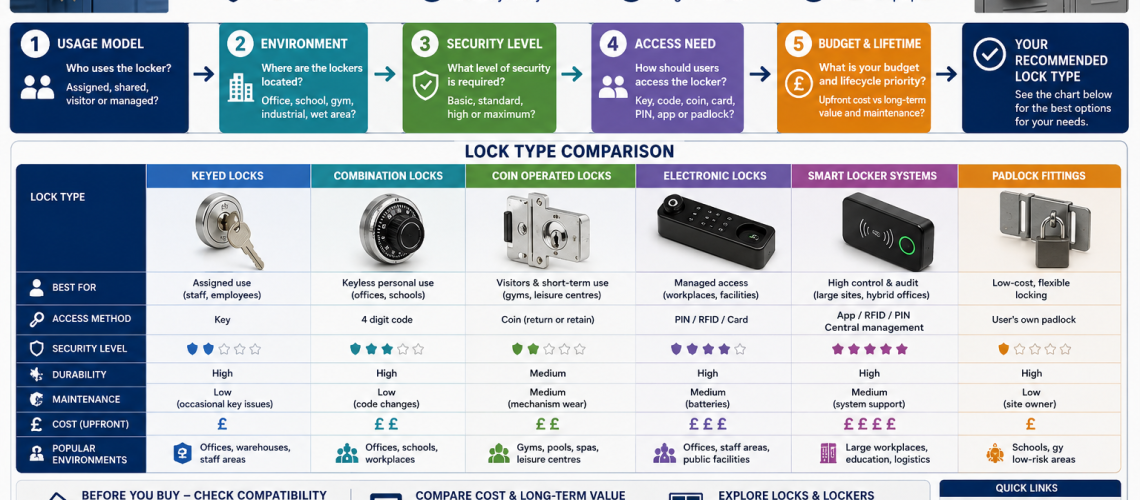
The best locker lock depends on where the lockers are used, who uses them, how often access changes, the level of security required and whether the locks need to fit existing doors. Use this locker lock selection tool to choose the right lock type for UK workplaces, schools, gyms, leisure centres, offices and commercial sites.
Quick answer: Choose keyed locks for simple assigned use, combination locks for keyless personal use, coin locks for leisure and visitor areas, electronic locks for managed access, padlock fittings for low-cost flexibility and smart locker systems where audit trails, allocation or software control are needed.
Before ordering replacement locks, also check whether the new lock will fit the existing locker door. For dimensions, cam sizes, fixing footprints and retrofit checks, use our locker lock compatibility guide. Long-term budgeting, see our locker lock cost guide.
For the full background guide, read Locker Locks UK: Complete Guide to Locker Lock Types, Security and Selection.
Locker lock selection tool
Use the table below as a fast decision route. Match your site type, usage model and risk level to the most suitable lock type.
| Your situation | Best lock type | Why it works | Next step |
|---|---|---|---|
| Staff lockers with assigned users | Keyed locker locks | Simple, familiar and easy to manage for fixed users | Read the keyed locker locks guide |
| Offices or workplaces where users want keyless access | Combination locker locks | No physical key to lose and simple daily access | Read the combination locker locks guide |
| Gyms, pools, spas and leisure centres | Coin operated locker locks | Works well for visitors and short-term use | Read the coin operated locker locks guide |
| Schools, public sites or high-risk areas | Anti-vandal or high-security locks | Better resistance to misuse, forced access and repeated damage | Read the anti-vandal locker locks guide |
| High-traffic staff areas | Durable mechanical or electronic locks | Designed for repeated use and stronger access control | Read the high-traffic locker locks guide |
| Managed workplace storage or hybrid offices | Electronic or smart locker systems | Supports PIN, RFID, allocation, audit trails and central control | Read the smart locker systems guide |
| Lowest-cost flexible locking | Padlock fittings | Users provide their own padlock and the locker has fewer lock parts | Read the padlock fittings guide |
Step 1: Choose by usage model
The first decision is whether each locker is assigned to one person or shared by different users during the day. This affects the lock type more than almost anything else.
| Usage model | Recommended lock | Avoid |
|---|---|---|
| Assigned staff locker | Keyed lock, combination lock or electronic lock | Coin locks unless visitor use is needed |
| Shared daily-use locker | Coin lock, combination lock or electronic lock | Basic keyed locks without a clear key control process |
| Visitor locker | Coin lock, digital lock or padlock fitting | Assigned keyed systems |
| Managed workplace locker | Electronic lock or smart locker system | Untracked keys where accountability is needed |
For a detailed comparison, use our locker lock selection guide.
Step 2: Choose by environment
The locker location changes the lock requirement. A dry office does not need the same lock as a swimming pool changing room, school corridor or busy warehouse.
| Environment | Best option | Reason |
|---|---|---|
| Office | Combination or electronic locks | Clean setting, regular users and simple access needs |
| Warehouse or factory | Keyed, combination or high-traffic locks | Durability and repeated use matter |
| School | Anti-vandal locks, padlock fittings or managed systems | Higher risk of misuse, lost keys and damage |
| Gym or leisure centre | Coin locks, wet-area locks or electronic locks | Visitor use and moisture resistance are important |
| Public facility | Coin, anti-vandal or electronic locks | Shared use and security control are needed |
| Hybrid office | Smart locker system | Supports changing users and flexible allocation |
For swimming pools, spas and changing rooms, see our locker locks for wet areas guide. For public or damage-prone spaces, read our high security locker locks guide.
Step 3: Check compatibility before ordering
If you are buying locks for new lockers, compatibility is normally handled when the locker specification is chosen. If you are replacing or upgrading locks on existing lockers, compatibility must be checked before ordering.
- Measure the existing lock hole.
- Check the locker door thickness.
- Check the cam length and cam position.
- Check the fixing footprint.
- Check the lock body depth behind the door.
- Check whether the door has enough clearance for electronic or larger lock bodies.
Use the full locker lock compatibility guide before placing an order for replacement, retrofit or upgrade locks.
Step 4: Choose by security level
| Security need | Suitable lock type | Best fit |
|---|---|---|
| Basic personal storage | Keyed lock or padlock fitting | Staff lockers and low-risk areas |
| Keyless convenience | Combination lock | Offices, schools and workplaces |
| Visitor control | Coin lock | Gyms, pools and leisure centres |
| Higher accountability | Electronic lock | Shared staff areas and managed storage |
| High-risk area | Anti-vandal or high-security lock | Schools, transport sites and public buildings |
| Audit trail and allocation control | Smart locker system | Hybrid offices, estates teams and managed workplaces |
Step 5: Compare cost and lifetime value
The cheapest lock is not always the lowest-cost option over time. Lost keys, damaged locks, battery changes, staff time and replacement parts all affect the true cost of a locker lock system.
| Lock type | Upfront cost | Ongoing cost | Cost risk |
|---|---|---|---|
| Keyed lock | Low | Key replacement and key control | Lost keys |
| Combination lock | Medium | Code resets and occasional replacement | Forgotten codes |
| Coin lock | Medium | Coin mechanism maintenance | Wear in busy leisure sites |
| Electronic lock | Higher | Battery checks and replacement | Battery failure or misuse |
| Smart locker system | Highest | System management and support | Over-specification if not needed |
| Padlock fitting | Low | Low for the site owner | User padlock quality varies |
For a deeper commercial comparison, read our locker lock cost guide.
Recommended lock by buyer type
| Buyer | Best starting point | Why |
|---|---|---|
| Facilities manager | Electronic, combination or high-traffic locks | Balances durability, access and maintenance |
| School business manager | Anti-vandal locks or padlock fittings | Helps reduce key issues and damage risk |
| Gym or leisure manager | Coin locks or wet-area locks | Supports visitor use and changing rooms |
| Office manager | Combination or smart locker systems | Works well for staff storage and flexible work |
| Warehouse manager | Keyed, combination or heavy-use locks | Simple, durable and suitable for repeated use |
| Procurement team | Selection guide, cost guide and compatibility guide | Reduces ordering errors and lifecycle cost risk |
Product routes
Once you know the correct lock type, use the product links below to move from selection to ordering or enquiry.
- View locker locks
- View commercial lockers
- View workplace lockers
- View school lockers
- Order replacement locker keys
Best lock recommendations
For most assigned staff lockers, a keyed lock or combination lock is usually the simplest choice. For shared visitor lockers, coin locks or electronic locks are usually stronger options. High-risk settings, anti-vandal or high-security locks should be considered. For managed estates, hybrid offices and large workplace schemes, smart locker systems can provide better long-term control.
If you are unsure, start with three checks: usage model, environment and compatibility. These three checks normally narrow the decision to one or two suitable lock types.
FAQ
What is the best locker lock for staff lockers?
For assigned staff lockers, keyed locks and combination locks are usually the most practical options. Electronic locks may be better where access needs to be managed centrally or where users change frequently.
What is the best locker lock for gyms?
Coin operated locks, wet-area locks and electronic locks are common choices for gyms and leisure centres. The right choice depends on whether lockers are free to use, coin return, coin retain or controlled by membership access.
What is the best locker lock for schools?
Schools often need durable, simple and easy-to-manage locks. Padlock fittings, combination locks and anti-vandal locks can all work depending on age group, site policy and the risk of damage or lost keys.
Can I replace old locker locks with a different type?
Yes, but only if the new lock is compatible with the locker door. Check the hole size, door thickness, cam length, fixing footprint and lock body depth before ordering.
Are electronic locker locks worth it?
Electronic locker locks can be worth it where key control is difficult, users change often or access needs to be managed more closely. They cost more than basic mechanical locks but can reduce some key management problems.
What locker lock is cheapest?
Basic keyed locks and padlock fittings are usually low-cost options. However, the cheapest upfront lock may not be the lowest-cost option if keys are often lost, locks are damaged or staff spend time managing access issues.
Do locker locks fit all lockers?
No. Locker locks are not universal. Compatibility depends on the locker door, fixing hole, cam, lock body, spindle and clearance behind the door.
Discover more from Blog Total Locker Service
Subscribe to get the latest posts sent to your email.