Leisure Locker Access Systems UK: RFID Wristbands, Public Lockers and Wet-Area Access Control
May 12, 2026
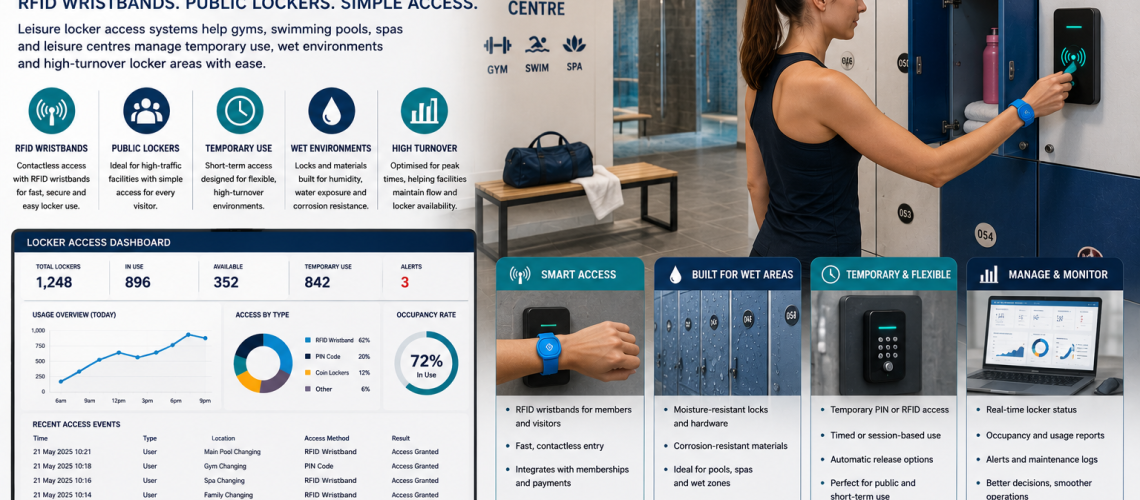
Leisure locker access systems should be designed around temporary use, high visitor turnover, wet changing environments, family groups, peak-time congestion and the need to return lockers quickly to availability. The access requirement should be defined before choosing RFID, PIN, coin, keyed or another lock technology.
This guide owns the leisure-sector access requirement for gyms, swimming pools, spas, leisure centres and public changing facilities. It focuses on how lockers need to operate in busy, temporary-use environments rather than which specific technology is best.
Leisure Access Requirements = define how temporary users, wet areas and changing-room flow must work. Access Control = choose the technology that supports it.
Quick Answer: What Should a Leisure Locker Access System Support?
- Short-term or session-based locker use
- Fast release and reset between users
- Peak-time visitor turnover
- Wet hands, humidity and cleaning environments
- Simple operation for occasional users
- Family and group use where required
- Lost-access support
- Controlled staff override
- Accessible routes and practical use
- A clear process for abandoned or unreleased lockers
For the technology decision, use Locker Access Control Systems UK. For current locker products, see lockers.
What This Page Owns, and What It Hands Off
- Leisure-specific locker access requirements: this page
- Shared-use vs assigned-use behaviour: Shared-Use vs Assigned Locker Locks UK
- Temporary credential lifecycle: Temporary Locker Access Systems UK
- Choosing RFID, PIN, key, coin or another technology: Locker Access Control Systems UK
- Actual usage and availability evidence: Locker Occupancy Management Systems UK
- Access-event evidence: Locker Access Audit Systems UK
- Wet-area lock specification: Locker Locks for Wet Areas UK
- Heavy-use lock specification: Locker Locks for High-Traffic Areas UK
- Locker maintenance and servicing: Locker Parts and Servicing Guide
- Access-data compliance: Locker Access Compliance UK
Why Leisure Locker Access Is Different
Leisure facilities often have a temporary-use pattern that is very different from permanent workplace or school storage.
- Users may visit only once.
- Members may attend several times each week but use different lockers.
- Visitors may be unfamiliar with the lock system.
- Locker turnover can be high throughout the day.
- Wet clothing and humid conditions can affect hardware.
- Families may need larger compartments or shared access.
- Access demand can rise sharply before classes, swim sessions or events.
The locker system therefore needs to support fast temporary use without creating unnecessary confusion or administration.
Most Leisure Lockers Are Temporary-Use Lockers
In many gyms, pools and leisure centres, the user needs a locker for only the duration of a visit or session.
A typical operating cycle is:
- The locker is available.
- A visitor selects or receives the locker.
- The locker remains occupied for the permitted session.
- The user removes belongings.
- The locker is released or reset.
- The locker returns to availability for another user.
The important requirement is the temporary-use cycle, not whether the lock uses a wristband, PIN, coin, key or another method.
Define When Temporary Use Ends
A leisure facility should define the point at which a temporary locker allocation ends.
- When the visitor releases the locker
- At the end of a booked session
- After a defined time period
- At closing time
- After an authorised staff reset
The correct rule depends on the facility, but users and staff should understand it clearly.
Locker Release and Reset Are Core Leisure Requirements
A temporary locker system only works if compartments return to availability reliably.
- Users should know how to release the locker.
- Staff should know how to identify lockers that remain unavailable.
- There should be an authorised reset or opening process.
- Belongings left behind should follow the site’s lost-property procedure.
- The locker should be returned to service only when appropriate.
The technical reset method belongs to the chosen access system. This page owns the operational requirement that a reliable release process must exist.
Abandoned or Unreleased Lockers Can Reduce Capacity
In a high-turnover leisure setting, lockers that remain apparently occupied after the user has gone can reduce availability quickly.
The facility should define:
- how long a locker may remain in use;
- what counts as abandoned use;
- who may open the locker;
- how belongings are handled;
- how the locker is reset;
- and how it returns to general use.
Peak-Time Turnover Matters More Than Average Daily Use
Leisure facilities often experience concentrated access peaks rather than evenly distributed locker demand.
- Before fitness classes
- Before and after public swim sessions
- After-school swimming
- Weekend sports activity
- Holiday periods
- Spa session changes
- Club training periods
The access system should therefore be judged on how it performs when many users arrive or leave together.
Changing-Room Flow Is Part of the Access Requirement
Locker access can affect how quickly people move through the changing area.
- Users may stop in front of lockers while learning the lock.
- Queues can form where access is slow or confusing.
- Families may need more space around larger lockers.
- Bench positions can concentrate people in narrow areas.
- Wet and dry routes may cross near locker banks.
- Accessible routes must remain usable during busy periods.
Access design should therefore support the wider changing-room layout rather than be treated as a separate hardware decision.
Wet Hands and Humidity Affect the Requirement
Swimming pools, spas and shower areas can expose locker hardware to humidity, condensation, wet hands and cleaning chemicals.
The access requirement should consider:
- how users operate the lock with wet hands;
- whether surfaces become slippery;
- how frequently the area is cleaned;
- whether the hardware is exposed to splash or persistent humidity;
- and how easy the system is to inspect and service.
The detailed material and lock specification belongs in Locker Locks for Wet Areas UK.
High Turnover Is Not the Same as Occupancy Tracking
A leisure facility may need lockers to turn over quickly without needing digital occupancy monitoring.
High turnover describes the operating pattern. Occupancy management is a separate question about whether the organisation needs evidence of which lockers are actually in use or available.
If actual usage evidence is required, use Locker Occupancy Management Systems UK.
RFID Wristbands Are a Technology Option, Not a Leisure Requirement
RFID wristbands can be useful in some leisure facilities, especially where visitors already receive a wearable credential, but they are not automatically the correct answer for every pool, gym or spa.
Before considering RFID, define whether the facility actually needs:
- a wearable credential;
- temporary assignment;
- integration with another access system;
- cashless or membership functions;
- central management;
- or other capabilities that justify the extra complexity.
Use Locker Access Control Systems UK to compare technologies.
PIN and Digital Access Are Also Technology Choices
PIN and electronic systems may support temporary use without physical keys, but they still create requirements for code recovery, batteries where applicable, administrator access and user instructions.
They should be chosen because those capabilities solve a real leisure-site problem, not because they are newer.
Coin and Token Systems Can Still Fit Low-Complexity Temporary Use
Coin-return, coin-retain and token systems can support simple temporary-use workflows where the facility prefers a self-contained method.
Whether they are appropriate depends on the site’s operating model, user expectations, maintenance process and payment or token arrangements. They are one option among several rather than the default leisure solution.
Family Changing Creates a Group-Use Requirement
Family changing can involve several people using one larger compartment or one parent managing access for multiple users.
- Larger compartments may be required.
- The responsible adult may need to manage access.
- The locker should be easy to find again.
- The access process should be simple enough to use while supervising children.
- Routes around the locker should remain accessible.
The family-use requirement should be defined before selecting the access method.
Members, Visitors and Staff May Need Different Locker Models
A single leisure site can contain several user groups.
| User group | Possible requirement |
|---|---|
| Day visitor | Temporary session-based locker |
| Regular member | Temporary locker each visit or assigned locker where justified |
| Staff | Persistent assigned storage may be required |
| Family group | Temporary group access to a larger locker |
| Club or team | Temporary or allocated group storage depending on use |
| Contractor | Short-term access for a defined period |
Do not assume every locker in the building should operate in the same way.
Lost Keys, Forgotten Codes and Failed Credentials Need a Support Process
Leisure users are often occasional users, so access problems need to be resolved quickly and consistently.
- Confirm the user’s entitlement to the locker.
- Use the authorised override method.
- Resolve the key, code or credential problem.
- Check whether the issue is a user-access problem or a hardware fault.
- Return the locker to normal operation.
Staff Override Should Be Controlled
Staff may need authorised access for lost credentials, abandoned lockers, maintenance, welfare concerns or end-of-day clearance.
The facility should define:
- who may override a locker;
- why override may be used;
- how the override method is controlled;
- whether the action needs recording;
- and what happens after the locker is opened.
User Instructions Matter in Public-Use Areas
Visitors may never have seen the lock type before, so the system should not rely on familiarity.
- Show how to secure the locker.
- Show how to reopen it.
- Explain when the allocation ends.
- Explain what to do if access is lost.
- Make instructions visible before the user becomes stuck.
- Use simple wording and diagrams where helpful.
Accessibility Should Be Considered Within the Changing Area
Accessible locker access includes more than simply providing a low-level compartment.
- Can the intended user reach the lock?
- Can it be operated with the required grip and dexterity?
- Is the route to the locker clear?
- Is there enough space for assisted changing where required?
- Are instructions understandable and visible?
For the wider planning topic, use Accessible Locker Planning UK.
Maintenance Capacity Is a Requirement, Not This Page’s Maintenance Programme
Leisure operators should understand what maintenance burden they can support before choosing an access system.
- Can staff inspect locks regularly?
- Can batteries be managed where required?
- Can damaged components be replaced quickly?
- Can the facility obtain spare parts?
- Can faults be dealt with outside peak periods?
The detailed servicing programme belongs in Locker Parts and Servicing Guide.
Leisure Access Requirements Matrix
| Requirement | Question to define | Next owner |
|---|---|---|
| Temporary use | When does the locker allocation end? | Leisure Access / Temporary Access |
| Shared vs assigned | Does the same user keep the locker? | Shared vs Assigned |
| Wet environment | What exposure must the hardware tolerate? | Wet-Area Locks |
| Heavy use | How often is the lock operated? | High-Traffic Locks |
| Occupancy evidence | Do we need to know what is actually in use? | Occupancy Management |
| Access events | Do we need records of access activity? | Access Audit |
| Technology | RFID, PIN, coin, key or another method? | Access Control |
| Compliance | How is resulting access data handled? | Access Compliance |
Common Leisure Locker Access Mistakes
- Choosing RFID, PIN or coin before defining the operating requirement.
- No clear end point for temporary use.
- No process for lockers left occupied after the user has gone.
- Planning around average use instead of peak sessions.
- Ignoring wet hands and humidity.
- Using complicated instructions for occasional users.
- No controlled staff override.
- Confusing allocation status with actual occupancy.
- Assuming all leisure lockers should operate in the same way.
- Adding digital capability without a defined need.
- Ignoring maintenance capacity when selecting the system.
Leisure Locker Access Checklist
- Are lockers temporary-use or assigned?
- When does temporary use end?
- How does the locker return to availability?
- What happens if the user leaves belongings behind?
- What are the busiest sessions?
- Will users have wet hands?
- Is the area humid or exposed to cleaning chemicals?
- Are family lockers required?
- Are visitor instructions clear?
- Who can override lockers?
- How are lost keys, forgotten codes or failed credentials handled?
- Are accessible routes and controls considered?
- What maintenance can the site support?
- Only after those points are defined: which access technology fits the requirement?
Where Leisure Locker Questions Go Next
| Question | Next guide |
|---|---|
| Should lockers be shared or assigned? | Shared-Use vs Assigned Locker Locks UK |
| How should temporary credentials be managed? | Temporary Locker Access Systems UK |
| Which access technology should we choose? | Locker Access Control Systems UK |
| How do we measure actual locker usage? | Locker Occupancy Management Systems UK |
| How do we record access events? | Locker Access Audit Systems UK |
| Which locks suit wet areas? | Locker Locks for Wet Areas UK |
| What does repeated heavy use change? | Locker Locks for High-Traffic Areas UK |
| How should locks be serviced? | Locker Parts and Servicing Guide |
| How should access data be handled? | Locker Access Compliance UK |
Leisure Locker Access FAQs
What is a leisure locker access system?
It is the operating arrangement that controls how members, visitors, staff and other authorised users gain temporary or continuing access to lockers in gyms, pools, spas and leisure centres.
Do leisure centres need RFID wristband lockers?
Not automatically. RFID can be useful where a wearable credential or integration solves a defined operational problem, but other access methods may also support temporary leisure use.
How should temporary-use leisure lockers work?
The user obtains a locker for a defined session or period, removes their belongings when finished and releases or resets the locker so it returns to availability for another user.
Why are wet areas important when choosing locker access?
Wet hands, humidity, condensation, cleaning chemicals and repeated exposure can affect operation and hardware durability, so those conditions should be included in the specification.
Do leisure lockers need occupancy tracking?
Not necessarily. A facility may need fast temporary turnover without needing digital occupancy evidence. Occupancy tracking is a separate requirement and should be justified by a specific operational need.
How should abandoned leisure lockers be handled?
The facility should define how long a locker may remain occupied, who may open it, how belongings are handled and how the locker is returned to general use.
Should leisure locker systems have staff override?
Many facilities need controlled staff access for lost credentials, abandoned lockers, maintenance or welfare concerns. The override method and authorised users should be defined before choosing the technology.
Summary
Leisure locker access should start with temporary use, high turnover, wet conditions, changing-room flow and visitor behaviour rather than a preferred technology.
Define when use ends, how lockers return to availability, how abandoned lockers are handled, what happens at peak sessions, how families and visitors use the system, and how staff resolve access problems.
Then use Access Control Systems UK to choose the lowest-complexity technology that reliably supports those requirements.
Discover more from Blog Total Locker Service
Subscribe to get the latest posts sent to your email.