Locker Replacement Planning UK: Procurement, Phasing & Estate Renewal
May 13, 2026
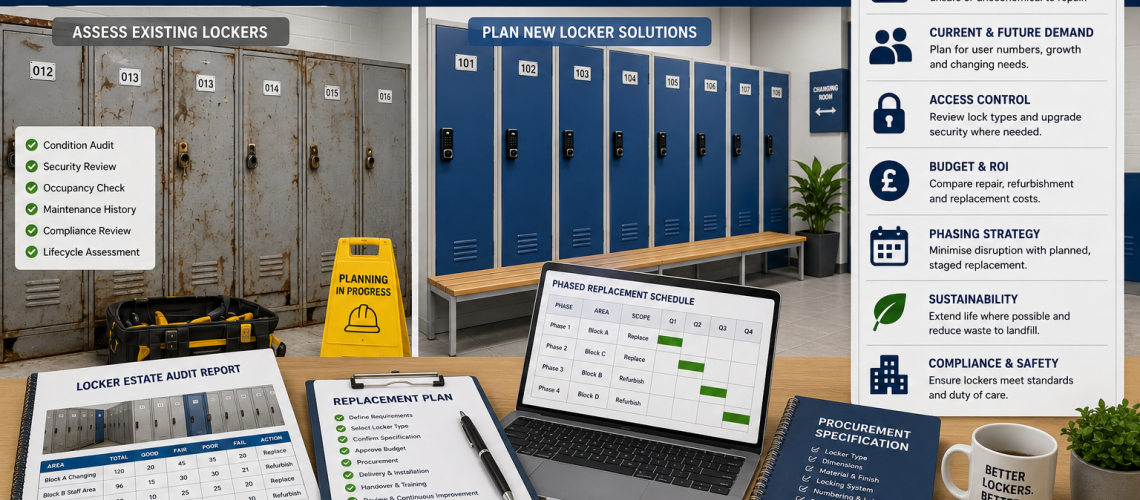
Locker replacement planning is the project-delivery process used after particular locker assets have already been approved for replacement.
It turns an approved replacement requirement into a controlled programme covering project scope, design inputs, budget, procurement, phasing, temporary provision, removal, delivery, installation, commissioning, handover and the transfer of the new lockers into the estate record.
This page does not decide whether lockers should be repaired, refurbished or replaced. Use Locker Estate Audit UK for verified condition evidence and Locker Lifecycle Management UK for the intervention decision. Replacement Planning begins once replacement has been approved.
Lifecycle Management decides that replacement is required. Replacement Planning defines, procures and delivers the approved renewal project.
Quick Answer: What Is Locker Replacement Planning?
Locker replacement planning converts approved replacement assets into a deliverable project. It establishes what will be replaced, what design work is still required, how the project will be funded and procured, when old lockers can be removed, how users will be supported during the work and how the replacement estate will be commissioned and recorded.
| Replacement-planning area | Main question | Output |
|---|---|---|
| Approved scope | Which assets are already authorised for replacement? | Project boundary |
| Design inputs | What quantity, dimensions, configuration and environment must the new scheme support? | Planning brief |
| Specification handover | Has the detailed locker specification been completed? | Procurement-ready requirement |
| Budget | What does the complete project need to allow for? | Budget basis |
| Procurement | What information must suppliers price against? | Comparable quotation package |
| Programme priority | Which already-approved project should be delivered first? | Delivery sequence |
| Phasing | Can the project be divided without creating incompatible systems? | Controlled phases |
| Temporary provision | How will users be supported while lockers are unavailable? | Continuity plan |
| Removal and installation | How will old lockers leave and new lockers enter the site? | Installation plan |
| Commissioning | How will the installed scheme be checked before use? | Acceptance record |
| Handover | How will assets, locks, keys and records enter normal operation? | Updated estate baseline |
What This Page Owns
- the approved replacement project boundary;
- programme sequencing between already-approved projects;
- replacement-project assumptions and dependencies;
- confirmation that quantity, layout and specification work is complete;
- budget structure;
- procurement information;
- quotation comparability;
- phasing;
- temporary storage and operational continuity during works;
- old-locker removal;
- delivery and site access;
- installation planning;
- commissioning and snagging;
- project variations;
- handover;
- closure of replaced assets;
- creation of the new asset baseline;
- and return of completed status to Estate Management.
What This Page Hands Off
| Question | Detailed owner |
|---|---|
| Should the existing lockers remain, be repaired, refurbished, replaced or decommissioned? | Locker Lifecycle Management UK |
| What is the verified physical condition? | Locker Estate Audit UK |
| What quantity, dimensions, configuration and room layout should the new scheme use? | Locker Planning UK |
| How is an approved refurbishment delivered instead? | Locker Refurbishment UK |
| Which key, PIN, RFID or digital access method should be selected? | Locker Access Control Systems UK |
| Who may administer, reset or override access? | Locker Access Permissions & Governance UK |
| How are users reassigned or returned to lockers? | Locker Management Systems UK |
| What does current occupancy or utilisation show? | Locker Occupancy Management Systems UK |
| What stable asset fields should exist before and after the project? | Locker Asset Register UK |
| Where is the overall replacement programme visible? | Locker Estate Management UK |
Inputs to an Approved Replacement Project
Replacement Planning should receive a defined handover from the upstream estate and lifecycle processes rather than reopening the intervention decision.
- asset or locker-bank reference;
- site and location;
- approved replacement status;
- reason the lifecycle process approved replacement;
- existing quantity and configuration;
- current operational importance;
- known occupancy or demand evidence;
- known accessibility issue where relevant;
- environmental requirements;
- existing lock or access system;
- known project dependencies;
- whether temporary storage may be required;
- and any target programme window already imposed by the organisation.
Locker Estate Management UK should keep the overall programme visible, while Locker Asset Register UK supplies the stable physical references. Replacement Planning uses those inputs to create and deliver the project.
Use a Project Readiness Gate Before Procurement
An approved replacement decision does not automatically mean the project is ready to order. Before requesting final quotations, confirm that the information needed for a comparable and deliverable procurement is complete.
| Readiness check | Question |
|---|---|
| Replacement approval | Are the assets formally within the approved replacement scope? |
| Quantity | Has current demand been validated rather than copying the old quantity automatically? |
| Layout | Has the room layout been checked where replacement changes size, quantity or position? |
| Specification | Are material, dimensions, configuration, finish and accessories defined? |
| Access | Has the access technology been selected through the appropriate access-control process? |
| Accessibility | Have known accessibility requirements been incorporated into the design? |
| Delivery | Are unloading, internal movement and site restrictions known? |
| Installation | Is the installation responsibility and fixing requirement clear? |
| Removal | Is responsibility for clearing and removing old lockers defined? |
| Temporary provision | Is continuity arranged where users cannot lose storage during the works? |
| Programme | Is there a realistic delivery and installation window? |
| Budget | Does the allowance cover the complete agreed project boundary? |
If one of these items is unresolved, route it to the specialist owner before treating the procurement package as complete.
Prioritise Already-Approved Replacement Projects
Where several replacement projects have already been approved, Replacement Planning may need to decide the delivery sequence. This is programme prioritisation, not a second repair-versus-replace assessment.
| Programme factor | Why it may affect sequence |
|---|---|
| Operational restriction already imposed | An area already operating with reduced usable capacity may need earlier delivery |
| User or service dependency | Some changing areas or storage locations are harder to take out of service than others |
| Temporary-capacity constraint | The organisation may only be able to decant one area at a time |
| Building works | Replacement may need to align with flooring, decoration, relocation or wider refurbishment |
| School holiday / shutdown window | Some sites have limited practical installation periods |
| Site-access constraint | Restricted access can determine the feasible programme order |
| Procurement or product lead time | Different approved projects may become deliverable at different times |
| Funding period | Approved capital may need to be committed within a defined financial period |
| Cross-phase compatibility | One phase may need to establish the lock, numbering or product standard used by later phases |
The underlying reason why each asset reached replacement status remains a Lifecycle Management record. Replacement Planning uses the approved status and project constraints to decide delivery order.
Do Not Reuse the Old Locker Quantity Automatically
Replacing 200 old lockers with 200 new lockers without checking current demand can reproduce an outdated arrangement.
Before final quantities are placed into the procurement package, confirm whether the planning process has considered:
- current user numbers;
- peak attendance;
- shift patterns;
- shared versus assigned use;
- hybrid-working patterns where relevant;
- pupil or department changes;
- PPE, uniform or equipment requirements;
- accessible provision;
- spare capacity;
- and future expansion already included in the brief.
Use Locker Occupancy Management Systems UK where utilisation evidence is required, then use Locker Planning UK to establish the replacement quantity and layout. Replacement Planning should consume that completed design output rather than create its own capacity methodology.
Create the Project Scope Before Requesting Prices
A supplier quotation is only useful when the project boundary is clear. Define what is included, what is excluded and which elements have already been specified.
- site and room;
- old locker banks to be removed;
- new locker quantity;
- locker dimensions;
- compartment configuration;
- material;
- colour and finish;
- stored items or operational use;
- approved lock/access technology;
- numbering and identification;
- bases, stands, plinths or sloping tops;
- benches or accessories where included;
- accessible provision;
- delivery restrictions;
- unloading responsibility;
- internal movement;
- installation requirement;
- fixing requirements where known;
- old-locker removal;
- temporary storage;
- required completion window;
- and any future-expansion allowance already agreed in Planning.
The detailed locker design belongs in Locker Planning UK. Replacement Planning verifies that the resulting design is complete enough to procure and deliver.
Prepare a Comparable Procurement Package
If several quotations are required, suppliers should be pricing the same project basis wherever practical. Otherwise a lower price can simply represent a narrower scope.
- Use the same quantity and configuration schedule.
- State the required material and finish.
- State the approved lock or access technology.
- Define numbering and accessories.
- State whether delivery is supply-only or includes additional handling.
- State whether installation is required.
- State whether removal of old lockers is included.
- Describe delivery access and restrictions.
- State required programme dates or windows.
- Identify optional items separately.
- Ask suppliers to identify exclusions and assumptions.
This makes price, scope, lead time and project responsibility easier to compare without turning Replacement Planning into a product-selection article.
Budget for the Complete Replacement Project
The locker purchase price is only one part of the replacement project. Build the budget around the agreed project boundary.
| Budget area | Possible content |
|---|---|
| Locker supply | Quantity, material, configuration, finish and accessories |
| Access system | Approved locks, credentials and required management hardware |
| Numbering | Locker numbers, asset labels and related identification |
| Delivery | Vehicle access, delivery restrictions and project-specific requirements |
| Unloading / internal movement | Movement from delivery point to final room |
| Installation | Positioning, levelling, nesting, stands, bases and fixing where included |
| Old locker removal | Emptying, dismantling, movement and disposal route where included |
| Temporary storage | Interim provision during the project |
| Room preparation | Floor repairs, decoration, cleaning or enabling works |
| Commissioning / handover | Checks, numbering, records, keys, credentials and manuals |
| Contingency | Agreed allowance for project uncertainties |
Separate confirmed, estimated, optional and excluded costs. If capital approval is required, the replacement programme should provide scope, assumptions, dependencies and cost basis to the organisation’s normal governance process.
Separate the Approved Programme From the Future Pipeline
Large estates may want visibility beyond the projects already approved, but do not quietly promote future lifecycle candidates into the replacement programme.
| Portfolio view | Meaning | Owner |
|---|---|---|
| Approved replacement programme | Projects already authorised for replacement and being budgeted, procured or delivered | Replacement Planning |
| Replacement review | Assets whose evidence is being assessed before a replacement decision | Lifecycle Management |
| Monitor / future concern | Assets that may need later intervention but have not reached replacement status | Lifecycle / Estate Management |
| Long-range capital visibility | Indicative estate information used for budgeting context, not an approval decision | Estate Management / organisation budgeting process |
A rolling capital view can be useful, but it should preserve these statuses. Do not assign a fixed replacement year simply because an asset is old or because a budget horizon needs a number.
Phase the Replacement Programme
Phasing can reduce disruption, spread approved expenditure and make delivery manageable where an organisation cannot release every affected area at once.
- Work site by site, building by building, floor by floor or department by department.
- Use school holidays or planned shutdown windows where appropriate.
- Coordinate with flooring, decoration, welfare or building projects.
- Sequence phases around temporary-storage capacity.
- Use the first phase to validate installation detail, numbering and handover procedures.
- Keep later phases aligned with the approved end-state specification.
Control Cross-Phase Consistency
Phasing can create a fragmented estate if product, access, numbering and record decisions change without control.
- Record the intended end-state product or specification.
- Record approved lock and access-system references.
- Control numbering ranges.
- Document colours and finishes where matching matters.
- Record any master-key or credential structure through the appropriate access process.
- Identify which old locker banks remain active between phases.
- Update the Asset Register after every completed phase.
- Record approved changes rather than allowing undocumented substitutions.
Plan Temporary Storage and Decant
Replacement often removes usable lockers before the new installation is ready. Active workplaces, schools, healthcare sites and changing facilities may therefore need a temporary-storage or decant plan.
- Which users lose lockers during each phase?
- How long will the area be unavailable?
- Can another locker bank absorb temporary demand?
- Are temporary lockers required?
- Who communicates the change to users?
- How will keys or credentials be handled?
- How will abandoned contents be resolved before removal?
- When will users move into the replacement lockers?
Formal user reassignment belongs in Locker Management Systems UK. Replacement Planning coordinates the project dependency and required timing.
Plan Delivery and Site Access
Confirm practical delivery constraints before the order is finalised. A project can have the correct locker specification and still fail operationally if the delivery or movement route has not been considered.
- vehicle access;
- agreed delivery point;
- who unloads;
- distance from unloading point to final room;
- stairs, lifts or narrow routes;
- door and corridor dimensions;
- site inductions or escorts;
- restricted delivery periods;
- other contractors sharing the access route;
- and space to stage lockers before installation.
Where the project has specific delivery restrictions, timings or site requirements, make them part of the quotation and order information rather than adding them after manufacture or despatch planning.
Plan Removal of Old Lockers
Old-locker removal is part of the project boundary and should be resolved before installation starts.
- Confirm who empties the lockers.
- Resolve abandoned or unidentified contents through the site’s normal process.
- Confirm who dismantles or moves the old units.
- Identify any lockers that will be relocated rather than removed.
- Protect floors and routes where necessary.
- Define the disposal or recycling route where included.
- Close obsolete user references.
- Ensure removed assets no longer remain active in the Asset Register.
The physical intervention decision has already been made upstream. Replacement Planning now ensures that the approved removal is executed and recorded correctly.
Coordinate Room and Enabling Work
Replacement may expose work that is easier to complete while the old lockers are out and before the new lockers are installed.
- floor repairs;
- decoration;
- cleaning;
- wall or fixing preparation;
- bench changes;
- electrical or data work for approved electronic access systems;
- and correction of environmental problems that affected the previous lockers.
Make the dependency clear in the programme. Do not schedule new lockers to arrive before prerequisite room work is complete.
Control Project Variations
Conditions can change after old lockers are removed or after final site measurement. Use a controlled variation process rather than allowing informal changes to quantities, locks, colours or installation scope.
- Record what changed.
- Record why it changed.
- Identify the effect on quantity, cost or programme.
- Check whether the change affects accessibility or layout.
- Check whether the change affects access-system compatibility.
- Obtain the required approval before implementation.
- Update drawings, schedules or order information.
- Carry the final variation into handover records.
Commission the Replacement Lockers
Installation completion and operational handover are not necessarily the same moment. Before the new lockers enter normal use, check the delivered project against the approved scope.
- installed quantity matches the final schedule;
- locker banks are in the correct locations;
- doors open and close correctly;
- units are level, stable and fixed as required by the installation;
- locks operate correctly;
- approved management access works where relevant;
- numbering is complete;
- accessories are fitted;
- visible damage or installation defects are recorded;
- snagging items have an owner and status;
- and the area is ready for handover.
Manage Snagging Before Project Close-Out
Record incomplete or defective items rather than treating physical installation as automatic project completion.
- missing components;
- damaged doors or panels;
- incorrect numbering;
- lock faults;
- alignment problems;
- missing accessories;
- finish defects;
- incorrect location or configuration;
- and incomplete records or handover information.
Close the project only when outstanding items have been resolved or formally accepted into an agreed follow-up process.
Handover the New Locker Estate
The replacement project should create a clean baseline for the new physical estate and pass operational responsibilities to the systems that own them.
- final installed quantity;
- site and precise location;
- locker-bank or asset references;
- locker range, dimensions and configuration;
- material and finish where required;
- installed lock type;
- numbering;
- installation or handover date;
- manuals or maintenance information where applicable;
- management keys or credentials transferred to the authorised process;
- snagging status;
- old assets closed, relocated or decommissioned;
- and new active physical asset records created.
Use Locker Asset Register UK for the stable physical fields. User allocation belongs in Locker Management Systems UK. Access authority belongs in Locker Access Permissions & Governance UK.
Close Out the Replacement Project
Project close-out should reconcile the approved scope with what was actually delivered.
- final quantities and configurations;
- actual locations;
- asset IDs;
- lock and access-system references;
- approved variations;
- installation and handover dates;
- remaining defects or follow-up actions;
- old assets removed or relocated;
- new assets activated;
- and records passed to Estate Management, Asset Register, Locker Management, access administration and CAFM where applicable.
Locker Estate Management UK should then show the replacement programme as completed or update any remaining phases.
Keep Access-Technology Selection Separate
Replacement is a sensible point to review access technology, but Replacement Planning should not independently decide whether the new scheme uses keys, hasps, combinations, coin locks, PIN, RFID or another digital credential.
Use Locker Access Control Systems UK for the technology decision. Once selected, Replacement Planning should carry the approved access requirement into procurement, installation, commissioning and handover.
- Specify the approved lock family.
- Include any required management hardware.
- Include keys, credentials or programming items where part of supply.
- Check later phases remain compatible with the approved architecture.
- Hand privileged access into the authorised governance process.
School Locker Replacement Planning
For schools, Replacement Planning should concentrate on delivering the approved scheme around the education timetable rather than recreating the school specification.
- Receive the confirmed quantity and layout from school/locker planning.
- Plan work around holidays or agreed low-occupancy periods where practical.
- Resolve contents and old allocations before removal.
- Coordinate numbering and handover into the school’s management process.
- Define delivery and internal-access constraints.
- Phase by block, floor, room or year area where appropriate.
- Keep later phases compatible with the approved product, lock and numbering structure.
Use School Lockers UK for education-specific material, configuration and use requirements.
Workplace and Industrial Locker Replacement Planning
For workplaces and industrial sites, the replacement project should consume the confirmed demand, PPE and storage requirement rather than recreate the occupancy or capacity analysis.
- Receive confirmed peak-demand and quantity outputs from Planning and Occupancy Management.
- Carry approved PPE, workwear, boot, helmet or equipment requirements into the project brief.
- Coordinate installation with shifts and welfare-area access.
- Arrange temporary storage where workers cannot lose secure provision.
- Phase large sites by department, changing area or building.
- Carry the approved lock and access structure into handover.
Use Workplace Lockers UK for workplace-specific locker requirements.
NHS and Healthcare Locker Replacement Planning
Healthcare replacement planning should focus on delivering the approved project without unnecessarily disrupting active staff-changing provision.
- Receive confirmed quantities and configuration from the healthcare/planning process.
- Identify which changing areas can be released and when.
- Plan temporary staff storage where required.
- Coordinate removal, room preparation and cleaning before new lockers enter service.
- Carry approved accessible provision into the project scope.
- Carry the approved lock/access technology into procurement and handover.
- Phase work by department or changing area where appropriate.
- Update estate records after each completed phase.
Use NHS & Healthcare Changing Room Planning UK for staff-changing workflow, shift patterns, uniforms, benches and department-specific planning.
Sustainability and End-of-Project Materials
By the time an asset reaches Replacement Planning, Lifecycle Management has already approved replacement. This page should therefore concentrate on responsible project delivery rather than reopening whether the old lockers ought to have been retained.
- Identify old lockers that are being relocated under an already-approved plan.
- Separate reusable parts where the organisation has a defined reuse route.
- Avoid unnecessary damage during removal where materials will be recovered.
- Use an appropriate recycling or disposal route for removed materials where possible.
- Record what left the active estate.
- Use documented failure or suitability evidence to avoid reproducing the same specification problem in the new project.
Common Locker Replacement Planning Mistakes
- Reopening the repair-versus-replace decision. That belongs upstream in Lifecycle Management.
- Starting with products instead of an approved project boundary.
- Copying the old locker quantity without current planning evidence.
- Allowing programme priority to become another condition score.
- Procurement before quantity, layout or access technology is resolved.
- Comparing supplier prices based on different scopes.
- Budgeting only for locker supply.
- Ignoring unloading, internal movement or old-locker removal.
- Ignoring temporary storage for active users.
- Phasing without an approved end-state specification.
- Changing access technology informally inside the replacement project.
- Failing to control project variations.
- Calling installation complete before commissioning and snagging.
- Failing to close old asset records.
- Failing to create a verified baseline for the new assets.
Locker Replacement Planning Checklist
- Has Lifecycle Management approved replacement?
- Are the exact locker banks in scope identified?
- Is the reason for the approved replacement recorded?
- Has current demand been validated?
- Is the replacement quantity confirmed?
- Is the room layout confirmed?
- Are dimensions and configuration defined?
- Is the material defined?
- Are colours and finishes defined where required?
- Has the access technology been selected separately?
- Is accessible provision included?
- Are bases, stands, plinths, tops or benches defined where required?
- Is the procurement package comparable?
- Does the budget cover the full project boundary?
- Are optional and excluded costs clear?
- Is the phase structure defined?
- Is temporary storage planned?
- Are delivery restrictions known?
- Is unloading responsibility known?
- Is internal movement planned?
- Is old-locker removal defined?
- Are enabling works coordinated?
- Is there a controlled variation process?
- Is commissioning defined?
- Is snagging tracked?
- Are old assets closed?
- Are new asset records created?
- Are lock, key and credential handovers routed to the correct owner?
- Has Estate Management been updated?
Related Locker Replacement Planning Guides
- Locker Lifecycle Management UK – decides whether an asset should be repaired, refurbished, replaced or decommissioned.
- Locker Estate Audit UK – verifies physical condition and evidence.
- Locker Estate Management UK – coordinates the overall estate and replacement-programme status.
- Locker Asset Register UK – stable physical asset IDs and handover fields.
- Locker Refurbishment UK – delivers an approved refurbishment where Lifecycle selects that intervention.
- Locker Planning UK – quantity, dimensions, layout and specification.
- Locker Access Control Systems UK – key, PIN, RFID and digital access technology.
- Locker Access Permissions & Governance UK – privileged authority, resets and overrides.
- Locker Management Systems UK – user onboarding, reassignment, offboarding and return to availability.
- Locker Occupancy Management Systems UK – occupancy, availability and utilisation evidence.
- Accessible Locker Planning UK – accessible positions, reach, manoeuvring and layout requirements.
Locker Replacement Planning UK FAQs
What is locker replacement planning?
Locker replacement planning turns an approved replacement requirement into a deliverable project covering scope, design inputs, budget, procurement, phasing, temporary provision, removal, installation, commissioning and handover.
When should locker replacement planning begin?
It should begin after Lifecycle Management has already approved replacement for the relevant locker assets. Condition evidence and the repair-versus-refurbish-versus-replace decision should be resolved before the replacement project enters procurement.
What is the difference between locker lifecycle management and replacement planning?
Lifecycle Management decides what physical intervention should happen to the existing asset. Replacement Planning begins after replacement is approved and organises the resulting project, including scope, budget, procurement, phasing, removal, installation and handover.
Should new lockers use the same quantity as the old lockers?
Not automatically. Current demand, occupancy, user numbers, shift patterns, shared-use requirements, accessibility and future capacity should be checked through the planning process before the new quantity is confirmed.
Can locker replacement be phased?
Yes. Replacement can be phased by site, building, floor, room or department where this reduces disruption or matches funding and access constraints. Later phases should follow a controlled end-state specification.
What should a locker replacement budget include?
The budget may need to include locker supply, access hardware, numbering, delivery, unloading, internal movement, installation, old-locker removal, temporary storage, room preparation, commissioning, handover and agreed contingency.
Should access technology be selected inside the replacement project?
The access requirement should be decided through the access-control process. Replacement Planning then carries the approved key, PIN, RFID or digital access requirement into procurement, installation, commissioning and handover.
What should happen to old locker asset records?
When old lockers are removed, close, relocate or decommission their physical asset records as appropriate so they no longer appear as active capacity. Create verified records for the new locker estate during handover.
When is a locker replacement project complete?
The project is complete when the agreed installation has been commissioned, material snagging is resolved or assigned for follow-up, the old assets are closed, the new physical assets are recorded and ongoing access, allocation and maintenance responsibilities have been handed to their operational owners.
Summary
Locker Replacement Planning should answer one main question: how do we turn an approved replacement decision into a controlled, deliverable project?
Keep the boundaries clear. Audit verifies condition. Lifecycle decides whether replacement is required. Planning defines the new quantity, dimensions and layout. Access Control chooses the access technology. Replacement Planning then owns project readiness, scope, budget, procurement, phasing, temporary provision, removal, delivery, installation, commissioning, handover and close-out.
When the project is ready for product comparison, use the approved design and procurement brief to compare current commercial locker ranges. After installation, update Locker Asset Register UK and Locker Estate Management UK so the replacement is reflected in the active estate.
Discover more from Blog Total Locker Service
Subscribe to get the latest posts sent to your email.